Bank Of Jiangsu(600919)

Search documents
银行研思录25:银行股息率排名与中期分红进度梳理-20251114
CMS· 2025-11-14 03:02
Investment Rating - The report does not explicitly state an investment rating for the banking sector, but it provides detailed insights into dividend yields and distribution processes, which can inform investment decisions. Core Insights - The report outlines the latest dividend yields and mid-term dividend processes for A and H shares of listed banks, emphasizing the importance of accurately calculating dynamic dividend yields to avoid discrepancies across periods [1][2]. - It details the two processes for mid-term dividends following the 2023 revision of the regulatory guidelines, highlighting the conventional and simplified processes for implementing mid-term dividends [2]. - The report provides a comprehensive overview of key dates related to dividend distribution for both A and H shares, including the importance of purchasing shares before the ex-dividend date to qualify for dividends [3][4]. Summary by Sections Dynamic Dividend Yield Calculation - A simplified yet accurate method for calculating dynamic dividend yield is introduced, defined as "rolling 12-month EPS * cash dividend rate / share price," which helps avoid issues related to overlapping or missing annual and mid-term dividends [1]. - The report calculates the cash dividend rate using a standardized approach across different banks, resulting in a clear comparison of dividend yields as of November 13, 2025 [1]. Mid-Term Dividend Processes - The report explains the two processes for mid-term dividends: the conventional process requiring shareholder approval and a simplified process allowing for quicker implementation [2]. - The simplified process is designed to enhance flexibility for companies in distributing mid-term dividends, thereby improving shareholder returns [2]. Dividend Distribution Key Dates - For A shares, investors must purchase shares before the ex-dividend date to receive dividends on the same day, while H shares typically see a delay of about one month for dividend payments [3][4]. - The report outlines the differences in the dividend distribution timeline between A and H shares, emphasizing the need for investors to be aware of these timelines to maximize their returns [3][4]. Mid-Term Dividend Progress - As of November 13, 2025, 31 A-share banks have confirmed mid-term dividends, while 11 H-share banks have also confirmed their dividend distributions [9][11]. - The report categorizes banks based on their dividend status, detailing those that have implemented dividends, those that are pending, and those that have opted not to distribute dividends [9][10][11]. - It highlights that the end of 2025 and early 2026 is expected to be a peak period for mid-term dividend distributions, suggesting potential investment opportunities for dividend-seeking investors [11].





2025年南京市企业百强榜单发布 南钢蝉联综合百强及制造业百强榜首
Nan Jing Ri Bao· 2025-11-14 00:17
Core Insights - The 2025 Nanjing Top 100 Enterprises list was released, showcasing the growth and development of the "Top 100 family" in Nanjing over the past seven years [1] Group 1: Rankings and Revenue - Nanjing Iron and Steel Group topped the comprehensive and manufacturing sectors with a revenue of 180.793 billion yuan [1] - Jiangsu Bank and Jiangsu Fuel Group led the service and growth sectors, respectively [1] - The threshold for entry into the comprehensive top 100 increased from 4.666 billion yuan to 5.176 billion yuan, while the manufacturing threshold rose from 1.044 billion yuan to 1.165 billion yuan [1] Group 2: Industry Composition - The comprehensive top 100 includes 59 service enterprises, an increase of 6 from the previous year, while manufacturing and construction sectors have 36 and 5 enterprises, respectively [1] - The service sector's dominance is reinforced, with notable growth in financial services, business services, and software and information technology services [1] Group 3: Financial Performance - The total revenue of the comprehensive top 100 enterprises was 2,537.5 billion yuan, remaining stable compared to last year, while total assets reached 11,739.5 billion yuan, reflecting a year-on-year growth of 7.58% [2] - Research and development expenses amounted to 27.217 billion yuan, with an average increase in R&D expenses over the past three years [2] - The average R&D intensity for manufacturing top 100 enterprises was 4.17%, indicating a clear trend towards high-end and intelligent transformation [2] Group 4: Ownership Structure - Among the comprehensive top 100, there are 58 state-owned enterprises and 32 private enterprises, with their respective revenue shares being 72.34% and 21.5% [2] - In the manufacturing sector, there are 30 state-owned and 45 private enterprises, with revenue shares of 60.6% and 22.21% [2] - The service sector comprises 64 state-owned and 35 private enterprises, with revenue shares of 68.94% and 30.1% [2]


下半年以来23家上市银行共获748家机构调研
Zheng Quan Ri Bao· 2025-11-13 23:12
Core Insights - In the second half of this year, institutions have actively researched and tracked the operational status of listed banks, with 748 institutions conducting 133 investigations into 23 listed banks as of November 13 [1][2] - The focus of these investigations has been primarily on city commercial banks and rural commercial banks, with key areas of interest including net interest margin trends, non-interest income trends, and capital replenishment [1][2] Group 1: Institutional Research - The majority of institutions conducting research on listed banks are fund companies and securities firms, accounting for 53% of the total [2] - Jiangsu Bank emerged as the most popular among institutions, receiving 83 investigations, followed by Chongqing Rural Commercial Bank and Ningbo Bank with 76 and 75 investigations respectively [2] - Ruifeng Bank had the highest number of total investigations at 22 [2] Group 2: Net Interest Margin Trends - Net interest margin has been a focal point for institutions, with some listed banks showing signs of stabilization or slight recovery compared to the previous year [2] - Several banks reported successful measures to reduce funding costs, such as exiting high-cost deposits and enhancing the absorption of low-cost current deposits [3] - Xiamen Bank reported a 4 basis point increase in net interest margin to 1.08% in the first half of the year, with continued stabilization in the third quarter [3] Group 3: Debt Market Analysis - The bond market has shown a volatile trend this year, impacting the investment income of some listed banks, particularly city and rural commercial banks [4] - Banks are focusing on their investment strategies in the bond market, with a cautious approach to market trends and adjustments in trading positions [4] - Shanghai Bank plans to enhance its market analysis capabilities and maintain flexibility in its investment strategies to mitigate risks from market interest rate fluctuations [4] Group 4: Non-Interest Income and Capital Replenishment - Many banks noted changes in non-interest income, particularly in net income from fees and commissions, which have been affected by regulatory requirements on self-managed wealth management [6] - Banks are exploring various methods for capital replenishment, combining internal capital accumulation with external sources to strengthen their capital base [6]



东兴中债1-3年政策性金融债指数证券投资基金基金份额发售公告
Shang Hai Zheng Quan Bao· 2025-11-13 18:13
登录新浪财经APP 搜索【信披】查看更多考评等级 基金管理人:东兴基金管理有限公司 基金托管人:江苏银行股份有限公司 二零二五年十一月 重要提示 1、东兴中债1-3年政策性金融债指数证券投资基金(以下简称"本基金")于【2025】年【7】月【21】 日经中国证券监督管理委员会证监许可【2025】1527号文注册募集。中国证监会对本基金的注册并不代 表中国证监会对本基金的风险和收益做出实质性判断、推荐或者保证。 2、本基金为契约型开放式、债券型证券投资基金。 3、本基金的基金管理人和注册登记机构为东兴基金管理有限公司(以下简称"本公司"),基金托管人为 江苏银行股份有限公司。 4、本基金自2025年11月17日至2025年12月9日止,通过直销柜台和其他销售机构公开发售。 5、本基金的募集对象为符合法律法规规定的可投资于证券投资基金的个人投资者、机构投资者、合格 境外投资者以及法律法规或中国证监会允许购买证券投资基金的其他投资人。 6、投资者欲购买本基金,需开立本公司基金账户。除法律法规另有规定外,每个投资者仅允许开立一 个本公司基金账户,已经开立本公司基金账户的投资者可免予开户申请。本基金直销柜台和指定销售机 ...
下半年以来23家上市银行共获748家机构调研 净息差走势、非息收入趋势、资本补充等被重点关注
Zheng Quan Ri Bao· 2025-11-13 16:49
Core Insights - Institutions are actively researching the operational status of listed banks in the second half of the year, with 748 institutions conducting 133 investigations into 23 listed banks, primarily focusing on city commercial banks and rural commercial banks [1][2] Group 1: Institutional Research - The majority of institutions conducting research are fund companies and securities firms, accounting for 53% of the total [2] - Jiangsu Bank is the most popular among institutions, receiving 83 investigations, followed by Chongqing Rural Commercial Bank and Ningbo Bank with 76 and 75 investigations respectively [2] - Ruifeng Bank leads in total investigation counts with 22 [2] Group 2: Net Interest Margin Trends - Net interest margin (NIM) has stabilized for some listed banks, with a slight year-on-year recovery noted [2] - Several banks have reported success in reducing funding costs, which alleviates downward pressure on NIM by exiting high-cost deposits and enhancing low-cost deposit absorption [2][3] - Xiamen Bank reported a 4 basis point increase in NIM to 1.08% in the first half of the year, with continued stabilization in the third quarter [3] Group 3: Debt Market Analysis - The bond market has shown volatility this year, impacting investment income for some banks, particularly city and rural commercial banks [4] - Banks are adjusting their investment strategies in response to market conditions, with a focus on defensive strategies and selective trading opportunities [4] - Shanghai Bank aims to enhance market analysis and maintain flexibility in its investment strategies while managing interest rate risks [4] Group 4: Non-Interest Income and Capital Supplementation - Non-interest income, particularly from fees and commissions, has been affected by regulatory requirements on self-managed wealth management products [5] - Banks are exploring ways to supplement capital through internal accumulation and external sources to strengthen their capital base [5] - Qingdao Bank focuses on standardized fixed-income securities and emphasizes duration management to ensure steady growth in bond investment income [5]
银行2025年三季报综述:息差筑底,手续费改善,国有行全部营利双增
China Post Securities· 2025-11-13 10:57
Industry Investment Rating - The industry investment rating is maintained at "Outperform" [2] Core Viewpoints - The overall operating income, pre-provision profit, and net profit growth rates for listed banks in the first three quarters of 2025 are 0.91%, 0.56%, and 1.48% respectively, indicating a recovery in performance driven by scale and an ongoing improvement in fee income [4][12] - The growth rate of interest-earning assets for listed banks is 9.40% year-on-year, with loans and debt investments increasing by 7.83% and 13.94% respectively [4][5] - The net interest margin for listed banks is stable at 1.35%, with a slight decline in state-owned banks, while other types of banks have stabilized [5] - Non-interest income has increased by 5.02% year-on-year, although it has seen a quarter-on-quarter decline due to adjustments in the bond market [5] - The asset quality is improving, with the non-performing loan ratio at 1.23%, showing a slight decrease from the previous half-year [5] Summary by Sections 1. Performance Recovery Driven by Scale and Fee Improvement - In the first three quarters of 2025, listed banks showed a growth in operating income, pre-provision profit, and net profit, with respective growth rates of 0.91%, 0.56%, and 1.48% [12] - City commercial banks outperformed other types of banks, while state-owned banks also showed positive growth [12] 2. Growth of Interest-Earning Assets and Slower Expansion of Liabilities - The year-on-year growth rate of interest-earning assets for listed banks is 9.40%, with loans and debt investments increasing by 7.83% and 13.94% respectively [4][5] 3. Stabilization of Net Interest Margin - The net interest margin for listed banks is stable at 1.35%, with a slight decline in state-owned banks [5] 4. Non-Interest Income Performance Affected by Bond Market Adjustments - Non-interest income increased by 5.02% year-on-year, but saw a quarter-on-quarter decline due to bond market adjustments [5] 5. Improvement in Asset Quality and Declining Credit Costs - The non-performing loan ratio for listed banks is 1.23%, showing a slight decrease from the previous half-year, with a significant decline in credit costs [5][12] 6. Investment Recommendations - Focus on banks with significant deposit maturities and potential for interest margin improvement, such as Chongqing Bank, China Merchants Bank, and Bank of Communications [6] - Attention to city commercial banks that will benefit from improvements in fixed asset investment, such as Jiangsu Bank, Qilu Bank, and Qingdao Bank [6]





基本面选股组合月报:AEG估值潜力组合今年实现6.46%超额收益-20251113
Minsheng Securities· 2025-11-13 10:53
Quantitative Models and Construction Methods Models and Construction Methods 1. Model Name: Competitive Advantage Portfolio - **Model Construction Idea**: This model incorporates the competitive environment and strategic factors of enterprises into the stock selection logic, providing a value quantification perspective different from traditional factor investing[12] - **Model Construction Process**: The framework identifies four types of industries: "Barrier Shield", "Intense Competition", "Steady Progress", and "Seeking Breakthrough". The strategy focuses on identifying "dominant" companies in the "Barrier Shield" industries and "cooperative win-win" companies in industries without clear leaders. For non-"Barrier Shield" industries, the strategy targets "efficient operation" companies that perform well even in competitive environments[12][13] - **Model Evaluation**: This model has been effective in identifying companies with significant management competitive advantages and maintaining market leadership positions[12] 2. Model Name: Margin of Safety Portfolio - **Model Construction Idea**: The core of competitive advantage lies in creating entry barriers for enterprises, ensuring their unique position and sustainable profitability in the market[17] - **Model Construction Process**: The model calculates the intrinsic value of a company based on its profitability value, selecting the top 50 stocks with the highest margin of safety from a pool of stocks with comprehensive competitive advantages. The portfolio is weighted by dividend yield to maximize the margin of safety[17][19] - **Model Evaluation**: This model effectively identifies companies with significant intrinsic value gaps, providing a reliable reflection of the actual value of enterprises[17] 3. Model Name: Dividend Low Volatility Adjusted Portfolio - **Model Construction Idea**: The model aims to avoid the "high dividend trap" by considering the sustainability of company earnings and long-term value, rather than solely chasing high dividend yields[23] - **Model Construction Process**: The model predicts dividend yields and excludes stocks with extreme price performance or abnormal debt ratios, optimizing the dividend strategy[23] - **Model Evaluation**: This model effectively balances dividend yield and company stability, avoiding the pitfalls of high dividend traps[23] 4. Model Name: AEG Valuation Potential Portfolio - **Model Construction Idea**: The model focuses on the abnormal earnings growth (AEG) to determine the value of investments based on expected total returns, including dividend reinvestment[27] - **Model Construction Process**: The model selects the top 100 stocks using the AEG_EP factor, then narrows down to the top 50 stocks with high dividend reinvestment/P ratios[31] - **Model Evaluation**: This model targets companies with growth potential not yet fully recognized by the market, providing significant investment opportunities[27][31] 5. Model Name: Cash Cow Portfolio - **Model Construction Idea**: The model introduces free cash flow (FCF) and cash flow return on investment (CFOR) as key analysis dimensions to evaluate the profitability and cash generation efficiency of enterprises[35] - **Model Construction Process**: The CFOR system dissects cash flow return rates, revealing how companies convert operating cash flows into net profits, and evaluates the stability of free cash profit ratios and operating asset return rates[35][36] - **Model Evaluation**: This model provides a comprehensive assessment of a company's operational performance and financial stability[35] 6. Model Name: Distress Reversal Portfolio - **Model Construction Idea**: The model captures short-term valuation fluctuations to gain from valuation improvements, complementing the long-term effectiveness of prosperity investment[42] - **Model Construction Process**: The model uses inventory cycles to depict distress reversals, considering accelerated recovery and undervaluation, and constructs a top 50 portfolio based on valuation improvements[42] - **Model Evaluation**: This model effectively captures valuation-driven returns, providing continuous gains even when prosperity investment strategies fail[42] Model Backtest Results Competitive Advantage Portfolio - **Annualized Return**: 20.60%[16] - **Sharpe Ratio**: 0.97[16] - **IR**: 0.12[16] - **Max Drawdown**: -19.32%[16] - **Calmar Ratio**: 1.07[16] Margin of Safety Portfolio - **Annualized Return**: 23.45%[22] - **Sharpe Ratio**: 1.17[22] - **IR**: 0.16[22] - **Max Drawdown**: -16.89%[22] - **Calmar Ratio**: 1.39[22] Dividend Low Volatility Adjusted Portfolio - **Annualized Return**: 17.23%[24] - **Sharpe Ratio**: 1.01[24] - **IR**: 0.16[24] - **Max Drawdown**: -21.61%[24] - **Calmar Ratio**: 0.80[24] AEG Valuation Potential Portfolio - **Annualized Return**: 25.13%[33] - **Sharpe Ratio**: 1.14[33] - **IR**: 0.15[33] - **Max Drawdown**: -24.02%[33] - **Calmar Ratio**: 1.05[33] Cash Cow Portfolio - **Annualized Return**: 14.11%[40] - **Sharpe Ratio**: 0.71[40] - **IR**: 0.10[40] - **Max Drawdown**: -19.80%[40] - **Calmar Ratio**: 0.71[40] Distress Reversal Portfolio - **Annualized Return**: 25.02%[44] - **Sharpe Ratio**: 1.01[44] - **IR**: 0.15[44] - **Max Drawdown**: -33.73%[44] - **Calmar Ratio**: 0.74[44]

长期定存不香了?
Xin Jing Bao· 2025-11-13 07:58
Core Insights - The recent announcement by Inner Mongolia's Tongyu Mengyin Village Bank to cancel its 5-year fixed deposit product marks a significant shift in the banking sector, reflecting a broader trend of declining deposit rates and the market's response to interest rate adjustments [1][3][6] Deposit Rate Trends - Many banks are suspending or lowering the rates on 5-year fixed deposit products, with some banks like China Merchants Bank offering only a 1.3% interest rate for 5-year deposits, which is lower than the 1.4% for 2-year deposits [2][4] - The phenomenon of longer-term deposit rates being lower than shorter-term rates has become common, with several banks reporting that their 5-year deposit rates are less attractive compared to 3-year options [3][5] Market Dynamics - The market for 3-year specialty fixed deposit products is highly competitive, with customers needing to "抢" (grab) limited quotas, indicating a scarcity of available products [1][2] - Banks are adjusting their deposit products in response to market conditions, with some banks increasing the entry thresholds for 3-year deposits, reflecting a shift in customer demand and risk appetite [3][4] Future Outlook - Industry experts predict that deposit rates will continue to decline, driven by banks' need to reduce funding costs and maintain profitability amid shrinking net interest margins [6][7] - The ongoing adjustments in deposit products and rates are seen as necessary for banks to manage their liabilities effectively, especially for smaller banks that may struggle with long-term deposits [8][9]



长期定存不香了?实探多家银行5年定存产品下架 利率倒挂成常态
Xin Jing Bao· 2025-11-13 07:27
Core Insights - The announcement from Inner Mongolia's Tongyu County Mengyin Village Bank regarding the cancellation of 5-year fixed deposits has drawn market attention, marking the first instance of such a move by a bank [1] - Many banks are suspending or have already removed 5-year specialty fixed deposit products, while 3-year specialty fixed deposits are becoming competitive and require prior reservation to secure [2][3] - The phenomenon of long-term deposit rates being lower than short-term rates has become commonplace, with several banks offering lower rates for 5-year deposits compared to 3-year deposits [4][5] Summary by Sections Deposit Rate Adjustments - Mengyin Village Bank has reduced its 5-year fixed deposit rate to 1.9%, which is only 0.5% higher than its 3-year fixed deposit rate before adjustments [1] - Other banks, including China Merchants Bank, have also suspended their 5-year specialty fixed deposit products, offering only standard fixed deposits at lower rates [2][3] Market Trends - The trend of long-term deposit rates being lower than short-term rates is evident, with banks like China Merchants Bank and SPDB offering 5-year fixed deposits at rates below 1.4% [4][5] - The average rate for 3-year specialty fixed deposits can reach up to 1.75%, making them more attractive compared to 5-year options [4] Future Outlook - Industry experts predict that deposit rates will continue to decline, leading banks to adjust their deposit products and strategies to manage costs effectively [6][7] - The narrowing of net interest margins across the banking sector is a significant concern, prompting banks to reconsider their long-term deposit offerings [8]
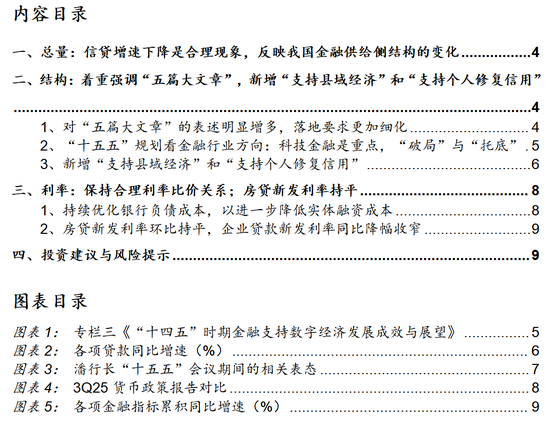
戴志锋:3Q25货币政策执行报告点评
Xin Lang Cai Jing· 2025-11-12 11:59
Summary of Key Points Overall Credit Growth - The decline in credit growth is a reasonable phenomenon, reflecting changes in China's financial supply-side structure. The focus should be on social financing scale and money supply as more comprehensive indicators compared to bank loans [1][8]. - Factors contributing to the decline include local special bonds replacing financing platform loans, the reform of small and medium-sized banks, and the trend of long-term economic structural evolution [9][12]. - Since last year, local governments have issued 4 trillion yuan in special refinancing bonds, with approximately 60-70% used to repay bank loans [10]. - In 2024, financial institutions are expected to write off about 1.3 trillion yuan in loans, with over 1 trillion yuan already written off in the first nine months of this year [11]. - The decline in real estate loans and the low credit dependence of light asset industries make it difficult to fill the gap left by real estate [12]. Structural Emphasis - The monetary policy report emphasizes the "Five Major Articles," with increased focus on supporting county economies and personal credit repair [2][18]. - The "14th Five-Year Plan" highlights technology finance as a key area, with policies aimed at breaking through economic growth ceilings and stabilizing macroeconomic environments [16]. - New measures include improving financial support mechanisms for county economic development and implementing policies for personal credit repair, which will not display certain default information in credit systems for individuals who have repaid loans [18][19]. Interest Rates - Maintaining a reasonable interest rate relationship is crucial, with new mortgage rates remaining stable [3][21]. - Continuous optimization of bank liability costs is necessary to lower financing costs for the real economy. The report notes that loan rates are decreasing faster than deposit rates, which compresses banks' net interest margins [21]. - As of September 2025, new loan rates for general loans, personal housing loans, and corporate loans are 3.67%, 3.06%, and 3.14%, respectively, with year-on-year declines of 48 basis points, 25 basis points, and 37 basis points [22]. Investment Recommendations - The banking sector is transitioning from a "pro-cyclical" to a "weak cyclical" phase, with a focus on the stability and sustainability of the sector [4]. - Two main investment lines are suggested: regional banks with strong certainty and high dividend stability, particularly in areas like Jiangsu, Shanghai, and Fujian [4].