Bank Of Jiangsu(600919)

Search documents
对近期重要经济金融新闻、行业事件、公司公告等进行点评:晨会纪要-20251117
Xiangcai Securities· 2025-11-17 02:29
Macro Strategy - Fixed asset investment in China showed a cumulative year-on-year decline of -1.70% for the first ten months of 2025, worsening from -0.50% in September. Key components such as infrastructure investment and manufacturing also experienced declines, with infrastructure down by 1.83 percentage points and manufacturing down by 1.30 percentage points. Real estate development investment saw a significant drop of -14.70% compared to -13.90% in September [2][4][5] Stock Market Overview - A-share indices experienced narrow fluctuations and slight declines from November 10 to November 14, 2025, with the Shanghai Composite Index down by 0.18% and the ChiNext Index down by 3.01%. The market is currently in a "slow bull" phase, with expectations of continued wide fluctuations and gradual upward movement in November [3][4][7] Industry Performance - Among the 31 first-level industries, most showed gains, with the top performers being comprehensive and textile sectors, which rose by 6.99% and 4.41% respectively. In contrast, the communication and electronics sectors faced declines of -4.77% each. Year-to-date, energy metals and components have seen significant increases of 92.91% and 85.55% respectively [5][6] Banking Sector Insights - The central bank's report emphasized maintaining reasonable growth in financial totals and solidifying credit support. The report indicated that recent weak credit growth is influenced by various factors, including local government debt replacement and the structural evolution of the economy. The central bank aims to keep financial totals, including credit and bond financing, growing steadily [14][15] - The central bank plans to enhance support for technology finance, which is a key focus of the 14th Five-Year Plan. This includes optimizing monetary policy tools to support technological innovation and ensuring that banks maintain reasonable net interest margins to facilitate continued support for the real economy [15][17] Investment Recommendations - The banking sector is expected to attract investment due to high dividend yields, with recommendations to focus on state-owned banks and potential valuation recovery opportunities in joint-stock and regional banks. Specific banks highlighted include Industrial and Commercial Bank of China, Bank of China, and others [17]





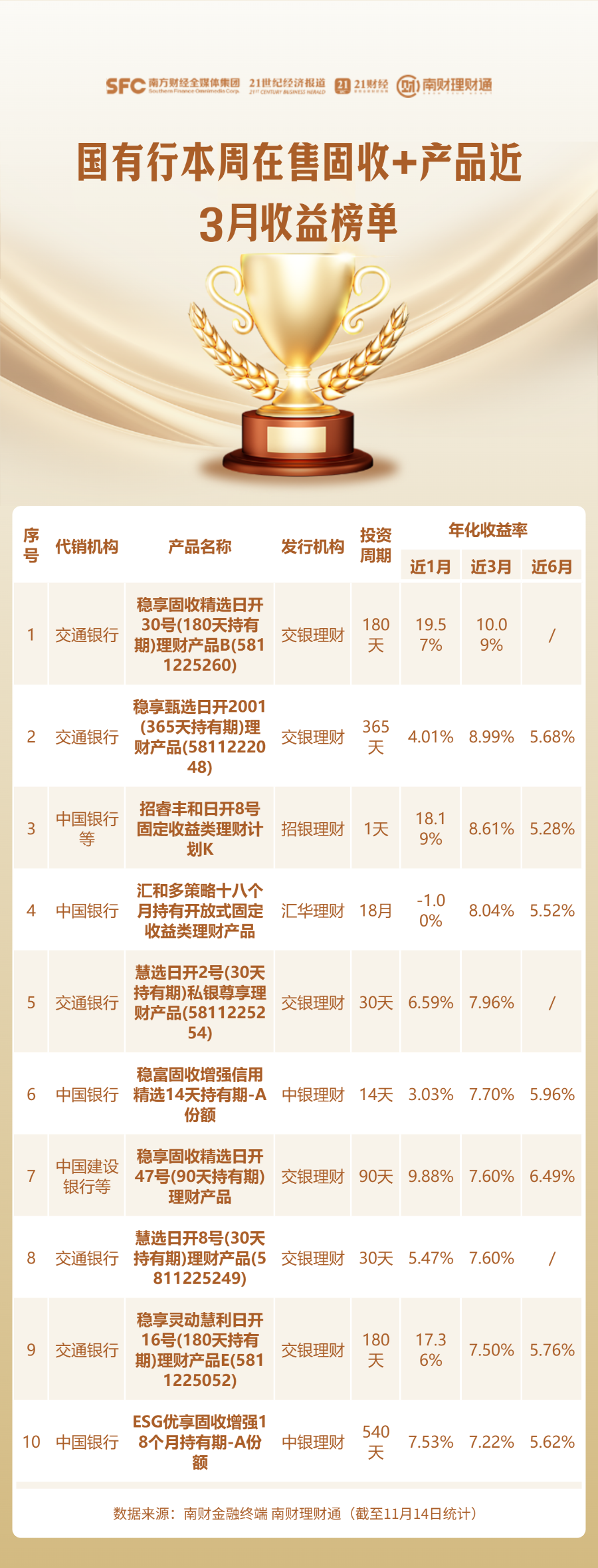
本周各银行在售“固收+”产品哪家强?
2 1 Shi Ji Jing Ji Bao Dao· 2025-11-17 01:20
Core Viewpoint - The article emphasizes the importance of selecting suitable wealth management products, particularly "fixed income+" products, from various banks, highlighting the need for investors to discern among numerous similar offerings [1][5]. Summary by Category Performance Ranking - The article presents a performance ranking of wealth management products based on their annualized returns over the past month, three months, and six months, with a focus on the three-month annualized yield for recent market performance [1][5]. Institutions Involved - A total of 28 banks are involved in the distribution of these wealth management products, including major institutions such as Industrial and Commercial Bank of China, Bank of China, Agricultural Bank of China, and others [1]. Product Selection - The ranking aims to assist investors in identifying high-performing products, with specific attention to the "fixed income+" category, which has gained popularity among investors seeking stable returns [1][5]. Market Dynamics - The article notes that the availability of these products may vary due to factors such as sold-out quotas or differences in product listings across banks, suggesting that investors should verify product availability through the respective bank's app [1].




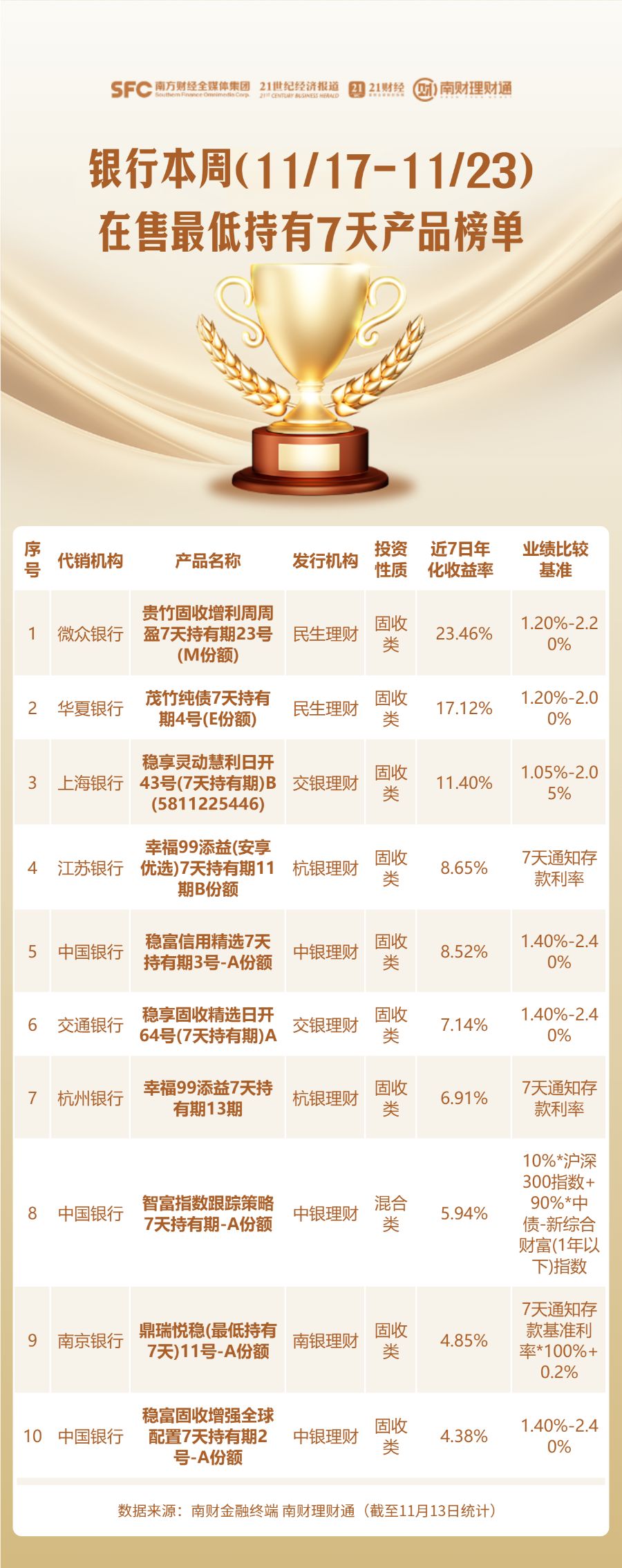
最低持有期榜单出炉!互联网银行7天持有期代销产品收益最高
2 1 Shi Ji Jing Ji Bao Dao· 2025-11-17 01:20
Core Insights - The article focuses on the performance of bank wealth management products with varying minimum holding periods, aiming to help investors identify and select high-performing products [1][5][12] Summary by Category Performance Rankings - The article provides a ranking of wealth management products based on their annualized returns for different holding periods: 7 days, 14 days, 30 days, and 60 days [1][5][12] - For the 7-day holding period, the top-performing product is from Minsheng Bank with an annualized return of 17.12% [4] - For the 14-day holding period, Minsheng Bank's product also leads with a return of 19.88% [6] - In the 30-day category, Minsheng Bank again tops the list with a return of 21.98% [10] - The 60-day holding period shows a leading return of 9.74% from Minsheng Bank [13] Product Categories - The products are categorized into fixed income and mixed types, with specific focus on their respective annualized returns and performance benchmarks [4][10][13] - The rankings are based on data from 28 distribution institutions, including major banks like ICBC, Bank of China, and Agricultural Bank of China [1] Investor Guidance - The article emphasizes the importance of checking the actual availability of products on bank apps, as some may be sold out or not displayed uniformly across different clients [1] - It aims to reduce the selection cost for investors by providing a clear performance overview of available products [1][5]
财政支持力度同比下降,M1增速见顶回落:银行业周报(20251110-20251116)-20251116
Huachuang Securities· 2025-11-16 14:42
Group 1 - The core view of the report indicates a decline in fiscal support year-on-year, with M1 growth peaking and then receding [1][3] - The report highlights a decrease in credit volume, with October RMB loan growth at 6.5% year-on-year, a reduction of 0.12 percentage points month-on-month, and a new loan addition of 220 billion yuan, which is 280 billion yuan less than the previous year [2] - The report emphasizes the importance of "supply-demand balance" in the credit market, noting that weak demand in the household sector, particularly for short-term loans, is a significant factor [2] Group 2 - M1 and M2 growth rates fell by 1 percentage point and 0.2 percentage points respectively in October, with M1 at 6.2% and M2 at 8.2% [3] - The report suggests that the decline in M1 growth is attributed to a booming capital market, leading to a shift of deposits from residents and enterprises to non-bank deposits [3] - The investment recommendation remains focused on the banking sector, highlighting that the long-term investment value of banks continues to be strong, with a suggestion to focus on state-owned banks and quality regional banks [4][9] Group 3 - The report provides a detailed analysis of the banking sector's performance, indicating that the Shenyin & Wanguo Bank Index rose by 1.70% during the week, outperforming the CSI 300 Index by 2.78 percentage points [8] - It notes that the overall market performance for the week saw major indices decline, with the CSI 300 down by 1.08% and the Shanghai Composite Index down by 0.18% [8] - The report also includes a forecast for key companies, with EPS and PE ratios provided for several banks, indicating a positive outlook for banks like Ningbo Bank and Jiangsu Bank [10]


行业点评报告:社融延续降速,存款“搬家”部分流向理财
KAIYUAN SECURITIES· 2025-11-14 09:43
Investment Rating - The industry investment rating is "Positive" (maintained) [1] Core Viewpoints - The report highlights a continued slowdown in social financing and a shift of deposits towards wealth management products, indicating a need for observation regarding the recovery of resident confidence and corporate operational activity [5][6] - The report notes that the credit growth is slowing down, with new RMB loans added in October amounting to 220 billion yuan, a year-on-year decrease of 280 billion yuan, reflecting seasonal demand factors and constraints on credit expansion [3][4] - Government bonds remain the main contributor to social financing growth, with new government bonds issued in October at 489.3 billion yuan, marking the lowest monthly level for the year [4] Summary by Sections Credit Market Analysis - In October, the new RMB loans were 220 billion yuan, with a year-on-year decrease of 280 billion yuan, and the balance growth rate was 6.5%, down 0.1 percentage points from September [3] - The report indicates that corporate loans increased by 220 billion yuan year-on-year, primarily supported by a 331.2 billion yuan increase in bills, while residential borrowing intentions decreased [3][4] Social Financing Trends - In October, social financing increased by 815 billion yuan, a year-on-year decrease of 597 billion yuan, with a stock growth rate of 8.5%, down 0.2 percentage points from September [4] - The report emphasizes that while social financing growth has been declining since July, the overall downward trend has been limited, with government bonds continuing to play a significant role [4] Deposit and Liquidity Dynamics - The M2 money supply grew by 8.2% year-on-year, while M1 grew by 6.2%, indicating a shift towards demand deposits [5] - There is a notable trend of deposits moving from residents to non-bank financial institutions, with a significant increase of 770 billion yuan in non-bank deposits, suggesting a migration of funds towards wealth management products [5][6] Investment Recommendations - The report suggests that despite the ongoing slowdown in credit growth and social financing, the retail risk for listed banks remains manageable, supported by robust provisioning and stable dividend policies [6] - It recommends increasing allocations to the banking sector, particularly state-owned banks, which are seen as offering value relative to risk-free rates, highlighting specific banks such as CITIC Bank and others as beneficiaries [6]


2025年10月金融数据点评:社融信贷均偏弱,存款搬家继续演绎
Yin He Zheng Quan· 2025-11-14 07:21
Investment Rating - The report maintains a "Recommended" rating for the banking industry [1]. Core Viewpoints - The growth of social financing (社融) has slowed down, with October's new social financing amounting to 814.9 billion yuan, a year-on-year decrease of 597.1 billion yuan. The total social financing stock increased by 8.49% year-on-year, with a slight month-on-month decline of 0.18 percentage points [3]. - Demand for loans remains weak, with a notable decrease in both household and corporate financing needs. In October, the balance of RMB loans grew by 6.5% year-on-year, a decrease of 0.1 percentage points from the previous month [3]. - The phenomenon of "deposit migration" continues, as M1 and M2 growth rates have declined. In October, M1 and M2 increased by 6.2% and 8.2% year-on-year, respectively, with month-on-month declines of 1 percentage point and 0.2 percentage points [3]. Summary by Sections Social Financing - In October, the new social financing was 814.9 billion yuan, down 597.1 billion yuan year-on-year. The government bond issuance has weakened its support for social financing [3]. - RMB loans decreased by 20.1 billion yuan in October, a year-on-year reduction of 316.6 billion yuan. The issuance of new government bonds was 489.3 billion yuan, down 560.2 billion yuan year-on-year [3]. Loan Demand - The demand for loans from the real economy remains weak, with household loans decreasing by 360.4 billion yuan in October, a year-on-year drop of 520.4 billion yuan. Corporate loans increased by 350 billion yuan, primarily driven by a significant rise in bill financing [3]. Deposit Trends - The total RMB deposits in financial institutions increased by 610 billion yuan in October, a year-on-year increase of 100 billion yuan. However, household deposits decreased by 1.34 trillion yuan, indicating ongoing deposit migration [3]. - Non-bank deposits increased by 1.85 trillion yuan year-on-year, reflecting a shift in capital towards more active markets [3]. Investment Recommendations - The report suggests that the weakening support from government bonds for social financing and the ongoing weak loan demand necessitate attention to the effectiveness of new policy financial tools. The banking sector's transformation driven by the 14th Five-Year Plan is expected to provide opportunities for fundamental recovery [3]. - Specific stock recommendations include Industrial and Commercial Bank of China (601398), Agricultural Bank of China (601288), Postal Savings Bank of China (601658), Jiangsu Bank (600919), Hangzhou Bank (600926), and China Merchants Bank (600036) [3].


2025年10月金融数据点评:信贷放缓、M1回落,量价均衡新周期愈发明朗
Shenwan Hongyuan Securities· 2025-11-14 06:30
Investment Rating - The industry investment rating is "Overweight," indicating that the industry is expected to outperform the overall market performance [24]. Core Insights - The report highlights a continued slowdown in credit growth, with October's new credit addition at 2.2 trillion yuan, a year-on-year decrease of 2.8 trillion yuan. The total new credit for the first ten months of the year is 14.97 trillion yuan, down 1.6 trillion yuan year-on-year [5][6]. - The report emphasizes the importance of monitoring forward-looking indicators such as PPI, which has shown signs of recovery, potentially improving the demand for real economy and reflecting positively on bank profits [5][6]. - The banking sector is expected to stabilize net interest margins, leading to improved net interest income growth. The focus will be on leading banks and quality regional banks for investment opportunities [5][6]. Summary by Sections Financial Data Overview - In October, new social financing was 815 billion yuan, a year-on-year decrease of 597 billion yuan, with a stock growth rate of 8.5%, down 0.2 percentage points month-on-month. M1 grew by 6.2%, while M2 grew by 8.2%, both showing a decline in growth rates compared to the previous month [3][6][9]. Credit Market Analysis - The report notes a significant decrease in corporate general loans, with a drop of 1.6 trillion yuan in October. The decline in corporate short-term loans was 1.9 trillion yuan, while bill discounting increased by over 500 billion yuan [5][6]. - Retail credit demand remains under pressure, with a net decrease of nearly 360 billion yuan in household credit in October, indicating a continued deleveraging phase for households [5][6]. Government Debt and Social Financing - The issuance of government bonds has slowed, contributing to the continued decline in social financing growth. In October, government bond issuance was 203.3 billion yuan, down over 560 billion yuan year-on-year [5][6]. - The report anticipates that the contribution from government bonds will weaken further, as the issuance for 2024 is expected to peak in the fourth quarter [5][6]. Investment Recommendations - The report suggests focusing on leading banks and undervalued regional banks as key investment themes. It highlights the potential for valuation recovery in leading banks and the opportunity for growth in quality regional banks under favorable policies [5][6].
南京VS苏州购票公告 将于11月14日19时至11月16日20时在苏服办平台预约
Yang Zi Wan Bao Wang· 2025-11-14 05:12
2025江苏银行(600919)第二届江苏省足球发展重点城市对抗赛11月22日比赛(南京市VS苏州市)将于11月14日19时至11月16日20时,在苏服办"省足球联 赛预约购票"平台进行预约,预约结束后由公证机构摇号,确定中签结果。 11月18日20时起,市民可登录预约购票平台查看中签结果。中签市民也将收到短信提醒,确认中签后须在规定时间内支付方可获得门票。未及时支付的名 额将被释放,按候补中签顺序依次递补。扬子晚报/紫牛新闻记者张昊 ...

银行股集体上涨,中证A500红利低波ETF(561680)红盘向上
Xin Lang Cai Jing· 2025-11-14 03:07
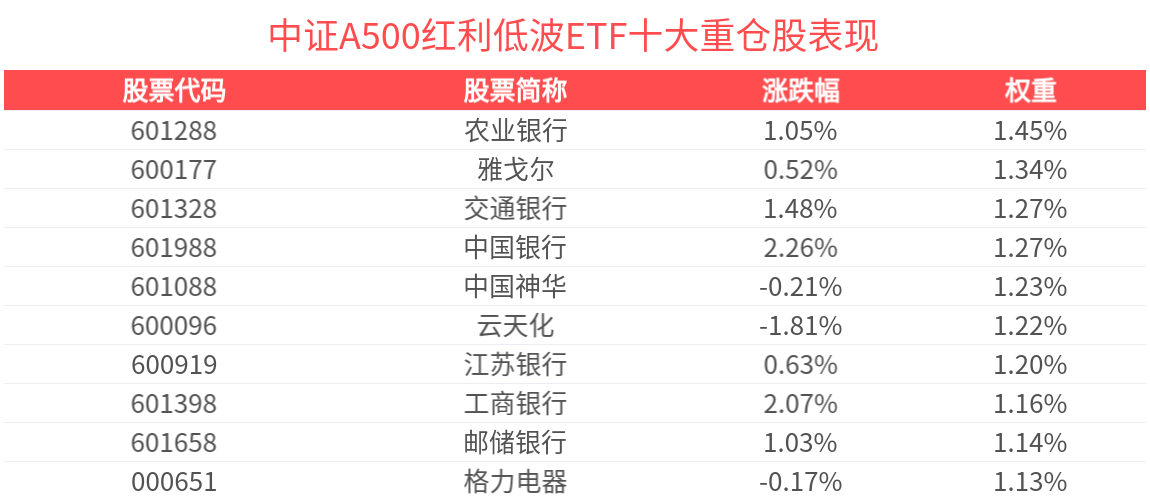
Core Insights - The China A500 Dividend Low Volatility Index (932422) has shown a slight increase of 0.14% as of November 14, 2025, with notable gains in major banks such as Bank of China (601988) up by 2.26% and Industrial and Commercial Bank of China (601398) up by 2.07% [1] Investment Environment - The National Bureau of Statistics emphasizes the need to focus on high-quality development, optimize investment structure, and enhance the investment environment to stimulate private investment and promote healthy investment growth [1] - According to Zhongtai Securities, the investment logic for bank stocks is shifting from "pro-cyclical" to "weak-cyclical," making high-dividend bank stocks more attractive during economic stagnation [1] - With the M1 growth rate declining, major financial data has entered a downward cycle, attributed to weaker fiscal expansion and the fading of low base effects [1] ETF Performance - The China A500 Dividend Low Volatility ETF (561680) has a turnover rate of 1.8% and a transaction volume of 3.36 million yuan as of November 14, 2025 [2] - Since its inception, the ETF has recorded a maximum monthly return of 3.37% and an average monthly return rate of 3.37%, with a monthly profit probability of 78.57% [2] - The maximum drawdown since inception is 3.42%, with a recovery period of 30 days [2] Index Composition - As of October 31, 2025, the top ten weighted stocks in the China A500 Dividend Low Volatility Index account for 31.82% of the index, including Agricultural Bank of China (601288) and China Shenhua Energy (601088) [3] - The top ten stocks include major banks and companies, indicating a strong representation of the financial sector within the index [3][5]

银行研思录25:银行股息率排名与中期分红进度梳理-20251114
CMS· 2025-11-14 03:02
Investment Rating - The report does not explicitly state an investment rating for the banking sector, but it provides detailed insights into dividend yields and distribution processes, which can inform investment decisions. Core Insights - The report outlines the latest dividend yields and mid-term dividend processes for A and H shares of listed banks, emphasizing the importance of accurately calculating dynamic dividend yields to avoid discrepancies across periods [1][2]. - It details the two processes for mid-term dividends following the 2023 revision of the regulatory guidelines, highlighting the conventional and simplified processes for implementing mid-term dividends [2]. - The report provides a comprehensive overview of key dates related to dividend distribution for both A and H shares, including the importance of purchasing shares before the ex-dividend date to qualify for dividends [3][4]. Summary by Sections Dynamic Dividend Yield Calculation - A simplified yet accurate method for calculating dynamic dividend yield is introduced, defined as "rolling 12-month EPS * cash dividend rate / share price," which helps avoid issues related to overlapping or missing annual and mid-term dividends [1]. - The report calculates the cash dividend rate using a standardized approach across different banks, resulting in a clear comparison of dividend yields as of November 13, 2025 [1]. Mid-Term Dividend Processes - The report explains the two processes for mid-term dividends: the conventional process requiring shareholder approval and a simplified process allowing for quicker implementation [2]. - The simplified process is designed to enhance flexibility for companies in distributing mid-term dividends, thereby improving shareholder returns [2]. Dividend Distribution Key Dates - For A shares, investors must purchase shares before the ex-dividend date to receive dividends on the same day, while H shares typically see a delay of about one month for dividend payments [3][4]. - The report outlines the differences in the dividend distribution timeline between A and H shares, emphasizing the need for investors to be aware of these timelines to maximize their returns [3][4]. Mid-Term Dividend Progress - As of November 13, 2025, 31 A-share banks have confirmed mid-term dividends, while 11 H-share banks have also confirmed their dividend distributions [9][11]. - The report categorizes banks based on their dividend status, detailing those that have implemented dividends, those that are pending, and those that have opted not to distribute dividends [9][10][11]. - It highlights that the end of 2025 and early 2026 is expected to be a peak period for mid-term dividend distributions, suggesting potential investment opportunities for dividend-seeking investors [11].