
HZBank(600926)

Search documents
机构密集“踩点”银行股息差与资产质量等成焦点
Zhong Guo Zheng Quan Bao· 2025-09-29 20:45
Core Viewpoint - The article highlights the increasing interest of institutional investors in regional banks, particularly in the Yangtze River Delta, due to their strong performance and resilience in a developed economic region [1][2]. Group 1: Institutional Research Focus - As of September 29, 2023, A-share listed banks have been surveyed over 300 times by more than 2000 institutions, with regional banks in the Yangtze River Delta receiving significant attention [1]. - Institutions are particularly focused on net interest margin stability, potential asset quality risks, and future credit allocation strategies during their research [2][3]. Group 2: Financial Performance of Regional Banks - Changshu Bank reported a revenue of 6.062 billion yuan, a year-on-year increase of 10.10%, and a net profit of 1.969 billion yuan, up 13.51% [2]. - The bank also declared its first interim cash dividend since its listing, distributing 0.15 yuan per share, totaling 499 million yuan [2]. Group 3: Investment Trends in Banking Sector - The investment logic for bank stocks is shifting from valuation recovery to deep value discovery of high-quality banks amid industry differentiation [3]. - As of September 29, 2023, the Shenwan Primary Bank Index closed at 4000.30 points, with a year-to-date increase of 2.33%, while individual stocks like Agricultural Bank, Qingdao Bank, and Pudong Development Bank rose over 20% [4]. - Institutional investments in bank stocks have increased, with insurance funds actively purchasing shares in various banks, indicating a preference for high dividend returns and stable earnings [4].

上市银行“十四五回望”之资负结构与息差变迁
CMS· 2025-09-28 15:09
Investment Rating - The report maintains a recommendation for the banking industry [3] Core Insights - The report provides a comprehensive analysis of the asset-liability structure and interest margin changes of 42 A-share listed banks during the "14th Five-Year Plan" period, highlighting a shift towards corporate loans on the asset side and a stronger retail focus on the liability side [12][14] - The asset-liability structure indicates a significant increase in the proportion of corporate loans, rising from 57.02% to 63.22% from the end of 2020 to mid-2025, while the proportion of demand deposits decreased from 41.94% to 30% [12][14] - The report notes a decline in both asset yield and interest margin, with the yield on interest-earning assets dropping from 4.43% to 3.32% and the net interest margin decreasing from 2.23% to 1.53% during the same period [14][15] Summary by Sections Overall Asset-Liability Structure and Interest Margin Changes - The asset-liability structure shows an increase in loan-to-earning asset ratio from 54.19% to 56.49%, with corporate loans making up a larger share of total loans [14][15] - The average yield on interest-earning assets decreased significantly, with the loan yield falling from 5.34% to 3.82% [15] - The net interest margin for listed banks remains higher than that of commercial banks, despite a decline [14][15] Changes in Each Banking Sector's Asset-Liability Structure and Interest Margin - City commercial banks experienced a more significant increase in the proportion of corporate loans, with their interest margin narrowing less compared to other banks [18] - The report highlights that the proportion of deposits in interest-bearing liabilities for state-owned banks decreased, while it increased for rural commercial banks [18] - The decline in interest-bearing liabilities' cost rate was most pronounced in city commercial banks, leading to a smaller reduction in their interest margin [18]





杭州银行闪耀数贸会:数智向新打造金融新动能
Zhong Guo Jing Ji Wang· 2025-09-28 08:56
Core Insights - The Fourth Global Digital Trade Expo was held in Hangzhou, showcasing the integration of digital technology and financial services by Hangzhou Bank [1] - The theme of the expo was "Connecting the World, Co-creating a Digital Future," focusing on the deep integration of digital trade and artificial intelligence [1] - Hangzhou Bank has elevated digital transformation to a core strategic position, emphasizing customer-centric value creation through digital thinking and AI technology [1] Group 1: Service Innovation - Hangzhou Bank introduced the "Four Connections and Three Easy" matrix, featuring products like "Financial Connection, Government Connection, Ticket Connection, Investment Connection, Exchange Trading, Salary Easy, and Easy Collection" [2] - This system aims to provide comprehensive, one-stop financial solutions for corporate and institutional clients, enhancing management efficiency and optimizing operational processes [2] Group 2: Interactive Experience - The bank showcased its upgraded Harmony Smart Hall solution, which integrates various technologies for a comprehensive service application system [3] - This solution enhances traditional business processing and service workflows, significantly improving the intelligent operation level and precise customer service capabilities of bank branches [3] - Hangzhou Bank is committed to leveraging cutting-edge technologies like AI, big data, and cloud computing to embed digital capabilities throughout its financial services [3]

固收深度报告20250927:从42家上市银行半年报解读银行债券投资“攻守道”





Soochow Securities· 2025-09-27 14:32
1. Report Industry Investment Rating No information about the report industry investment rating is provided in the given content. 2. Core Viewpoints of the Report - External environment factors such as interest rate fluctuations, bond supply - demand, and policy orientation jointly impact bond investment returns. In H1 2025, the bond investment of 42 listed banks showed certain characteristics in scale, structure, and profit and loss, but there are still challenges in maintaining stable returns in the future [1]. - The overall bond investment scale of 42 listed banks expanded steadily in H1 2025. There were differences in the investment structure among different types of banks, with state - owned banks and city commercial banks having stable growth in the bond allocation portfolio, while joint - stock banks and rural commercial banks increased their efforts in the bond trading portfolio. The bond investment portfolio generally presented a pattern of "stable foundation and flexible gain" [1]. - The coupon income of 42 listed banks was generally stable in H1 2025 but showed a slight year - on - year decline. The fair value change loss was significant, and the investment income increased. However, the bond investment of the banking industry still faces pressure to maintain stable returns [1]. 3. Summary According to the Table of Contents 3.1 42 Listed Banks' Bond Investment Volume - **Overall Bond Investment Scale: Steady Expansion**: In H1 2025, the total scale of the three types of bond - type financial assets of 42 listed banks showed a steady expansion trend. The growth of debt investment - type financial assets measured at amortized cost was relatively slow, while the growth of trading financial assets measured at fair value and included in current profits and losses was relatively large, indicating that banks increased the proportion of trading positions [9]. - **Differentiated Bond Investment Distribution Structures among Different Bank Types**: In H1 2025, state - owned banks and city commercial banks showed stable growth in the bond allocation portfolio, which may be related to their participation in the primary - market issuance of important national and regional bond varieties. Joint - stock banks and rural commercial banks slightly weakened their bond allocation power but significantly increased their efforts in the bond trading portfolio, showing a differentiated feature of "stable allocation by large banks and prominent trading flexibility by small and medium - sized banks" [13]. - **Bond Investment Allocation Tilted towards Government - Related Bonds**: In H1 2025, commercial banks increased their allocation of government - related bonds, with an average month - on - month increase of about 10% for state - owned banks, joint - stock banks, and city commercial banks, and a slightly smaller increase for rural commercial banks. The allocation of financial bonds and other bonds was differentiated. All banks held a relatively large scale of government - related bonds, followed by financial bonds and credit - related bonds [18]. - **Correlation between Financial Asset Types and Bond Variety Structures**: The banking industry maintained a stable growth of interest - rate bonds in the bond allocation portfolio and increased the allocation of credit bonds, while the allocation of financial bonds was relatively weak. In the bond trading portfolio, interest - rate bonds and financial bonds were the core varieties, with a more significant increase than credit bonds, showing a "stable foundation and flexible gain" pattern [22]. 3.2 42 Listed Banks' Bond Investment Profit and Loss - **Coupon Income: Generally Stable and Still the Main Source of Income**: In H1 2025, the total coupon income of 42 listed banks decreased slightly year - on - year. Although the scale of held - to - maturity bonds increased, the decline in the coupon rate of newly issued bonds led to a decrease in coupon income. In the future, coupon income is still expected to be the main source of bond investment income for commercial banks [26]. - **Fair Value Change Loss: Losses in the Trading Level**: In H1 2025, the total fair value change loss of 42 listed banks decreased significantly year - on - year, indicating that it was difficult to obtain capital gains through short - term trading in the volatile bond market, and there were floating losses in bond trading [28]. - **Investment Income: Growth in All Bank Types**: In H1 2025, the actual investment income of 42 listed banks in the bond field increased significantly year - on - year. Although the book value appreciation of bond - type trading financial assets and other debt investment - type financial assets was not as good as that of the previous year, banks could still increase their investment income by selling floating - profit old bonds and waiting for the maturity of high - coupon bonds [31]. 3.3 Attribution and Summary - **External Environment Driving Factors: Interest Rate Fluctuations, Bond Supply - Demand, and Policy Orientation Jointly Impact Bond Investment Returns**: In H1 2025, the "more adjustments and fewer opportunities" bond market environment led to a general decline in the prices of existing bonds, resulting in a significant year - on - year decline in the fair value change loss of listed banks' bond investment. The supply of national bonds, local government bonds, and policy - based financial bonds increased, but the coupon rate of newly issued bonds decreased, leading to a decline in coupon income. Regulatory policies indirectly affected bond investment performance [35]. - **Banking Industry's Bond Investment Pressure and Future Outlook** - Overall Income Shows a Positive Trend but There Are Still Hidden Concerns: In H1 2025, the actual bond investment income of 42 listed banks increased slightly year - on - year, but the coupon income faced downward pressure in the interest - rate downward cycle, and it was more difficult to obtain spread income through band trading. Since H2 2025, the "stock - strong and bond - weak" pattern has emerged, and the loss caused by fair value change will be more obvious [3]. - Different Bank Types Show Differentiated Performance, and State - owned Banks' Pressure Is Relatively Controllable: State - owned banks can maintain a certain profit - making ability in the low - interest - rate volatile bond market due to their advantages in bond allocation and trading portfolios. Joint - stock banks, city commercial banks, and rural commercial banks are more vulnerable, and they may increase their capital allocation in the equity market, commodity market, and related structured fixed - income products in the future [3].
多家银行下调存款利率!应对零售存款流失,加码“固收+”
券商中国· 2025-09-26 03:20
Core Viewpoint - Since September, local small and medium-sized banks have been continuously lowering deposit interest rates to alleviate net interest margin pressure and follow the lead of larger banks [1][3]. Group 1: Deposit Rate Adjustments - On September 25, several banks in Henan, including Luoyang Rural Commercial Bank, announced reductions in RMB deposit rates, with the highest cut reaching 35 basis points [2][3]. - The new rates for fixed-term deposits at Luoyang Rural Commercial Bank are now 0.75% for three months, 1.00% for six months, 1.30% for one year, and 1.35% for two years, reflecting a reduction of 15 basis points [3]. - Other banks, such as Jieyang Rural Commercial Bank and Shanghai Huarui Bank, have also lowered rates across various deposit products, indicating a broader trend among local banks to adjust rates following national banks [3]. Group 2: Retail Deposit Trends - There is a noticeable outflow of retail deposits as customers shift to investment products with higher returns, such as cash management and fixed-income bank wealth management products, which offer annual yields of 2% to 3% [2][5]. - Retail deposit growth has significantly slowed, with banks facing challenges in attracting new customers and retaining existing deposits [5][6]. - Data shows that major banks like China Merchants Bank and Ping An Bank experienced a decline in retail deposit growth rates in the first half of 2025 compared to the same period in 2024, with decreases of 3.43 and 3.73 percentage points, respectively [8]. Group 3: Wealth Management Strategies - In response to declining retail deposits, banks are focusing on expanding their wealth management services, leveraging the recent bullish trends in capital markets [9][10]. - Wealth management products, particularly those linked to equity funds, are becoming key revenue drivers for banks as they seek to retain customer assets [9]. - The "fixed income plus" product category is seen as a new pathway for banks to attract deposits in a low-interest-rate environment, highlighting the need for diversified investment options [10].




城商行板块9月25日跌0.94%,重庆银行领跌,主力资金净流出2.78亿元
Zheng Xing Xing Ye Ri Bao· 2025-09-25 08:37
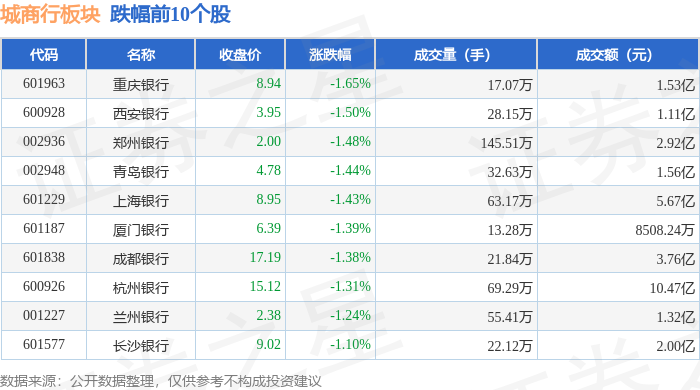
Market Performance - The city commercial bank sector declined by 0.94% on September 25, with Chongqing Bank leading the decline [1] - The Shanghai Composite Index closed at 3853.3, down 0.01%, while the Shenzhen Component Index closed at 13445.9, up 0.67% [1] Individual Stock Performance - Chongqing Bank closed at 8.94, down 1.65% with a trading volume of 170,700 shares and a transaction value of 153 million [1] - Other notable declines include Xi'an Bank down 1.50% to 3.95, Zhengzhou Bank down 1.48% to 2.00, and Qingdao Bank down 1.44% to 4.78 [1] - Shanghai Bank and Xiamen Bank also saw declines of 1.43% and 1.39%, respectively [1] Capital Flow Analysis - The city commercial bank sector experienced a net outflow of 278 million from institutional investors, while retail investors saw a net inflow of 152 million [1] - The table indicates that Suzhou Bank had a significant net outflow from institutional investors of 48.08 million, while Qilu Bank had a net inflow of 25.86 million [2] - Chongqing Bank specifically had a net outflow of 5.68 million from institutional investors but a net inflow of 10.91 million from retail investors [2]


城商行板块9月24日涨1.64%,齐鲁银行领涨,主力资金净流出6917.64万元
Zheng Xing Xing Ye Ri Bao· 2025-09-24 08:46
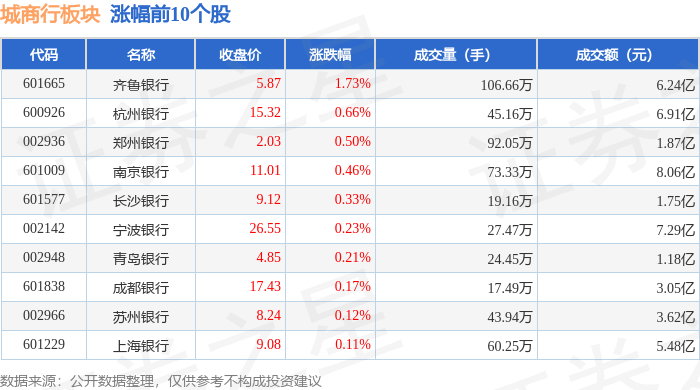
Market Performance - The city commercial bank sector increased by 1.64% on September 24, with Qilu Bank leading the gains [1] - The Shanghai Composite Index closed at 3853.64, up 0.83%, while the Shenzhen Component Index closed at 13356.14, up 1.8% [1] Individual Stock Performance - Qilu Bank closed at 5.87, with a rise of 1.73% and a trading volume of 1.0666 million shares, amounting to a transaction value of 624 million yuan [1] - Hangzhou Bank closed at 15.32, up 0.66%, with a trading volume of 451,600 shares and a transaction value of 691 million yuan [1] - Zhengzhou Bank closed at 2.03, up 0.50%, with a trading volume of 920,500 shares and a transaction value of 18.7 million yuan [1] - Nanjing Bank closed at 11.01, up 0.46%, with a trading volume of 1.7333 million shares and a transaction value of 806 million yuan [1] - Other banks such as Changsha Bank, Ningbo Bank, and Qingdao Bank also showed slight increases in their stock prices [1] Capital Flow Analysis - The city commercial bank sector experienced a net outflow of 69.1764 million yuan from institutional investors, while retail investors saw a net inflow of 55.8208 million yuan [2] - The overall capital flow indicates a mixed sentiment, with institutional investors withdrawing funds while retail investors continued to invest [2] Detailed Capital Flow for Selected Banks - Ningbo Bank had a net inflow of 74.388 million yuan from institutional investors, but a net outflow of 51.098 million yuan from speculative funds [3] - Shanghai Bank saw a net inflow of 17.1761 million yuan from institutional investors, while retail investors had a net outflow of 30.1701 million yuan [3] - Chengdu Bank experienced a net inflow of 16.3117 million yuan from institutional investors, with a net outflow from retail investors [3]
浙江金融监管局核准王西刚杭州银行董事任职资格
Jin Tou Wang· 2025-09-24 03:20
Core Viewpoint - Zhejiang Financial Regulatory Bureau approved the qualification of Wang Xigang as a director of Hangzhou Bank, emphasizing compliance with regulatory requirements and the importance of continuous learning in financial laws and regulations [1] Group 1 - The approval of Wang Xigang's directorship at Hangzhou Bank is officially recognized [1] - Hangzhou Bank is required to ensure that the approved individual adheres to regulatory guidelines and reports their onboarding status within three months [1] - The regulatory body mandates ongoing education for the approved director to maintain awareness of risk compliance and understand their job responsibilities [1]
A股银行股集体上涨,南京银行涨超4%
Ge Long Hui A P P· 2025-09-23 02:27
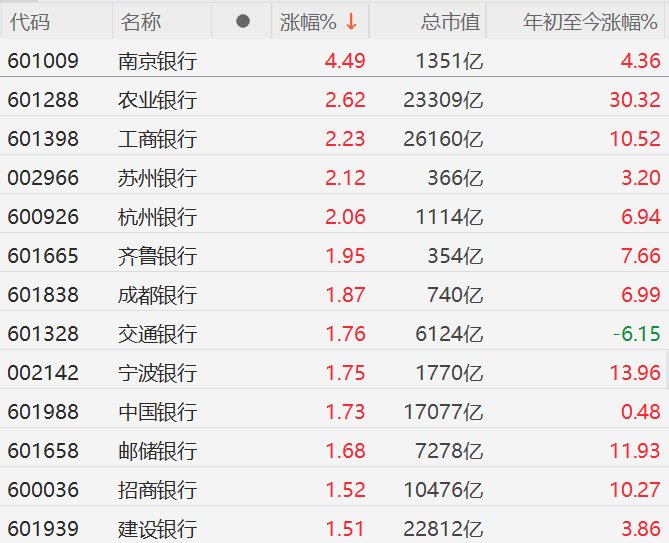
Core Viewpoint - The A-share market has seen a collective rise in bank stocks, with notable increases in several banks' share prices, indicating positive market sentiment towards the banking sector [1]. Group 1: Stock Performance - Nanjing Bank experienced a rise of 4.49%, with a total market capitalization of 135.1 billion and a year-to-date increase of 4.36% [2]. - Agricultural Bank saw a 2.62% increase, bringing its market value to 2,330.9 billion, with a year-to-date rise of 30.32% [2]. - Industrial and Commercial Bank's shares rose by 2.23%, with a market cap of 2,616.0 billion and a year-to-date increase of 10.52% [2]. - Suzhou Bank and Hangzhou Bank both increased by over 2%, with market caps of 36.6 billion and 111.4 billion respectively [2]. - Other banks such as Qilu Bank, Chengdu Bank, and Ningbo Bank also showed positive performance, with increases ranging from 1.75% to 1.95% [2]. Group 2: Technical Indicators - The formation of a MACD golden cross signal suggests a strong upward momentum in these bank stocks, contributing to their positive performance [1].

浙江省首批“浙科联合贷”落地 杭州银行携手同业全生命周期陪伴科技企业成长壮大
Zhong Guo Jing Ji Wang· 2025-09-22 12:33
Core Viewpoint - Hangzhou Bank is committed to serving the real economy and has successfully launched the "Zheke United Loan," a new financing model for technology enterprises, reflecting its long-term efforts in building a specialized technology financial service system [1] Group 1: Overview of "Zheke United Loan" - "Zheke United Loan" is guided by multiple financial and governmental bodies, aiming to address the financing challenges faced by technology enterprises throughout their lifecycle [2] - The loan program includes three sub-products: "Inclusive United Loan," "Growth United Loan," and "Leading United Loan," tailored to meet the diverse financial needs of technology enterprises at different stages [2] Group 2: Focus on Inclusive Financing - The program emphasizes inclusive finance, targeting small and micro technology enterprises that require assistance [3] - A joint service team was established between Hangzhou Bank and Industrial and Commercial Bank of China to provide tailored support to high-growth technology enterprises [3] Group 3: Growth Financing Solutions - The "Growth United Loan" has been customized for a startup medical enterprise, providing a credit line of 12 million yuan with a loan rate 26 basis points lower than the average [5] - This support has enabled the enterprise to meet its funding needs for research, production, and expansion [5] Group 4: Large Demand Financing - The "Leading United Loan" is designed for mature technology enterprises with significant funding needs, offering high credit limits and long terms [6] - A collaboration with Minsheng Bank has facilitated a project that supports a digital healthcare enterprise, enhancing its capacity for innovation and service quality [6] - The program integrates various resources to provide stable and diverse financial support for technology enterprises throughout their growth lifecycle [6]