Chongqing Rural Commercial Bank(601077)

Search documents
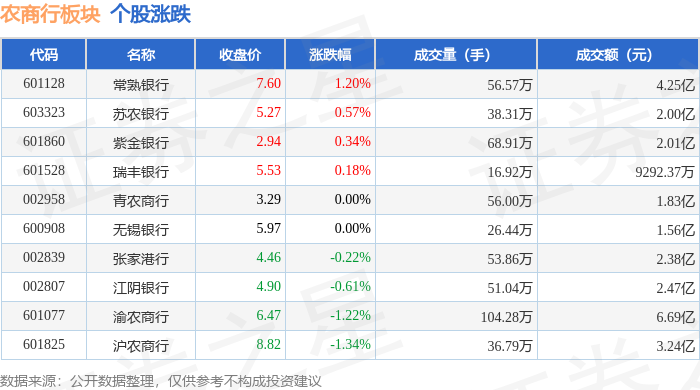
农商行板块9月4日跌0.61%,沪农商行领跌,主力资金净流入38.47万元
Zheng Xing Xing Ye Ri Bao· 2025-09-04 08:48
Market Overview - On September 4, the rural commercial bank sector declined by 0.61% compared to the previous trading day, with Hu Nong Bank leading the decline [1] - The Shanghai Composite Index closed at 3765.88, down 1.25%, while the Shenzhen Component Index closed at 12118.7, down 2.83% [1] Individual Stock Performance - Among the rural commercial banks, Changshu Bank saw a closing price of 7.60 with a gain of 1.20%, while Hu Nong Bank closed at 8.82, down 1.34% [1] - The trading volume and turnover for various banks were reported, with Changshu Bank having a trading volume of 565,700 shares and a turnover of 4.25 billion yuan [1] Capital Flow Analysis - The rural commercial bank sector experienced a net inflow of 384,700 yuan from institutional investors, while retail investors saw a net inflow of 11.7 million yuan [1] - The table of capital flow indicates that the majority of the funds were flowing into certain banks, with Yu Nong Bank receiving a net inflow of 73.51 million yuan from institutional investors [2] Detailed Capital Flow by Bank - Yu Nong Bank had a net inflow of 73.51 million yuan from institutional investors, while it faced a net outflow of 41.89 million yuan from speculative funds [2] - Changshu Bank experienced a net inflow of 19.16 million yuan from institutional investors, but a significant outflow of 51.75 million yuan from speculative funds [2] - Other banks like Zijin Bank and Su Nong Bank also reported net outflows from institutional and speculative funds, indicating varied investor sentiment across the sector [2]



A股银行股普跌,渝农商行、沪农商行跌超2%
Ge Long Hui A P P· 2025-09-04 06:57
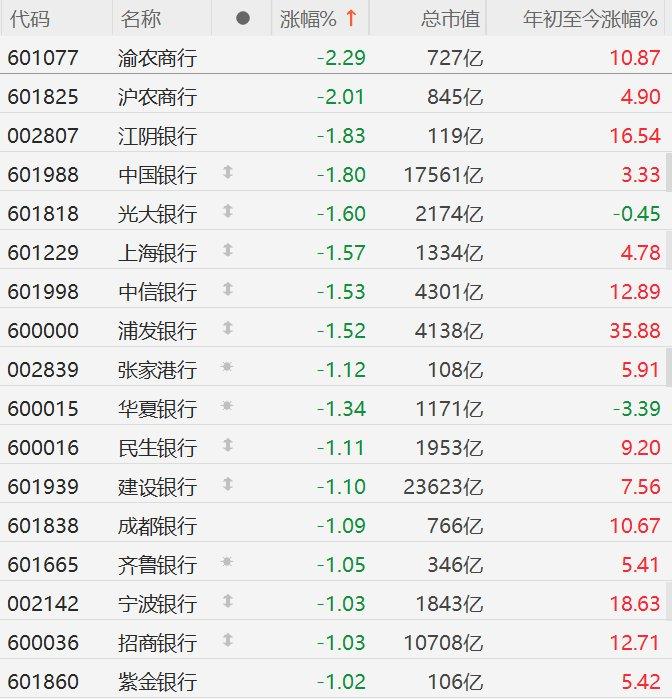
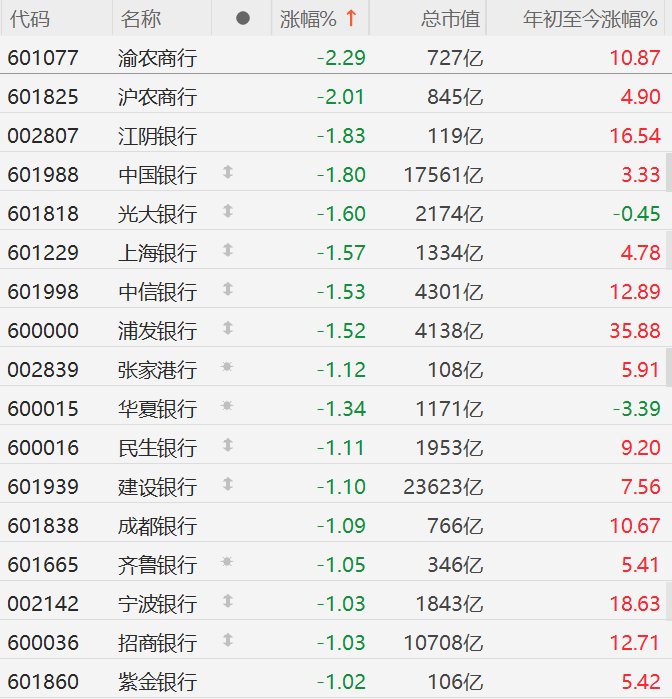
Core Viewpoint - The A-share market experienced a widespread decline in bank stocks, with several banks falling over 2% and others declining by more than 1% [1] Group 1: Stock Performance - Yunnan Rural Commercial Bank (渝农商行) saw a decline of 2.29%, with a total market capitalization of 72.7 billion [2] - Shanghai Rural Commercial Bank (沪农商行) decreased by 2.01%, with a market cap of 84.5 billion [2] - Jiangyin Bank (江阴银行) fell by 1.83%, with a market value of 11.9 billion [2] - Bank of China (中国银行) dropped by 1.80%, with a market capitalization of 1,756.1 billion [2] - China Everbright Bank (光大银行) decreased by 1.60%, with a market cap of 217.4 billion [2] - Shanghai Bank (上海银行) declined by 1.57%, with a market value of 133.4 billion [2] - CITIC Bank (中信银行) fell by 1.53%, with a market capitalization of 430.1 billion [2] - Pudong Development Bank (浦发银行) decreased by 1.52%, with a market cap of 413.8 billion [2] - Zhangjiagang Bank (张家港行) saw a decline of 1.12%, with a market value of 10.8 billion [2] - Huaxia Bank (华夏银行) fell by 1.34%, with a market capitalization of 117.1 billion [2] - Minsheng Bank (民生银行) decreased by 1.11%, with a market cap of 195.3 billion [2] - China Construction Bank (建设银行) dropped by 1.10%, with a market capitalization of 23,623 billion [2] - Chengdu Bank (成都银行) saw a decline of 1.09%, with a market value of 76.6 billion [2] - Qilu Bank (齐鲁银行) decreased by 1.05%, with a market cap of 34.6 billion [2] - Ningbo Bank (宁波银行) fell by 1.03%, with a market capitalization of 184.3 billion [2] - China Merchants Bank (招商银行) decreased by 1.03%, with a market cap of 1,070.8 billion [2] - Zijin Bank (紫金银行) saw a decline of 1.02%, with a market value of 10.6 billion [2]


银行研究框架及25H1业绩综述:营收及利润增速双双转正
GOLDEN SUN SECURITIES· 2025-09-04 06:14
Investment Rating - The report indicates a positive outlook for the banking industry, with overall revenue and net profit growth rates turning positive in the first half of 2025, at 1.0% and 0.8% respectively, showing improvements from the previous quarter [4]. Core Insights - The banking sector's net interest margin for the first half of 2025 is reported at 1.42%, a decrease of 10 basis points compared to the previous year, but the decline is narrowing due to improved cost management on the liability side [5]. - Non-interest income, particularly from fees and commissions, has increased by 3.1% year-on-year, driven by a recovery in wealth management and a more active market environment [5]. - The asset quality remains stable, with a non-performing loan ratio of 1.23% and a provision coverage ratio of 239%, indicating a solid credit environment [5]. Summary by Sections Financial Performance Overview - The overall revenue and net profit growth for listed banks in the first half of 2025 were 1.0% and 0.8%, respectively, with both metrics showing improvement from the first quarter [4][22]. - The total assets of listed banks reached 321.3 trillion yuan, growing by 6.35% year-to-date, with loans and advances totaling 179.4 trillion yuan, accounting for 55.84% of total assets [21][24]. Income Sources - Net interest income decreased by 1.3% year-on-year, but the decline rate has slowed, reflecting better management of funding costs [5]. - Fee and commission income grew by 3.1% year-on-year, benefiting from a recovering market and the gradual impact of regulatory changes [5]. - Other non-interest income saw a significant increase of 10.7%, primarily due to favorable market conditions in the bond market [5]. Asset Quality and Management - The non-performing loan ratio remained stable at 1.23%, with a provision coverage ratio of 239%, indicating a robust asset quality [5]. - The credit cost for the first half of 2025 was 0.81%, a decrease of 5 basis points year-on-year, suggesting manageable credit risks [5]. Loan Growth and Composition - Loan growth was primarily driven by corporate lending, with significant contributions from infrastructure and manufacturing sectors [20]. - Personal loan growth was weaker, with a year-on-year increase of only 3.6%, reflecting a cautious approach to consumer lending amid rising risks [20]. Investment and Market Conditions - The investment asset proportion decreased to 34% as banks adjusted their strategies in response to market volatility [20]. - The overall yield on bonds fluctuated significantly, prompting banks to engage in tactical trading to enhance returns [20].



银行股普跌,渝农商行、沪农商行跌超2%
Ge Long Hui· 2025-09-04 03:29
Group 1 - The A-share market experienced a widespread decline in bank stocks, with notable drops in Chongqing Rural Commercial Bank and Shanghai Rural Commercial Bank, both falling over 2% [1] - Other banks such as Jiangyin Bank, Bank of China, Everbright Bank, Shanghai Bank, CITIC Bank, Pudong Development Bank, Zhangjiagang Bank, Huaxia Bank, Minsheng Bank, China Construction Bank, and China Merchants Bank also saw declines of around 1% [1] Group 2 - Specific stock performance data shows Chongqing Rural Commercial Bank down by 2.29% with a market cap of 72.7 billion, and Shanghai Rural Commercial Bank down by 2.01% with a market cap of 84.5 billion [2] - Jiangyin Bank decreased by 1.83% with a market cap of 11.9 billion, while Bank of China fell by 1.80% with a market cap of 1,756.1 billion [2] - Other banks like Everbright Bank, Shanghai Bank, and CITIC Bank also reported declines, with respective market caps of 217.4 billion, 133.4 billion, and 430.1 billion [2]
银行板块盘初下挫,渝农商行跌超3%
Mei Ri Jing Ji Xin Wen· 2025-09-04 01:57
Group 1 - The banking sector experienced a decline at the beginning of trading on September 4, with Chongqing Rural Commercial Bank falling over 3% [1] - Other banks such as Xi'an Bank, Bank of China, Jiangyin Bank, and Shanghai Rural Commercial Bank also saw declines of over 2% [1]
金融中报观|银行零售业务梯队格局背后,谁在领跑,谁在补课
Bei Jing Shang Bao· 2025-09-03 14:17
Core Insights - The competitive landscape of retail banking in A-shares is becoming clearer as the 2025 mid-year reports are disclosed, revealing a distinct tiered structure in retail AUM (Assets Under Management) [1][2] - The first tier consists of major state-owned banks and China Merchants Bank, all exceeding 16 trillion yuan in retail AUM, while the second tier includes joint-stock banks and some leading city commercial banks [1][2] - The retail business performance is mixed, with many banks facing pressure on retail revenue and net profit, highlighting a structural issue of profit growth without revenue increase [1][6] Tiered Structure of Retail AUM - The first tier banks, including Industrial and Commercial Bank of China (ICBC) and Agricultural Bank of China (ABC), lead with AUM exceeding 16 trillion yuan, with ICBC at over 24 trillion yuan and ABC at 23.68 trillion yuan [2][3] - China Construction Bank (CCB) and Postal Savings Bank of China also show strong performance, with CCB managing over 22 trillion yuan and Postal Savings Bank at 17.67 trillion yuan [2] - China Merchants Bank, known as the "king of retail," has a retail AUM of 16.03 trillion yuan, reflecting a 7.39% increase from the previous year [2] Second Tier Performance - The second tier banks have retail AUM ranging from 1 trillion to 6 trillion yuan, with notable growth from banks like Bank of Communications at 5.79 trillion yuan and Industrial Bank at 5.52 trillion yuan [3] - Joint-stock banks are active in this tier, with CITIC Bank and Shanghai Pudong Development Bank also showing significant growth in retail AUM [3] Third Tier Characteristics - The third tier banks have retail AUM mostly below 1 trillion yuan, with Nanjing Bank and Shanghai Rural Commercial Bank showing notable growth rates of 14.25% and 3.99% respectively [4] - Regional banks are leveraging local advantages to deepen market penetration, but face challenges in competing with larger banks [5] Retail Profitability Challenges - The retail banking sector is undergoing significant adjustments, with a shift in customer demand towards diversified financial solutions, which raises the bar for product innovation and service customization [6] - Leading banks like ICBC and China Merchants Bank are showing resilience, with ICBC's net profit rising by 46.05% despite a slight revenue decline [6][7] - However, some banks, including ABC and Ping An Bank, are experiencing declines in both revenue and net profit, indicating a challenging environment [7] Asset Quality Concerns - The retail banking sector is facing challenges in asset quality, particularly in personal loans, with rising non-performing loan (NPL) ratios reported by several banks [9][10] - For instance, China Merchants Bank's retail loan NPL ratio increased to 1.04%, while Chongqing Rural Commercial Bank's rose to 2.04% [9] - Some banks, like Ping An Bank and Industrial Bank, have managed to improve their asset quality through refined risk management practices [10] Strategic Recommendations - Analysts suggest that banks, especially smaller ones, should focus on enhancing their support for small and micro enterprises and optimizing financial resource allocation to uncover new growth points [8] - There is a call for banks to improve their digital capabilities and customer experience to better compete with larger institutions [8]



不靠利息靠投资?透视A股农商行中期业绩:营收持续分化,非利息收入扛起增长“大旗”
Mei Ri Jing Ji Xin Wen· 2025-09-03 13:08
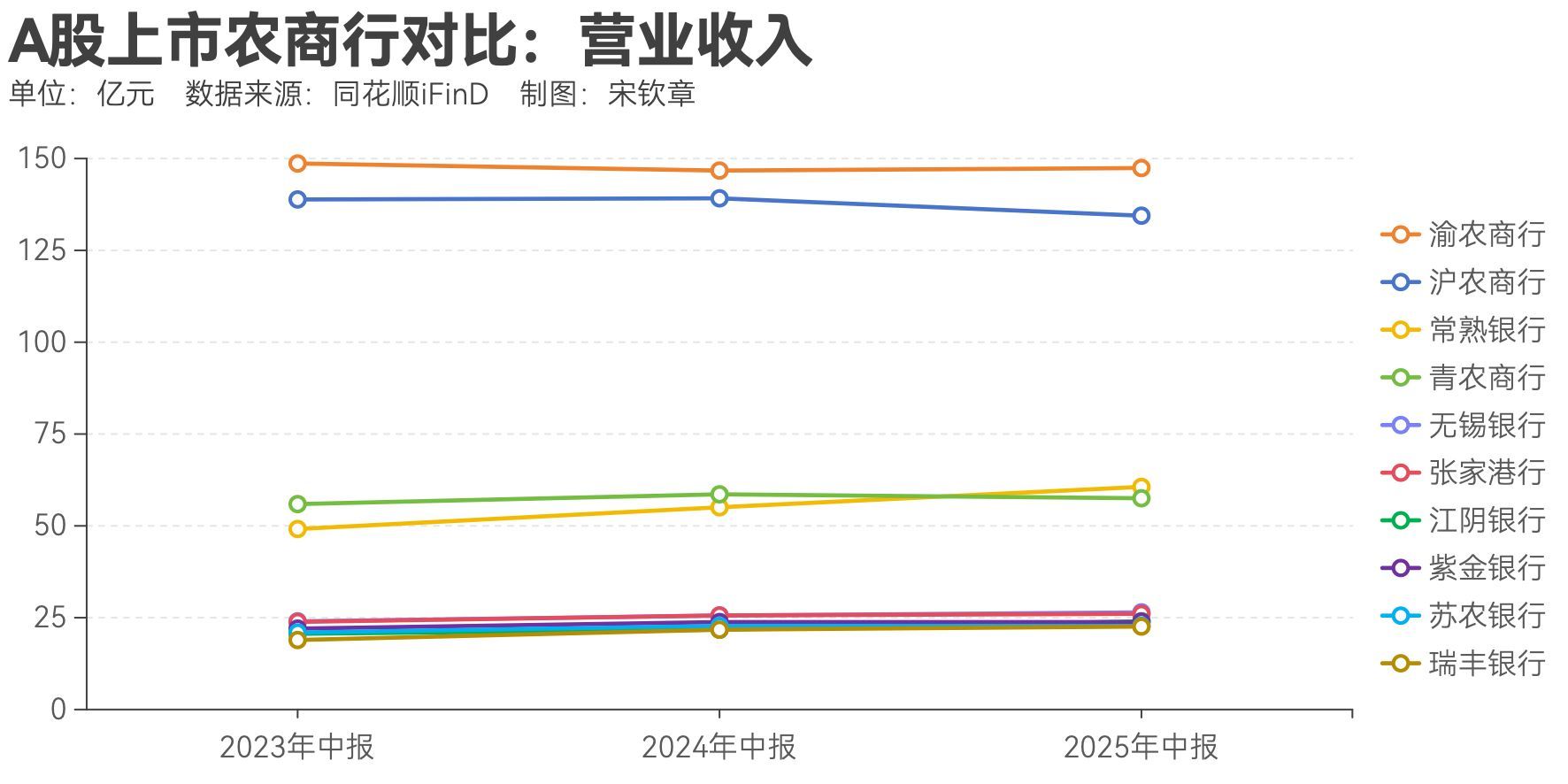
Core Viewpoint - The financial performance of listed rural commercial banks in China is showing a trend of increasing differentiation, with significant revenue growth observed in certain banks while others lag behind [1][4]. Group 1: Revenue Performance - In the first half of 2025, Chongqing Rural Commercial Bank (渝农商行) and Shanghai Rural Commercial Bank (沪农商行) reported revenues of 14.741 billion and 13.444 billion yuan respectively, both nearing 15 billion yuan [4]. - Changshu Bank (常熟银行) and Qingdao Rural Commercial Bank (青农商行) achieved revenues of 6.062 billion and 5.752 billion yuan, exceeding 5 billion yuan [4]. - Other banks such as Wuxi Bank (无锡银行), Zhangjiagang Bank (张家港行), Jiangyin Bank (江阴银行), Zijin Bank (紫金银行), Sunan Bank (苏农银行), and Ruifeng Bank (瑞丰银行) reported revenues below 3 billion yuan [4]. Group 2: Year-on-Year Growth - Changshu Bank and Jiangyin Bank experienced significant year-on-year revenue growth, both exceeding 10%, with net profit growth also surpassing 12% [4][5]. - The revenue growth for these banks is attributed to non-interest income, particularly investment income, with Changshu Bank reporting a 637.77% increase in net commission income [5]. Group 3: Interest Income and Net Interest Margin - The net interest margin for listed rural commercial banks collectively declined compared to the previous year, impacting interest income for many banks [5]. - Chongqing Rural Commercial Bank reported a net interest income of 11.744 billion yuan, a year-on-year increase of 5.98%, despite a 2.47% decline in interest income due to lower market rates [8]. Group 4: Investment Income - Investment income is a crucial component of non-interest income, with most listed rural commercial banks showing significant increases compared to the previous year [6]. - Zijin Bank and Jiangyin Bank reported year-on-year increases in investment income of 95.41% and 81.44% respectively [6]. Group 5: Dividend Distribution - Several banks, including Changshu Bank and Jiangyin Bank, announced their first interim dividend distributions, aiming to enhance investor returns and boost long-term holding confidence [9]. - Shanghai Rural Commercial Bank proposed a cash dividend of 2.41 yuan per 10 shares, totaling 2.324 billion yuan, with a distribution ratio of 33.14% [9].
渝农商行换帅后首交半年报 北京农商行营收增速为其18倍
Zhong Guo Jing Ji Wang· 2025-09-03 08:11
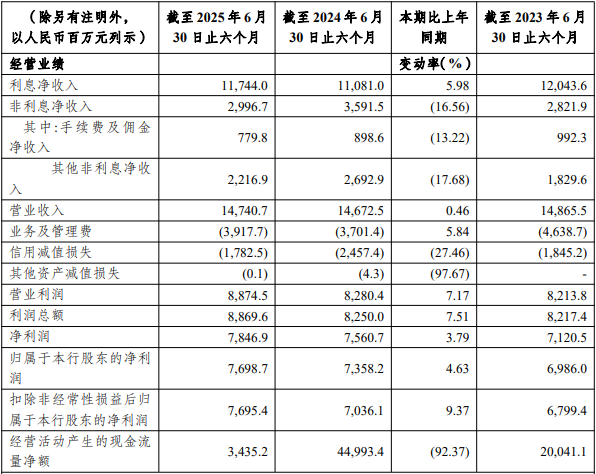
Core Viewpoint - Chongqing Rural Commercial Bank (渝农商行) reported a slight increase in revenue and net profit for the first half of 2025, but a significant decline in cash flow from operating activities [1][2]. Financial Performance - The bank achieved an operating income of 14.74 billion yuan, a year-on-year increase of 0.46% [1][2]. - Net profit reached 7.85 billion yuan, reflecting a growth of 3.79% compared to the previous year [1][2]. - The net profit attributable to shareholders was 7.70 billion yuan, up 4.63% year-on-year [1][2]. - Operating cash flow decreased significantly by 92.37%, amounting to 3.44 billion yuan [1][2]. Income Breakdown - Net interest income was reported at 11.74 billion yuan, an increase of 5.98% from the previous year [2]. - Non-interest income fell by 16.56% to 2.99 billion yuan, with fees and commissions down by 13.22% [2]. - Other non-interest income also decreased by 17.68% to 2.22 billion yuan [2]. Comparison with Peers - Beijing Rural Commercial Bank reported an operating income of 9.05 billion yuan for the same period, showing a growth rate of 8.43%, which is significantly higher than that of Chongqing Rural Commercial Bank [3]. - In 2024, Chongqing Rural Commercial Bank's revenue growth was 1.09%, while Beijing Rural Commercial Bank's was 18.09%, indicating a substantial difference in performance [3]. Management Changes - The bank's president, Sui Jun, has been acting as the chairman and legal representative since October 2024, following the departure of former chairman Xie Wenhui [3].
银行业2025年中报综述:业绩筑底,关注顺周期标的
Guoxin Securities· 2025-09-03 05:14
Investment Rating - The industry maintains an "Outperform" rating, indicating expected performance above the market benchmark [2][93]. Core Views - The report suggests that 2025 may mark the end of the current earnings downturn cycle for the banking sector, with expectations of improved fundamentals in the following year [2][90]. - The overall revenue and net profit growth for listed banks in the first half of 2025 showed a slight increase, with total operating income reaching 2.92 trillion yuan, up 1.0% year-on-year, and net profit attributable to shareholders at 1.10 trillion yuan, up 0.8% year-on-year [2][12]. - The net interest margin (NIM) for listed banks decreased by 14 basis points to 1.41% year-on-year, with expectations of a slight narrowing in the decline due to policy support and a reduction in deposit rates [2][31]. - Asset quality pressures have slightly increased, primarily in the retail sector, with rising overdue rates and an increase in non-performing loan generation rates [2][42]. Summary by Sections Overall Review - The banking sector's revenue and profit growth have rebounded, driven by improvements in non-interest income [2][12]. - The total assets of listed banks grew by 9.6% year-on-year, with significant contributions from major banks and city commercial banks [2][75]. Non-Interest Income - Fee income has stabilized after a period of decline, while other non-interest income has seen renewed growth due to favorable market conditions [2][81][85]. Industry Outlook - The report anticipates that 2025 will be a year of bottoming out for the banking sector, with a potential turning point for revenue and profit growth expected in 2026 [2][90]. - Key drivers for the sector include a slight narrowing of NIM declines, positive growth in fee income, and stable non-interest income trends [2][89]. Investment Recommendations - The report recommends focusing on high-quality cyclical stocks such as Ningbo Bank, Changshu Bank, Changsha Bank, Chongqing Rural Commercial Bank, and China Merchants Bank [2][93].


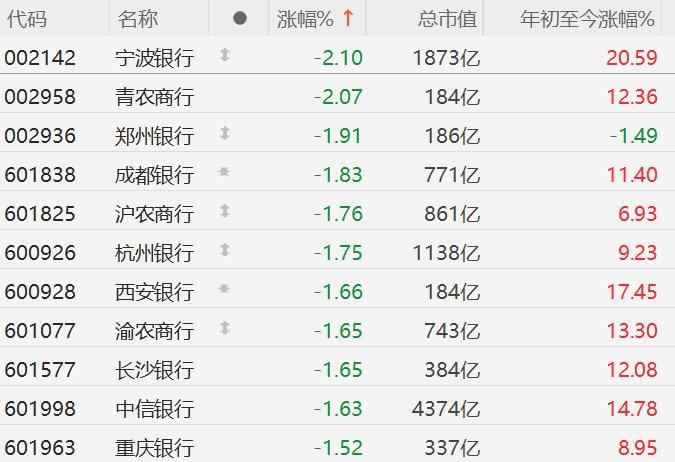
A股银行股普跌,宁波银行、青农商行跌超2%
Ge Long Hui A P P· 2025-09-03 03:49
Group 1 - The A-share market experienced a widespread decline in bank stocks, with several banks falling over 2% and others dropping more than 1% [1][2] - Notable declines included Ningbo Bank and Qingnong Commercial Bank, which fell by 2.10% and 2.07% respectively, while Zhengzhou Bank and Chengdu Bank also saw significant decreases [2] - The total market capitalization of Ningbo Bank is 187.3 billion, and Qingnong Commercial Bank stands at 18.4 billion, indicating their substantial presence in the market despite recent declines [2] Group 2 - Year-to-date performance shows that Ningbo Bank has increased by 20.59%, while Qingnong Commercial Bank has risen by 12.36%, suggesting a strong performance prior to the recent downturn [2] - Other banks such as Hu'nong Commercial Bank and Hangzhou Bank have also shown positive year-to-date growth, with increases of 6.93% and 9.23% respectively [2] - The overall trend indicates a challenging environment for bank stocks in the A-share market, with multiple institutions facing downward pressure [1][2]