AGRICULTURAL BANK OF CHINA(601288)

Search documents
中国农业银行甘肃省分行:奋力书写“科技金融”大文章 点燃科创企业发展“强引擎”
Xin Lang Cai Jing· 2025-12-17 04:47
(来源:甘肃金融) 党的二十届四中全会通过的《中共中央关于制定国民经济和社会发展第十五个五年规划的建议》,对"加快高 水平科技自立自强,引领发展新质生产力"作出战略部署,明确提出"推动科技创新和产业创新深度融合"的重 大任务。其中,科技金融被列为金融行业的重点发展方向,旨在强化对新质生产力的金融支持,坚守风险底 线,为实现高水平科技自立自强提供坚实支撑。 该行迅速组建工作专班,主动对接国家数据中心集群(甘肃·庆阳)"东数西算"产业园区,将金融服务嵌入项 目规划与建设全周期。重大科技基础设施投资规模大、建设周期紧,传统的信贷流程难以匹配其节奏。为 此,农行甘肃省分行专门开辟信贷审批绿色通道,针对数据中心机架搭建、高速算力网络铺设等核心需求, 提供定制化融资方案。 高效,是赢得客户的关键。凭借专业的服务团队和高效的联动机制,农行甘肃省分行成功为园区内重点算力 建设企业授信16亿元,并为一家重大算力企业快速审批发放固定资产贷款3亿元,有力保障了项目建设的资金 需求。从账户开立、资金结算到履约保函、项目融资,农行提供的"一站式"服务,成为"东数西算"工程在庆 阳落地生根的金融加速器。这不仅是简单的贷款投放,而且是农行 ...


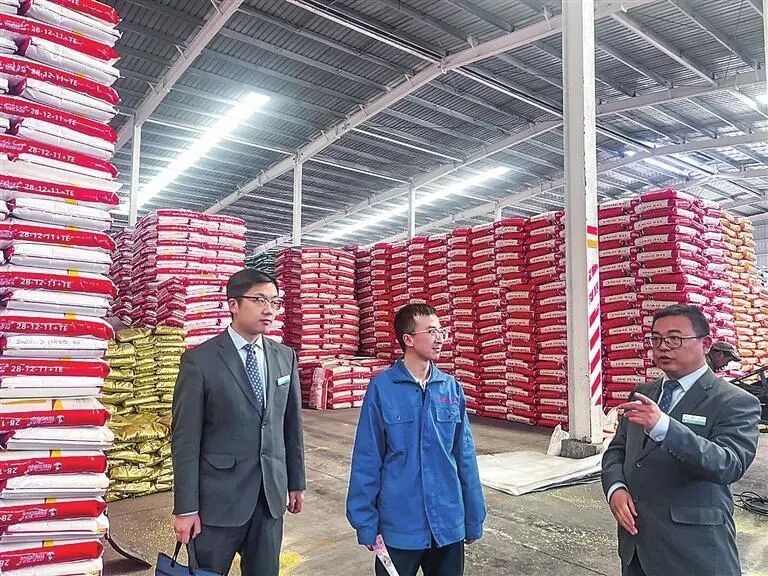
多家银行调整代理上金所贵金属业务,重点“清理”无持仓不动户
Jing Ji Guan Cha Wang· 2025-12-17 04:31
Core Viewpoint - The tightening of personal precious metals trading by banks acting as agents for the Shanghai Gold Exchange is aimed at managing market risks, complying with regulatory pressures, and fulfilling investor suitability obligations, leading to a more concentrated and mature market structure focused on institutional clients [1][3]. Group 1: Bank Adjustments - Several banks, including Industrial and Commercial Bank of China (ICBC), have announced adjustments to their personal precious metals trading business, actively clearing inactive "three-no" clients (no positions, no inventory, no debts) [2][3]. - ICBC's announcement states that from December 19, 2025, it will transfer the balances of these clients' margin accounts to their linked settlement accounts and terminate related business functions [2][3]. - Other banks such as Agricultural Bank of China and China Postal Savings Bank have also made similar announcements regarding the termination of agreements with inactive clients [2]. Group 2: Market Implications - Experts believe that the exit of personal investors from bank channels may lead to a decrease in trading volume and a return of margin funds, while also pushing investors towards futures companies, brokerages, or physical gold platforms, accelerating the differentiation and specialization of precious metals investment channels [4][5]. - The adjustments are expected to help investors reassess the risk-return characteristics of gold investments, promoting a shift from short-term speculation to long-term asset allocation [4][5]. Group 3: Transformation of Banking Precious Metals Business - The retail side of banking precious metals business is transitioning from a trading channel to asset allocation services, moving away from high-risk, high-leverage products towards more stable financial products like gold ETFs [5]. - This shift indicates a transformation in the retail precious metals business model from providing trading channels and physical sales to offering asset allocation services and standardized financial products [5]. - Future growth opportunities for banks in the precious metals sector include promoting lower-risk investment products such as accumulated gold and physical gold bar sales, catering to residents' demand for hedging and asset allocation [5].





农行内蒙古分行:金融活水润民生 北疆消费绽活力
Zhong Guo Jin Rong Xin Xi Wang· 2025-12-17 04:06
消费是经济增长的主引擎,民生是金融服务的落脚点。在内蒙古,农业银行将金融服务深度融入百姓生 活,为消费市场注入金融活水。截至11月末,农行内蒙古分行个人消费贷款余额超190亿元。 转自:新华财经 场景延伸,点亮美好生活 金融支持不仅点亮个体梦想,也滋养着区域产业生态。 冬日的阿尔山银装素裹,美不胜收。随着冰雪旅游升温,"粗茶淡饭"餐馆的生意也越来越好。"多亏了 农行的贷款,让我赶在旅游旺季前完成了店面改造。"餐馆老板朱大哥所说的,正是农行发放的8.3万 元"商户e贷"。从申请到放款仅用3个工作日,高效的服务解决了他的燃眉之急,助力小店焕新迎客。 针对内蒙古文旅资源丰富的特点,农行内蒙古分行还推出"兴旅贷"等特色产品,精准支持旅游产业发 展。截至11月末,"兴旅贷"已累计投放5719万元,支持文旅经营户204家,有效促进了当地旅游消费。 (鲁娜 王晓慧) 紧抓政策,激发市场活力 紧跟政策导向,农行内蒙古分行积极服务消费市场新需求。 在包头,市民杨先生通过农行客户经理分享的活动信息,在购置新冰箱时,叠加享受了商户优惠与农行 信用卡分期满减,省下了一笔可观费用。"没想到这么快就办完,省了不少钱!"为推进消费品以旧换 ...
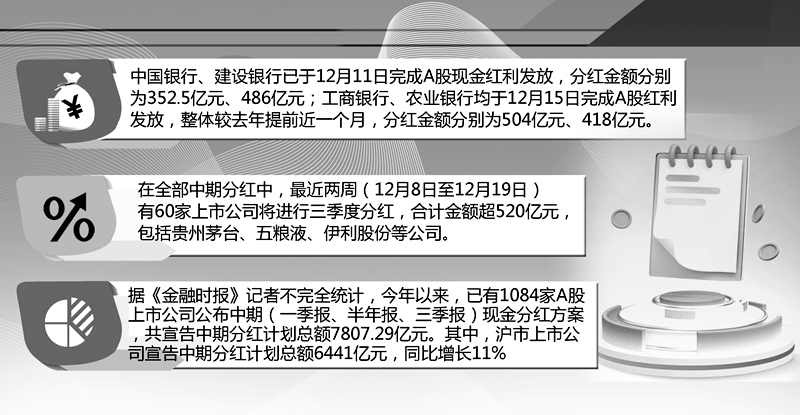
A股市场春节前现金分红密集落地 近两周内逾2400亿元“红包”将派发
Jin Rong Shi Bao· 2025-12-17 03:34
12月11日,贵州茅台(600519)披露中期权益分派实施公告,以总股本12.52亿股为基数,每股派发23.957元现金 红利,共计派发300.01亿元,此次分红除权除息日为12月19日。 事实上,近期A股市场正迎来一波现金"红包雨",掀起"春节前分红"的一波阶段性小高峰。《金融时报》记者根据 数据统计,截至12月15日,近两周内(12月8日至12月19日),包括四大银行、贵州茅台等在内,共有75家上市公 司合计2402.13亿元现金分红即将到账。 据《金融时报》记者不完全统计,今年以来,已有1084家A股上市公司公布中期(一季报、半年报、三季报)现 金分红方案,共宣告中期分红计划总额7807.29亿元。其中,沪市上市公司宣告中期分红计划总额6441亿元,同比 增长11%,显示出沪市公司分红意愿、分红能力同步提升的良性态势。 值得一提的是,上述分红一部分已在或将在春节前发放。据《金融时报》记者不完全统计,目前,拥有中期分红 计划的公司尚有127家未确定除权除息日,对应金额为913.87亿元待发放,有望在春节前落地。 稳定的分红策略,正在深度重塑上市公司与投资者之间的关系,这也是资本市场回归本源、夯实价值投资基 ...


辽宁金融监管局核准徐伟中国农业银行沈阳分行副行长任职资格
Jin Tou Wang· 2025-12-17 03:16
2025年12月9日,辽宁金融监管局发布批复称,《中国农业银行(601288)辽宁省分行关于对徐伟任职 资格进行核准的请示》(农银辽发〔2025〕118号)收悉。经审核,现批复如下: 一、核准徐伟中国农业银行股份有限公司沈阳分行副行长的任职资格。 二、中国农业银行应要求上述核准任职资格人员严格遵守金融监管总局有关监管规定,自中国农业银行 政许可决定作出之日起3个月内到任,并按要求及时报告到任情况。未在上述规定期限内到任的,本批 复文件失效,由决定机关办理行政许可注销手续。 三、中国农业银行应督促上述核准任职资格人员持续学习和掌握经济金融相关法律法规,牢固树立风险 合规意识,熟悉任职岗位职责,忠实勤勉履职。 ...
A股市场春节前现金分红密集落地
Jin Rong Shi Bao· 2025-12-17 02:07
Core Viewpoint - Guizhou Moutai announced a cash dividend of 23.957 yuan per share, totaling 30 billion yuan, as part of a broader trend of cash dividends in the A-share market ahead of the Spring Festival [1][4] Group 1: Dividend Distribution - A total of 75 listed companies are set to distribute 240.21 billion yuan in cash dividends from December 8 to December 19 [1] - The four major banks, including Industrial and Commercial Bank of China, Agricultural Bank of China, Bank of China, and China Construction Bank, announced a combined cash dividend of 176.1 billion yuan, accounting for 27% of the total mid-term dividends declared [3][4] - The total mid-term cash dividend plan announced by A-share companies this year reached 780.73 billion yuan, with a year-on-year increase of 11% for companies listed on the Shanghai Stock Exchange [4] Group 2: Policy and Market Trends - The implementation of "pre-Spring Festival dividends" has become a widespread practice among listed companies, driven by policy guidance and compliance requirements [3] - The new policies introduced by the State Council in April 2024 encourage companies to optimize their dividend strategies, including multiple dividends per year and pre-Spring Festival dividends [3] - Analysts believe that the trend of pre-Spring Festival dividends reflects a commitment to enhancing investor returns and improving investor relations [4][5] Group 3: Future Outlook - There are still 127 companies with mid-term dividend plans pending, amounting to 91.39 billion yuan, expected to be distributed before the Spring Festival [5] - The stable dividend strategy is reshaping the relationship between listed companies and investors, marking a significant step towards value investing in the capital market [5]
以优质高效的服务助力经济实现质量双升
Jin Rong Shi Bao· 2025-12-17 02:01
12月12日,农业银行召开党委会议,传达学习中央经济工作会议精神,传达全国金融系统工作会议 要求,研究农业银行贯彻落实措施。农业银行党委书记、董事长谷澍主持会议并讲话。 会议要求,要坚守服务"三农"主责主业,进一步加大县域乡村融资投放,推动县域经济高质量发 展,持续巩固拓展脱贫攻坚成果。要围绕坚持内需主导和建设强大国内市场,全面对接"两新"政策 和"两重"项目,靠前做好提振消费和稳投资重大项目信贷投放。要创新完善科技金融服务体系,加大先 进制造业和新一轮重点产业链高质量发展贷款投放,助力建设现代化产业体系和发展新质生产力。要深 化普惠民生金融服务,进一步提升绿色金融和中小微企业金融服务质效。全面服务好高水平对外开放, 进一步支持外贸平稳增长。要更好统筹发展和安全,积极稳妥化解重点领域风险,确保资产质量稳定, 牢牢守住不发生系统性风险的底线。 责任编辑:杨喜亭 会议提出,要深刻认识和领会新形势下做好经济工作的"五个必须",自觉把"五个必须"运用到金融 工作实践中,统筹好金融供给的总量、结构和节奏,兼顾防风险与促高质量发展,不断提升金融服务质 效。 会议强调,要切实把思想和行动统一到中央经济工作会议精神特别是习近 ...

银行业着力做好数字金融大文章
Jin Rong Shi Bao· 2025-12-17 01:17
随着数字技术与实体经济的深度融合以及客户行为与市场环境的深刻变迁,数智化转型已成为银行 业金融机构高质量发展、打造新质生产力的关键引擎。 当转型步入深水区,银行业金融机构对数智化的需求早已不是最初简单的技术叠加,而是向着更高 级别、更多联结、更广覆盖的金融生态转变。 从底层筑基到业务赋能,这场以技术为引擎、以客户为中心的深层次变革,正在从局部试点探索向 全流程、全体系的纵深推进阶段阔步前行,中国银行业已步入数智化转型的加速轨道。 升级核心系统 为转型发展筑基 "未来的银行必然是数字银行。"北京银行董事长霍学文在该行2025年半年度业绩说明会上道出了银 行业金融机构争先布局数智化转型的重要原因。 欲筑室者,先治其基。数智化转型的深化,绕不开底层核心系统的升级与革新。换言之,银行业数 智化转型的关键,在于借助技术力量重塑业务内核,以实现自身运营提效、客户体验升级和市场破局。 今年以来,多家银行的新一代核心系统上线或进一步优化,以分布式、云原生、自主可控等为重要 特征的技术底座,在一家又一家银行落地并迅速发挥效能。 数据是新型生产要素,也是银行业金融机构数字化、智能化转型的核心要素。2025年,银行业在数 据治理、 ...

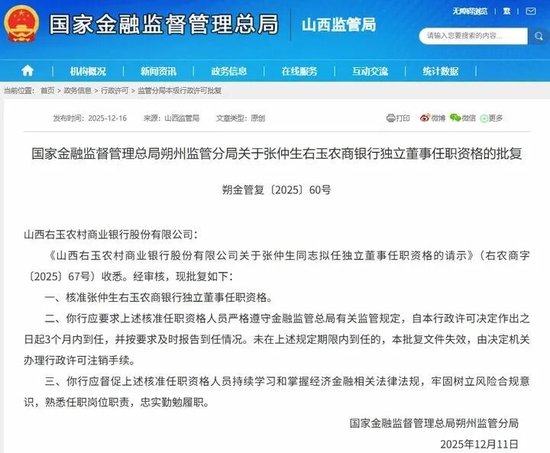
山西金融高管任职核准与否决的背后:16位获批,1位被否
Xin Lang Cai Jing· 2025-12-17 00:37
Core Viewpoint - The approval and disapproval of financial executives' qualifications reflect the regulatory body's emphasis on corporate governance and risk management within financial institutions [2][10]. Group 1: Approved Executives - A total of 16 financial executives have received approval for their positions across various banks, including rural commercial banks and major state-owned banks [1][11]. - Specific approvals include Zhang Zhongsheng and Zhang Haiyan as independent directors at Youyu Rural Commercial Bank, and Zhang Guodong and Yang Shaorong as vice presidents at Shanyin Rural Commercial Bank [3][4]. - Other approved positions include Wang Wenchao and Niu Shijun as vice presidents at Youyu Rural Commercial Bank, and Li Yahui as a director at Yingxian Rural Commercial Bank [4][14]. Group 2: Disapproved Executives - Recent cases of disapproval include Li Honghong's qualification for the position of secretary of the board at Shanxi Jingle Rural Commercial Bank, which was denied due to a lack of necessary knowledge, experience, and capability [6][7]. - Another disapproval involved Zhang Yanqing's qualification for the position of president at Lingqiu County Changqing Village Bank, which was rejected for not meeting specific regulatory requirements [7][18]. Group 3: Regulatory Framework - The regulatory body has established a comprehensive set of standards for the qualification of financial executives, including eight basic conditions such as having full civil capacity and the necessary knowledge and experience for the position [8][19]. - For rural and small banks, additional requirements include familiarity with the management framework and profit model of similar institutions [19]. Group 4: Professional Development in Shanxi - The recent approvals of multiple financial executives are seen as a foundation for the healthy development of Shanxi's financial sector, enhancing management levels and risk control capabilities [9][20]. - The regulatory body has previously approved several executives, including Zhao Chongping as president of Jinshang Consumer Finance Co., and other vice presidents at major banks [9][20]. Group 5: Regulatory Dynamics - The approval and disapproval of executive qualifications illustrate the regulatory body's commitment to maintaining a baseline of competence while encouraging the selection of outstanding talent [10][20]. - All approved executives are required to continuously learn and understand relevant economic and financial laws and regulations, emphasizing the importance of risk compliance awareness [10][20].
中金2026年展望 | 银行:稳中求进
中金点睛· 2025-12-16 23:50
Core Viewpoint - The banking sector has entered a stage of high-quality development, with a focus on high dividend investments and stable growth in profits and revenues expected through 2026 [2][3][4]. Group 1: Banking Sector Performance - The expected revenue growth for listed banks in 2026 and 2027 is +2.5% and +3.6% respectively, while net profit growth is projected at +1.9% and +2.6% [2]. - Factors contributing to improved revenue and profit growth include narrowing net interest margin pressure, quality-focused credit issuance, and stabilization of fee income growth after several years of reductions [2][4]. - The net non-performing loan generation rate is expected to stabilize or slightly decline, with retail and corporate sectors showing different trends in risk exposure [4][25]. Group 2: Credit and Financing Trends - The demand for credit is expected to slow slightly by 2026, with a shift in the structure of new social financing reflecting changes in customer needs and regulatory impacts [3][4]. - The government and state-owned enterprises are becoming significant contributors to leverage, influencing the structure of new social financing and the banks' balance sheets [3]. Group 3: Market Dynamics and Regulatory Environment - The banking industry is experiencing a reduction in the number of licenses, indicating accelerated supply-side reforms and improved competitive dynamics [4][22]. - Regulatory policies are evolving, with a focus on enhancing the quality of service rather than merely increasing customer numbers, particularly in inclusive finance [3][4]. Group 4: Financial Metrics and Projections - The net interest margin is projected to narrow by 6 basis points in 2026, with a balanced structure of volume and price being crucial for achieving high-quality financial metrics [4][16]. - The total assets of banks are expected to grow at a rate of 7.8% YoY, with net profit growth rates showing a gradual increase from 12.6% to 2.6% over the forecast period [12][16].