
PICC(601319)

Search documents
中国人民保险集团(01339.HK):2月9日南向资金减持107万股
Sou Hu Cai Jing· 2026-02-09 19:35
Core Viewpoint - Southbound funds have reduced their holdings in China People's Insurance Group (01339.HK) by 1.07 million shares on February 9, with a total net reduction of 5.68 million shares over the last five trading days and 28.08 million shares over the last twenty trading days [1] Group 1: Shareholding Changes - Southbound funds have reduced their holdings in China People's Insurance Group for 4 out of the last 5 trading days, totaling a net reduction of 5.68 million shares [1] - Over the last 20 trading days, southbound funds have reduced their holdings on 15 occasions, resulting in a cumulative net reduction of 28.08 million shares [1] - As of now, southbound funds hold 2.52 billion shares of China People's Insurance Group, accounting for 28.87% of the company's total issued ordinary shares [1] Group 2: Company Overview - China People's Insurance Group is a holding company primarily engaged in providing insurance products [1] - The company and its subsidiaries are involved in various insurance sectors, including property insurance, health insurance, life insurance, reinsurance, Hong Kong insurance, and pension insurance [1] - The property insurance segment includes products for both corporate and individual clients, such as motor vehicle insurance, agricultural insurance, property insurance, and liability insurance [1] - The health insurance segment focuses on health and medical insurance products [1] - The life insurance segment offers various life insurance products, including participating, whole life, annuity, and universal life insurance [1] - The Hong Kong insurance segment encompasses property insurance operations in Hong Kong [1] - The pension insurance segment includes corporate annuities and occupational annuities [1]


大型险企密集召开2026工作会,透露哪些信号?
2 1 Shi Ji Jing Ji Bao Dao· 2026-02-09 09:20
Group 1: Core Themes - The insurance industry is focusing on "high-quality development" and "risk prevention" as core themes for 2026, with companies aiming for stable performance and effective risk management [2][3][4] - China Life aims to contribute to national modernization by achieving steady operational performance and solid risk control [2] - China Re emphasizes a business philosophy of "scale development, effective underwriting, and stable investment," aiming for breakthroughs through reform and innovation [3] Group 2: Service to the Real Economy - The insurance sector is transitioning from a "single risk provider" to a comprehensive role as a "national strategic financial tool," enhancing support for the real economy [4][5] - China Life provided risk coverage exceeding 1,400 trillion yuan and increased investment in the real economy by 800 billion yuan, reaching 5.4 trillion yuan in 2025 [4] - China Re reported a risk coverage amount exceeding 87.5 trillion yuan, reflecting an 11.4% year-on-year increase [5] Group 3: Digital Transformation and Internationalization - Digital and intelligent upgrades are seen as growth engines, with varying focuses among companies [6][7] - China Life has elevated "digital transformation" to a strategic level, focusing on data, algorithms, and platforms to optimize management and reshape business models [6] - China Re is prioritizing both digitalization and internationalization as key areas for future capability building [7] Group 4: Differentiated Strategies - Companies are adopting distinct strategies based on their functional positioning for 2026 [8][9] - China Life continues to implement its "333 strategy," focusing on three new growth areas: pension, health, and wealth management [9] - China Re is focusing on transforming business models and optimizing management mechanisms to enhance profitability in international business [9]




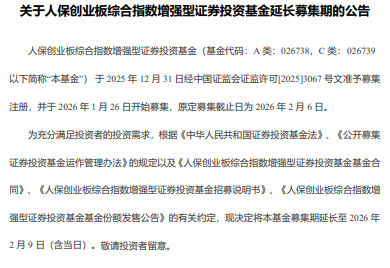
人保创业板综合指数增强基金延长募集期
Zhong Guo Jing Ji Wang· 2026-02-09 08:08
Group 1 - The China Pacific Insurance Asset Management Co., Ltd. announced an extension of the fundraising period for the PICC ChiNext Composite Index Enhanced Securities Investment Fund [1] - The fund was approved for fundraising registration by the China Securities Regulatory Commission on December 31, 2025, and fundraising commenced on January 26, 2026 [1] - The original fundraising deadline was set for February 6, 2026, but has now been extended to February 9, 2026 [1] Group 2 - The fund manager, Liu Shikai, has a diverse background, having worked as a data analyst at UnionPay Business, a senior product development manager at Changjiang Securities, and an investment manager at multiple firms [1] - Liu Shikai joined the PICC Asset Management Public Fund Division in March 2024 and has been the fund manager since September 19, 2024 [1]

非银金融行业周报:新年新开户数亮眼,中国平安再次增持中国人寿(H)-20260208
Shenwan Hongyuan Securities· 2026-02-08 13:39
Investment Rating - The report maintains a positive outlook on the non-bank financial sector, indicating an "Overweight" rating for the industry [4][48]. Core Insights - The report highlights a significant increase in new account openings, with 4.9158 million new accounts in January 2026, representing a year-over-year increase of 213% and a quarter-over-quarter increase of 89% [4]. - The report emphasizes the ongoing shift of funds from traditional banks to capital markets and non-bank financial institutions, driven by the expiration of 70 trillion yuan in one-year or longer deposits and a decline in net interest margins [4]. - The report discusses the need for China's financial sector to transition from being large to strong, focusing on mergers and acquisitions as a core growth engine for brokerages [4]. - The report notes that the international business landscape for brokerages is expanding due to the deepening process of RMB internationalization and the demand for cross-border wealth management and investment banking services [4]. - The report mentions that Ping An Group has increased its stake in China Life (H) multiple times, reflecting a strong confidence in the insurance sector [4][12]. Summary by Sections Market Review - The Shanghai Composite Index closed at 4,643.60 with a decline of 1.33%, while the non-bank index closed at 2,030.92 with a decline of 0.60% [8]. - The brokerage, insurance, and diversified financial indices reported declines of 0.65%, 0.71%, and an increase of 0.43%, respectively [8]. Non-Bank Industry News and Key Announcements - The report outlines regulatory updates regarding virtual currencies and asset tokenization, indicating a tightening of oversight in these areas [10]. - Ping An Group's recent acquisitions of shares in China Life (H) are detailed, showcasing a strategic investment approach [12]. - Huatai Securities plans to issue 10 billion HKD in zero-coupon convertible bonds to support overseas business development [14]. Investment Analysis Recommendations - The report suggests focusing on brokerages with strong comprehensive capabilities, recommending stocks such as Guotai Junan A+H, GF Securities A+H, and CITIC Securities A+H [4]. - For insurance, the report recommends China Life (H), New China Life, Ping An, China Pacific Insurance, and China Property & Casualty Insurance, highlighting the systemic value reassessment opportunities in the insurance sector [4].





投资银行业与经纪业:轮动对比视角复盘,当前非银子行业如何择时选股?
Changjiang Securities· 2026-02-08 11:58
Investment Rating - The report maintains a "Positive" investment rating for the non-bank sector [14]. Core Insights - The report analyzes the performance of insurance and brokerage sectors during historical bull markets in A-shares, highlighting their relative performance and the impact of different market types on their returns [3][17]. - It suggests that the current valuation of the non-bank sector has entered a cost-effective allocation range, recommending a focus on high-elasticity insurance and financial IT stocks while timing investments according to policy and regulatory rhythms [3][9]. Summary by Sections Historical Performance Analysis - Insurance and brokerage sectors have shown certain elastic characteristics during past bull markets, with both sectors achieving relative excess returns in three out of six analyzed bull market cycles [17]. - In different types of bull markets, brokerage firms tend to outperform insurance companies in leverage-driven or rapid bull markets, while insurance performs better in slow or value-driven bull markets [8][18]. - The report notes that brokerage firms often lead in performance at the beginning of bull markets, while insurance companies show resilience throughout the early stages and may gain momentum in the latter stages as interest rates and investment returns improve [8][18]. Current Market Outlook - Since 2025, there has been a notable divergence in performance between insurance and brokerage sectors, reflecting a preference for a structural "slow bull" market in the current cycle [9]. - The current price-to-book (PB) ratio for the securities sector has adjusted to 1.44x, placing it at the 24th percentile since 2012, while the average price-to-earnings value (PEV) for the insurance sector is at the 37.5th percentile [9]. - The report emphasizes that the current market correction presents a favorable time for quality allocations in the sector, with insurance companies expected to see a significant upward trend in return on equity (ROE) driven by improved liability cost management and asset allocation strategies [9][10]. Stock Recommendations - The report recommends stocks that are likely to benefit from the slow bull market, including major life insurance companies such as Xinhua Insurance, China Life, Ping An, and China Pacific Insurance, as well as brokerage and financial IT firms like Jiufang Zhitu, Zhinan Zhen, Tonghuashun, Dongfang Caifu, CICC, Dongfang Securities, and Guotai Junan [10].
保险基本面梳理112:保险有春节红包行情吗?-20260208
Changjiang Securities· 2026-02-08 10:12
Investment Rating - The report maintains a "Positive" investment rating for the insurance sector [11]. Core Insights - The insurance sector is expected to benefit from a stable interest rate environment and a slow bull market, leading to improved interest spreads and valuations. If new premium growth remains strong, profitability is likely to improve, further enhancing sector valuations. The report recommends specific stocks including New China Life, Ping An, China Life, and China Pacific Insurance [3][10]. Summary by Sections Insurance Market Outlook - Historical data indicates that the insurance index typically shows positive returns in the five trading days before the Spring Festival, with a success rate of approximately 71.4%. The report anticipates a potential repeat of this trend in 2026, as the conditions appear favorable for premium growth [8][9]. Premium and Profitability Analysis - The report projects that the life insurance market could reach a scale of 4.8 trillion yuan, with a year-on-year growth rate of about 10%. The asset side is expected to benefit from a strong stock market performance, while the focus should be on long-term profitability improvements driven by policy and market changes [9][10]. Long-term Valuation Recovery - The insurance industry's ability and willingness to allocate equity will significantly increase in the foreseeable future, leading to improved interest spreads and enhanced policy profitability. The report emphasizes the importance of long-term perspectives on profitability improvement, suggesting that the sector has substantial room for valuation recovery [10].
最近流行去香港买保险
投资界· 2026-02-08 08:16
Core Viewpoint - The article emphasizes the growing attractiveness of the Hong Kong insurance market for mainland investors, highlighting the significant growth in insurance premiums and the advantages of Hong Kong insurance products over mainland offerings [2][5][7]. Group 1: Insurance Market Trends - In the context of declining interest rates, insurance has become a favored asset class, with the insurance sector index in A-shares achieving a 3-year return of 51.75%, compared to the 31.01% return of the securities index [2]. - The total net profit of the five major listed insurance companies in A-shares reached 426 billion yuan in the first three quarters of 2025, marking a year-on-year increase of 33.5% [3]. - The Hong Kong insurance market saw a surge in new policies, with a premium of 173.7 billion HKD in the first half of 2025, reflecting a year-on-year growth of 50.5% [5]. Group 2: Investment Preferences of Mainland Investors - Approximately 55% of the assets of new middle-class individuals in China are allocated to real estate, while 31% are held in banks, prompting a shift towards higher-yielding investments such as Hong Kong insurance [3]. - The article notes that 29% of new insurance policies in Hong Kong were purchased by mainland visitors, indicating a strong interest from this demographic [5]. Group 3: Advantages of Hong Kong Insurance Products - Hong Kong insurance products offer greater flexibility and higher investment returns compared to mainland products, with a significant portion of new policies being denominated in USD (79.8%) [7]. - The expected return rates for Hong Kong's participating insurance policies can reach up to 7%, significantly higher than the 2% maximum for similar products in mainland China [7][10]. - Hong Kong's critical advantage lies in its ability to provide policies that can be settled in multiple currencies, enhancing their appeal to investors [7]. Group 4: Market Dynamics and Future Outlook - The article predicts that by 2026, the "new three treasures" of Hong Kong—insurance, stocks, and overseas expansion—will stand out as key investment opportunities [4]. - The Hong Kong stock market has seen a notable increase in IPO activity, with 286.3 billion HKD raised in 2025, making it the top global destination for IPO financing [15]. - The average daily trading volume in the Hong Kong stock market increased by 90% in 2025, indicating heightened market activity and investor interest [16].
非银金融行业跟踪周报:券商密集融资发展境外业务,八部门升级虚拟货币等监管框架-20260208
Soochow Securities· 2026-02-08 08:03
Investment Rating - Maintain "Buy" rating for the non-bank financial sector [1] Core Views - The non-bank financial sector has shown resilience, with various sub-sectors outperforming the Shanghai and Shenzhen 300 Index recently [9][10] - The report highlights the ongoing regulatory tightening on virtual currencies by eight government departments, which may impact market dynamics [16] - The insurance sector is expected to see significant growth in new business value (NBV) and profitability in 2026, driven by favorable market conditions and product demand [23][33] - The securities industry is undergoing transformation, with potential new growth points emerging from market recovery and supportive policies [21] - The trust industry is entering a stable transition phase, while the futures market continues to maintain high transaction volumes [40][41] Summary by Sections 1. Recent Performance of Non-Bank Financial Sub-Sectors - All sub-sectors of non-bank financials outperformed the Shanghai and Shenzhen 300 Index in the last five trading days [9] - The multi-financial sector rose by 0.49%, while the securities and insurance sectors fell by 0.63% and 0.73%, respectively [9] 2. Non-Bank Financial Sub-Sector Insights 2.1 Securities - February trading volume decreased month-on-month, with average daily stock trading at 28,613 billion yuan, a 17.64% decline from the previous month but a 40.43% increase year-on-year [14] - The margin balance reached 26,809 billion yuan, up 49.43% year-on-year [14] - The average price-to-book (PB) ratio for the securities industry is projected at 1.2x for 2026 [21] 2.2 Insurance - The insurance sector is projected to see a significant increase in NBV, with expectations of a 50% year-on-year growth in net profit for 2025 [23] - The total premium income for life insurance is expected to reach 52,696 billion yuan in 2025, reflecting an 8.5% year-on-year increase [27] - The "insurance + health care" model is gaining traction, with ongoing developments in commercial health insurance [30] 2.3 Multi-Financial - The trust industry saw its asset scale reach 32.43 trillion yuan by mid-2025, a 20.11% year-on-year increase [34] - The futures market recorded a transaction volume of 9.51 billion contracts and a transaction value of 90.81 trillion yuan in December 2025, marking a 45.17% and 58.55% year-on-year growth, respectively [41] 3. Industry Ranking and Key Company Recommendations - The non-bank financial sector is currently undervalued, providing a safety margin for investors [21] - The insurance sector is favored due to its recovery potential and improving liability side, while the securities sector is expected to benefit from market recovery and policy support [21] - Recommended companies include China Life, Ping An, New China Life, China Pacific Insurance, CITIC Securities, and Tonghuashun [21]

非银金融行业:增量资金持续入市,关注非银板块配置机会
GF SECURITIES· 2026-02-08 04:29
Core Insights - The report emphasizes the continuous influx of incremental funds into the market, highlighting investment opportunities in the non-bank financial sector [1][7] - The industry rating remains at "Buy," indicating a positive outlook for the sector [2] Group 1: Market Performance - As of February 6, 2026, the Shanghai Composite Index closed at 4065.58 points, down 1.27%, while the Shenzhen Component Index fell 2.11% [12] - The average daily trading volume in the Shanghai and Shenzhen markets was 2.41 trillion yuan, reflecting a 3.38% decrease [7] Group 2: Industry Dynamics and Weekly Commentary Insurance Sector - The performance of listed insurance companies is expected to continue high growth, with a marginal improvement in long-term interest rate spreads [18] - China Ping An Group increased its stake in China Life H shares, indicating positive industry trends [18] - The first quarter of 2026 is anticipated to show better-than-expected performance for some insurance companies due to a low base in the first half of 2025 [18] Securities Sector - A significant increase in new accounts was observed in January 2026, with 491.58 million new A-share accounts opened, a 213% year-on-year increase [19] - The balance of margin trading reached a historical high, providing strong support for interest income in the securities industry [22] - The Hong Kong IPO market is active, with 384 companies applying for listings as of February 6, 2026, and a daily trading volume of 2202 billion yuan in January, a 94% year-on-year increase [24][28] Group 3: Investment Recommendations - The report suggests focusing on specific stocks within the insurance sector, including China Ping An (A/H), China Life (A/H), and New China Life (A/H) [18] - In the securities sector, recommended stocks include Guotai Junan (AH), CICC (H), and Huatai Securities (AH) due to their potential for performance improvement [7][18]

中国人保:2月6日召开董事会会议
Mei Ri Jing Ji Xin Wen· 2026-02-06 11:05
Group 1 - The company China Life Insurance announced the convening of its fifth board meeting on February 6, 2026, to discuss the capital expenditure plan for 2026 [1] - The meeting took place at the China Life Building located at 88 Xichang'an Street, Xicheng District, Beijing [1] Group 2 - The central bank, which has been increasing its gold reserves for two consecutive years, announced plans to purchase an additional 150 tons of gold, aiming to accumulate a total of 700 tons [1]