PICC(601319)

Search documents
对《关于推动健康保险高质量发展的指导意见》的点评:分红型疾病险实际支付成本或将下降,险司打开产品创新空间
Hua Yuan Zheng Quan· 2025-10-15 08:56
Investment Rating - The industry investment rating is "Positive" (maintained) [4][6] Core Viewpoints - The report highlights the release of the "Guiding Opinions on Promoting the High-Quality Development of Health Insurance" by the National Financial Regulatory Administration, which includes six key points aimed at developing commercial medical insurance, nursing insurance, disability insurance, and disease insurance, promoting the integration of health insurance and health management, and facilitating the coordinated development of the health industry [4][5] - The support for insurance companies with good regulatory ratings to develop participating long-term health insurance is expected to significantly impact listed insurance companies [5][6] - The report anticipates that the actual payment costs for participating disease insurance may decrease, opening up innovation opportunities for insurance products [6] Summary by Sections Industry Performance - The growth rate of health insurance premiums has declined from a peak of 40%-70% between 2014-2016 to below 10% since 2021, indicating a challenging sales environment for new long-term disease insurance policies [5] - The proportion of high-value critical illness insurance has decreased from 64% in 2020 to 56.4% in 2023 [5][11] Sales Trends - The sales of long-term disease insurance have weakened due to previous extensive coverage and a reduction in the preset interest rate from 3.5% to 2%, leading to higher policy prices [5][6] - Future sales growth may come from new births or previously uncovered populations, as well as existing policyholders increasing their coverage after price adjustments [5][6] Product Innovation - The report expects further guidelines on the development of participating disease insurance products, allowing insurance companies to innovate and meet specific customer needs [6] - The current environment for insurance industry spreads is improving, supporting the overall positive outlook for the industry [6][7]


保险板块10月15日涨2%,新华保险领涨,主力资金净流入10.14亿元
Zheng Xing Xing Ye Ri Bao· 2025-10-15 08:37
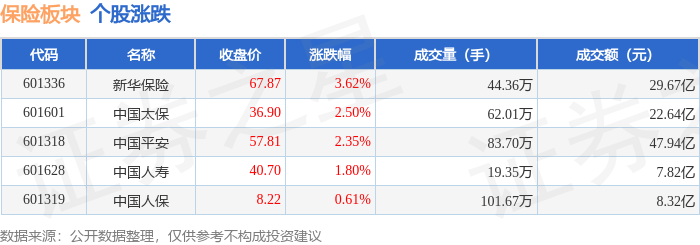
Core Insights - The insurance sector experienced a 2.0% increase on October 15, with Xinhua Insurance leading the gains [1] - The Shanghai Composite Index closed at 3912.21, up 1.22%, while the Shenzhen Component Index closed at 13118.75, up 1.73% [1] Insurance Sector Performance - Xinhua Insurance (601336) closed at 67.87, with a rise of 3.62% and a trading volume of 443,600 shares [1] - China Pacific Insurance (601601) closed at 36.90, up 2.50%, with a trading volume of 620,100 shares [1] - Ping An Insurance (601318) closed at 57.81, increasing by 2.35%, with a trading volume of 837,000 shares [1] - China Life Insurance (601628) closed at 40.70, up 1.80%, with a trading volume of 193,500 shares [1] - China Reinsurance (601319) closed at 8.22, with a slight increase of 0.61% and a trading volume of 1,016,700 shares [1] Capital Flow Analysis - The insurance sector saw a net inflow of 1.014 billion yuan from institutional investors, while retail investors experienced a net outflow of 660 million yuan [1] - Major capital inflows and outflows for specific companies include: - Ping An Insurance: 6.46 billion yuan net inflow from institutional investors, with a 13.49% share [2] - China Pacific Insurance: 213 million yuan net inflow from institutional investors, with a 9.41% share [2] - Xinhua Insurance: 127 million yuan net inflow from institutional investors, with a 4.27% share [2] - China Life Insurance: 28.87 million yuan net inflow from institutional investors, with a 3.69% share [2] - China Reinsurance: 708,600 yuan net outflow from institutional investors, with a -0.09% share [2]



内江监管分局同意中国人保寿险资中县支公司变更营业场所
Jin Tou Wang· 2025-10-15 06:49
Core Viewpoint - The National Financial Supervision Administration of Neijiang has approved the relocation of the business premises of China People's Life Insurance Co., Ltd. Zizhong County Branch to a new address [1] Group 1 - The new business location is specified as: No. 201, Building 14, 188 Chunlan North Road, Shuinan Town, Zizhong County, Sichuan Province [1] - The company is required to handle the change and obtain the necessary permits in accordance with relevant regulations [1]
中国人保20251014
2025-10-14 14:44
Summary of China Pacific Insurance Conference Call Company Overview - **Company**: China Pacific Insurance (中国人保) - **Date**: October 14, 2025 Key Points Industry Insights - The standardization of auto insurance is expected to regulate market competition, improve the situation of internal competition, and implement fee-based issuance, which will help improve cash flow and financial stability for property insurance companies, alleviate premium receivable pressure, and reduce claims disputes [2][3][5] - The recent non-auto insurance policy aims to lower premium scale assessment requirements, enforce fee-based issuance, and promote standardization, which is anticipated to have a positive impact on the entire property insurance industry [3] Financial Performance - For the first half of 2025, China Pacific Insurance's combined cost ratio was 95.3%, better than expected, attributed to a decrease in natural disasters, strict regulations, and internal reforms [2][5] - The full-year target for the combined cost ratio is set at 96% for auto insurance and 99% for non-auto insurance, with further room for improvement in the second half of the year [5] Claims Management - The company has strengthened process control, litigation resources, and pricing management in claims handling, achieving significant results in reducing claims through enhanced anti-fraud measures [2][6] New Energy Vehicle Insurance - In the first half of 2025, new energy vehicle insurance accounted for 19% of total auto insurance premium income, with a market share of 34%, leading the industry [2][7] - The company maintains a competitive edge despite the entry of manufacturers like BYD into the insurance market, as these new entrants face limitations in flexibility and data management [8] Product Development and Strategy - The "Car and Driver Everything" model aims to develop personal non-auto insurance business by creating precise customer profiles and expanding product pricing factors, leading to a 77% generation rate for additional products sold with vehicles [2][9] - The company is focusing on optimizing product structures and cost control, particularly in health insurance, to improve profitability [10][16] Investment Strategy - China Pacific Insurance is gradually reducing its fund allocation and increasing its stock proportion to enhance investment yield stability and respond to market changes [4][12] - The company plans to continue increasing its allocation to high-dividend stocks, which are categorized into classic dividends, cyclical industries, and potential dividends [14] Sales Channels - The bancassurance channel has shown strong performance, with a 70% increase in premium income in August 2025, indicating a recovery in sales following the switch in preset interest rates [15][18] - The company has established strong partnerships with major banks, which has contributed to the growth of the bancassurance channel [18] Dividend Policy - The dividend policy aims to maintain stable growth in dividends, with a 19% increase in the first half of the year, and expectations for continued stable growth throughout the year [19] Challenges and Future Outlook - The agricultural insurance segment saw a slight decline in premium income, attributed to policy adjustments and local government financial pressures, but is expected to rebound in the second half of the year [11] This summary encapsulates the key insights and strategic directions of China Pacific Insurance as discussed in the conference call, highlighting its performance, market positioning, and future outlook.
中国人保&中国财险
2025-10-14 14:44
Summary of Conference Call for China Insurance (China Life & China Property Insurance) Industry Overview - **Insurance Sector**: The overall performance of the insurance industry in 2025 is under scrutiny, with specific focus on car insurance, non-car insurance, and agricultural insurance sectors. Key Points Car Insurance - **Improvement in Operations**: Despite an increase in claims ratio due to inflation, the expense ratio has significantly decreased, leading to an overall improvement in operational conditions year-on-year [1][5] - **Growth Rate**: The annual growth rate for car insurance is projected to be around 3% to 4% [5] - **Regulatory Changes**: New energy vehicle insurance policies have been adjusted, with the self-increasing coefficient range raised from 1.35 to 1.4, affecting approximately 20% of new energy vehicle policies [4][12] Non-Car Insurance - **Policy Implementation**: The "reporting and pricing integration" policy for non-car insurance will be implemented starting November 1, aimed at reducing internal competition and enhancing industry standards [1][7] - **Performance Metrics**: Non-car insurance premium growth is expected to maintain a rate of 8% to 10% when excluding the impact of agricultural product price index insurance [3] - **Cost Improvement**: The implementation of the new policy is anticipated to improve the expense ratio by at least 1 percentage point in the following year [9] Agricultural Insurance - **Current Trends**: Agricultural insurance has shown a negative growth of approximately 3% in the first nine months of 2025, but a growth of about 8% when excluding the price index insurance impact [17][18] - **Future Outlook**: With increased government focus on food security and policy enhancements, agricultural insurance is expected to maintain a rapid growth trajectory [2][18] Investment Strategy - **Equity Investments**: Since 2025, the company has been increasing its equity positions, with a focus on traditional sectors such as banking and telecommunications [1][25] - **Bond Market Performance**: The impact of the underperforming bond market in Q3 was minimal due to a lower allocation in trading bonds and shorter durations [1][5] Profitability and Reserves - **Profitability Challenges**: The insurance industry faced significant profitability pressures in the first half of 2025, but improvements are expected in the second half, particularly in critical illness and health insurance [21][20] - **Reserve Adjustments**: The company has increased its reserve ratios across various categories to address the rising claims from new energy vehicles and personal injury cases [23][24] Dividend Policy - **Stable Dividend Guidance**: The group maintains a dividend payout of no less than 30%, with property insurance at no less than 40%. If 2025 profits perform well, dividends are expected to increase [27] Health Insurance - **Growth in Health Insurance**: Health insurance has shown stable growth, particularly through internet channels, with a focus on enhancing service quality and expanding product offerings [29][30] - **Future Development**: The company plans to strengthen its health management subsidiary to provide better services and integrate medical resources [32] Risk Management - **Effectiveness of Risk Reduction Measures**: The implementation of risk reduction measures has significantly minimized losses from natural disasters, with losses from multiple typhoons in Guangdong controlled to under 1 billion yuan [35] Regulatory Environment - **Impact of Regulatory Changes**: The "anti-involution" policy is expected to benefit leading companies by slightly increasing market share while maintaining overall stability [34] This summary encapsulates the key insights and developments discussed during the conference call, highlighting the strategic direction and operational performance of China Insurance in 2025.
保险板块10月14日涨2.83%,新华保险领涨,主力资金净流入1.13亿元
Zheng Xing Xing Ye Ri Bao· 2025-10-14 08:41
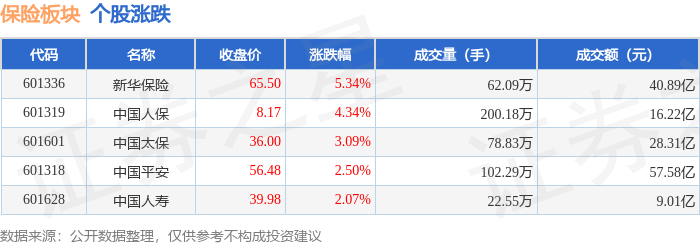
证券之星消息,10月14日保险板块较上一交易日上涨2.83%,新华保险领涨。当日上证指数报收于 3865.23,下跌0.62%。深证成指报收于12895.11,下跌2.54%。保险板块个股涨跌见下表: | 代码 | 名称 | 收盘价 | 涨跌幅 | 成交量(手) | 成交额(元) | | | --- | --- | --- | --- | --- | --- | --- | | 601336 | 新华保险 | 65.50 | 5.34% | 62.09万 | | 40.89 Z | | 601319 | 中国人保 | 8.17 | 4.34% | 200.18万 | | 16.22 乙 | | 601601 | 中国太保 | 36.00 | 3.09% | 78.83万 | | 28.31亿 | | 601318 | 中国平安 | 56.48 | 2.50% | 102.29万 | | 57.58 Z | | 601628 | 中国人寿 | 39.98 | 2.07% | 22.55万 | | 9.01亿 | 从资金流向上来看,当日保险板块主力资金净流入1.13亿元,游资资金净流出2.95亿元,散户资金净流入 ...
非车险“报行合一”将正式实行 多家险企成立工作专班推进
Zhong Guo Jing Ying Bao· 2025-10-14 08:36
Core Viewpoint - The National Financial Regulatory Administration is set to implement a new regulation for non-auto insurance, focusing on improving the quality of non-auto insurance business and addressing issues such as irregular operations and irrational competition, effective from November 1, 2025 [1][2]. Summary by Sections Regulatory Changes - The new regulation aims to optimize assessment mechanisms, standardize product development and usage, manage premium income, enhance market supervision, improve underwriting and claims services, and leverage industry organizations for support [1][2]. Non-Auto Insurance Market Insights - Non-auto insurance accounted for 50.77% of total premium income in the first eight months of 2025, with health insurance at 14.88%, agricultural insurance at 10.83%, and liability insurance at 8.24% [2]. - The share of non-auto insurance in total premium income has increased from 26%-27% between 2013 and 2016 to over 50% currently, although profitability remains weaker compared to auto insurance [2]. Fee Structure and Management - The regulation mandates that property insurance companies must set insurance rates based on fairness, reasonableness, and adequacy, and establish a mechanism for periodic rate review and dynamic adjustment [3]. - To address premium receivables, the regulation requires a "fee-for-policy" approach, ensuring that policies are issued only after premium payment is received [4]. Industry Response - Several insurance companies, including China Life and Ping An Property & Casualty, have established task forces to implement the new regulation, emphasizing the importance of transitioning from a focus on scale and speed to quality and efficiency [7][8]. - The implementation of "reporting and operation in unison" is expected to curb irrational price competition and promote rational market behavior, enhancing service quality and product competitiveness [5][6].
收盘丨创业板指高开低走跌近4%,半导体、通信板块全线下挫
Di Yi Cai Jing· 2025-10-14 07:17
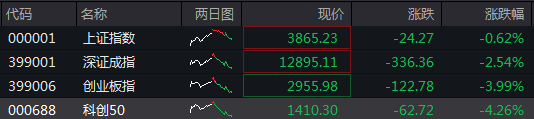
Market Overview - The total trading volume in the Shanghai and Shenzhen markets reached 2.58 trillion yuan, an increase of 221.5 billion yuan compared to the previous trading day, with over 3,500 stocks declining [1][4] - Major indices experienced declines, with the Shanghai Composite Index down 0.62%, the Shenzhen Component Index down 2.54%, the ChiNext Index down 3.99%, and the STAR Market 50 Index down over 4% [1][2] Sector Performance - Technology stocks, particularly in the semiconductor and communication sectors, saw significant pullbacks, with stocks like Tongfu Microelectronics hitting the daily limit down and several others dropping over 10% [3] - Conversely, traditional sectors such as liquor, finance, and coal showed resilience, with notable gains in stocks like Chongqing Bank, which rose over 6% [3][2] Capital Flow - Main capital flows indicated net inflows into banking, food and beverage, and coal sectors, while semiconductor, communication equipment, and battery sectors experienced net outflows [6] - Specific stocks with net inflows included Longi Green Energy, Shanzhi High-Tech, and Industrial and Commercial Bank of China, attracting 1.527 billion yuan, 1.032 billion yuan, and 757 million yuan respectively [6] - In contrast, companies like SMIC, Northern Rare Earth, and CATL faced significant sell-offs, with outflows of 2.598 billion yuan, 1.905 billion yuan, and 1.815 billion yuan respectively [6] Institutional Insights - Qianhai Bourbon Fund noted that despite short-term financing impacts, the market remains stable, with potential for breaking the consolidation structure and challenging new highs in October [8] - CITIC Securities highlighted that the liquor industry is stabilizing on the demand side, awaiting the next growth cycle [8] - Guotai Junan pointed out that the third-quarter reports are beginning to be released, with the non-ferrous metals and chemical industries showing strong performance, suggesting investors focus on companies with early disclosures and exceeding profit expectations [8]




A股突变,热门板块全线飘红
Zhong Guo Ji Jin Bao· 2025-10-14 05:47
Core Viewpoint - The A-share market showed mixed performance on October 14, with the Shanghai Composite Index nearing 3900 points, while the ChiNext Index fell over 2% after an initial rise [1][3]. Market Performance - The total trading volume in the Shanghai and Shenzhen markets reached 1.67 trillion yuan, an increase of 905 billion yuan compared to the previous trading day [3]. - Out of 2438 stocks, 42 hit the daily limit up, while 2825 stocks declined [3]. Sector Performance - The financial and liquor sectors were active, with insurance and banking stocks leading the gains [3][9]. - The coal sector rose over 3%, leading the market, with several stocks recording significant gains [9][10]. - The semiconductor sector experienced a notable decline, with various related stocks showing weakness [18]. Notable Stocks - New China Life Insurance saw a price increase of 6.16%, reaching 66.01 yuan per share, with a total market capitalization of 183.9 billion yuan [5][6]. - Major banks like Chongqing Bank and China Merchants Bank also saw gains, with Chongqing Bank rising over 5% [7][8]. - In the coal sector, Dayou Energy recorded a 10% increase, while other companies like Baotailong and Jiangtong Equipment also saw significant gains [10][11]. Liquor Sector Highlights - The liquor sector rebounded, with notable increases in stocks such as Kweichow Moutai and Wuliangye, which rose by 2.35% and 1.74% respectively [12][14]. - The sector was buoyed by market interest following comments from a well-known investor regarding Moutai [16]. Emerging Trends - The cultivated diamond sector saw a surge of over 6%, with stocks like Lili Diamond and Huifeng Diamond rising significantly [16][17]. - The semiconductor industry faced a downturn, with major companies like SMIC and Huagong Information experiencing declines of over 4% [18][19].



A股,突变!热门板块,全线飘红!
中国基金报· 2025-10-14 05:05
Market Overview - A-shares showed mixed performance with the Shanghai Composite Index approaching 3900 points, closing at 3897.56, up 0.21% [3][4] - The Shenzhen Component Index fell by 1.02%, and the ChiNext Index dropped by 2.24% [3] Trading Volume and Market Activity - The total trading volume in the Shanghai and Shenzhen markets reached 1.67 trillion yuan, an increase of 905 billion yuan compared to the previous trading day [6] - A total of 2438 stocks rose, while 2825 stocks declined, indicating a bearish sentiment overall [6] Sector Performance Financial Sector - The financial sector, particularly insurance and banking stocks, performed strongly, with the banking sector rising by 2.47% [12] - Notable gains included New China Life Insurance, which rose by 6.16%, and other major insurers like China Pacific Insurance and Ping An [9][10] Coal Sector - The coal sector led the market with an increase of over 3%, with stocks like Daya Energy and Baotailong hitting the daily limit [17][20] - Companies such as Lu'an Mining and Zhengzhou Coal Electric also saw significant gains, with increases exceeding 5% [19] Semiconductor Sector - The semiconductor sector experienced a notable decline, with major companies like SMIC and Huagong Technology seeing drops of 5.47% and 4.35% respectively [35][36] - The overall semiconductor index showed significant pullback, indicating a bearish trend in this sector [33] Beverage Sector - The food and beverage sector rebounded, particularly the liquor segment, with Kweichow Moutai rising by 2.35% [25][26] - Other notable performers included Wuliangye and Luzhou Laojiao, which also saw increases [25] Cultured Diamond Sector - The cultured diamond sector surged over 6%, with stocks like Lili Diamond and Huifeng Diamond seeing gains of 13.96% and 12.63% respectively [29][30] - This increase was driven by news of export controls on related products, which may impact supply dynamics [32]