BANK COMM(601328)

Search documents
招商基金王平旗下招商中证红利ETF三季报最新持仓,重仓宁波华翔
Sou Hu Cai Jing· 2025-10-26 21:39
Core Viewpoint - The report from the招商中证红利交易型开放式指数基金 indicates a net value growth rate of 9.21% over the past year, with significant changes in the top ten holdings compared to the previous quarter [1]. Group 1: Fund Performance - The fund achieved a net value growth rate of 9.21% over the last year [1]. - The report highlights the addition of new stocks to the top ten holdings, including 潞安环能, 中谷物流, 农业银行, 南钢股份, and 建设银行 [1]. Group 2: Changes in Top Holdings - New entries in the top ten holdings include: - 潞安环能 (669709): 7.7764 million shares valued at 1.11 billion - 中谷物流 (603560): 10.0744 million shares valued at 1.1 billion - 农业银行 (601288): 161.424 million shares valued at 1.08 billion - 南钢股份 (600282): 199.957 million shares valued at 1.05 billion - 建设银行 (601939): 117.632 million shares valued at 1.01 billion [2]. - 宁波华翔 (002048) saw an increase in holdings by 56.7 thousand shares, making it the largest holding at 2.73 billion [1][2]. - Other stocks that exited the top ten holdings include 成都银行, 兴业银行, 大秦铁路, 江苏银行, and 交通银行 [1][2].







贯彻落实党的二十届四中全会精神 多家银行为“十五五”金融工作“划重点”
Zheng Quan Ri Bao· 2025-10-26 16:38
Core Viewpoint - Recent meetings held by policy banks and major state-owned banks focus on implementing the spirit of the 20th Central Committee's Fourth Plenary Session, emphasizing financial services for the "14th Five-Year Plan" period and aligning with national development strategies [1][2]. Group 1: Policy Banks and State-Owned Banks' Focus - Policy banks are crucial platforms for implementing national development strategies, with the Agricultural Development Bank of China emphasizing support for food security, poverty alleviation, rural development, and ecological construction [1]. - The Export-Import Bank of China aims to enhance high-level opening-up and promote trade innovation and investment cooperation, contributing to the Belt and Road Initiative [1]. - State-owned banks are committed to balancing service to the real economy with sustainable development, integrating high-quality development into their management processes [1][2]. Group 2: Specific Strategies of Major Banks - Industrial and Commercial Bank of China plans to leverage international platforms to support high-level opening-up [3]. - Agricultural Bank of China focuses on common prosperity and increasing financial support for rural areas [3]. - Bank of China aims to enhance global competitiveness and support the internationalization of the RMB [3]. - China Construction Bank emphasizes infrastructure support and consumer finance initiatives [3]. - Bank of Communications is refining its strategic direction and priorities [3]. - Postal Savings Bank of China is committed to high-quality development and its unique financial strategies [3]. Group 3: Future Planning and Strategic Directions - Agricultural Bank of China will focus on key areas such as modern industrial systems, green transformation, and regional coordinated development over the next five years [4]. - The bank will prioritize intelligent, green, and integrated development while enhancing service quality for the real economy [4]. - China Construction Bank plans to optimize funding structures and promote regional development while managing potential risks [4].



交通银行推出“蕴通管账”服务,以高效支付结算赋能企业业财融合
2 1 Shi Ji Jing Ji Bao Dao· 2025-10-26 16:18
Core Insights - The core viewpoint of the news is that Bank of Communications has launched the "Yun Tong Guan Zhang" brand service plan, focusing on corporate payment and settlement scenarios to address pain points such as complex settlement tools, low reconciliation efficiency, and difficult fund supervision, thereby upgrading from a traditional service provider to a scene ecosystem enabler [1][2]. Group 1: Conceptual Innovation - The integration of business and finance is positioned as a new engine driving integrated management upgrades, responding to the higher demands for financial services in the digital economy [2]. - The "Yun Tong" financial brand system introduces the "Yun Tong Guan Zhang" sub-brand, emphasizing data-driven management across "scene, customer, account, and funds" [2]. - The unique "3+4" service model leverages core capabilities in payment settlement, reconciliation, and fund supervision to create service advantages [2]. Group 2: Product Empowerment - "Yun Tong Guan Zhang" offers a one-stop solution for funds, settlement, and operational management, enhancing efficiency across various business scenarios [3]. - In payment settlement, it provides multi-channel, intelligent services that streamline fund processing, enhancing procurement efficiency through automated payment processes [3][4]. - The reconciliation service includes account management, automatic write-offs, and clear transaction tracking, addressing the challenges of matching transaction flows with receivables [3][4]. Group 3: Ecological Interconnection - The service targets four core economic scenarios, providing tailored financial solutions that inject digital vitality into various sectors [5][6]. - For the real economy, it focuses on the entire operational chain of manufacturing enterprises, facilitating data flow across procurement, production, and sales [5]. - In the platform economy, it develops flexible account management systems to meet the complex fund clearing needs of e-commerce and internet finance platforms [6]. Group 4: Market Reach - The Bank of Communications has customized solutions for over 30 industries, serving nearly 160,000 government and enterprise clients, indicating a strong market presence [6]. - The "Yun Tong Guan Zhang" service aims to support enterprises in achieving business-finance integration and digital transformation, contributing to high-quality development [6].

信用卡债权腾挪背后
Bei Jing Shang Bao· 2025-10-26 15:50
Core Insights - The article discusses the ongoing trend of credit card debt transfer among banks in response to rising non-performing loans and capital pressure, indicating a strategic shift towards optimizing credit structures and managing risks [1][4]. Group 1: Credit Card Debt Transfer Activities - Multiple banks, including Ping An Bank, SPDB, Ningbo Bank, and Huaxia Bank, have been actively transferring credit card debts to local asset management companies (AMCs) to accelerate the clearing of non-performing loans [2][3]. - Ping An Bank has announced several batches of credit card debt transfers in October, emphasizing the legal obligation of debtors to repay the new creditors post-transfer [2][3]. - The trend is not isolated, as other banks like SPDB and Ningbo Bank have also engaged in similar debt transfer agreements with AMCs, highlighting a collective industry response to rising credit card defaults [3][4]. Group 2: Industry Trends and Data - The credit card non-performing loan transfer has become a common practice in the industry, driven by stricter regulations and increasing default rates [5][6]. - As of October 23, Everbright Bank listed seven personal non-performing loan transfer projects, involving a total of 20,516 borrowers with an outstanding principal and interest of 653 million yuan [5]. - Data from the first quarter indicates that the scale of personal non-performing loan transfers reached 37.04 billion yuan, a year-on-year increase of 7.6 times, with credit card overdrafts accounting for 5.19 billion yuan, or 14% of the total [6][7]. Group 3: Implications for Banks - Analysts suggest that the batch transfer of non-performing loans is a key strategy for banks to quickly reduce their non-performing asset scale and release occupied capital, thus meeting regulatory requirements [4][7]. - The transfer process improves asset quality metrics, directly lowering the non-performing loan ratio and enhancing capital adequacy ratios for banks [7][8]. - The shift towards batch transfers is seen as a more efficient and compliant method compared to traditional collection methods, which are often slow and costly [7][8]. Group 4: Challenges and Strategic Recommendations - The article highlights the dual challenge faced by banks, with both non-performing loan balances and rates increasing, necessitating a more nuanced approach to risk management [8][9]. - Large banks are encouraged to explore asset-backed securities (ABS) for non-performing asset management, while smaller banks should focus on batch transfers or revenue rights transfers to clear bad debts [9][10]. - Recommendations for improving risk management include enhancing credit models, leveraging technology for better risk assessment, and educating customers on responsible credit use [10].






银行“甩包袱”、资产管理公司接盘,信用卡债权“腾挪”背后
Bei Jing Shang Bao· 2025-10-26 14:26
Core Viewpoint - The ongoing trend of credit card debt transfer among banks is a response to rising non-performing loans and capital pressure, aiming for both short-term risk clearance and long-term credit structure optimization [1][5]. Group 1: Credit Card Debt Transfer Activities - Multiple banks, including Ping An Bank, SPDB, Ningbo Bank, and Huaxia Bank, have announced batch transfers of credit card debts to local asset management companies (AMCs) [3][4]. - Ping An Bank has issued four announcements in October alone regarding the transfer of credit card debts, emphasizing the obligation of debtors to repay the new creditors [3][4]. - The trend is not isolated, as SPDB and Ningbo Bank have also engaged in similar debt transfer agreements with AMCs, highlighting a collective industry movement [4][5]. Group 2: Industry Context and Trends - The transfer of credit card non-performing loans has become a norm in the industry, driven by stricter regulations and rising non-performing loan rates [7][9]. - Data from the first quarter of 2025 indicates that the scale of personal non-performing loan transfers reached 37.04 billion, a year-on-year increase of 7.6 times, with credit card overdrafts accounting for 5.19 billion [8]. - The efficiency of batch transfers compared to traditional collection methods is noted, as it allows banks to quickly offload non-performing assets and reduce capital occupation [9][10]. Group 3: Financial Health and Risk Management - As of mid-2025, the total non-performing credit card loans across 11 banks reached 162.69 billion, with a year-to-date increase of 5.885 billion [10][11]. - The rise in non-performing loans is attributed to aggressive card issuance practices and economic pressures affecting borrowers' repayment capabilities [10][11]. - Differentiated strategies for managing non-performing assets are recommended, with larger banks advised to explore asset securitization while smaller banks focus on batch transfers [11][12]. Group 4: Recommendations for Future Management - To achieve long-term non-performing asset clearance, banks must enhance their risk management frameworks, focusing on credit assessment and customer education [12]. - The implementation of technology in risk management, such as AI for predictive modeling and monitoring, is suggested to improve efficiency in identifying potential defaults [12].

贷款炒金的“黄金赌徒”后悔了:三天亏掉两个月工资
Di Yi Cai Jing· 2025-10-26 12:58
Core Insights - The recent decline in gold prices has led to significant losses for investors who leveraged loans to buy gold, highlighting the risks associated with such strategies [1][2][3] - The gold market has experienced extreme volatility, with prices reaching a peak of $4,381 per ounce before falling to around $4,100, resulting in substantial losses for many investors [2][3] - The trend of young investors entering the gold market is driven by perceived arbitrage opportunities, with many using loans to amplify their investments [5][6] Group 1: Investor Behavior - Many investors, like Ms. Li, initially profited from rising gold prices but are now facing losses due to price corrections, leading to difficult decisions about whether to sell at a loss or hold [1][3] - Investors are increasingly using various forms of credit, including personal loans and credit cards, to finance their gold purchases, often underestimating the risks involved [2][5] - The strategies of gold investors are diverging, with some opting to sell portions of their holdings to repay loans, while others choose to hold and wait for potential price rebounds [4] Group 2: Market Dynamics - The gold market has seen a dramatic price increase of nearly 70% since August, attracting a wave of new investors eager to capitalize on the trend [2] - Social media and online platforms have played a significant role in promoting gold investment, with influencers encouraging speculative trading behaviors among inexperienced investors [6] - The high volatility of gold prices poses a risk for leveraged investors, as they may face significant losses if they cannot accurately time their trades [6][7] Group 3: Institutional Responses - Several banks have raised the investment thresholds for gold products, reflecting concerns over market volatility and the risks associated with leveraged trading [8] - Financial institutions are increasingly warning investors about the potential for significant losses in the gold market, urging them to assess their risk tolerance and manage their positions carefully [7][8] - Some banks have implemented dynamic adjustments to their gold investment products, aligning purchase requirements with real-time gold prices to mitigate risks [8]
买金门槛变了!多家银行出手
新浪财经· 2025-10-26 08:04
Core Viewpoint - The article discusses the adjustment of the gold accumulation plan by Bank of Communications, which will now be linked to real-time gold prices, reflecting the recent volatility in gold prices and potentially influencing other banks to follow suit [2][4]. Group 1: Bank Adjustments - Starting from October 27, Bank of Communications will adjust its gold accumulation plan's minimum investment amount to be at least equal to the real-time gold price, with increments in multiples of 100 [2]. - Other banks, including Industrial and Commercial Bank of China, Bank of China, Ping An Bank, and Industrial Bank, have also raised their minimum investment thresholds for gold accumulation products in October [6][7]. - For instance, ICBC raised its minimum investment for its gold accumulation product from 850 to 1000 yuan, while Bank of China increased its minimum from 850 to 950 yuan [7]. Group 2: Market Dynamics - Gold prices have seen significant fluctuations, with a 24% increase since late August, reaching historical highs [4]. - The recent rise in gold prices is attributed to three main factors: declining real interest rates, increasing geopolitical tensions, and central banks in emerging markets boosting their gold reserves [9]. - Market volatility is expected, with recent price corrections linked to changes in geopolitical situations and positive signals regarding the U.S. government shutdown [9].

工行、农行、中行、建行、交行、邮储银行,集体表态!
券商中国· 2025-10-26 04:51
Core Viewpoint - The six major state-owned banks in China are aligning their strategies with the spirit of the 20th National Congress, focusing on supporting economic stability and high-quality development while enhancing risk management and financial services [1][2][3][4][5][6][7][8]. Group 1: Industrial Bank Strategies - Industrial Bank emphasizes the importance of integrating domestic and international strategies, supporting high-quality development, and enhancing risk management while fulfilling its responsibilities as a major bank [2]. - Agricultural Bank focuses on serving the rural economy, increasing financial supply in rural areas, and supporting the modernization of agriculture while ensuring financial risk management [3]. - Bank of China aims to enhance its global competitiveness, optimize financial resource allocation, and support the development of a modern industrial system while promoting the internationalization of the RMB [4]. - Construction Bank is committed to supporting the development of advanced manufacturing and enhancing its financial service system to promote new quality productivity [6]. - Bank of Communications emphasizes the importance of public engagement in strategic planning and aims to contribute to economic recovery while ensuring a smooth transition between the 14th and 15th Five-Year Plans [7]. - Postal Savings Bank prioritizes high-quality development, focusing on effective financial supply to meet the evolving needs of the economy and society [8].

交通银行重要公告,工商银行、中国银行、兴业银行等都出手了!
Mei Ri Jing Ji Xin Wen· 2025-10-26 01:20
Core Viewpoint - The Bank of Communications announced an adjustment to its precious metals wallet accumulation plan, linking the minimum investment amount to real-time gold prices, effective from October 27, 9:30 AM [1][4]. Group 1: Changes in Investment Thresholds - The minimum investment amount for the Bank of Communications' accumulation plan will now be greater than or equal to the real-time gold price, with increments required in multiples of 100 [1][3]. - Other banks, including Industrial and Commercial Bank of China, Bank of China, and Ping An Bank, have also raised their minimum investment thresholds for gold accumulation products in October [4][5]. - For instance, ICBC increased its minimum investment from 850 yuan to 1000 yuan, while Bank of China raised it from 850 yuan to 950 yuan [5]. Group 2: Market Dynamics and Investor Behavior - There has been a significant increase in inquiries and trading activity in gold accumulation products, particularly as international gold prices show strong momentum [8]. - The shift in customer asset allocation is attributed to the low yields of traditional financial products and time deposits, making gold accumulation an attractive option due to its clear investment threshold and direct linkage to physical gold [8]. - Experts indicate that banks are upgrading their risk management for gold accumulation businesses due to increased gold price volatility and regulatory requirements [8]. Group 3: Gold Price Trends and Market Sentiment - Gold prices have surged over 50% this year, leading to increased volatility and a rise in the risk of margin calls, prompting banks to raise minimum investment amounts and margin requirements [8]. - Analysts predict that gold prices are likely to experience high-level fluctuations in the short term, with underlying support from global central bank purchases and expectations of monetary easing [9]. - The current market is characterized by a crowded long position in gold, with profit-taking contributing to short-term volatility, while long-term upward trends remain intact due to ongoing global uncertainties [9].
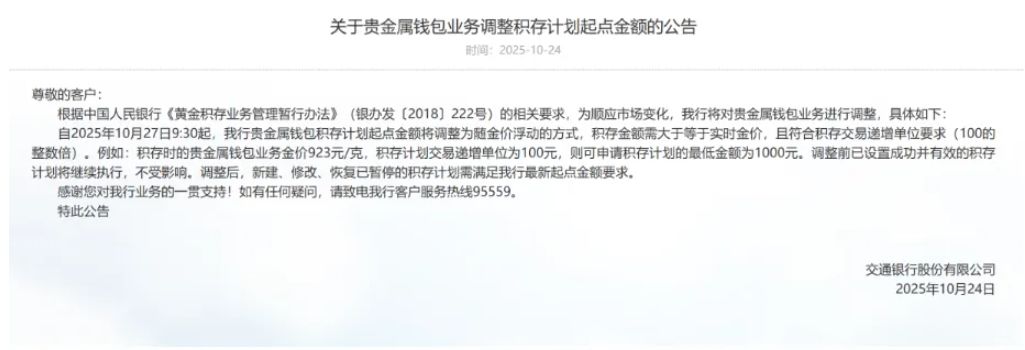
买金门槛变了!多家银行出手 上调积存金起投门槛
Zhong Guo Zheng Quan Bao· 2025-10-25 23:43
Core Viewpoint - The Bank of Communications announced a change in its precious metals wallet accumulation plan, linking the minimum investment amount to real-time gold prices, reflecting the recent volatility in gold prices [1][3]. Group 1: Changes in Investment Thresholds - Starting from October 27, the minimum investment amount for the precious metals wallet will be adjusted to be greater than or equal to the real-time gold price, with increments in multiples of 100 [1]. - Other banks, including ICBC, Bank of China, and Ping An Bank, have also raised their minimum investment thresholds for gold accumulation products in October [3]. - For example, ICBC increased its minimum investment from 850 yuan to 1000 yuan, while Bank of China raised it from 850 yuan to 950 yuan [3]. Group 2: Market Context and Drivers - Gold prices have seen significant fluctuations, with a reported increase of 24% since late August, reaching historical highs [1]. - The rise in gold prices is attributed to three main factors: declining real interest rates, increasing geopolitical tensions, and central banks in emerging markets boosting their gold reserves [4]. - Recent market corrections in gold prices are linked to changes in geopolitical situations and easing concerns over the U.S. government shutdown [4].