
BANK COMM(601328)

Search documents
六大行员工队伍,有新变化!
Jin Rong Shi Bao· 2025-09-04 07:57
Core Insights - The total number of employees in the six major banks reached 1.826 million as of June 30, 2023, reflecting a trend towards increasing technology talent and a reduction in traditional roles [1][2] - Agricultural Bank of China has the largest workforce among the six banks, with 445,100 employees, while Postal Savings Bank has the smallest with 193,800 employees [1][2] - The number of technology personnel in the six major banks has surpassed 100,000 for the first time, indicating a growing emphasis on digital talent [2] Employee Structure - Agricultural Bank of China employs 445,100 individuals, including 836 in overseas branches and 7,145 in subsidiaries and village banks, making it the largest employer among A-share listed banks [1] - Industrial and Commercial Bank of China has 408,400 employees, with 10,554 in domestic subsidiaries and 15,537 in overseas institutions [1] - China Bank and Construction Bank both have over 300,000 employees, with China Bank at 310,500 and Construction Bank at 373,100 [1] Trends in Recruitment and Talent Management - The demand for technology talents such as artificial intelligence and big data analysts is rapidly increasing, with banks competing for these skills [2] - Several major banks are focusing on enhancing grassroots employee training and directing compensation resources towards these employees as part of their human resource management strategy [2][3] - Agricultural Bank of China emphasizes the importance of nurturing young talents in rural areas to support rural revitalization efforts [3]






机构看好板块价值重估,银行ETF指数(512730)上涨近1%,上市银行上半年营收及利润增速双双转正
Xin Lang Cai Jing· 2025-09-04 07:18
Group 1 - The core viewpoint is that the banking sector is experiencing a recovery in revenue and profit growth, with overall operating income and net profit growth rates for listed banks turning positive [1][2] - The banking sector is expected to benefit from a stable low interest rate environment, leading investors to prefer lower-risk and more predictable return assets [1][2] - The banking sector's price-to-book (PB) ratio is considered undervalued, especially given the systemic risk concerns have been alleviated [1][2] Group 2 - Recent market conditions have led to increased long-term investments in banks by institutional investors, such as insurance funds and asset management companies [2] - The banking sector's asset quality is stable, and the pressure on interest margins is manageable, with expectations for interest margins to stabilize in the coming quarters [2] - The banking sector is anticipated to enter a new phase of stable return on equity (ROE), supported by fiscal stability and risk management from the central bank [2] Group 3 - The CSI Bank Index closely tracks the performance of the banking sector, with the top ten weighted stocks accounting for 65% of the index [3] - The top ten stocks in the CSI Bank Index include major banks such as China Merchants Bank, Industrial and Commercial Bank of China, and Agricultural Bank of China [3]



银行研究框架及25H1业绩综述:营收及利润增速双双转正
GOLDEN SUN SECURITIES· 2025-09-04 06:14
Investment Rating - The report indicates a positive outlook for the banking industry, with overall revenue and net profit growth rates turning positive in the first half of 2025, at 1.0% and 0.8% respectively, showing improvements from the previous quarter [4]. Core Insights - The banking sector's net interest margin for the first half of 2025 is reported at 1.42%, a decrease of 10 basis points compared to the previous year, but the decline is narrowing due to improved cost management on the liability side [5]. - Non-interest income, particularly from fees and commissions, has increased by 3.1% year-on-year, driven by a recovery in wealth management and a more active market environment [5]. - The asset quality remains stable, with a non-performing loan ratio of 1.23% and a provision coverage ratio of 239%, indicating a solid credit environment [5]. Summary by Sections Financial Performance Overview - The overall revenue and net profit growth for listed banks in the first half of 2025 were 1.0% and 0.8%, respectively, with both metrics showing improvement from the first quarter [4][22]. - The total assets of listed banks reached 321.3 trillion yuan, growing by 6.35% year-to-date, with loans and advances totaling 179.4 trillion yuan, accounting for 55.84% of total assets [21][24]. Income Sources - Net interest income decreased by 1.3% year-on-year, but the decline rate has slowed, reflecting better management of funding costs [5]. - Fee and commission income grew by 3.1% year-on-year, benefiting from a recovering market and the gradual impact of regulatory changes [5]. - Other non-interest income saw a significant increase of 10.7%, primarily due to favorable market conditions in the bond market [5]. Asset Quality and Management - The non-performing loan ratio remained stable at 1.23%, with a provision coverage ratio of 239%, indicating a robust asset quality [5]. - The credit cost for the first half of 2025 was 0.81%, a decrease of 5 basis points year-on-year, suggesting manageable credit risks [5]. Loan Growth and Composition - Loan growth was primarily driven by corporate lending, with significant contributions from infrastructure and manufacturing sectors [20]. - Personal loan growth was weaker, with a year-on-year increase of only 3.6%, reflecting a cautious approach to consumer lending amid rising risks [20]. Investment and Market Conditions - The investment asset proportion decreased to 34% as banks adjusted their strategies in response to market volatility [20]. - The overall yield on bonds fluctuated significantly, prompting banks to engage in tactical trading to enhance returns [20].


新疆金融监管局核准曾亮交通银行新疆区分行副行长任职资格
Jin Tou Wang· 2025-09-04 03:26
Core Viewpoint - The Xinjiang Financial Regulatory Bureau has approved the appointment of Zeng Liang as the Vice President of the Bank of Communications Xinjiang Branch, emphasizing compliance with regulatory requirements and ongoing professional development [1] Group 1 - The approval of Zeng Liang's appointment is officially documented in the communication from the Xinjiang Financial Regulatory Bureau [1] - The Bank of Communications is required to ensure that Zeng Liang assumes his position within three months of the approval, or the approval will become invalid [1] - The bank must encourage Zeng Liang to continuously learn and understand relevant economic and financial laws and regulations, and to maintain a strong awareness of risk compliance [1]
中期分红队伍持续壮大
Jin Rong Shi Bao· 2025-09-04 03:03
Core Viewpoint - The recent announcements of interim dividend plans by A-share listed banks highlight a trend towards increased shareholder returns, with a total proposed dividend amount exceeding 200 billion yuan from major state-owned banks and several joint-stock banks [1][4]. Group 1: State-Owned Banks - Six major state-owned banks have announced their interim dividend plans for 2025, with a total proposed dividend amount exceeding 200 billion yuan [1]. - Industrial and Commercial Bank of China leads with a proposed dividend of 1.414 yuan per 10 shares, totaling 503.96 billion yuan [1]. - Other state-owned banks, including Agricultural Bank of China, Bank of China, China Construction Bank, Bank of Communications, and Postal Savings Bank, have proposed dividends of 418.23 billion yuan, 352.50 billion yuan, 486.05 billion yuan, 138.11 billion yuan, and 147.72 billion yuan respectively [1]. Group 2: Joint-Stock Banks - Several joint-stock banks, including China Merchants Bank, CITIC Bank, Minsheng Bank, Ping An Bank, and Huaxia Bank, have confirmed their interim dividend plans for 2025 [1][2]. - China Merchants Bank announced its first interim profit distribution plan since its listing, with a cash dividend amounting to 35% of its net profit attributable to ordinary shareholders for the first half of 2025 [1][2]. - CITIC Bank plans to increase its interim dividend payout ratio to 30.7%, enhancing investor return expectations [2]. Group 3: New Participants in Interim Dividends - New entrants to the interim dividend group include Ningbo Bank, Changsha Bank, Su Nong Bank, and Jiangyin Bank, indicating a growing trend among listed banks to adopt interim dividends [2][4]. - Su Nong Bank announced its first interim dividend plan, proposing a cash dividend of 0.9 yuan per 10 shares, totaling 1.82 billion yuan [2][3]. Group 4: Overall Market Trends - A total of 23 A-share listed banks implemented interim dividends in 2024, distributing over 250 billion yuan, with the number of banks participating expected to increase in 2025 [4]. - The push for interim dividends is seen as a response to regulatory guidance aimed at enhancing shareholder returns and stabilizing market expectations [5].

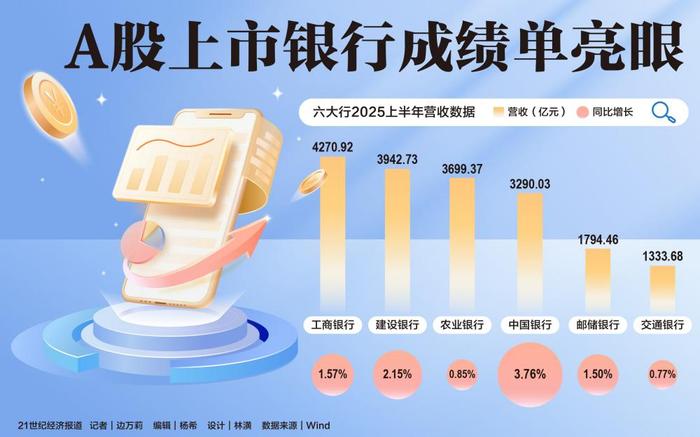
A股上市银行成绩单亮眼
2 1 Shi Ji Jing Ji Bao Dao· 2025-09-03 22:06
Core Insights - The banking sector in A-shares has shown resilience with a total revenue of 2.92 trillion yuan and a net profit of 1.1 trillion yuan for the first half of 2025, reflecting a year-on-year growth of 1% and 0.8% respectively [1][3] - The non-performing loan (NPL) ratio stands at 1.15%, indicating a slight improvement from the previous quarter [1][10] - The number of banks distributing mid-year dividends has increased to 18, with over half of them maintaining a dividend payout ratio of 30% or more [1][11] Revenue and Profit Growth - A-shares listed banks achieved a total revenue of 2.92 trillion yuan, marking a 1% increase year-on-year, while net profit reached 1.1 trillion yuan, up 0.8% [3][4] - Among the major banks, Industrial and Commercial Bank of China (ICBC) led with a revenue of 4270.92 billion yuan, showing a growth of 1.57% [3] - 30 out of 42 listed banks reported positive revenue growth, with 12 banks showing a reduced decline in revenue growth rates [3][4] Asset Quality and Loan Growth - The total assets of A-shares listed banks reached 321.33 trillion yuan, a 6.35% increase from the previous year [8] - Loans and advances amounted to 179.44 trillion yuan, reflecting an increase of approximately 13.4 trillion yuan or 8.07% [8][9] - The NPL ratio decreased by 1 basis point, with 25 banks showing a year-on-year decline in NPL ratios [10] Diversification of Income Sources - Non-interest income grew by 6.97% year-on-year, with significant contributions from investment income, which increased by 23.46% [6][7] - Banks are shifting towards a more diversified income structure, reducing reliance on traditional interest margins [6][7] - For instance, the non-interest income of China Bank surged by 26.43%, becoming a key driver of revenue growth [6] Dividend Distribution - The total cash dividends from the six major state-owned banks reached 2046.57 billion yuan, with ICBC leading at approximately 503.96 billion yuan [11][12] - Several banks, including China Merchants Bank and Jiangyin Bank, implemented mid-year dividends for the first time [11][12] - The dividend payout ratios for banks such as Shanghai Bank and CITIC Bank have also seen increases, reflecting strong performance [11][12]

做强上海主场优势,数字化转型再突破——交通银行2025年中报彰显高质量发展底色
Mei Ri Jing Ji Xin Wen· 2025-09-03 19:27
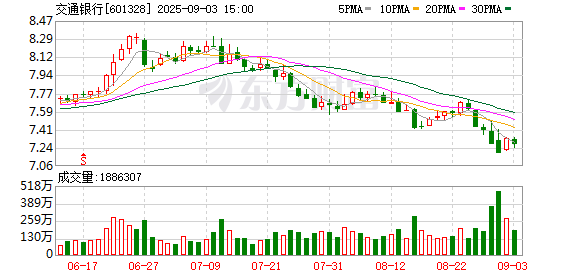
Core Viewpoint - The Bank of Communications has demonstrated strong operational resilience, achieving steady growth in key performance indicators amid a complex internal and external environment, with a notable increase in revenue and net profit for the first half of the year [1] Financial Performance - The group reported operating income of 133.368 billion yuan and net profit attributable to shareholders of 46.016 billion yuan, representing year-on-year growth of 0.77% and 1.61% respectively [1] - As of the end of June, total assets reached 15.44 trillion yuan, an increase of 3.59% from the end of the previous year, with a non-performing loan ratio reduced by 0.03 percentage points to 1.28% [1] Dividend Policy - The management announced a continuation of the mid-term dividend policy, proposing a cash dividend of 0.1563 yuan per share, totaling 13.811 billion yuan, which accounts for 30% of the net profit attributable to shareholders for 2025 [1] Loan Growth and Structure - The customer loan balance reached 9 trillion yuan, increasing by approximately 443.4 billion yuan, a growth rate of 5.18% [3] - The bank's loan disbursement has exceeded 60% of the annual target, with significant increases in technology loans, inclusive small and micro loans, and loans for the elderly care industry [3] Regional Focus - In the Yangtze River Delta region, the loan scale grew by 6.9%, accounting for nearly 30% of total loans, with public loans in key regions outpacing the bank's average growth [4] Support for Key Areas - The bank is actively leveraging policy opportunities to enhance financial supply capabilities in sectors such as small and micro enterprises, private enterprises, merger loans, and new models of real estate development [5] Digital Transformation - The bank has accelerated its digital transformation, with technology investments and personnel growth leading the industry, establishing a digital operation center to enhance service efficiency [8] - The digital operation center aims to strengthen direct operations, share foundational capabilities, and deepen the use of digital technologies for risk management and operational efficiency [9][10] Contribution to Economic Development - The bank has established partnerships with 60 major municipal projects and 118 district-level projects in Shanghai, contributing to the city's financial market development and international trade center construction [7] - The bank's initiatives include the creation of a cross-border trade comprehensive financial service platform and the optimization of offshore trade settlement processes [7]

做强上海主场优势 数字化转型再突破——交通银行2025年中报彰显高质量发展底色
Mei Ri Jing Ji Xin Wen· 2025-09-03 19:22
Core Viewpoint - The Bank of Communications has demonstrated strong operational resilience, achieving steady growth in key performance indicators amid a complex internal and external environment, with a focus on long-term value creation through digital empowerment and core business focus [2][11]. Financial Performance - In the first half of the year, the group reported operating income of 133.368 billion yuan and net profit attributable to shareholders of 46.016 billion yuan, representing year-on-year growth of 0.77% and 1.61% respectively [2]. - As of the end of June, total assets reached 15.44 trillion yuan, an increase of 3.59% from the end of the previous year, with a non-performing loan ratio reduced by 0.03 percentage points to 1.28% [2]. Dividend Policy - The management announced a mid-term dividend policy, proposing a cash dividend of 0.1563 yuan per share (before tax), totaling 13.811 billion yuan, which accounts for 30% of the net profit attributable to shareholders for 2025 [2]. Loan Growth and Structure - The customer loan balance reached 9 trillion yuan, increasing by approximately 443.4 billion yuan, a growth rate of 5.18% [3]. - The bank's loan disbursement has exceeded 60% of the annual target in the first half of the year [3]. Focus on Key Areas - The bank is strategically supporting national priorities and key sectors, with significant growth in technology loans, inclusive small and micro loans, and loans for the elderly care industry, all exceeding the average loan growth rate [4]. - Technology loans surpassed 1.5 trillion yuan, with the number of supported enterprises increasing by 11.12%, including 32,300 technology SMEs, which saw a 22.93% increase in loan balance [4]. Regional Development - In the Yangtze River Delta region, loan growth was 6.9%, accounting for nearly 30% of total loans, with public loans in key regions like Shanghai showing the highest market growth [4]. Digital Transformation - The bank has accelerated its digital transformation, with significant investments in technology and a new digital operation center aimed at enhancing service efficiency and supporting key sectors [9][10]. - The digital operation center focuses on direct retail business operations, online and offline integration, and centralized operations to improve risk management and customer service [10]. Contribution to Economic Development - The bank is actively leveraging its Shanghai headquarters to support the city's financial openness and innovation, contributing to the construction of Shanghai as an international technology innovation center [6][7][8].
A股近六成上市银行上半年中间业务收入同比增长
Zheng Quan Ri Bao Zhi Sheng· 2025-09-03 16:40
Core Viewpoint - The intermediary business income of A-share listed banks in China has shown improvement in the first half of 2025, becoming a crucial area for banks to transform and develop amid narrowing net interest margins [1][4]. Group 1: Overall Performance - In the first half of 2025, the total net income from fees and commissions of 42 listed banks reached 409.53 billion yuan, an increase of 3.06% compared to the same period last year [1]. - Out of the 42 listed banks, 25 reported positive growth in net income from fees and commissions, with three banks experiencing growth rates exceeding 100% and nine banks exceeding 10% [2]. Group 2: Performance by Bank Type - Among the six major state-owned banks, Bank of China and China Construction Bank both saw their fee and commission income grow by over 4%, while Agricultural Bank of China and Postal Savings Bank of China reported growth exceeding 10% [2]. - In the joint-stock banks category, four out of nine banks reported positive growth in net income from fees and commissions, with CITIC Bank achieving 16.91 billion yuan (up 3.38%), Industrial Bank at 13.08 billion yuan (up 2.59%), Huaxia Bank at 3.10 billion yuan (up 2.55%), and Minsheng Bank at 9.69 billion yuan (up 0.41%) [2]. Group 3: Notable Performers - Some city commercial banks and rural commercial banks exhibited significant growth in their fee and commission income, with Changshu Bank reporting a remarkable increase of 637.77% to 142 million yuan, followed by Ruifeng Bank with a 274.07% increase to 54 million yuan, and Zhangjiagang Bank with a 140% increase to 61 million yuan [3]. Group 4: Future Outlook - Analysts predict that the growth trend in intermediary business income is likely to continue in the second half of 2025, driven by supportive macroeconomic policies and increasing demand for high-yield products among residents [4]. - The focus for banks will be on expanding non-interest income, particularly in wealth management and other light-capital businesses, to optimize their income structure [4][6].
信用卡业务“跑马圈地”退潮后,转型创新路在何方?
Bei Jing Shang Bao· 2025-09-03 15:01
Core Insights - The credit card business in China's banking sector is undergoing a significant adjustment, shifting from an era of aggressive expansion to a focus on optimizing existing customer bases and asset quality [1][2][3] Group 1: Credit Card Business Performance - In the first half of 2025, 11 out of 15 listed banks reported a decline in credit card loan balances, with China Bank showing the most significant reduction of 13.89% to 510.97 billion yuan [2] - The total credit card loan balance for the 15 banks showed a mixed trend, with only four banks, including Industrial and Agricultural Banks, experiencing growth [2] - Credit card transaction volumes also declined, with a notable drop of 8.54% for China Merchants Bank, despite leading the sector with a transaction amount of 2.02 trillion yuan [3] Group 2: Bad Debt and Risk Management - The total bad credit card loans across 11 banks reached 162.69 billion yuan, an increase of 5.88 billion yuan from the beginning of the year, with notable increases in bad loans for banks like China Communications Bank and Industrial Bank [4] - Only three banks managed to improve their bad loan ratios, while eight banks, including China Merchants Bank and Industrial Bank, saw increases in their bad loan ratios [4] - The overall credit card market is experiencing a contraction, with the total number of credit cards decreasing to 715 million by Q2 2025, down from 727 million in Q4 2024 [5] Group 3: Strategic Adjustments and Future Directions - Banks are actively working to optimize asset quality and manage bad debts, with nearly a thousand bad loan transfer announcements made in 2025 [6] - The focus is shifting towards product innovation and differentiated competition, emphasizing quality over quantity in credit card offerings [6][7] - Strategies include targeting high-end customers and meeting basic customer needs, with an emphasis on enhancing customer experience and integrating credit cards with other retail banking services [7]



