BANK COMM(601328)

Search documents
机构:高股息率资产仍具吸引力,国企红利ETF(159515)整固蓄势
Sou Hu Cai Jing· 2025-08-26 05:53
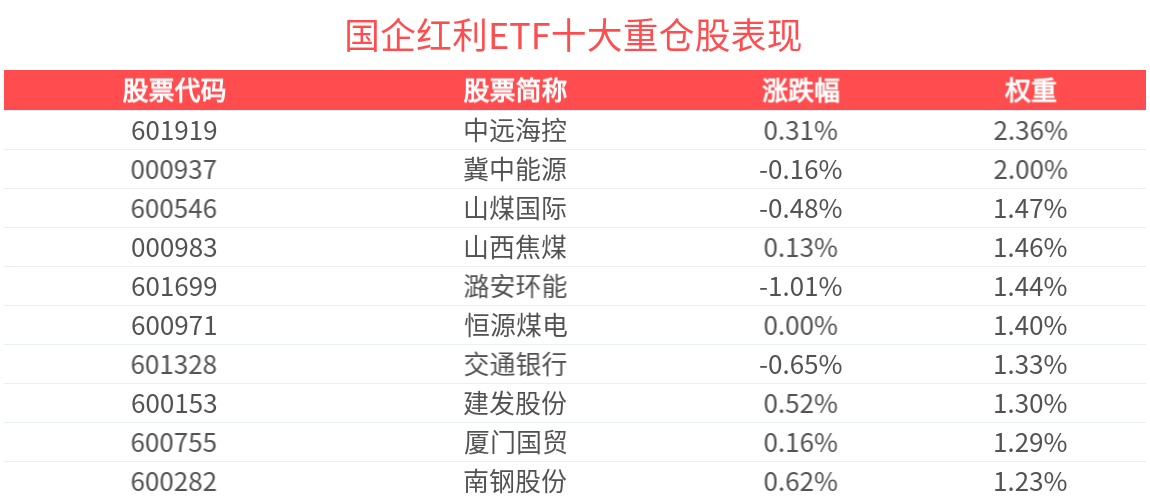
Group 1 - The China Securities State-Owned Enterprises Dividend Index (000824) decreased by 0.09% as of August 26, 2025, with mixed performance among constituent stocks [1] - China National Cereals, Oils and Foodstuffs Corporation (600737) led the gains with an increase of 5.90%, while Shaanxi Natural Gas (002267) experienced the largest decline [1] - The National State-Owned Enterprises Dividend ETF (159515) is consolidating, with the latest price at 1.17 yuan [1] Group 2 - The China Securities State-Owned Enterprises Dividend Index tracks 100 listed companies with high cash dividend yields, reflecting the overall performance of high-dividend securities among state-owned enterprises [2] - As of July 31, 2025, the top ten weighted stocks in the index accounted for 16.77% of the total index weight, including China COSCO Shipping (601919) and Jizhong Energy (000937) [2] Group 3 - Analysts from Minsheng Securities noted that insurance capital prefers undervalued, high-dividend stocks with strong performance certainty, especially in a declining long-term interest rate environment [1] - The report from Caixin Securities suggests that high dividend yield assets remain attractive, with long-term funds like insurance capital likely to continue flowing into these assets [1]



银行业助力实现乡村全面振兴
Jin Rong Shi Bao· 2025-08-26 01:44
Group 1 - The central task of the "Three Rural Issues" work is to increase farmers' income, with this year's Central No. 1 Document emphasizing the development of county-level industries to enhance farmers' income channels [1] - Financial support is crucial for rural revitalization and the development of rural specialty industries, with the People's Bank of China and the Ministry of Agriculture and Rural Affairs issuing guidelines to enhance financial services for rural reforms [1] - The banking sector is innovating financial products and services to support rural industry development and farmers' income growth, including the introduction of specialized financial products and flexible repayment options [1] Group 2 - The unique growing conditions of the Ningxia selenium sand melon, including its water retention and temperature regulation, contribute to its exceptional taste, which has become a significant agricultural product [2][3] - Agricultural Bank of China provided a 200,000 yuan "Fumin Loan" to a farmer, enabling him to improve land quality and increase watermelon yield and sweetness, showcasing the bank's tailored financial solutions for farmers [3] - As of June this year, Agricultural Bank of China's "Fumin Loan" has disbursed over 6 billion yuan, benefiting thousands of farmers in Ningxia [3] Group 3 - The spice industry in Guangxi, which accounts for about 70% of the national market, faces challenges such as funding shortages and slow cash flow during procurement seasons [5] - The Guangxi branch of the Bank of Communications launched the "Yulin Spice Flow Loan," which offers credit based on business cash flow and credit history, significantly improving loan approval times [6][7] - The rapid approval process of the "Yulin Spice Flow Loan" has attracted numerous small and micro-enterprises, indicating a strong demand for innovative financial products in the spice industry [7] Group 4 - In Xinyang, the tea culture is deeply rooted, and the bank's support for local tea companies directly benefits thousands of tea farmers by ensuring timely and sufficient purchase of fresh leaves [8] - In Qinghai, a bank provided a 3.5 million yuan loan to support a local embroidery company, which is expected to create 50 new jobs and increase the income of over 200 local embroiderers [9] - The bank's comprehensive financial service plan for "New Farmers" aims to provide tailored financial solutions to rural leaders, facilitating broader income generation opportunities [9]



交行四川省分行助力西部金融中心建设
Si Chuan Ri Bao· 2025-08-25 22:20
Core Viewpoint - The article highlights the significant role of the Bank of Communications Sichuan Branch in supporting the construction of the Chengdu-Chongqing economic circle, emphasizing its commitment to providing financial support for major projects and contributing to regional economic development [1][2]. Financial Support and Commitment - The Bank of Communications Sichuan Branch signed a strategic cooperation agreement with the Sichuan provincial government in September 2021, pledging to provide 800 billion yuan in special credit support during the 14th Five-Year Plan period, focusing on six key areas [1]. - As of mid-2025, the Sichuan Branch has provided over 50 billion yuan in credit support for major projects within the Chengdu-Chongqing economic circle [1]. Project Financing and Economic Impact - In 2024 alone, the Sichuan Branch granted over 10 billion yuan in credit for 13 key projects in Chengdu [1]. - The branch's loan balance exceeded 240 billion yuan by mid-2025, reflecting its extensive support for local enterprises and individuals [1]. Innovation in Financial Services - The Sichuan Branch has developed a multi-layered service system tailored to six key industries, including electronic information and equipment manufacturing, enhancing its support for medium-sized clients [1]. - The introduction of innovative financial products, such as "Science and Technology Quick Loan," has facilitated funding for technology-driven enterprises, with an increase of 2.256 billion yuan in inclusive loans by mid-2025 [1]. Collaboration and Regional Development - The Sichuan and Chongqing branches of the Bank of Communications have engaged in frequent interactions, conducting 11 mutual visits in 2024 and co-hosting financial innovation summits to explore new cross-border financial services [1]. - A flexible working team was established to enhance collaboration between the two branches, resulting in over 1.8 billion yuan in credit support for joint projects [1]. Community and Social Responsibility - The Sichuan Branch has expanded its partnerships with local governments, establishing connections with 21 cities and over 20 provincial departments to enhance financial services across the region [1]. - The branch has actively engaged with over 40 enterprises to understand their needs and develop new service models, demonstrating its commitment to integrating financial services with local industry [2].
国有大型银行板块8月25日跌0.32%,农业银行领跌,主力资金净流出2.62亿元
Zheng Xing Xing Ye Ri Bao· 2025-08-25 08:47
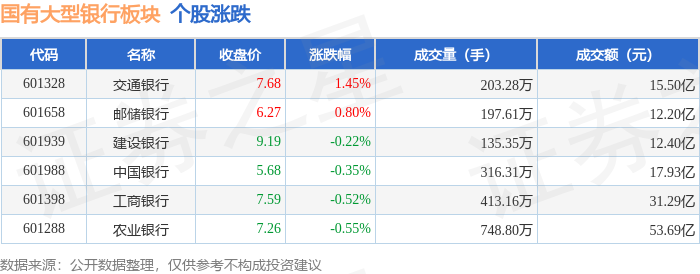
从资金流向上来看,当日国有大型银行板块主力资金净流出2.62亿元,游资资金净流入3.15亿元,散户资 金净流出5287.24万元。国有大型银行板块个股资金流向见下表: | 代码 | 名称 | 主力净流入 (元) | 主力净占比 游资净流入 (元) | | 游资净占比 散户净流入 (元) | | 散户净占比 | | --- | --- | --- | --- | --- | --- | --- | --- | | 601658 邮储银行 | | 1.53亿 | 12.55% | -609.22万 | -0.50% | -1.47 Z | -12.05% | | 601328 交通银行 | | 1.47 乙 | 9.50% | -1.08亿 | -6.95% | -3950.47万 | -2.55% | | 601288 农业银行 | | -1612.39万 | -0.30% | 1.41亿 | 2.63% | -1.25 Z | -2.33% | | 601939 建设银行 | | -5854.92万 | -4.72% | 2056.03万 | 1.66% | 3798.89万 | 3.06% | | 6019 ...


红利低波ETF(512890)成交5.46亿“霸榜” 险资近30次举牌托底高股息策略
Xin Lang Ji Jin· 2025-08-25 08:21
Market Overview - On August 25, the A-share market experienced a significant upward trend, with the Shanghai Composite Index approaching 3900 points and the ChiNext Index leading in gains [1] - The total trading volume of the two markets reached 3.14 trillion yuan, an increase of 594.4 billion yuan compared to the previous trading day [1] ETF Performance - The Dividend Low Volatility ETF (512890) rose by 0.83% on the same day, closing at 1.219 yuan, with a turnover rate of 2.59% and a trading volume of 546 million yuan, making it the top performer among similar ETFs [2][3] - As of August 22, 2025, the asset size of the ETF was 20.992 billion yuan, with a daily average trading volume of 483 million yuan over the past 20 trading days, indicating sustained market interest [2] Fund Flow Analysis - Recent fund flows indicate short-term outflows and medium to long-term inflows, with a net outflow of 57 million yuan over the past five trading days and 117 million yuan over the past ten days; however, there was a net inflow of 3.298 billion yuan over the past 60 days [2] - The ETF's cumulative return since its establishment in December 2018 has reached 141.74%, significantly outperforming its benchmark and ranking 33rd among 502 similar products [5] Holdings and Sector Focus - The ETF's top holdings are primarily in the banking sector, including Chengdu Bank, Industrial Bank, Sichuan Road and Bridge, and Daqin Railway, which all saw price increases on August 25, aligning with their high dividend and low valuation characteristics [4] - The frequency of insurance capital stake acquisitions has significantly increased in 2025, with nearly 30 instances by August 19, focusing on high-dividend, low-volatility sectors such as banking and utilities, which enhances market attention and capital inflow expectations for the ETF's holdings [4]




银行ETF指数(512730)红盘向上,多家银行披露半年度业绩
Xin Lang Cai Jing· 2025-08-25 06:05
Group 1 - The China Securities Bank Index (399986) increased by 0.28% as of August 25, 2025, with notable gains from Ping An Bank (3.07%), Ningbo Bank (2.04%), and others [1] - Seven A-share listed banks have disclosed their semi-annual performance for 2025, showing steady growth in total assets, operating revenue, and net profit attributable to shareholders, along with a decrease in non-performing loan ratios [1] - Ningbo Bank experienced rapid total asset expansion, while Shanghai Pudong Development Bank's total revenue surpassed 90 billion yuan, with several city commercial banks achieving double-digit growth in net profit [1] Group 2 - The CSI Dividend Total Return Index has underperformed compared to the broader market indices, with the banking index lagging behind the Wind All A Index by approximately 5% [2] - The performance of the banking sector is closely linked to the interest rate cycle, suggesting a focus on cyclical stability and the recovery of equity markets [2] - The Bank ETF Index closely tracks the China Securities Bank Index, providing investors with analytical tools to assess the performance of various industry sectors [2] Group 3 - As of July 31, 2025, the top ten weighted stocks in the China Securities Bank Index accounted for 64.84% of the index, including major banks like China Merchants Bank and Industrial and Commercial Bank of China [3]





中国银行 2025 年下半年展望:收益率压缩反弹以重拾动量
2025-08-25 01:38
Summary of the Conference Call on China Banks Industry Overview - The conference call focused on the **China banking sector** and provided insights into the performance and outlook for various banks in the region, particularly in the context of macroeconomic challenges expected in the second half of 2025 [2][5][9]. Core Insights and Arguments 1. **Performance Metrics**: Since July 2025, MSCI China banks and CSI 300 banks have underperformed MSCI China and CSI 300 by 11 percentage points and 10 percentage points, respectively [2][9]. 2. **Revenue and Profit Growth**: Despite a challenging macro environment, banks' revenues and profit growth are expected to improve sequentially in 2H25, driven by stabilization in Net Interest Margin (NIM) and a moderate recovery in fee income, particularly from wealth management [2][5][12]. 3. **Dividend Yields**: The average forecasted dividend yield for A-share banks is approximately 4.3%, significantly higher than the 3-year deposit yield, 10-year China Government Bonds (CGB), and 3-month Wealth Management Products (WMP) yields [5][12]. 4. **Investment Preferences**: There is a preference for banks with strong deposit franchises, with **China Merchants Bank (CMB-A)** being highlighted as a top pick due to its decent dividend yield and higher earnings sensitivity to capital markets [2][5][11]. 5. **Rating Changes**: - **Bank of Communications (BoCom)** was upgraded from Neutral to Overweight due to its higher revenue contribution from capital-market related fees and resilient NIM [5][41]. - **Ping An Bank** was upgraded to Neutral as its retail business restructuring is nearing completion, and it has a high NPL coverage ratio [5][57]. - **Agricultural Bank of China (ABC)** was downgraded to Neutral due to its low dividend yield and potential capital raising in 2026 [5][67]. Additional Important Insights 1. **NIM Stabilization**: The stabilization of NIM is expected as the rate cut cycle nears its end, with one or two more rate cuts anticipated in 2H25 or 2026 [5][12]. 2. **Asset Quality Concerns**: The Non-Performing Loan (NPL) formation ratio may increase due to declining macro growth, but impairment charges are expected to remain stable due to improved bad debt recovery efforts [5][12]. 3. **Market Sentiment**: The overall macro outlook does not support a large-scale rotation into growth stocks, maintaining demand for yield stocks [5][12]. 4. **Potential Upside**: Analysis suggests a potential share price upside of 10-20% for A and H share banks in the next six months, contingent on improvements in the earnings outlook [10][12]. 5. **Seasonality Effects**: Historically, banks' share prices have underperformed in July and August, but this trend is expected to fade as banks have started distributing interim dividends since 2024 [12][18]. Conclusion The conference call provided a comprehensive outlook on the China banking sector, emphasizing the resilience of banks amidst macroeconomic challenges, the attractiveness of dividend yields, and strategic investment recommendations. The insights suggest a cautiously optimistic view on the sector's performance in the latter half of 2025, with specific banks positioned favorably for growth.

交通银行以绿色金融“贷”动绿色发展
Zheng Quan Ri Bao Zhi Sheng· 2025-08-24 14:39
Group 1 - The core viewpoint of the articles emphasizes the commitment of Bank of Communications to green finance and its active role in supporting China's dual carbon strategy through various initiatives [1][4] - The bank has maintained steady growth in green loans, focusing on key areas such as infrastructure upgrades, low-carbon energy transition, and green consumption [1][4] - The bank has developed an ESG evaluation system to provide tailored financial services for agricultural transformation, exemplified by the first agricultural transformation loan in Huzhou, Zhejiang [2][3] Group 2 - The bank has successfully implemented the first methanol dual-fuel ship transformation financial loan in China, providing nearly 300 million yuan to support the green and intelligent transformation of the shipping industry [3] - In the rural revitalization sector, the bank has provided 1.5 billion yuan in funding for a photovoltaic project in Litang County, marking the first ultra-long-term renewable energy project loan in the region [4] - The bank aims to continuously improve its green financial service system to contribute to the economic and social green transition [4]
山东交行:精准赋能实体经济 助力药企“智”造升级
Zhong Guo Zheng Quan Bao· 2025-08-22 20:10
Group 1 - The core viewpoint of the articles emphasizes the commitment of the Bank of Communications Shandong Branch to serve the real economy and enhance financial service quality to support high-quality economic development in the province [1][2] - The Bank of Communications Shandong Branch has established a strong partnership with a pharmaceutical company in Shandong, providing tailored financial solutions to meet the company's evolving needs [1] - In 2024, the bank identified a financing need for the company's intelligent manufacturing project for pharmaceutical injectables, which is included in the Jinan City technical transformation re-loan project library [1] Group 2 - The bank provided a customized fixed asset loan plan with a limit of 280 million yuan for the intelligent manufacturing project, which aims to enhance the company's product line and position it as a leader in the chronic disease sector [1] - As of July 2025, the Bank of Communications Shandong Branch has issued project loans totaling 97 million yuan to the company, effectively alleviating its financial pressure and supporting its stable operation and continuous development [1][2] - Looking ahead, the bank will continue to empower the real economy and drive high-quality regional economic development by optimizing financing structures and extending service chains [2]
金融戍边筑根基 深耕主业显担当
Zhong Guo Jing Ying Bao· 2025-08-22 18:54
Core Viewpoint - The financial sector in Tibet has significantly contributed to the region's economic development and stability, aligning with national strategies and local needs, while focusing on high-quality growth and ecological protection [2][6]. Group 1: Economic Growth and Financial Support - Tibet's GDP reached 138.27 billion yuan in the first half of 2025, with a year-on-year growth of 7.2%, and is projected to reach 276.5 billion yuan in 2024, marking a 155-fold increase since 1965 [2]. - Agricultural Bank of China (601288.SH) has provided a total of 717.4 billion yuan in loans to local entities over 30 years, supporting major infrastructure projects like the Sichuan-Tibet Railway [3]. - China Bank (601988.SH) has established 33 branches in Tibet, with deposits exceeding 55 billion yuan and loans surpassing 75 billion yuan, playing a crucial role in the region's financial landscape [3]. Group 2: Inclusive Financial Services - The Agricultural Development Bank of China has issued 126.4 billion yuan in loans over 13 years, covering over 90% of counties in Tibet, significantly contributing to rural revitalization [4]. - China Life Insurance (601628.SH) has launched 28 inclusive insurance products, covering over 1.51 million people, and aims to build a multi-layered protection network in Tibet [5]. Group 3: Environmental and Innovative Financial Solutions - Industrial and Commercial Bank of China (601398.SH) has issued 18.07 billion yuan in green loans since the 14th Five-Year Plan, with a balance of 22.48 billion yuan, reflecting a growth rate of over 20% [5]. - China Life Property & Casualty Insurance has introduced insurance for ancient trees, providing 1 million yuan in risk coverage for five ancient trees in Tibet, marking the region's first such insurance [5]. Group 4: Policy and Strategic Initiatives - The Tibet Financial Regulatory Bureau has implemented the "Financial Strong Border and Enriching People Three-Year Action Plan (2025-2027)" to enhance financial services in border areas, aiming for 70% coverage of township financial institutions by 2027 [6][7]. - The Postal Savings Bank (601658.SH) plans to provide at least 200 billion yuan in financing over the next five years, focusing on various integration initiatives to support Tibet's economic development [8][9].