
BANK COMM(601328)

Search documents
自贸离岸债从“两头在内”到“两头在外”,国有大行香港分行相继发债
Xin Lang Cai Jing· 2025-08-21 11:10
Core Viewpoint - The People's Bank of China (PBOC) is promoting the development of offshore bonds in Shanghai's free trade zone, transitioning from a "two ends inside" model to a "two ends outside" model, which aims to enhance the internationalization of the Renminbi and broaden financing channels for enterprises involved in the Belt and Road Initiative [1][2][4]. Group 1: Development of Offshore Bonds - The PBOC's recent meeting emphasized the need to develop offshore bonds in Shanghai, with a focus on enhancing the functionality of free trade accounts [1]. - Since June 18, 2023, major state-owned banks in Hong Kong have begun issuing offshore bonds, with the first two issuances being completed in July and August, marking a significant restart of the market [2][4]. - The first issuance by Bank of China Hong Kong was priced at 500 million RMB with an interest rate of 1.65%, while the first public issuance by Bank of Communications Hong Kong had a rate of 1.85% and a three-year term [2]. Group 2: Market Characteristics and Trends - The offshore bonds are characterized by strict adherence to the "two ends outside" principle, meaning both the issuers and investors must be from outside China, which is a shift from the previous model that relied heavily on domestic funding [5][6]. - The offshore bond market has seen a cumulative issuance of 189 bonds from 2019 to 2023, totaling over 120 billion RMB, primarily involving local government financing vehicles [4][6]. - The current trend indicates that the issuers and investors are mainly overseas branches or subsidiaries of Chinese institutions, with expectations for increased participation from foreign investors as the market matures [5][6]. Group 3: Implications for Renminbi Internationalization - The development of offshore bonds is seen as a crucial step in enhancing the Renminbi's role as a financing currency, particularly as global interest rates shift [6][7]. - The PBOC has identified the enhancement of the Renminbi's international monetary function as a key task, with a focus on improving its financing capabilities [6]. - The offshore bond market is expected to help establish Shanghai as a regional bond pricing center and attract foreign investment, thereby increasing the international influence of Renminbi-denominated bonds [5][6].

假摔
Datayes· 2025-08-21 11:05
Core Viewpoint - The article discusses the recent adjustments in the A-share market, highlighting the challenges faced by new investors in making profits, and the overall market sentiment of uncertainty and volatility [1]. Market Performance - The A-share market experienced fluctuations, with the Shanghai Composite Index rising by 0.13%, while the Shenzhen Component and ChiNext Index fell by 0.06% and 0.47% respectively [10]. - The total trading volume across the Shanghai and Shenzhen markets reached 24,608.75 billion yuan, an increase of 119.53 billion yuan compared to the previous day [10]. - A total of 58 stocks hit the daily limit up, with 15 stocks closing at the limit and 9 stocks achieving consecutive limit ups, the highest being five consecutive limit ups [10]. Sector Performance - The digital currency sector saw significant gains, with stocks like Sanwei Xinan and Xinchen Technology hitting the daily limit up due to reports of potential approval for a roadmap on the internationalization of the renminbi [10]. - The oil and gas extraction and service sectors also performed well, with Huai Oil Co. hitting the daily limit up following a surge in international oil prices [10]. - The combustible ice sector gained traction, with ShenKai Co. hitting the daily limit up after a breakthrough in methane catalytic conversion technology [10]. Institutional Activity - The net outflow of main funds amounted to 578.47 billion yuan, with the machinery equipment sector experiencing the largest outflow [18]. - The top five sectors with net inflows included communication, public utilities, banking, retail, and agriculture [18]. - The top five individual stocks with net inflows were ZTE Corporation, Zhaoyi Innovation, China Oil Capital, Jingbei Fang, and Luxshare Precision [18]. Financial Results - Agricultural Bank of China reported a strong performance, with its latest PB and PE ratios at 0.86 and 8.34 respectively, indicating a premium over the average ratios of the six major banks [6]. - The financial results of several companies for the first half of 2025 showed significant growth, with Jin Qilin's revenue increasing by 24.34% and net profit by 226.14% [16]. - Other companies like Sainuo Medical and Tianyu Digital Science also reported substantial revenue and profit growth, with increases of 12.53% and 296.54% respectively [16].





多银行上线个人消费贷款贴息问答 套取贴息资金要承担哪些后果
Bei Ke Cai Jing· 2025-08-21 08:48
Core Viewpoint - The personal consumption loan interest subsidy policy is set to be implemented in September, aiming to stimulate consumer spending and support economic growth through financial collaboration [1][2][11]. Group 1: Policy Implementation - Various banks are actively developing detailed guidelines for the personal consumption loan interest subsidy, with some already providing information through mobile banking apps and official channels [1][6]. - The subsidy will not directly lower the interest rates of personal consumption loans but will provide a rebate after actual consumption occurs, with a subsidy rate of 1% and a cap of 50% of the loan contract rate [2][3]. Group 2: Subsidy Details - Each borrower can receive a maximum subsidy of 3,000 yuan, corresponding to a total eligible consumption amount of 300,000 yuan, with a specific cap of 1,000 yuan for individual loans under 50,000 yuan [2][12]. - The subsidy aims to enhance fiscal and financial collaboration, thereby supporting consumer spending and expanding domestic demand [2][11]. Group 3: Application Process - Banks are simplifying the application process, allowing automatic identification of eligible transactions after customer authorization, minimizing the need for separate applications [3][4]. - Customers must sign a supplementary agreement to allow banks to access their transaction information for subsidy eligibility [4][5]. Group 4: Market Impact - Analysts suggest that the subsidy policy will effectively boost consumer demand, with the potential for multiple applications across different institutions to maximize benefits [11][12]. - The policy is expected to lower the effective financing rates for quality borrowers to below 3%, which may further stimulate demand for consumption loans [13][15]. Group 5: Risk Management - Banks emphasize that they will not charge any fees for the subsidy process and will not engage third parties in the loan or subsidy application [7][10]. - Strict measures will be in place to prevent fraudulent activities related to the subsidy, with any violations potentially affecting the borrower's credit record [9][10].
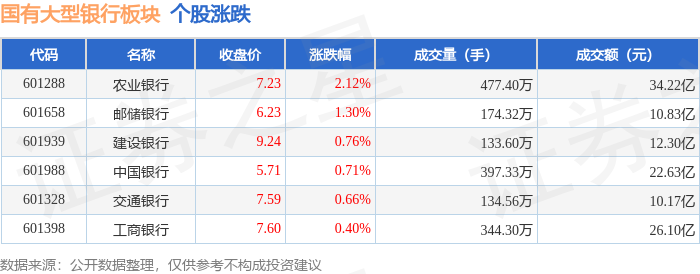
国有大型银行板块8月21日涨1.15%,农业银行领涨,主力资金净流入2.55亿元
Zheng Xing Xing Ye Ri Bao· 2025-08-21 08:38
证券之星消息,8月21日国有大型银行板块较上一交易日上涨1.15%,农业银行领涨。当日上证指数报收 于3771.1,上涨0.13%。深证成指报收于11919.76,下跌0.06%。国有大型银行板块个股涨跌见下表: 以上内容为证券之星据公开信息整理,由AI算法生成(网信算备310104345710301240019号),不构成投资建议。 | 代码 | 名称 | 收盘价 | 涨跌幅 | 成交量(手) | 成交额(元) | | --- | --- | --- | --- | --- | --- | | 601288 | 农业银行 | 7.23 | 2.12% | 477.40万 | 34.22 Z | | 601658 | 邮储银行 | 6.23 | 1.30% | 174.32万 | 10.83 Z | | 656109 | 建设银行 | 9.24 | 0.76% | 133.60万 | 12.30 Z | | 601988 | 中国银行 | 5.71 | 0.71% | 397.33万 | 22.63亿 | | 601328 | 交通银行 | 7.59 | 0.66% | 134.56万 | 10.17 乙 | ...

大连金融监管局同意交通银行太平洋信用卡中心大连分中心终止营业
Jin Tou Wang· 2025-08-21 03:15
Group 1 - The Dalian Financial Regulatory Bureau has approved the termination of operations for the Dalian branch of the Bank of Communications Pacific Credit Card Center [1] - Following the approval, the Dalian branch must immediately cease all business activities and return its license to the Dalian Financial Regulatory Bureau within 15 working days [1] - The branch is required to complete relevant procedures in accordance with applicable laws and regulations [1]

银行业:支持促消费政策落地 更好释放消费潜力
Jin Rong Shi Bao· 2025-08-21 02:23
Group 1 - Consumption is emphasized as a key driver for economic growth, with the People's Bank of China (PBOC) calling for stronger support to boost consumption in the second half of 2025 [1] - A series of policies aimed at promoting consumption and expanding domestic demand have been introduced, including a 500 billion yuan service consumption and pension relending program [1][4] - Experts believe that expanding domestic demand is crucial for maintaining stable economic growth in the coming months, with a clear policy direction favoring consumer spending [1] Group 2 - The government has allocated 300 billion yuan in special long-term bonds to support the "trade-in" program for consumer goods, which has positively impacted sales in key sectors like home appliances and communication devices [2] - The "trade-in" policy has led to improved profitability for related industries, while also stabilizing employment [2] - Banks are responding to the "trade-in" initiative by offering dedicated services to facilitate consumer participation and streamline the process [2][3] Group 3 - The PBOC's relending policy aims to enhance service consumption and improve the quality of services, which is expected to directly benefit the public and create more job opportunities [4][5] - Financial institutions are actively working to implement the service consumption and pension relending policies to support economic growth [4] Group 4 - The introduction of personal consumption loan interest subsidy policies is seen as an innovative approach to stimulate consumption by reducing financing costs for consumers and service industry operators [6] - Financial institutions are encouraged to tailor their offerings based on specific consumption scenarios to effectively meet the needs of consumers and businesses [7]

交通银行股份有限公司关于召开2025半年度业绩说明会的公告
Zhong Guo Zheng Quan Bao - Zhong Zheng Wang· 2025-08-21 02:01
Group 1 - The company will hold a half-year performance briefing on August 29, 2025, from 17:00 to 18:30 [7][8] - The briefing will be conducted via live streaming [3][8] - Investors can submit questions to the company's investor relations email by August 26, 2025, or ask questions during the live event [2][4] Group 2 - The company will disclose its 2025 half-year report on the same day as the briefing [2] - Attendees will include the company's president, independent director representatives, and other senior executives [8] - The live streaming interaction address will be provided for investors to participate [7]
消费贷贴息落地倒计时 有大行App即将上线“贴息专区”
Mei Ri Jing Ji Xin Wen· 2025-08-20 12:50
Core Viewpoint - The implementation plan for the personal consumption loan interest subsidy policy has been released, with major banks preparing to comply and establish specific operational guidelines [1][2]. Group 1: Policy Implementation - Major banks, including six large state-owned banks, are actively preparing to implement the personal consumption loan interest subsidy policy, with details to be announced through official channels [1][2]. - Some banks plan to set up a dedicated section in their mobile banking apps for loan interest subsidies, allowing customers to authorize transaction information for automatic identification of eligible loans [2][3]. Group 2: Loan Interest Rates - Current consumer loan interest rates in Shanghai remain at a minimum of 3%, with some banks offering rates as low as 3% after discounts [4][5]. - Analysts have noted that the subsidized consumer loan rates could drop below 3%, raising concerns about borrowers replacing higher-rate mortgage loans with lower-rate consumer loans [5][6]. Group 3: Loan Usage and Compliance - The subsidy applies to personal consumption loans used for specific categories, including consumer goods, home purchases, education, and healthcare [5][6]. - Banks have emphasized the importance of ensuring that loan funds are used for legitimate consumption purposes, warning against fraudulent practices to obtain subsidies [5][6].
三家大行接连发行TLAC债券,年内总规模达2500亿元
Cai Jing Wang· 2025-08-20 11:21
Core Viewpoint - The issuance of TLAC bonds by major state-owned banks in China has reached a total scale of 250 billion yuan this year, reflecting compliance with regulatory requirements for total loss-absorbing capacity [1][2][3]. Group 1: TLAC Bond Issuance - Major state-owned banks, including Bank of China, Agricultural Bank of China, and others, have issued TLAC bonds totaling 250 billion yuan this year, surpassing last year's issuance [2]. - The total issuance of TLAC bonds in the market has reached 480 billion yuan this year, with the five major banks receiving approval for a total of 440 billion yuan in TLAC debt instruments [2][3]. - Bank of China issued a 500 billion yuan TLAC bond with a fixed interest rate of 1.93% for a four-year term, aimed at enhancing its total loss-absorbing capacity [1]. Group 2: Compliance with Regulatory Requirements - The four major state-owned banks have successfully met the first phase of TLAC requirements, with their TLAC/RWA ratios exceeding the minimum requirement of 20% as of Q1 2025 [3]. - According to Fitch Ratings, the TLAC/RWA ratios for these banks need to reach 20% and 22% by 2025 and 2028, respectively, with specific targets for each bank [2][3]. - Agricultural Bank of China and Bank of China have TLAC/RWA ratios of 20.5% and 20.7%, respectively, indicating compliance with regulatory standards [3]. Group 3: Innovation in TLAC Bonds - The issuance of floating-rate TLAC bonds by Bank of Communications represents an innovative approach, with a total issuance of 300 billion yuan, including both fixed and floating-rate options [3][4]. - The floating-rate TLAC bond has a subscription rate of 1.42 times, indicating strong market interest and recognition of its investment value [4]. - The floating-rate bond's structure allows for effective hedging against interest rate risks, providing investors with a stable income stream [4].
交通银行(601328) - 交通银行关于召开2025半年度业绩说明会的公告
2025-08-20 09:30
股票代码:601328 股票简称:交通银行 编号:临 2025-053 交通银行股份有限公司 关于召开 2025 半年度业绩说明会的公告 交通银行股份有限公司(以下简称"交通银行"或"本公司")董事会及全体董事保证 本公告内容不存在任何虚假记载、误导性陈述或者重大遗漏,并对其内容的真实性、准确性 和完整性承担法律责任。 重要内容提示 全景网 https://rs.p5w.net/html/175489811078812.shtml 投资者如需提问,可于 2025 年 8 月 26 日(星期二)17:00 前将相关问 题发送至本公司投资者关系邮箱 investor@bankcomm.com,或于业绩说明会当日 登录上述直播地址问答区留言。 本 公 司 拟 于 2025 年 8 月 29 日 ( 星 期 五 ) 在 上 海 证 券 交 易 所 网 站 (www.sse.com.cn)披露 2025 半年度报告,并于同日 17:00-18:30 召开业绩说 明会,就 2025 半年度业绩予以说明,与分析师、媒体记者、投资者进行交流。 一、业绩说明会类型 本次业绩说明会通过网络直播方式召开。 二、业绩说明会有关安排 ...