
BANK COMM(601328)

Search documents
上海“金洽会”闭幕:92位普惠金融顾问进园区,近400家企业获精准对接
Xin Lang Cai Jing· 2025-12-04 11:25
交通银行副行长杨涛在大会现场表示,未来将携手广大金融机构加大力度支持上海三大先导产业、六大 重点产业以及未来产业的发展,为各类企业在不同发展的阶段协力构筑全生命周期金融服务体系,切实 保障上海现代化产业体系的建设提速增效。 他指出,新一轮科技革命催生了新业态、新赛道,对金融服务的需求更趋多元。要推动金融行业加速构 建从科技创新相适应的金融服务体系,会同银、政、保、投资各类机构,聚焦各自职能定位发挥功能优 势,齐心协力,助力企业更便捷地获得一揽子金融支持,提升上海的营商环境。 据相关负责人透露,微信小程序"上海金洽会"线上展将持续至2026年9月。线上平台除集中展示最新金 融产品、政策信息外,还将上海普惠金融顾问综合服务平台嵌入小程序,为中小微企业提供持续可得的 在线金融咨询窗口,延伸"金洽会"服务效能。 12月4日,金融一线消息,第十九届上海"金洽会"在闵行大零号湾举办闭幕大会,为期三个月的系列活 动正式收官。 自今年9月开幕以来,本届金洽会在黄浦、静安、奉贤、崇明等10个区共举办十二场"园区行"专场融资 对接活动,通过组织金融服务下沉园区、直达企业,将金融资源精准引向产业发展所需的重点园区,打 造出流动的金 ...

智慧港口,绿意盎然——解码全球港航转型中的“山港样板”
Mei Ri Jing Ji Xin Wen· 2025-12-04 06:53
Core Insights - Shandong Port has achieved a cargo throughput of over 1.8 billion tons and container volume exceeding 44 million TEUs, maintaining its position as the world's largest port [1] - The port is transitioning from a focus on quantity to quality, emphasizing "smart" and "green" initiatives to build a world-class intelligent and eco-friendly port [1] Group 1: Energy Transition - Yantai Port has implemented shore power systems, eliminating diesel generator use for over 8,000 vessels, resulting in a reduction of over 10,000 tons of CO2 emissions [2] - Weifang Port in Bohai Bay is the first "zero-carbon port" in China, utilizing a multi-energy supply system including solar, wind, and hydrogen energy, with an annual power generation capacity of 69.15 million kWh [2] - By 2024, clean energy usage at Shandong Port is projected to reach 63%, with a green electricity supply capacity of 200 million kWh [3] Group 2: Technological Empowerment - Automation and technology are enhancing operational efficiency at Shandong Port, with Qingdao Port's automated terminal achieving an average efficiency of 62.62 TEUs per hour, setting a global record [5][6] - The implementation of automated unloading processes at various ports has led to over a 20% increase in efficiency and an 80% reduction in dust pollution [6] Group 3: Financial Support for Green Initiatives - Financial institutions like Bank of Communications are providing significant funding support, with a total credit line of 46 billion yuan to support various port operations and projects [3][6] - The "Port Easy Payment" platform facilitates financing for small and medium enterprises in the supply chain, addressing challenges related to financing costs and access [7][9] Group 4: Sustainable Development Goals - Shandong Port is committed to building a comprehensive service system for the supply chain, transitioning from traditional port operations to a role as a supply chain service organizer [7] - The integration of green supply chain finance is enhancing the environmental standards across the entire supply chain, promoting a sustainable development model [9][10]
六家国有大行将在2026年年初派发2000亿红包!
Zhong Guo Jing Ying Bao· 2025-12-04 04:56
12月2日晚间,邮储银行发布公告,将于2026年2月13日派发中期股息每10股1.23元,合计派息约147.72 亿元,占2025年上半年归母净利润的30%。 部分银行分红比例提升 银行中期分红从"可选项"逐渐转变为"常规动作",与近年来监管层的持续倡导密不可分。 2023年12月中旬,中国证监会发布《上市公司监管指引第3号——上市公司现金分红》,该指引修订内 容主要有三个方面,其中包括简化中期分红程序,推动进一步优化分红方式和节奏。鼓励公司在条件允 许的情况下增加分红频次。新"国九条"也提出,"加大对分红优质公司的激励力度,多措并举推动提高 股息率。增强分红稳定性、持续性和可预期性,推动一年多次分红、预分红、春节前分红。" 尽管面临净息差持续收窄等周期性挑战,但上市银行,尤其是国有大行和部分优质股份制银行,依然展 现出较强的盈利韧性和分红意愿。且记者注意到,部分上市银行此次提出的中期分红比例进一步提升。 如上海银行2025年中期现金分红比例进一步提升至32.22%;沪农商行2025年中期分红比例为33.14%, 较2024年的中期分红比例继续小幅提升。 《中国经营报》记者梳理发现,除邮储银行外,其他五家国有 ...



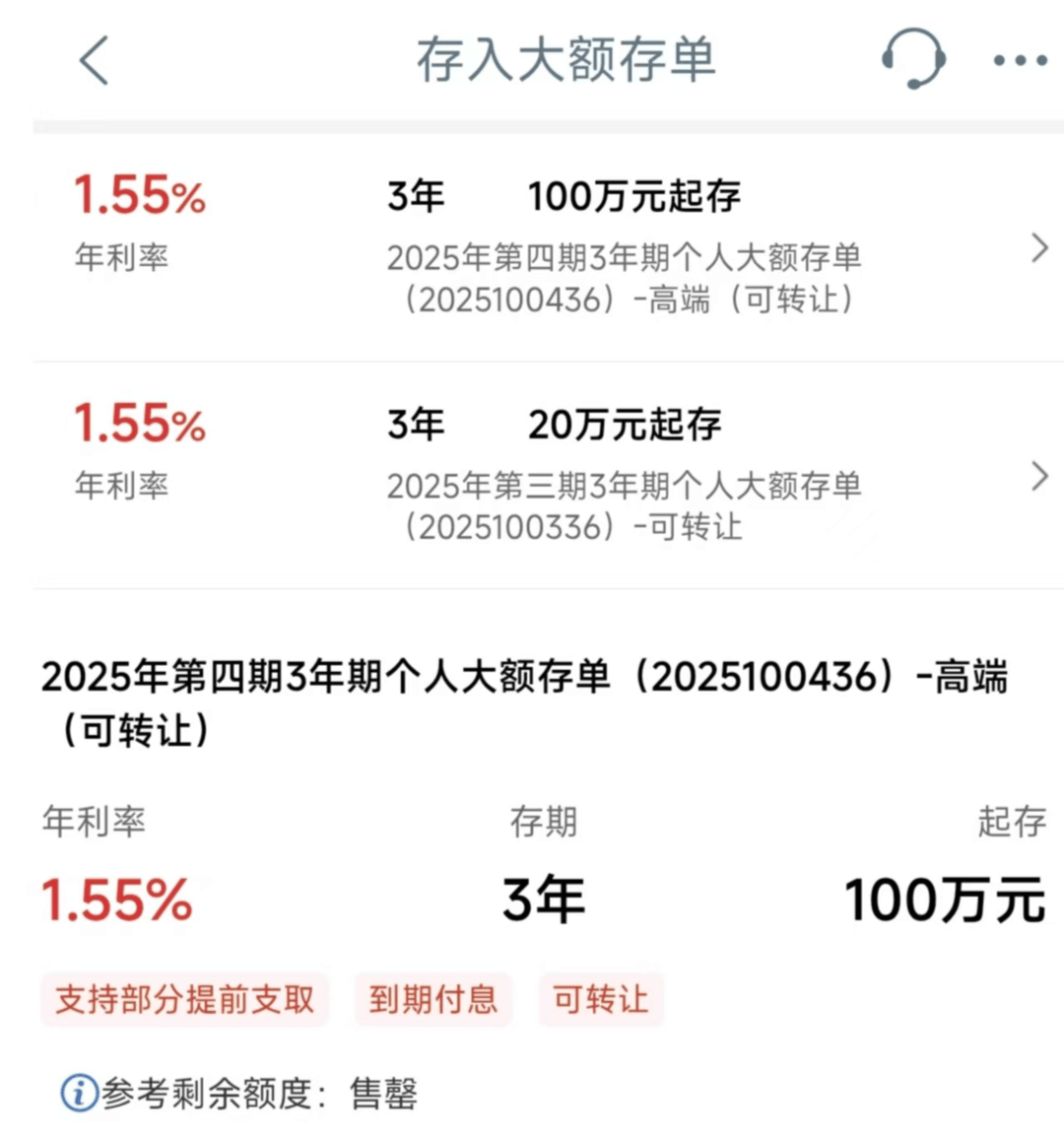
大额存单起存门槛升高,工行存100万与存20万利率相同,农行存500万利率1.55%
Sou Hu Cai Jing· 2025-12-04 03:59
Core Viewpoint - The latest issuance of 3-year large-denomination certificates of deposit (CDs) by Industrial and Commercial Bank of China (ICBC) has seen the minimum deposit requirement raised to 1 million yuan, with an interest rate of 1.55%, which is currently sold out [1][4]. Group 1: Large-Denomination CDs - The interest rate for the 3-year large-denomination CDs is set at 1.55% with a minimum deposit of 1 million yuan [2][3]. - Previously, ICBC offered a 3-year large-denomination CD with a minimum deposit of 200,000 yuan, also at an interest rate of 1.55% [1][4]. - Other banks, including China Construction Bank, Agricultural Bank of China, and Bank of China, are also offering 3-year large-denomination CDs with a minimum deposit of 200,000 yuan at the same interest rate of 1.55% [4]. Group 2: Market Dynamics and Strategies - The increase in the minimum deposit requirement for large-denomination CDs without a corresponding increase in interest rates reflects banks' proactive liability management strategies in a low-interest-rate environment [4]. - By raising the minimum deposit amount, banks are effectively tightening the supply of large-denomination CDs, aiming to optimize their liability structure and reduce reliance on high-cost deposits [4]. - The main advantages of large-denomination CDs over regular deposits, despite the current interest rate trends, include higher liquidity and flexibility, such as transferability and collateral options, making them suitable for large depositors with short-term capital needs [4].


交通银行聘任张薇为审计监督局局长 其职业生涯深耕交行体系
Xi Niu Cai Jing· 2025-12-04 03:28
12月1日,交通银行股份有限公司(以下简称 "交通银行")发布第十一届董事会第三次会议决议公告,会议同意聘任张薇为该行审计监督局局长,任职自董 事会审议通过之日起正式生效。 二、董事会会议审议情况 (一)关于聘任张薇女士为审计监督局局长的决议 会议同意聘任张薇女士为本行审计监督局局长,任职自董事会审议通过之日 起生效。 表决情况:同意15 票,反对 0 票,弃权 0 票 交通银行股份有限公司 第十一届董事会第三次会议决议公告 交通银行股份有限公司(以下简称"交通银行"或"本行")董事会及全体董事保证本 公告内容不存在任何虚假记载、误导性陈述或者重大遗漏,并对其内容的真实性、准确性和 完整性承担法律责任。 一、董事会会议召开情况 根据《交通银行股份有限公司章程》第 158 条和第 161 条的规定,经任德奇 董事长提议,本行第十一届董事会第三次会议(临时会议)以书面传签方式召开。 本行于 2025年11月24日以专人送达或电子邮件的方式,向全体董事发出本次 会议通知和文件。本次会议应参加表决董事 15名,截至 2025年12月1日,共 收回有效表决票 15 份。根据表决结果,参加表决人数符合《中华人民共和国公 ...

烟台金融监管分局:辖区大型银行创新举措助推绿色低碳高质量发展
Qi Lu Wan Bao· 2025-12-04 02:09
2025年,是"绿水青山就是金山银山"理念提出20周年,是"双碳"目标提出5周年,也是中央金融工作会 议明确"绿色金融"等五篇大文章2周年。近年来,烟台金融监管分局紧紧围绕烟台市绿色低碳高质量发 展大局,深入贯彻落实国家及省市相关政策部署,坚持监管引领与服务实体相结合,引导辖区大型银行 切实发挥"头雁"作用,持续聚焦重点领域、优化金融服务、深化金融创新,为打造绿色低碳高质量发展 示范城市注入强劲动力。 引领信贷总量稳步增长 实现绿色规模"新突破" 烟台金融监管分局通过制定工作指引、开展季度监测、实施差异化监管等措施,引导大型银行持续加大 绿色信贷投放力度。截至2025年10月末,辖区大型银行绿色贷款余额突破1300亿元大关,较年初增幅达 20.8%,高于各项贷款平均增速9.73个百分点。在规模稳步增长的同时,信贷质量保持优异水平,绿色 贷款不良率仅为0.006%,远低于各项贷款平均水平。绿色贷款客户覆盖面显著扩大,存量户数突破1.65 万户,较年初增幅12.05%。绿色贷款占全部贷款比重提升至25.6%,较年初提高2.07个百分点,绿色金 融已成为信贷增长的重要引擎。 推动流程体系健全优化 构建绿色融资"新格 ...
银行业持续强化金融法治建设
Jin Rong Shi Bao· 2025-12-04 02:00
Group 1 - The core viewpoint emphasizes the importance of legal construction in supporting the high-quality development of the financial industry in China, as highlighted by the Central Financial Work Conference [1] - The legal construction is an essential part of the socialist legal system with Chinese characteristics, as stated in the suggestions for the 15th Five-Year Plan [1] - Financial institutions are increasingly integrating legal principles into their management practices to enhance risk prevention, business innovation, and customer rights protection [1] Group 2 - Agricultural Bank of China is strengthening compliance management and incorporating legal education into leadership assessments to enhance legal awareness among all employees [2] - Industrial and Commercial Bank of China in Qinghai has established a legal education leadership group to coordinate legal education efforts across the bank [2] - Bank of Communications in Shanghai is focusing on employee legal education through various training activities to promote compliance awareness [2] Group 3 - Minsheng Bank in Chongqing is integrating legal construction with its operational development, establishing a leadership group to oversee legal initiatives [3] Group 4 - Legal compliance is viewed as the first line of defense in risk management for commercial banks, marking a significant shift in operational focus towards legality [4] - Banks are embedding legal and compliance principles throughout their business processes to ensure orderly and compliant operations [4] - Minsheng Bank in Zhengzhou emphasizes strict adherence to legal protocols in business operations to support the real economy [4] Group 5 - Postal Savings Bank is enhancing the anti-fraud capabilities of frontline staff through customized legal training conducted by practicing lawyers [5] Group 6 - The financial industry is focusing on protecting consumer rights as a reflection of its political and social responsibilities [6] - Financial institutions are actively engaging in public legal education to help citizens understand and protect their legal rights [6] - Industrial and Commercial Bank of China in Suzhou is conducting public legal education activities to enhance community awareness of financial safety [6] Group 7 - Construction Bank in Guangdong is participating in public awareness campaigns to expose illegal financial activities and educate the public on potential risks [7]

国有行五年期大额存单集体“隐身”
Nan Fang Du Shi Bao· 2025-12-03 23:07
Core Viewpoint - The five-year large denomination certificates of deposit (CDs) have been collectively removed from the offerings of major state-owned banks in China, leaving only three-year products available, reflecting ongoing pressure on the banking sector's net interest margins [2][3][4]. Group 1: Market Changes - Major state-owned banks, including ICBC, ABC, and BOC, have removed five-year large denomination CDs from their online platforms, with the focus now on three-year and shorter-term products [3][4]. - The interest rate for three-year large denomination CDs has decreased to approximately 1.55%, while one-year and two-year products have been reduced to 1.20% [3][4]. - The removal of five-year products is part of a broader trend in the banking industry, which has been experiencing a tightening of available quotas for large denomination CDs since last year [4]. Group 2: Interest Rate Trends - The interest rates for large denomination CDs have been on a downward trajectory, with the three-year rate dropping from 2.15% to 1.55% over the past year, a decline of 60 basis points [4]. - The net interest margin for commercial banks was reported at 1.42% as of the end of Q3 this year, showing a year-on-year decrease of 11 basis points, indicating ongoing pressure on profitability [7]. Group 3: Product Differentiation - There is a common misconception among depositors that the removal of five-year large denomination CDs means the closure of all five-year deposit options; however, regular five-year fixed deposits remain available with a lower entry threshold [5][6]. - The minimum deposit for five-year fixed deposits is only 50 yuan, contrasting sharply with the 200,000 yuan minimum for large denomination CDs, providing a stable option for those with limited funds [6]. Group 4: Strategic Adjustments - The adjustments in the offerings of large denomination CDs reflect banks' strategies to manage liabilities and control costs in a low-interest-rate environment [7][8]. - Analysts suggest that banks are responding to the pressures of maintaining net interest margins by reducing the availability of high-cost large denomination CDs and increasing entry barriers for these products [7][8].


六大国有银行全面停售5年期大额存单
Mei Ri Shang Bao· 2025-12-03 22:55
Core Insights - The long-term large-denomination certificates of deposit (CDs) are gradually disappearing, with major state-owned banks ceasing to offer 5-year CDs, reflecting a shift in banks' liability management strategies in a low-interest-rate environment [1][2][4] Group 1: Changes in Product Offerings - Six major state-owned banks, including ICBC, ABC, BOC, CCB, BOCOM, and PSBC, have completely removed 5-year large-denomination CDs from their offerings [2][3] - The remaining products from these banks have shifted towards shorter terms, with ICBC offering rates of 1.55% for 3-year CDs and 1.20% for 1-year and 2-year CDs [2][3] - The absence of 5-year CDs has been noted across other banks, with Agricultural Bank of China also not listing any 5-year products in its catalog from 2018 to 2025 [3] Group 2: Impact on Interest Margins - The reduction of long-term high-cost CDs is seen as a direct method for banks to optimize their liability structure and stabilize net interest margins [4] - As of Q3 2025, the net interest margin for commercial banks in China was reported at 1.42%, remaining at a historical low [4] - Since the establishment of the market-oriented deposit rate adjustment mechanism in April 2022, major banks have reduced deposit rates in seven rounds, with the latest cuts occurring in May 2025 [4] Group 3: Shifts in Investment Behavior - With declining interest rates, there is a growing need for depositors to adopt rational expectations and consider diversified asset allocations, such as government bonds and low-risk investment products [5] - A survey indicated that 62.3% of urban residents preferred "more savings," a decrease of 1.5 percentage points from the previous quarter, while 18.5% favored "more investments," an increase of 5.6 percentage points [5] - The scale of the banking wealth management market reached 32.13 trillion yuan by the end of Q3 2025, reflecting a year-on-year increase of 9.42% [5]
首批3家全国性股份制银行AIC获准开业—— 促进我国投融资体系多元发展
Jing Ji Ri Bao· 2025-12-03 21:51
Core Insights - The recent approval of three financial asset investment companies (AICs) marks the establishment of the first batch of national joint-stock bank AICs in China, expanding the total number of bank-affiliated AICs to nine [1][2] Group 1: AIC Establishment and Function - The newly approved AICs include Xinyin Financial Asset Investment Co., Xinyin Financial Asset Investment Co., and Zhaoyin Financial Asset Investment Co., with registered capitals of 150 billion yuan and 100 billion yuan respectively [1] - AICs were initially designed for market-oriented debt-to-equity swaps, serving as a "risk isolation wall" and "asset restructuring expert" within the banking system, aimed at reducing corporate leverage and mitigating financial risks [1][3] - The role of AICs has evolved to become a major player in equity investment, particularly following recent policy expansions that have increased their investment scope and intensity [1] Group 2: Comparison Between AICs - The newly established AICs share common features with state-owned bank AICs, including core functions, regulatory frameworks, policy guidance, and operational models [2] - Differences exist in shareholder backgrounds, resource endowments, capital scales, and regional layouts, with state-owned AICs benefiting from larger asset scales and nationwide networks, focusing on large state-owned enterprises [2] - In contrast, joint-stock bank AICs have a slightly lower capital scale and are more concentrated in their initial focus, primarily serving private and innovative small and medium-sized enterprises [2] Group 3: Impact on the Economy - The entry of AICs is expected to significantly promote enterprise transformation and high-quality development by alleviating corporate debt burdens through debt-to-equity swaps, thereby facilitating technological research and product innovation [3] - AICs are positioned to support specialized and innovative enterprises, as well as technology-driven small and medium-sized enterprises, while also restructuring and revitalizing companies in debt distress through market-oriented and legal means [3]

