
NCI(601336)

Search documents
2220亿元险资加速布局A股!保险系私募再添新军
Guo Ji Jin Rong Bao· 2025-08-13 08:53
Core Insights - The recent approval of Taiping Asset's establishment of Taiping (Shenzhen) Private Securities Investment Fund Management Co., Ltd. marks a significant step in the long-term investment reform pilot for insurance funds in China, with a total of six insurance-related private fund management companies now approved [1][3]. Group 1: Long-term Investment Reform Pilot - The establishment of private securities funds by insurance companies aims to invest primarily in the secondary market and hold stocks for the long term, reflecting the practical implementation of the long-term investment reform pilot [2]. - The first batch of pilot approvals in October 2023 included China Life and Xinhua Life, each contributing 25 billion yuan to establish Honghu Zhiyuan (Shanghai) Private Securities Investment Fund Co., Ltd. [2]. - By 2025, the pilot program has accelerated, with a total of 222 billion yuan approved across three batches, injecting significant incremental capital into the market [2][4]. Group 2: Fund Management Companies and Products - Six insurance-related private securities fund management companies have been approved, including Guofeng Xinghua, Taikang Stable, Taibao Zhiyuan, Hengyi Chiying, and Sunshine Asset [3]. - The first private fund product, Honghu Fund Phase I, launched in March 2024, successfully invested 50 billion yuan, achieving returns above the benchmark with lower risk [4]. - Subsequent funds, such as Honghu Fund Phase II and III, have been established with significant contributions from major insurance companies, focusing on large listed companies in the A+H share market [4][5]. Group 3: Investment Strategies and Market Impact - The investment strategy for these funds emphasizes fundamental analysis, targeting high-quality listed companies in both domestic and Hong Kong markets, aiming for stable long-term growth [5]. - The introduction of long-term insurance capital into the market is expected to enhance market stability and encourage investments in technology innovation and advanced manufacturing, thereby alleviating pressure on insurance companies [5][6]. - The long-term nature of insurance capital aligns well with the liabilities of life insurance policies, helping to mitigate asset-liability mismatches [6].


《个人消费贷款财政贴息政策实施方案》点评:方案出台刺激消费,利好消费信贷及保险
GUOTAI HAITONG SECURITIES· 2025-08-13 05:28
Investment Rating - The report assigns an "Overweight" rating for the industry, indicating an expected performance that exceeds the Shanghai and Shenzhen 300 Index by more than 15% [4][11]. Core Insights - The implementation of the "Personal Consumption Loan Interest Subsidy Policy" is expected to enhance consumer demand and improve the consumption finance and insurance sectors. The subsidy reflects a downward trend in interest rates, which may be lower than anticipated [2][4]. Summary by Sections Policy Overview - The policy aims to stimulate consumption and expand domestic demand by providing interest subsidies for eligible personal consumption loans. The subsidy is set at 1 percentage point and applies to key consumption areas such as household vehicles and general consumption below 50,000 yuan [4]. Implementation Details - The policy will be effective from September 1, 2025, to August 31, 2026. It covers two categories of consumption: general consumption below 50,000 yuan and key consumption of 50,000 yuan and above, with a maximum subsidy of 3,000 yuan per individual [4]. Impact on Financial Institutions - The subsidy is expected to stimulate demand for consumer credit, benefiting consumer finance companies directly. It will lower borrowing costs for consumers, potentially leading to an expansion in the scale of consumer loans and an increase in business volume and revenue for consumer finance institutions [4]. Recommendations - The report recommends investing in leading companies in the automotive finance sector, such as Yixin Group, which is well-positioned to benefit from the policy's support for household vehicle consumption. Additionally, it suggests insurance sector stocks like New China Life Insurance and China Life Insurance due to improved interest rate expectations [4][5].
5家上市险企发放907.89亿元“现金红包”
Jin Rong Shi Bao· 2025-08-13 03:03
Group 1: Dividend Announcements - China Pacific Insurance and New China Life Insurance have announced their 2024 A-share dividend distributions, with both companies having a record date of August 7 and an ex-dividend date of August 8 [1] - China Pacific Insurance plans to distribute a cash dividend of 0.117 yuan per share, totaling 5.174 billion yuan, with an annual cash dividend of 7.96 billion yuan, reflecting a 15.4% increase from the previous year [1] - New China Life Insurance will distribute a cash dividend of 1.99 yuan per share, totaling 6.208 billion yuan, with a combined cash dividend of 7.893 billion yuan for 2024, representing a significant increase of 197.6% compared to 2023 [1] Group 2: Overall Dividend Performance - Five listed insurance companies have finalized their 2024 dividend distributions, totaling 90.789 billion yuan, which is a year-on-year increase of 20.21% [2] - Ping An Insurance will distribute a cash dividend of 1.62 yuan per share, with a total cash dividend of 46.174 billion yuan, showing a nearly 5% increase [2] - China Life Insurance will distribute a total cash dividend of 0.65 yuan per share, amounting to 18.372 billion yuan, which is a 51.14% increase year-on-year [2] Group 3: Policy and Regulatory Context - The new "National Nine Articles" issued by the State Council in April 2024 emphasizes strengthening cash dividend regulations for listed companies [3] - The China Securities Regulatory Commission has encouraged companies to develop and disclose medium to long-term dividend plans, increasing the frequency and optimizing the timing of dividends [3] - Insurance companies are responding to regulatory requirements and business development needs by implementing interim dividends, with executives citing the importance of enhancing investor confidence and sharing company growth benefits [3] Group 4: Market Perception and Future Outlook - Dividends are viewed as a key indicator of investment value, with companies that consistently pay dividends signaling strong operational health and stability [4] - The dual drivers of policy guidance and internal development needs suggest that listed insurance companies are likely to continue optimizing their dividend policies to create more value for shareholders [4]



分红险红利实现率陆续出炉 突破100%的产品增多
Mei Ri Shang Bao· 2025-08-12 23:51
Group 1 - Major insurance companies in China, including China Life, Xinhua Insurance, and Ping An Life, have reported significant increases in their dividend insurance annual bonus realization rates compared to last year [1] - The overall trend shows a recovery in bonus realization rates, with many existing "old products" seeing increases from 25% to 35% and from around 35% to over 40% or even 50% [1] - Several products have surpassed a 100% bonus realization rate, a stark contrast to the previous year when very few products achieved this level [1] Group 2 - Differentiated adjustment levels are expected to drive the industry towards a full transition to dividend insurance, which has lower guaranteed costs and allows for flexible bonus distribution based on investment performance [2] - Insurance companies view the shift to dividend insurance as a strategic move to mitigate "interest spread loss" risks, accelerating the transition across the industry [2] - Many insurance firms plan to actively promote the launch and sales of dividend insurance products during the upcoming transition from old to new products [2]

2220亿险资加速布局A股!保险系私募再添新军
Guo Ji Jin Rong Bao· 2025-08-12 15:08
Core Viewpoint - The recent approval of insurance-funded private equity funds marks a significant advancement in China's long-term investment reform pilot, enhancing the role of insurance capital in the capital market [1][2][3] Group 1: Insurance Fund Private Equity Developments - China Pacific Insurance's subsidiary, Taiping Asset, has received approval to establish Taiping (Shenzhen) Private Securities Investment Fund Management Co., indicating a growing trend of insurance companies entering the private equity space [1][3] - A total of six insurance-related private equity fund management companies have been approved, including Guo Feng Xing Hua and Tai Kang Stable Walk, among others [3] - The first batch of pilot programs was approved in October 2023, with China Life and Xinhua Life each contributing 25 billion yuan to establish Honghu Zhiyuan (Shanghai) Private Securities Investment Fund Co. [2] Group 2: Fund Performance and Strategy - The Honghu Fund I, launched in March 2024, has successfully invested 50 billion yuan, achieving returns above the benchmark with lower risk [4] - The second phase of the Honghu Fund, with a total scale of 20 billion yuan, focuses on large listed companies in the A+H share market [4] - The Tai Kang Stable Walk Fund, which began operations in June 2023, aims for long-term stable growth through fundamental analysis of quality companies in domestic and Hong Kong markets [5] Group 3: Market Impact and Future Outlook - The introduction of long-term insurance capital is expected to enhance market stability and direct investments towards technology innovation and advanced manufacturing [5][6] - Insurance funds entering the market will increase the allocation of equity assets, helping to mitigate the pressure from low interest rates and aligning with the long-term liabilities of life insurance policies [6]
新华保险山东分公司积极开展“反欺诈 保诚信 护未来”系列宣传活动
Qi Lu Wan Bao· 2025-08-12 08:55
Core Viewpoint - The company is actively engaging in a series of anti-insurance fraud promotional activities themed "Anti-Fraud, Maintain Integrity, Protect the Future" to enhance public awareness and capability in preventing insurance fraud [1]. Group 1: Activities and Initiatives - The company is conducting outreach in medical institutions to establish a strong anti-fraud defense at the source, targeting healthcare professionals and patients by explaining typical cases, highlighting common risks, and distributing promotional materials [4]. - Community engagement is emphasized through the distribution of easy-to-understand pamphlets that explain the social dangers of insurance fraud and recognition techniques, aiming to integrate anti-fraud knowledge into daily life [4]. - A collaboration with local police is underway to enhance public awareness of fraud, utilizing engaging methods such as quizzes to educate residents about common scams and prevention strategies [8]. Group 2: Importance of Anti-Fraud Measures - The company recognizes that fraudulent activities not only disrupt the insurance market order but also infringe upon the legitimate rights of honest consumers [8]. - The company prioritizes consumer rights protection as the foundation of its anti-fraud efforts, supported by technological means, and is committed to building a collaborative anti-fraud framework involving all employees and external partners [8].

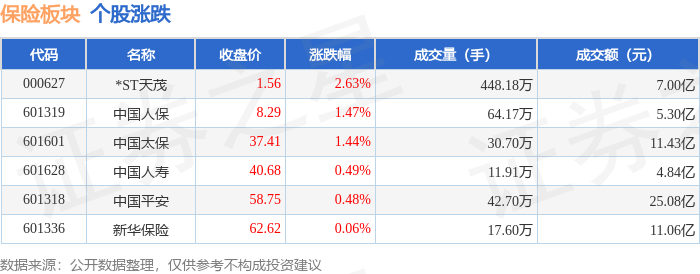
保险板块8月12日涨0.71%,*ST天茂领涨,主力资金净流入2.91亿元
Zheng Xing Xing Ye Ri Bao· 2025-08-12 08:31
证券之星消息,8月12日保险板块较上一交易日上涨0.71%,*ST天茂领涨。当日上证指数报收于 3665.92,上涨0.5%。深证成指报收于11351.63,上涨0.53%。保险板块个股涨跌见下表: | 代码 | 名称 | 主力净流入 (元) | 主力净占比 游资净流入 (元) | | 游资净占比 散户净流入 (元) | | 散户净占比 | | --- | --- | --- | --- | --- | --- | --- | --- | | 000627 | *ST天茂 | n 1.27亿 | 18.06% | -7808.91万 | -11.15% | -4841.55万 | -6.91% | | 601601 | 中国太保 | 9971.19万 | 8.72% | -1958.54万 | -1.71% | -8012.65万 | -7.01% | | 601318 中国平安 | | 5167.26万 | 2.06% | -2197.17万 | -0.88% | -2970.09万 | -1.18% | | 601628 中国人寿 | | 4726.59万 | 9.76% | 2128.42万 | 4.4 ...

宝武系!新华保险新任董事任职资格获批
Hua Er Jie Jian Wen· 2025-08-12 07:45
Core Viewpoint - Xinhua Insurance has recently announced the appointment of Zhang Xiaodong as a director, following approval from the National Financial Regulatory Administration [1][6]. Group 1: Appointment Details - Zhang Xiaodong's term as a director will commence on August 6, 2025, and will last until the end of the eighth board term [2]. - The previous director, Li Qiangqiang, resigned on June 10 due to work reasons, leading to Zhang's nomination as a candidate for the non-executive director position [6]. Group 2: Background of Zhang Xiaodong - Zhang Xiaodong currently serves as the chairman and party secretary of Huabao (Shanghai) Equity Investment Fund Management Co., Ltd., and is also a director at Shanxi Taigang Stainless Steel Co., Ltd. [3]. - He has a strong background in the steel industry, having held various positions at Taiyuan Iron and Steel (Group) Co., Ltd., including deputy chief accountant and general manager of several subsidiaries [4]. - Zhang holds a master's degree in business administration from Renmin University of China and is a senior accountant [5]. Group 3: Shareholding Context - As of the end of Q1 2025, China Baowu Steel Group, which Zhang is associated with, is the third-largest shareholder of Xinhua Insurance, holding a 12.09% stake [4].
净资产对利率的敏感性分析和保单负债成本测算:寿险公司的利差风险或可控
Hua Yuan Zheng Quan· 2025-08-12 07:09
Investment Rating - The report maintains a "Positive" investment rating for the insurance industry [4][49]. Core Insights - The report highlights that the interest spread risk for life insurance companies is manageable, despite concerns in a low interest rate environment. The average net investment yield for six major listed insurance groups has decreased from 4.7% in 2020 to 3.6% in 2024, leading to pessimism regarding the interest spread (investment yield minus liability cost) [4][8]. - The sensitivity of net assets to interest rates varies significantly among companies, with China Life and China Pacific experiencing a 13.6% and 7% decline in net assets, respectively, under a 50 basis point interest rate drop scenario [16][21]. - The cost of new policies has effectively decreased, with major companies like China Life and China Pacific seeing a reduction of approximately 50 basis points in liability costs to 2.4-2.5% in 2024 [4][36]. - The report anticipates a turning point for the cost of existing policies post-2028, as high-cost premium cash flows will cease, and companies like Xinhua are increasing equity allocations to hedge against interest rate declines [4][39]. Summary by Sections Section 1: Interest Rate Sensitivity - Long-term interest rates impact life insurance companies' net assets through three main pathways: duration gap between assets and liabilities, the effect on contracts with Variable Fee Approach (VFA), and the ultimate discount rate applied to policy contracts [13][14]. - Under a stress scenario of a 50 basis point decline in interest rates, the net asset impacts for major companies were calculated, showing varying degrees of sensitivity [16][21][27]. Section 2: New Policy Liability Costs - The liability costs for new policies have significantly decreased, with the report noting that the maximum liability rates for traditional and participating insurance products have been lowered, leading to a reduction in the break-even liability cost for major insurers [36][37]. - The report provides a detailed analysis of the break-even liability costs for major insurers from 2021 to 2024, indicating a downward trend in these costs [38]. Section 3: Existing Policy Costs - The report discusses the potential turning point for existing policy costs, with expectations that high-cost premium cash flows will diminish after 2028, thus reducing liability costs [39][40]. - Xinhua Insurance is highlighted for its strategy of increasing equity exposure to mitigate risks associated with declining interest rates, achieving significant investment returns [39][41].
五大险企“点金”权益市场 布局路线图明晰
Xin Hua Wang· 2025-08-12 06:28
Core Viewpoint - The five major A-share listed insurance companies in China believe that the current equity market has strategic allocation value, despite market fluctuations and declining interest rates [1][3]. Group 1: Investment Performance - In 2021, the five major insurance companies achieved a total net profit of CNY 215.96 billion, with China Ping An, China Life, China Pacific Insurance, China Property & Casualty, and New China Life reporting net profits of CNY 101.62 billion, CNY 50.92 billion, CNY 26.83 billion, CNY 21.64 billion, and CNY 14.95 billion respectively [2]. - The investment yield for these companies remained around 5%, with New China Life achieving the highest total investment yield of 5.90% and China Property & Casualty having the highest net investment yield at 4.80% [2]. - The successful investment performance is attributed to a "barbell strategy," which involves combining two types of investment products with significantly different styles [2]. Group 2: Market Outlook - Insurance companies see the current market adjustment as a release of risks and an opportunity for long-term investment, with a belief that the equity market is showing strategic allocation value [3]. - The macroeconomic environment in 2022 is expected to support steady growth, providing a solid foundation for the equity market [3]. - Current market valuations are considered relatively low, with major indices like the Shanghai Composite Index and CSI 300 Index below the 30th percentile of their valuations over the past decade [3]. Group 3: Investment Strategy - The focus for future equity asset allocation will be on sectors aligned with national policy directions, such as carbon neutrality, digital economy, and healthcare [4][5]. - Companies are looking to capitalize on structural investment opportunities arising from traditional industries' valuation recovery and emerging strategic sectors like consumption upgrades and technological innovation [4][5]. - There is an emphasis on exploring investment opportunities in the Hong Kong market and diversifying equity investments [5].