
ICBC(601398)

Search documents
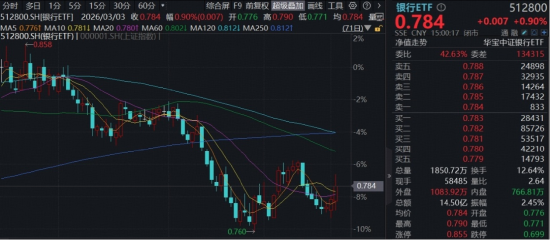
A股开启避险模式,银行强势反弹!农业银行涨近4%,规模最大银行ETF(512800)放量上探1.6%
Xin Lang Cai Jing· 2026-03-03 11:30
Core Viewpoint - The intensification of geopolitical conflicts has led to a rise in global risk aversion, resulting in a strong performance of bank stocks, with the largest bank ETF (512800) seeing a price increase of 1.67% at one point and closing up 0.9% [1][9] Group 1: Market Performance - The bank ETF (512800) recorded a trading volume of 1.45 billion yuan, the highest since December 2025 [1][9] - Major state-owned banks experienced significant gains, with Agricultural Bank rising nearly 4%, and others like Bank of Communications, Industrial and Commercial Bank, China Construction Bank, and Bank of China increasing over 2% [1][9] - Some regional banks also showed strong performance, with Chongqing Bank rising over 5% and Yunnan Rural Commercial Bank increasing over 3% [1][9] Group 2: Fund Flows and Investment Appeal - Net buying in the banking sector reached 5.334 billion yuan, making it the second highest among primary industries, following oil and transportation [3][11] - The strength of bank stocks is attributed to their "dividend + defensive" asset characteristics, as geopolitical risks have heightened market risk aversion [3][11] - As of March 3, 22 out of 42 A-share bank stocks had dividend yields exceeding 4.5%, with the overall dividend yield of the China Securities Bank Index at 4.74% and a price-to-book ratio of only 0.64 [3][11][12] Group 3: Historical Performance - The China Securities Bank Index has shown a cumulative return of 660.32% since 2005, significantly outperforming major indices like the Shanghai Composite Index and CSI 300 [4][12] - The index's performance over the last five years includes a return of 6.79% in 2025 and 34.71% in 2024, while it faced declines in 2023, 2022, and 2021 [4][13] Group 4: Investment Tools - The bank ETF (512800) and its linked funds are efficient investment tools that track the overall performance of the banking sector, with the ETF's latest scale exceeding 11 billion yuan and an average daily trading volume of over 800 million yuan since 2025 [5][14][6]




银行投资思考20260301:系统重要性银行的进与退
Guolian Minsheng Securities· 2026-03-03 10:30
Investment Rating - The report maintains a positive long-term outlook on the banking sector, indicating a preference for banks with stable performance and low valuations, expecting long-term excess returns [6]. Core Insights - The report discusses the recent changes in the list of domestic systemically important banks (SIBs) released by the People's Bank of China, highlighting the inclusion of Zhejiang Commercial Bank and the downgrade of Industrial Bank [5][10]. - The adjustments in the SIB list are primarily driven by the growth rates of on-balance and off-balance sheet assets, with banks experiencing lower growth rates facing downgrades [5][10]. - Inclusion in the SIB list or an upgrade in group classification leads to higher capital requirements, which may restrict risk asset expansion but also enhances regulatory focus and operational advantages [5][10]. - Different stakeholders, including regulators, shareholders, creditors, and depositors, have varying interests regarding the SIB changes, with implications for capital adequacy and risk management [21][22]. Summary by Sections Recent Market Performance - The banking sector underperformed compared to the broader market, with A-share banks declining by 0.96% while the Wind All A index rose by 2.75% during the specified period [4][24]. - Notable individual performances included Lanzhou Bank (+1.75%) and Zhengzhou Bank (+1.05%), while Chongqing Bank (-4.11%) and Shanghai Bank (-2.91%) saw significant declines [24]. Changes in Systemically Important Banks - The new SIB list includes Zhejiang Commercial Bank for the first time and sees Industrial Bank drop from the third to the second group, affecting the overall composition of the groups [5][10]. - The report emphasizes that the changes in the SIB list are significant for banks, with the most substantial impacts arising from inclusion or exclusion from the list rather than intra-group changes [5][10]. Investment Strategy - The report suggests a long-term positive outlook for the banking sector, with a focus on banks that exhibit strong performance and low valuations [6][11]. - Short-term strategies recommend focusing on smaller city commercial banks with low passive fund ratios and strong earnings certainty, while mid-term strategies highlight banks like Ningbo and Qingdao [6][11].


【金融服务】工商银行上海市分行成功举办第34届华交会采购对接会-东南亚专场
Xin Lang Cai Jing· 2026-03-03 10:03
Core Viewpoint - The 34th East China Import and Export Commodity Fair (referred to as "HuaJiaoHui") will be held from March 1 to 4, 2026, at the Shanghai New International Expo Center, with the Industrial and Commercial Bank of China (ICBC) Shanghai Branch actively supporting the event to promote Chinese brands internationally and contribute to the Belt and Road Initiative [1][3]. Group 1: Cross-Border Trade Facilitation - The procurement matchmaking event successfully connected nearly 30 overseas professional buyers with over 50 domestic foreign trade enterprises through both online and offline methods, facilitating deep cooperation and achieving multiple intended transaction results across various sectors such as consumer goods, daily necessities, and electronics [1][4]. Group 2: Tailored Services for Overseas Buyers - ICBC Shanghai Branch provided one-on-one exclusive guidance for overseas buyers, assisting them in identifying product needs and potential exhibitors, while also offering multilingual support for real-time translation during the event [2][5]. Group 3: Comprehensive Financial Services for Foreign Trade Enterprises - ICBC Shanghai Branch offered a range of financial services including international settlement, trade financing, and foreign exchange risk management, promoting policies for cross-border trade facilitation and new financial products to support Chinese foreign trade enterprises in the international market [3][7]. - The bank plans to enhance its cross-border financial service capabilities through strategic cooperation with government agencies, industry associations, and domestic and foreign enterprises, aiming to contribute to stabilizing foreign trade and promoting openness [7].
做好普惠金融大文章,工商银行上海市分行引金融活水润千企万户
Xin Lang Cai Jing· 2026-03-03 10:01
Core Viewpoint - The Industrial and Commercial Bank of China (ICBC) Shanghai Branch emphasizes its commitment to supporting small and micro enterprises (SMEs) as a foundation of the real economy, focusing on enhancing inclusive finance through various strategies and services [1] Group 1: Mechanism and Strategy - ICBC Shanghai Branch places inclusive finance at a strategic level, utilizing technology and institutional innovation to ensure resource allocation for SMEs [2] - The bank has established a three-tiered service system to effectively coordinate financing efforts, having visited over 45,000 SMEs to address their financing needs [2] Group 2: Product Innovation - The bank has developed a comprehensive product system tailored to different industries and scenarios, including specialized loans for technology, foreign trade, and employment support [3] - Specific products include "ICBC Innovation Loan" for tech SMEs and data-driven credit solutions for foreign trade SMEs, addressing unique financing challenges [3] Group 3: Ecosystem Development - ICBC Shanghai Branch has activated over 450 service centers dedicated to SMEs, customizing services based on local characteristics and establishing regular connections with key industrial parks [4] - The bank has formed a cooperative alliance to innovate risk-sharing models, alleviating financing difficulties for SMEs [4] Group 4: Comprehensive Services - The bank aims to provide not just financing but also intelligence and business support through a three-dimensional service system, including platforms for product display and market expansion [5] - Initiatives such as the "Youth Pioneer" teams offer personalized services to SMEs, integrating policy guidance and financial relief measures to support their growth [5]
暴涨120%!三大板块,逆市爆发
证券时报· 2026-03-03 09:16
Core Viewpoint - The oil, gas, and shipping sectors have experienced significant gains despite a broader market downturn, driven by geopolitical tensions and supply chain concerns [12][13]. Group 1: Market Performance - On March 3, major Asia-Pacific stock indices fell sharply, with the Nikkei 225 down over 3% and the Korean Composite Index down 7.24%, marking its largest single-day drop since August 5, 2024 [1]. - The A-share market also declined, with the Shanghai Composite Index dropping 1.43% to 4122.68 points, and the ChiNext Index falling 2.57% [2]. - Despite the overall market weakness, the oil, gas, and shipping sectors saw substantial gains, with major companies like China National Petroleum, China National Offshore Oil, and Sinopec hitting consecutive daily limits [2][5]. Group 2: Sector Highlights - In the oil sector, companies such as Keli Co. and Tongyuan Petroleum reached their daily limits, with Keli Co. up 30% and Tongyuan Petroleum up 20% [6][7]. - The gas sector also showed strength, with Kaiti Gas hitting a 30% limit and several other companies like Shenzhen Gas and Meino Energy seeing gains of over 20% [8][9]. - The shipping sector saw continuous gains, with companies like China Merchants Energy and China Merchants Shipping achieving daily limits [10]. Group 3: Geopolitical Impact - Reports indicate that the Strait of Hormuz has been closed by Iranian forces, raising concerns about global oil supply disruptions, as approximately 20% of the world's oil transport passes through this strait [12]. - The escalation of tensions in the Middle East is expected to significantly increase global shipping prices, benefiting various shipping segments [13]. Group 4: Banking and Insurance Performance - The banking sector showed resilience, with Agricultural Bank of China rising nearly 4% and other major banks like Industrial and Commercial Bank of China and China Construction Bank increasing over 2% [15][16]. - The insurance sector also saw gains, with companies like New China Life and China Life Insurance rising over 1% [17]. Group 5: Semiconductor Sector Decline - The semiconductor sector faced a sharp decline, with companies like Zhenlei Technology and Canxin Technology dropping over 10% [19][20]. - Despite the current downturn, institutions remain optimistic about long-term investment opportunities in semiconductor-related sectors due to ongoing demand for AI infrastructure [21][22].






内银股多数上扬 建设银行、工商银行均涨超2%
Zhi Tong Cai Jing· 2026-03-03 06:12
Group 1 - The majority of Chinese bank stocks have risen, with notable increases in shares such as Zhongyuan Bank up 4.55% to HKD 0.345, and Chongqing Rural Commercial Bank up 4.35% to HKD 6 [1] - Galaxy Securities highlights that the Central Political Bureau meeting has set the tone for the "14th Five-Year Plan," maintaining a macro policy direction of stability and proactive measures, which is favorable for bank operations and transformation [1] - The banking sector is expected to see a continuous recovery in net profit growth by 2025, with a focus on low valuation opportunities for investment [1] Group 2 - Huatai Securities notes that the difficulty in further repairing market risk premiums has increased, while high dividends still hold certain allocation value [1] - In Q4 2025, commercial banks are expected to see improved profit growth, with net interest margins remaining stable [1] - Among 12 banks that disclosed preliminary performance reports for 2025, 9 reported revenue increases and 8 reported profit improvements, indicating a potential for continued performance recovery in 2026 [1]

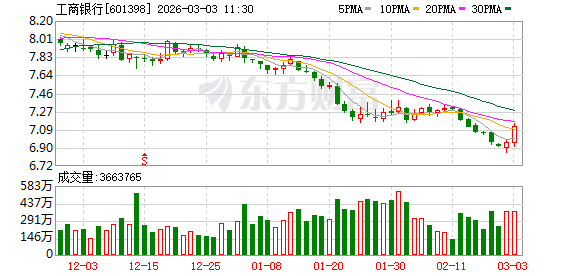
港股异动 | 内银股多数上扬 建设银行(00939)、工商银行(01398)均涨超2%
智通财经网· 2026-03-03 05:59
Group 1 - The majority of Chinese bank stocks have risen, with notable increases in shares such as Zhongyuan Bank up 4.55% to HKD 0.345, and Chongqing Rural Commercial Bank up 4.35% to HKD 6 [1] - The Central Political Bureau meeting has set the tone for the "14th Five-Year Plan," maintaining a macro policy direction of stability and proactive measures, which is favorable for bank operations and transformation [1] - Passive capital outflows are continuing to recede, with expectations for the banking sector's net profit growth rate to recover steadily by 2025, highlighting a low valuation window for bank investments [1] Group 2 - Huatai Securities notes that the difficulty in repairing market risk premiums has increased, with ongoing uncertainties in overseas markets, yet high dividends still hold certain allocation value [1] - In Q4 2025, commercial banks are expected to see improved profit growth, with net interest margins remaining stable; preliminary performance reports from 12 banks indicate revenue and profit improvements for the majority [1] - The outlook for 2026 suggests continued performance recovery driven by stable net interest margins and contributions from wealth management income [1]
工商银行2025年制造业贴现量近3.3万亿元
Xin Hua Cai Jing· 2026-03-03 03:53
Group 1 - The core viewpoint of the article highlights that by the end of 2025, Industrial and Commercial Bank of China (ICBC) expects to exceed 1 trillion yuan in discount balances for both manufacturing and technology finance, serving nearly 50,000 enterprises [2] - In 2025, the total discount amount for the manufacturing sector is projected to be approximately 3.3 trillion yuan, while the technology finance discount amount is expected to surpass 2.5 trillion yuan [2] - The discount balance for strategic emerging industries is anticipated to reach nearly 540 billion yuan by the end of 2025, with the number of clients served in specialized and innovative "little giant" enterprises increasing by 210% year-on-year [2] Group 2 - ICBC has launched a specialized product called "Technology Innovation Discount" to cater to the financing needs of technology enterprises, leveraging its advantages in low-cost and high-efficiency bill services [2] - The bank is actively participating in the innovation of the national unified bill market, having successfully executed the first bill discount business on a newly established comprehensive service platform [2] - ICBC is enhancing the accessibility and inclusiveness of its bill financing services by bringing these services to grassroots outlets, ensuring that professional financial services reach enterprises directly [2] Group 3 - The bank is integrating financial technology with its bill business, utilizing AI models to create a chain service system that automates the processing of trade background materials, significantly reducing the time required for review from hours to minutes [3] - This automation not only minimizes operational errors but also greatly improves the efficiency of the discount processing, enhancing the overall experience for enterprises seeking bill discount services [3]
工商银行对《电子银行章程》进行了修订完善
Jin Tou Wang· 2026-03-03 03:22
Core Viewpoint - The announcement by Industrial and Commercial Bank of China (ICBC) regarding the revision of the "Electronic Banking Charter" aims to enhance customer experience and service quality, effective from April 1, 2026 [1] Group 1: Announcement Details - ICBC has revised and improved the "Electronic Banking Charter" to provide more comprehensive and high-quality services [1] - The revised charter will officially take effect on April 1, 2026 [1] - Customers can inquire about the changes through various channels, including customer service hotline, official website, and mobile banking apps [1] Group 2: Customer Options - Customers who disagree with the modifications to the charter can choose to cancel their electronic banking services during the announcement period [1] - If customers do not cancel or continue using electronic banking after the announcement period, they will be deemed to have accepted the changes to the charter [1]
固收周报:避险情绪主导债市,美债收益率显著回落-20260302



工银国际· 2026-03-02 11:58
Report Summary 1. Investment Rating The provided content does not mention the investment rating of the industry. 2. Core View - The market sentiment is dominated by risk - aversion, leading to a significant decline in US Treasury yields. The 10 - year and 2 - year US Treasury yields decreased by 15 and 10 basis points respectively last week to 3.94% and 3.37%. Although recent data shows a rebound in US inflation pressure, risk - aversion sentiment has overshadowed this, causing the yields to drop [1][2][3]. - The geopolitical conflict between the US, Israel and Iran has escalated, with the US and Israel launching military actions against Iran and Iran counter - attacking and blocking the Strait of Hormuz. This has led to a sharp rise in crude oil prices, which may affect inflation. The military action may last for four weeks, and in the short term, US Treasuries may remain volatile under the resonance of risk - aversion and rising inflation expectations. Higher - than - expected inflation data and the rise in energy prices triggered by geopolitical conflicts have further reduced the possibility of the Fed cutting interest rates in March [1][3]. - Driven by the significant decline in US Treasury yields, Chinese dollar - denominated bonds performed well last week, with the Bloomberg Barclays Chinese dollar - denominated bond total return index rising 0.4% for the week. Among them, the high - rating index rose 0.5% and the high - yield index rose 0.2% [1][3]. - In the on - shore market, after the Spring Festival, the central bank net - withdrew short - term liquidity of 611.4 billion RMB through reverse repurchase operations and net - injected long - term funds of 300 billion RMB through MLF over - renewal. Bank - to - bank funding rates have rebounded significantly compared to before the Spring Festival. The 3 - year and 10 - year Treasury yields were flat and up 2 basis points respectively compared to before the Spring Festival, reaching 1.38% and 1.82%. The domestic interest - rate bond market was also boosted by risk - aversion sentiment on Monday, with yields on Treasury bonds of various maturities generally declining. The Two Sessions will be held this week, and the 2026 economic targets, fiscal support, and possible release of more monetary policy signals will be priced in the bond market [1][4]. 3. Summary by Category Off - shore Market - The issuance of Chinese dollar - denominated bonds remained light, with only one new issuance of over $100 million for the whole week. In contrast, the issuance of off - shore RMB bonds was quite active, with a total issuance of 65.5 billion RMB for the whole week, mainly driven by the issuance of 50 billion RMB central bank bills by the People's Bank of China [2]. - The significant decline in US Treasury yields was due to the market being dominated by risk - aversion sentiment. Although recent inflation data in the US has rebounded, the geopolitical risk has significantly escalated, and the US Treasury market has priced in the war risk in advance [2][3]. On - shore Market - After the Spring Festival, funds flowed back to the banking system. The central bank adjusted the liquidity through reverse repurchase operations and MLF. Bank - to - bank funding rates increased, and the yields of 3 - year and 10 - year Treasury bonds changed compared to before the Spring Festival. The domestic interest - rate bond market was affected by risk - aversion sentiment, and the yields of Treasury bonds of various maturities declined. The upcoming Two Sessions may bring new economic and policy signals to the bond market [1][4]. List of Chinese Dollar - denominated Bonds The documents provide a detailed list of Chinese dollar - denominated bonds, including information such as issuers, guarantors, coupon rates, issuance amounts, maturities, and ratings [7][17][23].