
ICBC(601398)

Search documents
上调至100%!金价迅猛上涨,国有大行紧急出手
Sou Hu Cai Jing· 2026-02-27 00:39
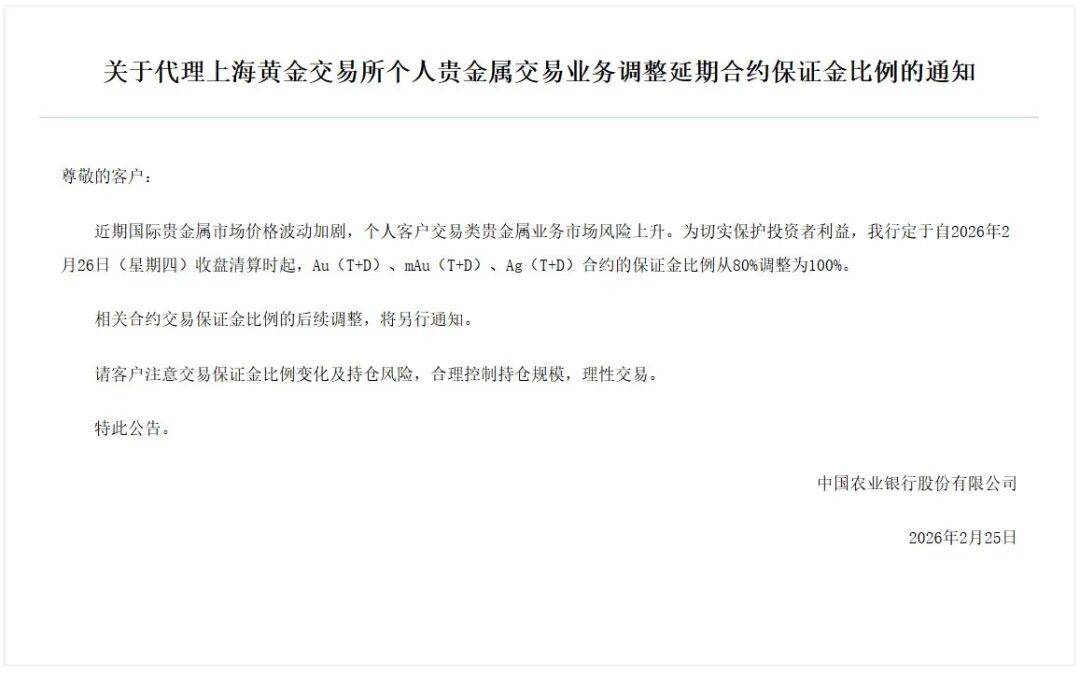
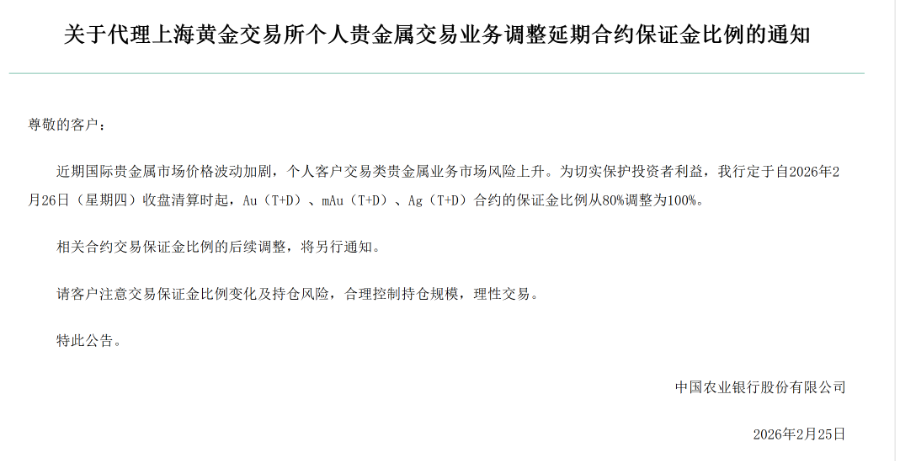
Core Viewpoint - The recent adjustments in margin requirements for personal precious metals trading by several banks reflect increased market volatility and risk in the international precious metals market, particularly gold and silver. Group 1: Price Movements - London spot gold rebounded to over $5200 per ounce on February 26, following a period of price fluctuations [1] - Major jewelry brands in China, such as Chow Tai Fook, reported an increase in gold prices, with the latest price for 24K gold jewelry at 1576 RMB per gram, up from 1570 RMB per gram [1] Group 2: Margin Requirement Adjustments - Agricultural Bank of China announced an increase in the margin requirement for personal precious metals trading from 80% to 100% effective February 26, 2026, due to heightened market risks [2] - Industrial and Commercial Bank of China also confirmed a similar adjustment, effective February 27, 2026, for various gold and silver contracts [4][5] - Other banks, including China Construction Bank and Bank of China, have also made similar margin adjustments in response to market conditions [8] Group 3: Price Increase Announcements - Multiple jewelry brands are expected to raise prices, with Chow Tai Fook planning a price adjustment for gold products around March 10, with anticipated increases of 15% to 30% [11] - Lao Pu Gold announced a price increase starting February 28, 2026, following previous adjustments in 2025 [11] Group 4: Market Outlook - Deutsche Bank maintains a bullish outlook on gold prices, predicting a target of $6000 per ounce, supported by strong demand for gold and other precious metals [12] - JPMorgan has raised its long-term gold price forecast to $4500 per ounce, while maintaining a year-end target of $6300 per ounce for 2026 [12] - Bank of America anticipates gold prices could reach $6000 per ounce within the next 12 months, despite potential short-term declines in silver prices [12]




各大银行盯上了压岁钱:孩子存1000元,比你存20万利息高
Mei Ri Jing Ji Xin Wen· 2026-02-27 00:26
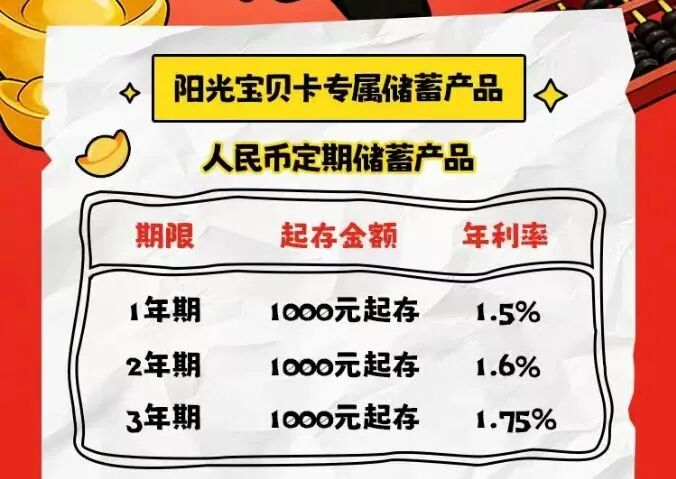
Core Insights - The article discusses the emerging trend of banks offering higher interest rates on children's savings accounts compared to traditional adult deposit products, indicating a strategic shift in the banking sector towards targeting the youth market [1][2][3]. Group 1: Interest Rate Dynamics - Beijing Rural Commercial Bank's "Sunshine Baby Card" offers a three-year interest rate of 1.75%, surpassing both the bank's standard fixed deposit rates and high-value time deposit rates [1][2]. - This "interest rate inversion" phenomenon, where children's small deposits yield higher rates than adult large deposits, is becoming a common strategy among banks to attract young customers [2][3]. Group 2: Strategic Implications - Industry experts suggest that this trend represents a long-term investment in customer lifetime value, as banks aim to establish emotional connections with young clients who will have a financial lifecycle of 50 to 60 years [3][7]. - The strategy allows banks to optimize their liability structure and manage liquidity more effectively, as children's savings typically have long retention periods and lower transaction frequencies [3][7]. Group 3: Product Offerings and Market Segmentation - Different types of banks are creating tailored product matrices to capture the significant market of "lucky money" from the Chinese New Year, focusing on specialized accounts, unique deposits, and parent-child co-management [4][5][6]. - State-owned banks leverage their comprehensive financial services to create one-stop solutions for financial management and education, while joint-stock banks emphasize differentiated account features and service experiences [4][5]. Group 4: Long-term Relationship Building - The shift towards children's financial products is seen as a transition from merely attracting deposits to building long-term relationships with families, allowing banks to access a broader range of financial needs within households [7][8]. - Successful examples include banks like China Merchants Bank and Beijing Bank, which have reported significant growth in their child account customer bases, indicating the effectiveness of this strategy in establishing family financial connections [8]. Group 5: Future Directions - Analysts recommend that banks expand their children's financial services within compliance frameworks, enhancing product offerings and integrating financial literacy education to create a comprehensive service ecosystem [9]. - The focus should be on transforming "lucky money" into a child's first financial asset, emphasizing the importance of financial education and responsible management of funds [9].



多家银行推出亲子产品 让压岁钱变身财商课
Xin Lang Cai Jing· 2026-02-26 23:52
Core Insights - The article discusses how banks are competing for children's New Year's money by offering attractive savings products and higher interest rates, emphasizing financial education for children [2][4]. Interest Rate Competition - Major banks, including state-owned and city commercial banks, have increased their medium to long-term deposit rates, particularly for three-year fixed deposits, which are now more appealing [2]. - The five major state-owned banks maintain a three-year deposit interest rate around 1.55%, while some joint-stock banks offer rates around 1.75% [2]. - City commercial banks have emerged as leaders in this interest rate competition, with three-year rates generally between 1.8% and 2.0%, with some banks like Jilin Bank and Fuxin Bank reaching 2.0% [2]. Product Innovation - Banks are focusing on the emotional and educational aspects of their products, with new offerings like the "Youth Version" savings account designed for children under 16, which can be opened by guardians [4]. - These children's accounts often come with additional features such as point systems that can be exchanged for educational materials, aiming to extend the savings process into a financial education journey [4]. Financial Guidance - Financial advisors suggest that parents open children's savings accounts to diversify asset allocation, which can help children understand basic financial concepts and create a substantial education fund over time [5]. - The approach not only serves as a financial gift but also instills a sense of family responsibility and emotional connection, making the New Year's money a valuable part of the child's growth [5].

继续降,部分银行代理贵金属业务杠杆已降至1倍
Di Yi Cai Jing· 2026-02-26 22:46
Core Viewpoint - The recent fluctuations in gold and silver prices have prompted banks to increase margin requirements for precious metals trading, reflecting heightened market risks and regulatory compliance needs [2][4][8]. Group 1: Margin Adjustments by Banks - Agricultural Bank of China announced an increase in margin requirements for gold and silver contracts from 80% to 100% due to rising market risks [4]. - Industrial and Commercial Bank of China also raised the margin for various gold and silver contracts to 100%, following a previous increase from 60% to 80% [4][5]. - Several banks, including China Construction Bank and Bank of China, have similarly adjusted their margin requirements, with some reaching 100% [5][6]. Group 2: Regulatory and Compliance Actions - Banks are not only increasing margins but also cleaning up existing business, including closing accounts with no activity and reducing transaction channels [2][10]. - Postal Savings Bank announced a complete cessation of certain precious metals trading services, with mandatory liquidation for inactive accounts by a specified deadline [10]. - Many banks have already suspended new account openings and trading activities in precious metals, focusing on existing clients [9][10]. Group 3: Market Context and Implications - The adjustments in margin requirements come in response to significant price volatility in the precious metals market, which has seen historical highs [8]. - The tightening of margin requirements indicates a broader trend of risk management among banks in the face of fluctuating commodity prices [2][8].




南方中证全指农牧渔交易型开放式指数证券投资基金基金份额发售公告
Shang Hai Zheng Quan Bao· 2026-02-26 18:18
Core Points - The Southern CSI All-Index Agriculture, Animal Husbandry, and Fishery ETF has been registered with the China Securities Regulatory Commission and will be available for subscription from March 9 to March 20, 2026 [1][4][17] - The fund is classified as an equity-type open-ended index fund and will be managed by Southern Fund Management Co., Ltd. with China Industrial and Commercial Bank as the custodian [1][4][9] - The maximum fundraising limit for the fund is set at 8 billion RMB, and the subscription fee will not exceed 0.3% [15][18] Fund Subscription Details - Investors can subscribe through online cash subscription or offline cash subscription methods, both available from March 9 to March 20, 2026 [17][31] - A minimum subscription of 1,000 shares is required for both online and offline subscriptions, with no upper limit on total subscriptions unless specified by regulations [10][31] - Investors must have a Shenzhen A-share account or a Shenzhen securities investment fund account to participate in the subscription [24][26] Fund Management and Operations - The fund will adopt a "day-end proportional confirmation" method to control the subscription scale, ensuring that if the total valid subscription approaches or exceeds 8 billion shares, the fundraising will be closed early [15][16] - The fund will be listed on the Shenzhen Stock Exchange, and investors will be able to trade on the secondary market after the fund is launched [9][39] - The fund's net value may fluctuate due to market conditions, and investors are encouraged to understand the product characteristics and risks before investing [7][8]
银行存贷差走阔意味着什么?
GF SECURITIES· 2026-02-26 15:12
Investment Rating - The report provides a "Buy" rating for the banking sector, indicating an expectation that stock prices will outperform the market by more than 10% over the next 12 months [54]. Core Insights - Recent high growth in bank deposits has led to market interpretations of banks being "asset deficient." However, this interpretation is challenged by the contractual nature of banking operations, where deposits and loans are derived simultaneously [4][12]. - The widening of the loan-to-deposit spread (LDR) is influenced by six key factors: cash withdrawal demand, reserve requirements, interbank lending, bond investment scale, bond issuance, and bank capital [4][14]. - The increase in net bond financing is a significant factor contributing to the widening of the loan-to-deposit spread. Two scenarios are identified: when bond financing costs are lower than loan rates, and when non-bank entities reduce their borrowing, leading to a return of funds to banks [4][35]. - From January 2025 to January 2026, the loan-to-deposit spread widened by 11.4 trillion CNY, with new bond investments contributing 16.6 trillion CNY and market bond net financing at 20.6 trillion CNY [4][45]. - In January 2026, net bond investment increased by 1.9 trillion CNY, while total market bond net financing was only 1.4 trillion CNY, indicating a negative contribution of -9.68% from bond financing to the loan-to-deposit spread [4][45]. Summary by Sections Section 1: Implications of Widening Loan-to-Deposit Spread - The loan-to-deposit spread for large banks increased from 15.8 trillion CNY in January 2025 to 21.8 trillion CNY in January 2026, while for medium-sized banks, it rose from 16.5 trillion CNY to 23.5 trillion CNY [12]. - The decline in loan-to-deposit ratios for large banks from 89.1% to 86.5% and for medium-sized banks from 88.3% to 84.7% reflects a shift in asset allocation demands [12]. Section 2: Factors Influencing Loan-to-Deposit Spread - The six factors affecting the loan-to-deposit spread include: 1. Cash withdrawal demand 2. Reserve situation 3. Interbank lending to non-banking entities 4. Scale of bond investments 5. Bond issuance 6. Bank capital [4][14]. - The report emphasizes that the relationship between bond financing and loans must differentiate between government and non-government bonds, as the issuance of government bonds does not affect the loan-to-deposit spread [4][35]. Section 3: Analysis of Recent Changes in Bank Assets and Liabilities - The report details the contributions of various factors to the loan-to-deposit spread, including a -47% contribution from bank funds exiting the balance sheet and a 173% contribution from the substitution effect of bonds for loans [4][45]. - The analysis of January 2026 data shows that non-bank funds returning to banks contributed 25.9% to the loan-to-deposit spread, while interbank net assets contributed 43.3% [4][45].
继续降!部分银行代理贵金属业务杠杆已降至1倍
Di Yi Cai Jing· 2026-02-26 14:31
Core Viewpoint - The recent fluctuations in gold and silver prices have prompted banks to increase margin requirements for precious metal trading, effectively reducing leverage to 1 for many institutions [1][4]. Group 1: Margin Adjustments by Banks - Agricultural Bank announced an increase in margin requirements for gold and silver contracts from 80% to 100% due to heightened market risks [2]. - Industrial and Commercial Bank also raised its margin requirements for various gold and silver contracts to 100%, following a previous increase from 60% to 80% [2]. - Other banks, including China Construction Bank and Bank of China, have similarly raised their margin requirements, with some reaching 100% [4]. Group 2: Regulatory and Compliance Actions - Banks are not only increasing margin requirements but are also cleaning up existing business, including the closure of accounts with no activity and the reduction of trading channels [1][6]. - Some banks, like Postal Savings Bank, have announced the cessation of related business, with plans for forced liquidation of positions if clients do not act by specified deadlines [8]. Group 3: Market Context and Risk Management - The Shanghai Gold Exchange recently adjusted margin levels downward, yet banks have chosen to increase their margin requirements, indicating a cautious approach to risk management amid volatile market conditions [3][4]. - The tightening of margin requirements reflects a broader trend of banks reducing exposure to precious metals trading, particularly for new accounts and positions [6][7].

去杠杆!工行、农行上调个人贵金属延期合约保证金比例
2 1 Shi Ji Jing Ji Bao Dao· 2026-02-26 14:17
Core Viewpoint - Major Chinese banks, including Industrial and Agricultural Banks, have raised the margin requirement for personal precious metals deferred business from 80% to 100% in response to increased market volatility and rising personal investment interest in precious metals [1][4]. Group 1: Market Conditions - International precious metal prices have been fluctuating at high levels, with London spot gold reaching $5,205.472 per ounce on February 26 [1]. - The domestic futures market for gold and silver also opened significantly higher on the first trading day of the Year of the Horse, indicating a continued rise in market sentiment [1]. Group 2: Bank Actions - Agricultural Bank announced the margin increase effective from February 26, citing heightened market risks associated with personal trading in precious metals [1]. - Industrial Bank followed suit, implementing the same margin adjustment for various gold and silver contracts starting February 27 [4]. Group 3: Contract Types - The contracts affected include Au (T+D), mAu (T+D), Ag (T+D), and others, which represent different types of deferred trading products for gold and silver [7][8]. - The adjustment in margin requirements is expected to reduce leverage in trading, promoting more rational investment behavior among clients [8]. Group 4: Historical Price Trends - Since 2025, precious metal prices, particularly gold, have surged, with a nearly 65% increase in the annual price of London gold [8]. - In 2026, gold prices continued to rise, surpassing $5,500 per ounce, attracting a large number of personal investors and amplifying market risks [8]. Group 5: Industry Response - Prior to the margin increase, several banks had begun to tighten their personal precious metal trading operations, with some banks announcing the closure of related business functions [9]. - For instance, Postal Savings Bank announced the cessation of its personal precious metal business effective January 12, 2026 [9].
银行业2025年四季度监管数据总结:利润增速回正,息差连续两季度企稳
GF SECURITIES· 2026-02-26 14:05
Investment Rating - The industry investment rating is "Buy" [2] Core Viewpoints - The banking industry has shown a recovery in profit growth, with net profit for commercial banks increasing by 2.33% year-on-year in 2025, reflecting a quarter-on-quarter improvement of 2.35 percentage points [13][14] - The overall asset growth of commercial banks continued, with total assets increasing by 9.01% year-on-year as of Q4 2025, while loan growth slightly decreased to 7.26% year-on-year [29][30] - Net interest margin stabilized for two consecutive quarters at 1.42%, with expectations for a gradual recovery in 2026 [54] Summary by Sections Performance - The net profit of commercial banks increased by 2.33% year-on-year in 2025, with state-owned banks, joint-stock banks, city commercial banks, and rural commercial banks showing growth rates of 2.25%, -2.84%, 12.87%, and 4.57% respectively [13][14] - The return on equity (ROE) and return on assets (ROA) for commercial banks were 7.78% and 0.60%, reflecting a year-on-year decline of 0.33 percentage points and 0.03 percentage points respectively [13] Scale - Total assets of commercial banks grew by 9.01% year-on-year as of Q4 2025, with state-owned banks showing a growth rate of 10.78% [29][30] - Loan growth for commercial banks was 7.26% year-on-year, with city commercial banks experiencing a counter-cyclical increase in loan growth [29][30] Interest Margin - The net interest margin for commercial banks was stable at 1.42%, with a year-on-year decline of 10.50 basis points [54] - Expectations for 2026 indicate potential downward pressure on net interest margins in Q1, but a gradual recovery is anticipated thereafter [54] Asset Quality - The non-performing loan ratio for commercial banks was 1.50%, showing a quarter-on-quarter decrease of 2.00 basis points, while the provision coverage ratio was 205.21% [54] Capital - The core Tier 1 capital adequacy ratio for commercial banks was 10.92%, reflecting a quarter-on-quarter increase of 0.05 percentage points [54]

保证金比例上调至100%!金价迅猛上涨,工行、农行紧急出手
2 1 Shi Ji Jing Ji Bao Dao· 2026-02-26 13:56
Core Viewpoint - The international precious metals market continues its strong performance post-Spring Festival, with London spot gold reaching $5,205.472 per ounce on February 26, 2023, following a series of rebounds [1] Group 1: Market Trends - The prices of international precious metals are experiencing sustained high volatility, attracting increased personal investment interest [1] - The recent price movements indicate a robust demand for gold, as evidenced by the significant price levels achieved [1] Group 2: Regulatory Actions - Industrial and Agricultural Banks have announced an increase in the margin ratio for personal precious metals deferred business from 80% to 100% [1] - This adjustment in margin requirements effectively reduces the leverage level in trading, promoting more rational investment behavior among clients [1] - The change means that a contract valued at 1 million yuan, which previously required 800,000 yuan in margin (approximately 1.25 times leverage), now requires the full 1 million yuan (1 time leverage) [1] Group 3: Risk Management - The increase in margin requirements is a proactive measure by financial institutions to mitigate potential risks during a period of historical high prices and increased market volatility [1] - This action aligns with the implementation of investor suitability management practices [1]