
KJS(601579)

Search documents
会稽山涨2.01%,成交额1.31亿元,主力资金净流入276.21万元
Xin Lang Zheng Quan· 2025-11-25 06:02
Group 1 - The core viewpoint of the news is that Kuaijishan has shown significant stock performance with a year-to-date increase of 95.26%, despite recent declines in the last five, twenty, and sixty trading days [1] - As of November 25, Kuaijishan's stock price is 20.83 yuan per share, with a market capitalization of 9.987 billion yuan and a trading volume of 1.31 billion yuan [1] - The company has been actively traded, appearing on the "Dragon and Tiger List" three times this year, with the most recent occurrence on May 27 [1] Group 2 - Kuaijishan's main business involves the production, sales, and research of Shaoxing yellow wine, with revenue composition being 75.67% from yellow wine and 24.33% from other sources [1] - As of September 30, the company reported a revenue of 1.212 billion yuan for the first nine months of 2025, reflecting a year-on-year growth of 14.12%, and a net profit attributable to shareholders of 116 million yuan, up 3.23% [2] - The number of shareholders increased by 14.94% to 29,900, while the average circulating shares per person decreased by 13.00% to 16,025 shares [2] Group 3 - Kuaijishan has distributed a total of 793 million yuan in dividends since its A-share listing, with 431 million yuan distributed over the past three years [3] - Among the top ten circulating shareholders, the Wine ETF (512690) is the fifth largest, holding 7.4086 million shares, an increase of 2.4553 million shares from the previous period [3] - Hong Kong Central Clearing Limited is the eighth largest shareholder, holding 4.958 million shares, which is a decrease of 979,900 shares compared to the previous period [3]

“黄酒一哥”地位有变,古越龙山跨界啤酒寻增量
Bei Ke Cai Jing· 2025-11-25 03:17
Core Viewpoint - The leading advantage of Guyue Longshan, the top player in the yellow wine market, is gradually diminishing, as its revenue has been surpassed by its competitor, Kuaijishan, in the first three quarters of this year [1][2]. Financial Performance - In the first three quarters, Guyue Longshan reported revenue of 1.186 billion yuan, a year-on-year decline of 8.1%, while net profit was 135 million yuan, a slight increase of 0.17% [2]. - The third quarter revenue was 293 million yuan, down nearly 27% year-on-year, with net profit at 40 million yuan, an increase of 11.78%. However, the non-recurring net profit dropped to 582,000 yuan, a decrease of 85.26% [2][3]. - The cash flow from operating activities was negative 189 million yuan, reflecting a significant decrease in contract liabilities by 68.16% [2]. Market Competition - Guyue Longshan's sales in its home market of Zhejiang fell by over 10%, while Kuaijishan's sales in the same region increased by 17.89% [3]. - The competition between Guyue Longshan and Kuaijishan has intensified, with analysts noting that the gap in revenue and net profit between the two companies has been narrowing in recent years [5][6]. Product Strategy and Challenges - The company faces challenges in upgrading its product structure and has not fully capitalized on the high-end market, with the gross margin for mid-to-high-end products only slightly increasing [4][5]. - The mainstream price range for yellow wine has not significantly increased compared to other alcoholic beverages, limiting the company's ability to enhance brand value [4][5]. Innovation and Collaboration - Guyue Longshan has partnered with China Resources Beer to launch a cross-border product combining yellow wine and beer, aiming to leverage the extensive distribution network of China Resources [7][8]. - The effectiveness of this collaboration in expanding the market for yellow wine outside its traditional regions remains to be seen [8]. Product Line and Brand Positioning - Investors have raised concerns about the complexity and unclear positioning of Guyue Longshan's product line, suggesting a need for a more focused approach to enhance consumer loyalty [9][10]. - The recent change in indirect controlling shareholder may lead to potential brand enhancement and market growth opportunities for the company [10].

会稽山跌2.01%,成交额1.07亿元,主力资金净流出1063.03万元
Xin Lang Cai Jing· 2025-11-24 02:45
Group 1 - The core viewpoint of the news is that Kuaijishan's stock has experienced a decline recently despite a significant increase in its price year-to-date, indicating potential volatility in the market [1][2] - As of November 24, Kuaijishan's stock price is 20.52 yuan per share, with a market capitalization of 9.839 billion yuan and a trading volume of 1.07 billion yuan [1] - The company has seen a year-to-date stock price increase of 92.35%, but it has declined by 10.35% in the last five trading days [1] Group 2 - Kuaijishan's main business involves the production, sales, and research of Shaoxing yellow wine, with revenue composition being 75.67% from yellow wine and 24.33% from other sources [1] - For the period from January to September 2025, Kuaijishan achieved an operating income of 1.212 billion yuan, representing a year-on-year growth of 14.12%, and a net profit attributable to shareholders of 116 million yuan, up 3.23% year-on-year [2] - The company has distributed a total of 793 million yuan in dividends since its A-share listing, with 431 million yuan distributed in the last three years [3]
毕马威:2025年中国黄酒产业中期研究报告
Sou Hu Cai Jing· 2025-11-23 18:02
Core Insights - The report analyzes the current state, market environment, consumer characteristics, and future direction of the Huangjiu industry in China, highlighting its transition period between tradition and innovation, facing both challenges and opportunities from policies and market dynamics [1][2]. Industry Overview - Huangjiu production is widespread across China, with a concentration in the Jiangsu, Zhejiang, and Shanghai regions, particularly in Shaoxing, which is recognized as the "Hometown of Huangjiu" [15]. - Leading companies such as Guyue Longshan and Kuaijishan are driving industry development, with a focus on high-end and innovative products to attract younger consumers [15][2]. Market Performance (2024-2025) - The Huangjiu industry is expected to see a rise in both volume and price, with total revenue projected to reach 20 billion yuan in 2024, reflecting a 5.26% increase year-on-year [21]. - The three A-share Huangjiu listed companies reported a combined revenue of 4.146 billion yuan in 2024, marking a 10% increase from the previous year [22]. - Online sales for the top three companies surged by 42.3% year-on-year, indicating a strong shift towards e-commerce channels [26]. Market Environment - Continuous policy support has been observed, with Huangjiu being recognized as a classic industry, leading to various local governments implementing supportive measures [2]. - Major companies have collectively raised prices, enhancing the revenue share of mid-to-high-end products [2]. Consumer Insights - Male consumers dominate the market, accounting for 68.7%, with the primary age group being over 25 years old [2]. - Consumption scenarios primarily include social gatherings and family meals, with health and wellness being key motivators for purchasing decisions [2]. Future Development Suggestions - The report suggests several strategies for the Huangjiu industry, including leveraging traditional techniques for product innovation, enhancing brand culture, and promoting national and international expansion [2]. - The industry faces challenges in internationalization, particularly in cultural differences and channel development, necessitating a collaborative effort across the sector [2].



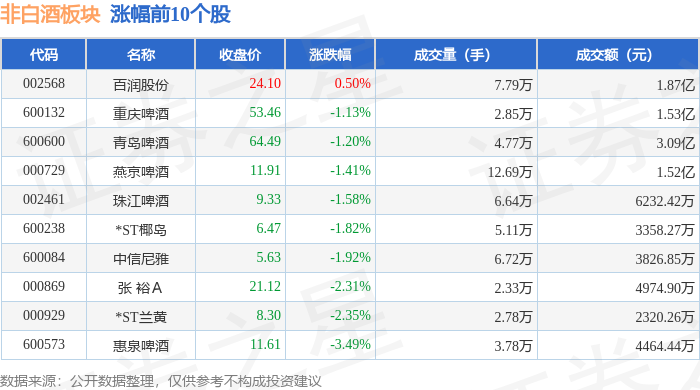
非白酒板块11月21日跌1.81%,会稽山领跌,主力资金净流出1.55亿元
Zheng Xing Xing Ye Ri Bao· 2025-11-21 09:33
Market Overview - The non-liquor sector experienced a decline of 1.81% on November 21, with Kuaijishan leading the drop [1] - The Shanghai Composite Index closed at 3834.89, down 2.45%, while the Shenzhen Component Index closed at 12538.07, down 3.41% [1] Stock Performance - Kuaijishan (601579) saw a significant drop of 5.97%, closing at 20.94 with a trading volume of 169,100 shares and a turnover of 368 million yuan [2] - Other notable declines include: - Caogao Co. (600543) down 5.81% to 6.00 - ST Xifa (000752) down 4.99% to 11.61 - Weilang Co. (603779) down 4.18% to 6.87 [2] Capital Flow - The non-liquor sector experienced a net outflow of 155 million yuan from institutional investors, while retail investors saw a net inflow of 116 million yuan [2] - The capital flow for specific stocks includes: - Zhongxin Niya (600084) with a net inflow of 2.65 million yuan from retail investors [3] - Zhang Yu A (000869) with a net outflow of 3.54 million yuan from retail investors [3] - Kuaijishan (601579) had a significant net outflow of 799.52 million yuan from institutional investors [3]
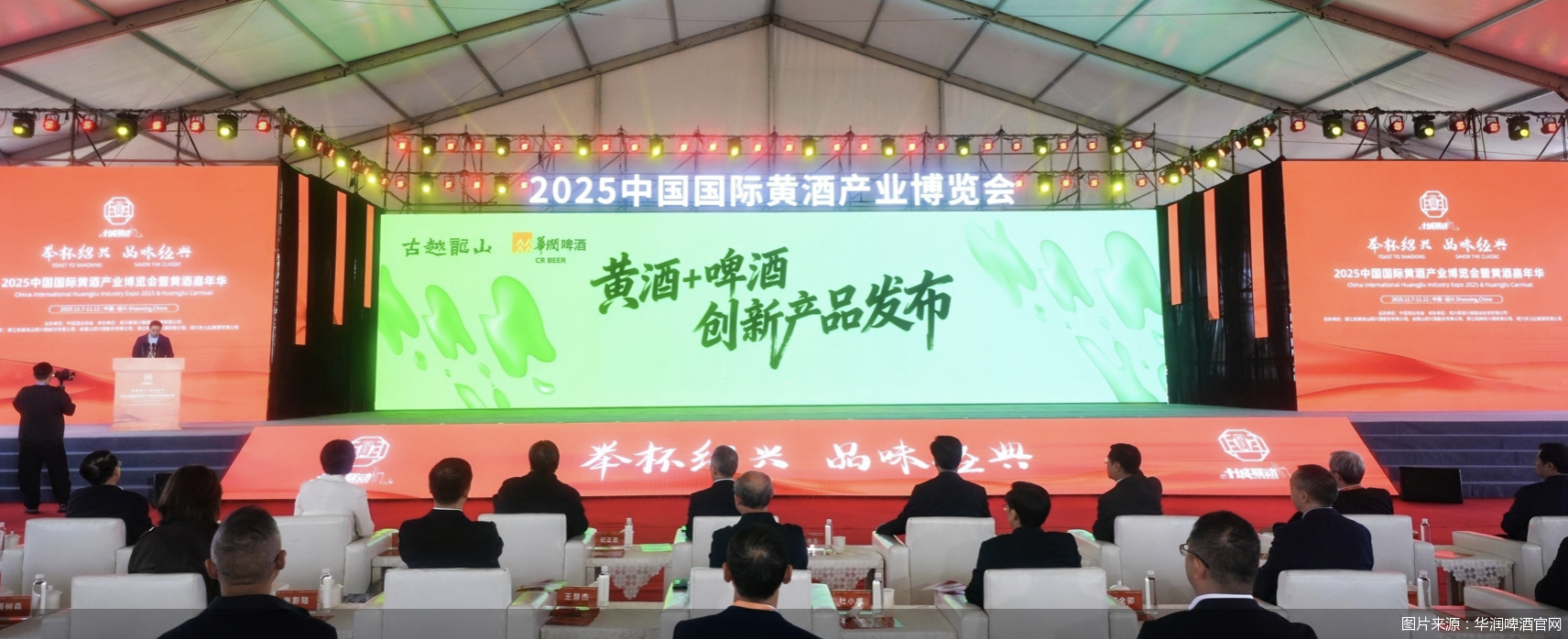
产品、营销玩法频出 跨界混搭能成黄酒出圈正解吗
Bei Jing Shang Bao· 2025-11-20 13:45
Core Insights - The traditional yellow wine industry is at a transformative crossroads, with leading brands exploring cross-industry collaborations to expand their consumer market [1][3] - The industry faces multiple challenges, including limited consumption regions and scenarios, prompting companies to seek new growth opportunities through innovative partnerships [1][6] Group 1: Industry Trends - Major yellow wine brands like Guyue Longshan and Kuaijishan are actively engaging in cross-industry collaborations, such as the launch of "Yue Xiao Pi" in partnership with China Resources Beer [3][4] - Guyue Longshan has introduced various innovative products, including coffee-infused yellow wine and a whiskey variant, indicating a shift towards younger consumer preferences [4][10] - The yellow wine market is experiencing a trend towards diversification, with brands exploring new consumption scenarios beyond traditional settings [4][9] Group 2: Market Dynamics - The yellow wine market is highly concentrated, with the Jiangsu, Zhejiang, and Shanghai regions accounting for over 70% of sales, leading to intense competition [6][7] - Financial reports reveal that Guyue Longshan and Kuaijishan derive a significant portion of their revenue from these regions, highlighting the geographical limitations of the market [6][7] - Despite the challenges, the yellow wine industry is projected to grow, with sales expected to exceed 300 billion yuan by 2025, driven by a shift in consumer preferences towards lower-alcohol beverages [9][10] Group 3: Consumer Engagement - Marketing experts suggest that yellow wine brands should enhance their appeal to younger consumers through innovative marketing strategies, including social media and influencer collaborations [5][11] - The emergence of "slow bars" and other experiential venues is seen as a way to engage consumers and gather valuable data on preferences and behaviors [10][11] - The industry must address the perception issues surrounding yellow wine, which has been labeled as "cooking wine," to improve brand recognition and value [7][8]
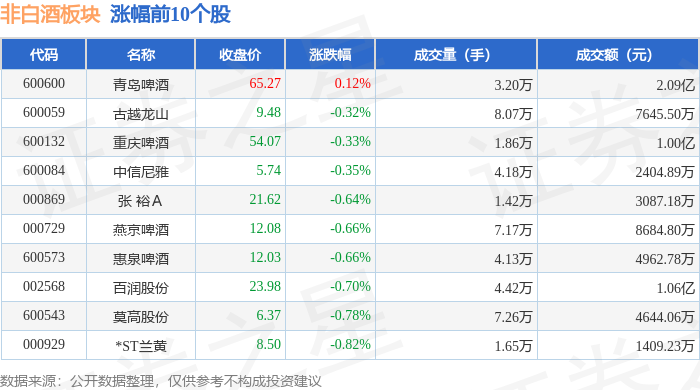
非白酒板块11月20日跌0.59%,会稽山领跌,主力资金净流出7488.33万元
Zheng Xing Xing Ye Ri Bao· 2025-11-20 09:09
Core Points - The non-liquor sector experienced a decline of 0.59% on the trading day, with Kuaijishan leading the drop [1] - The Shanghai Composite Index closed at 3931.05, down 0.4%, while the Shenzhen Component Index closed at 12980.82, down 0.76% [1] Non-Liquor Sector Summary - Kuaijishan (601579) closed at 22.27, down 2.15%, with a trading volume of 99,600 shares and a transaction value of 222 million yuan [2] - Other notable declines include ST Xifa (000752) down 2.00% and ST Yedao (600238) down 1.49% [2] - The overall net capital flow for the non-liquor sector showed a net outflow of 74.88 million yuan from main funds, while retail investors saw a net inflow of 78.72 million yuan [2]
非白酒板块11月19日跌0.33%,*ST椰岛领跌,主力资金净流出1298.75万元
Zheng Xing Xing Ye Ri Bao· 2025-11-19 08:52
Market Overview - The non-liquor sector experienced a decline of 0.33% on the previous trading day, with *ST Yedao leading the drop [1] - The Shanghai Composite Index closed at 3946.74, up 0.18%, while the Shenzhen Component Index closed at 13080.09, unchanged [1] Stock Performance - Key stocks in the non-liquor sector showed varied performance, with Kuaijishan (601579) rising by 1.47% to a closing price of 22.76, while *ST Yedao (600238) fell by 3.60% to 6.69 [1][2] - Other notable movements included ST Xifa (000752) increasing by 1.22% and Zhangyu A (000869) rising by 0.28% [1] Trading Volume and Value - Kuaijishan recorded a trading volume of 174,100 shares, with a transaction value of approximately 3.95 million yuan [1] - The total net outflow of main funds in the non-liquor sector was 12.99 million yuan, while retail investors saw a net inflow of 9.51 million yuan [2][3] Fund Flow Analysis - Main funds showed a net outflow in several stocks, including Kuaijishan with a net outflow of 23.57 million yuan, while Zhangyu A had a net inflow of 7.98 million yuan [3] - Retail investors contributed positively to the fund flow in stocks like 百润股份 (002568), which saw a net inflow of 20.47 million yuan despite a main fund outflow [3]


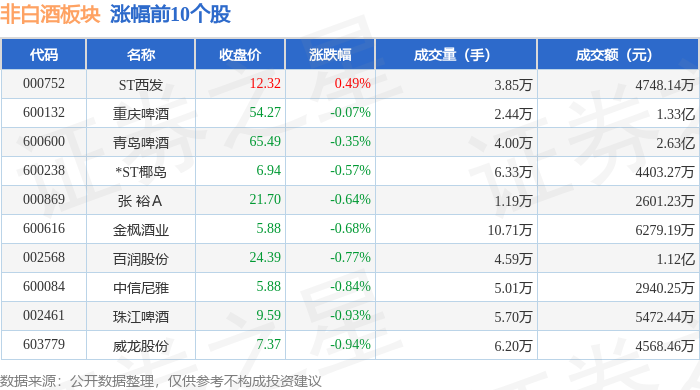
非白酒板块11月18日跌0.95%,燕京啤酒领跌,主力资金净流出1.09亿元
Zheng Xing Xing Ye Ri Bao· 2025-11-18 08:04
Market Overview - The non-liquor sector experienced a decline of 0.95% on November 18, with Yanjing Beer leading the drop [1] - The Shanghai Composite Index closed at 3939.81, down 0.81%, while the Shenzhen Component Index closed at 13080.49, down 0.92% [1] Stock Performance - Key stocks in the non-liquor sector showed varied performance, with ST Xifa closing at 12.32, up 0.49%, while other notable declines included Caijing Beer down 2.41% to 12.14 and Huichuan Beer down 2.41% to 12.15 [2] - The trading volume and turnover for selected stocks indicated significant activity, with Chongqing Beer recording a turnover of 1.33 billion and ST Xifa at 47.48 million [1][2] Capital Flow - The non-liquor sector saw a net outflow of 109 million from major funds, while retail investors contributed a net inflow of 115 million [2] - Detailed capital flow data showed that ST Xifa had a net inflow of 671,900 from major funds, while other stocks like ST Yedao experienced significant outflows [3]


非白酒板块11月17日跌0.64%,会稽山领跌,主力资金净流出1.55亿元
Zheng Xing Xing Ye Ri Bao· 2025-11-17 08:49
Market Overview - The non-baijiu sector experienced a decline of 0.64% on the trading day, with Kuaijishan leading the drop [1] - The Shanghai Composite Index closed at 3972.03, down 0.46%, while the Shenzhen Component Index closed at 13202.0, down 0.11% [1] Stock Performance - Notable gainers included: - *ST Yedao: Closed at 6.98, up 3.25% with a trading volume of 101,700 shares and a turnover of 70.11 million yuan [1] - Huichuan Beer: Closed at 12.45, up 1.30% with a trading volume of 57,300 shares and a turnover of 70.97 million yuan [1] - Significant decliners included: - Kuaijishan: Closed at 22.89, down 1.97% with a trading volume of 148,900 shares and a turnover of 342 million yuan [2] - Fick Beer: Closed at 12.44, down 1.74% with a trading volume of 198,400 shares and a turnover of 248 million yuan [2] Capital Flow - The non-baijiu sector saw a net outflow of 155 million yuan from institutional investors, while retail investors contributed a net inflow of 163 million yuan [2] - The capital flow for specific stocks showed: - *ST Lanhua: Net inflow from retail investors was 121,770 yuan, while institutional investors had a net outflow of 292,560 yuan [3] - Kuaijishan: Retail investors had a net inflow of 725,900 yuan, while institutional investors faced a net outflow of 216,510 yuan [3]
