
KJS(601579)

Search documents
会稽山(601579) - 会稽山绍兴酒股份有限公司第七届董事会第一次会议决议公告
2026-02-09 10:30
一、董事会会议召开情况 会稽山绍兴酒股份有限公司(以下简称公司)第七届董事会第一次会议于 2026 年 2 月 9 日现场表决方式召开。会议通知于 2026 年 2 月 4 日以电子邮件、 电话和专人送达等方式提交各位董事。 经与会董事表决,会议审议并通过了如下决议: 本次会议应表决董事 11 名,实际参与表决董事 11 名。会议参与表决人数及 召集、召开程序符合《公司法》和《公司章程》的有关规定,合法有效。本次会 议审议并通过了如下决议: 1、审议通过《关于选举公司董事会董事长、副董事长的议案》 公司董事会选举方朝阳先生为公司第七届董事会董事长,傅祖康、邬建昌先 生为公司第七届董事会副董事长,任期三年,自本次董事会审议通过之日起至公 司第七届董事会届满时止。 二、董事会审议情况 证券代码:601579 证券简称:会稽山 公告编号:2026-012 会稽山绍兴酒股份有限公司 第七届董事会第一次会议决议公告 本公司董事会及全体董事保证本公告内容不存在任何虚假记载、误导性陈述 或者重大遗漏,并对其内容的真实性、准确性和完整性承担法律责任。 根据《公司章程》规定,本公司法定代表人及代表公司执行公司事务的董事 为方朝 ...

会稽山(601579) - 会稽山绍兴酒股份有限公司关于完成董事会换届选举及聘任高级管理人员的公告
2026-02-09 10:15
证券代码:601579 证券简称:会稽山 公告编号:2026-013 会稽山绍兴酒股份有限公司 关于完成董事会换届选举及聘任高级管理人员的公告 本公司董事会及全体董事保证本公告内容不存在任何虚假记载、误导性陈述 或者重大遗漏,并对其内容的真实性、准确性和完整性承担个别及连带责任。 会稽山绍兴酒股份有限公司(以下简称公司)于 2026 年 2 月 9 日召开了 2026 年第一次临时股东会,审议通过了《关于选举公司第七届董事会非独立董事的议 案》《关于选举公司第七届董事会独立董事的议案》,选举产生了第七届董事会 非独立董事、独立董事,上述人员与职工代表大会选举产生的职工代表董事,共 同组成公司第七届董事会。同日,公司召开了第七届董事会第一次会议,选举产 生了董事长、副董事长及各专门委员会委员,并完成了高级管理人员的聘任工作。 具体情况公告如下: 一、第七届董事会组成情况 1、董事长:方朝阳先生(代表公司执行公司事务的董事) 2、副董事长:傅祖康先生、邬建昌先生 3、董事会成员:方朝阳先生、傅祖康先生、唐桂江先生、张曙华女士、邬 建昌先生、钱自强先生、刘扬先生(职工董事)、陈丹红女士(独立董事)、王 高先生(独立 ...
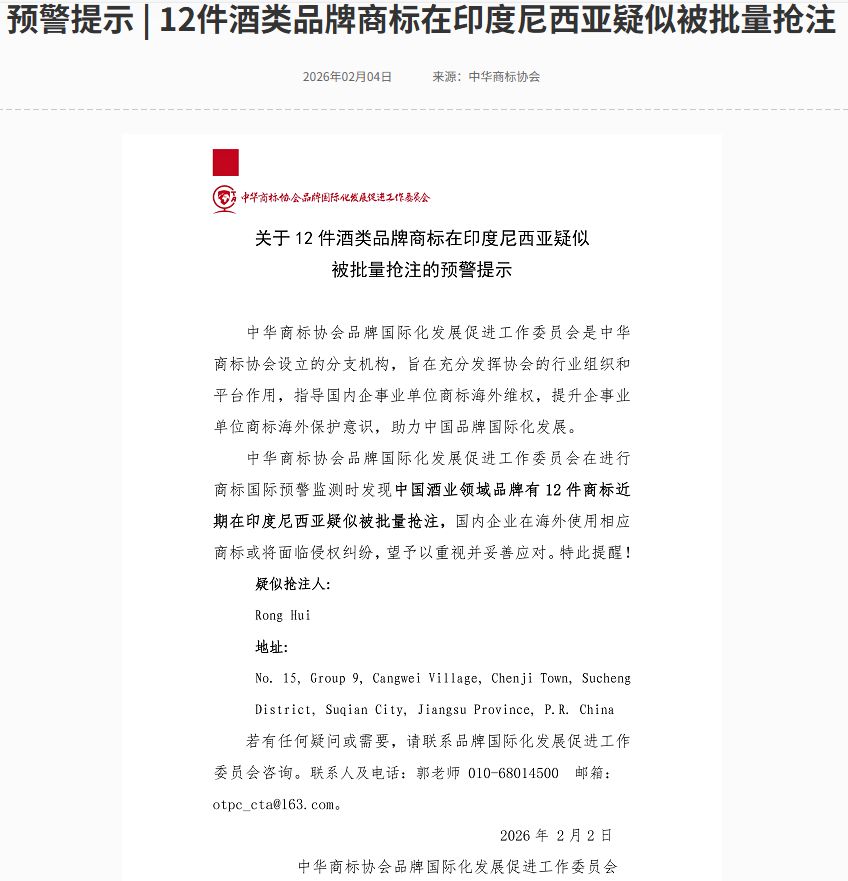
紧急预警!12件中国白酒商标疑在印尼被抢注,会稽山等酒企已着手处理
Mei Ri Jing Ji Xin Wen· 2026-02-09 09:23
Core Viewpoint - The Chinese Trademark Association has issued a warning regarding the potential mass registration of trademarks for 12 representative brands in the Chinese liquor industry in Indonesia, which could lead to infringement disputes for domestic companies operating overseas [1][5]. Group 1: Trademark Registration Warning - The warning was issued by the Brand International Development Promotion Committee of the Chinese Trademark Association, highlighting that 12 trademarks from the Chinese liquor sector have been suspected of mass registration in Indonesia [1][4]. - The brands affected include Kuaijishan, Fenggu, Baofeng, Baiyunbian, and others, covering various types of liquor such as strong aroma, light aroma, rice aroma, and yellow wine [5]. Group 2: Company Responses - Companies like Kuaijishan and Zhijiang Distillery are already taking steps to address the trademark registration issue [1]. - Kuaijishan has a dedicated trademark service provider managing the situation, asserting that any confirmed registrations will be deemed invalid [8]. Group 3: Industry Context and Historical Precedents - Kuaijishan, a leading yellow wine producer, has been expanding its overseas business, with international sales revenue reaching 6.857 million yuan in the first three quarters of 2025 [9]. - The article emphasizes the need for Chinese liquor companies to shift from passive responses to proactive defense strategies in trademark protection, which is crucial for transitioning from product export to brand internationalization [9]. - Historical instances of trademark disputes, such as the case of Wuliangye being registered in South Korea, serve as a warning for companies to establish comprehensive trademark strategies before entering international markets [10][11].

会稽山20260203
2026-02-04 02:27
Summary of Conference Call on Accounting Mountain Company Overview - The conference call focused on Accounting Mountain, a company in the beverage industry, specifically in the alcoholic beverage sector, including products like sparkling yellow wine and Lan Ting [1][2]. Key Points and Arguments - **High-tech Enterprise Recognition**: Accounting Mountain recently announced that it has obtained recognition as a high-tech enterprise, which will provide tax benefits from 2025 to 2027. This recognition allows the company to pay a corporate income tax rate of 15%, significantly enhancing its profitability [1][2]. - **Profit Impact**: Assuming a profit base from 2024, a reduction in the tax rate to 15% could increase profits by approximately 23 million yuan. Given that the company's profit base is around 200 million yuan, this tax policy adjustment is expected to have a notable positive impact [3]. - **Product Development**: The company is actively iterating its core products, including the introduction of a 600ml version of Lan Ting and new flavors and packaging for sparkling yellow wine, such as canned versions. These products are anticipated to achieve significant growth in 2025 [3]. - **Market Expansion**: Sparkling yellow wine has expanded its sales beyond the Jiangsu, Zhejiang, and Shanghai regions into key markets like Shandong, Guangdong, and Sichuan. The sales target for sparkling yellow wine in 2026 is set at 200 million yuan, with plans to penetrate more second- and third-tier cities to increase market penetration [3][4]. - **Long-term Growth Outlook**: The company is expected to maintain good revenue growth due to seasonal demand and the ongoing trend of premiumization and youth-oriented products. The brand's influence and market presence are projected to contribute to growth in external markets [4]. - **Earnings Projections**: The expected earnings per share (EPS) for 2025 and 2026 are projected to be 0.48 and 0.57 yuan, respectively. The corresponding price-to-earnings (PE) ratios are estimated to be around 45-47 times for 2025 and approximately 38 times for 2026. A "buy" rating is maintained for the stock [4]. Additional Important Information - The conference call emphasized the continuous updates and tracking of the alcoholic beverage sector, including various categories such as white liquor, yellow wine, beer, and whiskey, indicating a commitment to providing ongoing insights into market changes [4][5].
会稽山绍兴酒股份有限公司关于使用闲置自有资金委托理财进展的公告
Shang Hai Zheng Quan Bao· 2026-02-02 19:29
Core Viewpoint - The company is utilizing idle self-owned funds for entrusted wealth management to improve capital efficiency and generate greater economic benefits while ensuring normal operational liquidity [3][5]. Group 1: Basic Information - The company plans to invest up to RMB 300 million in high-security, high-liquidity financial products, including bank wealth management products, securities firm products, trust products, and other financial institution products [3]. - The decision to use idle funds for wealth management has been approved by the chairman and does not require further board or shareholder approval [3]. Group 2: Progress of Entrusted Wealth Management - As of the announcement date, the company has redeemed part of its wealth management products, receiving a total of RMB 100.30 million in principal and returns [4]. - From August 22, 2025, to the announcement date, the company has cumulatively invested RMB 280 million in wealth management products from CITIC Securities [4]. Group 3: Impact on the Company and Risk Control Measures - The use of idle funds for wealth management will not affect the company's daily cash flow or the normal development of its main business, and it is expected to enhance capital efficiency and increase returns for shareholders [5]. - The company will adhere to prudent investment principles, selecting reputable financial institutions for entrusted management, and will monitor investment progress to mitigate risks [5]. - Internal audit departments will supervise fund usage, and independent directors will have the authority to oversee and audit the process [5].
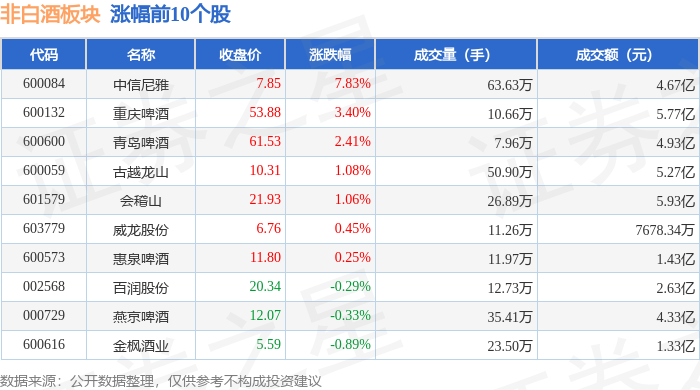
非白酒板块2月2日涨0.96%,中信尼雅领涨,主力资金净流出5108.94万元
Zheng Xing Xing Ye Ri Bao· 2026-02-02 09:15
Group 1 - The non-white liquor sector increased by 0.96% compared to the previous trading day, with CITIC Niyah leading the gains [1] - The Shanghai Composite Index closed at 4015.75, down 2.48%, while the Shenzhen Component Index closed at 13824.35, down 2.69% [1] - Key stocks in the non-white liquor sector showed varied performance, with CITIC Niyah closing at 7.85, up 7.83%, and Chongqing Beer at 53.88, up 3.40% [1] Group 2 - The non-white liquor sector experienced a net outflow of 51.09 million yuan from institutional investors, while retail investors saw a net outflow of 7.08 million yuan [2] - The main capital flow data indicates that Kuaijishan had a net inflow of 22.89 million yuan from institutional investors, while CITIC Niyah had a net outflow of 4.01 million yuan [3] - Retail investors showed a significant net outflow in several stocks, including Baorun Co., which had a net outflow of 22.42 million yuan [3]


会稽山(601579) - 会稽山绍兴酒股份有限公司关于使用闲置自有资金委托理财进展的公告
2026-02-02 08:15
证券代码:601579 证券简称:会稽山 公告编号:2026-010 会稽山绍兴酒股份有限公司 关于使用闲置自有资金委托理财进展的公告 本公司董事会及全体董事保证本公告内容不存在任何虚假记载、误导性陈述 或者重大遗漏,并对其内容的真实性、准确性和完整性承担法律责任。 重要内容提示: 基本情况 | 产品名称 | 信盈安享 001 一号 | | --- | --- | | 受托方名称 | 中信证券股份有限公司 | | 购买金额 | _2,000.00 万元 | | 产品期限 | 无固定期限,每周可申请赎回 | | 产品名称 | 中信粤湾 3 号集合资产管理计划 | | 受托方名称 | 中信证券股份有限公司 | | 购买金额 | _10,000.00 万元 | | 赎回金额 | _10,030.42 万元 | | 产品期限 | 2025.11.13-2026.1.28 | | 产品名称 | 中信证券资管财富私享投资 3819 号 FOF 单一资产管理计划 | | 受托方名称 | 中信证券股份有限公司 | | 购买金额 | _10,000.00 万元 | | 产品期限 | 无固定期限 | 风险提示 为提高资金使用效率 ...
会稽山(601579):更新报告:通过高新认证,新品持续迭代
Changjiang Securities· 2026-02-02 00:49
Investment Rating - The investment rating for the company is "Buy" and is maintained [9] Core Insights - The company has recently obtained the recognition as a high-tech enterprise, which allows it to enjoy tax benefits at a rate of 15% from 2025 to 2027, potentially increasing reported profits by approximately 23 million [2][7] - Key products such as Lanting and sparkling yellow wine are expected to continue their iterations in 2025, with Lanting launching a 600ml specification and sparkling yellow wine introducing canned versions and other flavors, both anticipated to achieve good growth [2][7] - The sales of sparkling yellow wine are projected to expand beyond the Jiangsu, Zhejiang, and Shanghai regions into key markets like Shandong, Guangdong, and Sichuan, supporting the company's strategy for youthfulness and national expansion [2][7] Summary by Sections Recent Developments - The company has received high-tech enterprise certification, which will enhance its profit margins due to favorable tax rates [2][7] - The product lineup is set to evolve with new specifications and flavors, aiming for significant growth in 2025 [2][7] Market Strategy - The company plans to broaden the market coverage of its sparkling yellow wine in 2026, targeting a sales goal of 200 million and entering more second and third-tier cities [2][7] Financial Projections - For 2025 and 2026, the expected earnings per share (EPS) are projected to be 0.48 and 0.57 respectively, with corresponding price-to-earnings (PE) ratios of 46 and 38 [2][7]
会稽山:公司会在年度报告、半年度及季度报告中披露股东人数信息
Zheng Quan Ri Bao Wang· 2026-01-30 15:14
Core Viewpoint - The company, Kuaijishan (601579), has decided not to disclose the number of shareholders on the "E Interaction" platform due to concerns about timely information dissemination and fairness to all investors [1] Group 1: Information Disclosure - The company will adhere to the principle of cautious fairness in its information disclosure practices [1] - Shareholder numbers will be disclosed in the annual, semi-annual, and quarterly reports as per relevant information disclosure regulations [1] - Investors can inquire about the number of shareholders by sending their stockholding proof and identification to the company's investor relations email [1]
行业点评报告:黄酒复兴趋势持续,期待2026年有新突破
KAIYUAN SECURITIES· 2026-01-30 11:44
Investment Rating - The industry investment rating is "Overweight" (maintained) [1] Core Insights - The report highlights the ongoing revival of the yellow wine industry, with a clear growth logic and significant price increases for premium products [3][4] - The trend of product premiumization is effectively taking shape, with leading companies optimizing their structures and upgrading their offerings [4] - The yellow wine sector is making strides towards national expansion, although it still faces challenges in breaking regional perceptions [6] - The report anticipates sustained growth in the yellow wine industry, driven by product, channel, and marketing upgrades [7] Summary by Sections Industry Overview - The yellow wine sector has shown a remarkable price increase, with stocks like Kuaijishan rising approximately 90% in 2025, significantly outperforming other alcoholic beverages [3] - The market is expected to benefit from the upcoming national standards for prepared dishes, which may enhance market concentration [3] Product Development - The high-end product strategy is yielding results, with successful transitions from "meal wine" to "social/banquet wine" [4] - Young consumers are becoming a core growth segment, with innovative products like "one day one smoke" sparkling yellow wine gaining popularity [5] Market Expansion - The current market share of yellow wine in regions outside Jiangsu, Zhejiang, and Shanghai is low, indicating potential for growth as companies push for national penetration [6] - Leading firms are adopting a multi-faceted approach to overcome regional barriers, focusing on product innovation and cultural empowerment [6] Future Trends - The report identifies three key trends that will continue to support the yellow wine industry's revival: stable growth among leading companies, conversion of short-term hits into long-term loyalty, and cultural value integration into consumer habits [7]