SFC(601595)

Search documents
龙虎榜机构新动向:净买入9股 净卖出19股
Zheng Quan Shi Bao Wang· 2025-11-27 15:10
Core Viewpoint - On November 27, the Shanghai Composite Index rose by 0.29%, with institutional investors appearing on the trading lists of 28 stocks, net buying 9 and net selling 19 stocks [1] Institutional Trading Summary - The stock with the highest net buying by institutional seats was Haike Xinyuan, which closed at the daily limit with a turnover rate of 39.89% and a transaction amount of 2.352 billion. The net buying amounted to 133.13 million [2] - LeiKe Defense saw a decline of 9.73% with a turnover rate of 44.16% and a transaction amount of 4.244 billion. Institutional seats net bought 100.40 million, while the stock experienced a net outflow of 478 million [2] - Shiji Information closed at the daily limit with a turnover rate of 7.12% and a transaction amount of 1.412 billion. Institutional seats net bought 84.30 million, with a net outflow of 240 million [3] Market Performance - The average increase of stocks with net institutional buying was 5.14%, outperforming the Shanghai Composite Index. Stocks like Xinmeixing and Huazi Technology showed strong performance, closing at the daily limit [3] - A backtest of stocks with net institutional buying over the past month revealed a 55.63% probability of rising the next day and a 54.34% probability of outperforming the Shanghai Composite Index [3] Net Selling Summary - The stock with the highest net selling by institutions was Nanguang Digital, with a turnover rate of 53.03% and a net selling amount of 88.63 million. The stock experienced a net outflow of 196 million [3] - Shanghai Film was on the trading list due to a decline of 7.35%, with institutional seats net selling 86.87 million [4] - Yunhan Xincheng had a turnover rate of 39.77% and a net selling amount of 85.52 million, with a net inflow of 858.36 million [4] Deep and Shanghai Stock Connect - On November 27, 18 stocks on the trading list had appearances from Deep and Shanghai Stock Connect, with net buying in stocks like Shida Group and Zhong'an Technology, amounting to 102 million and 38.81 million respectively [7] - The stocks with net selling included Dongbai Group and Guofeng New Materials, with net selling amounts of 65.45 million and 34.84 million respectively [7]

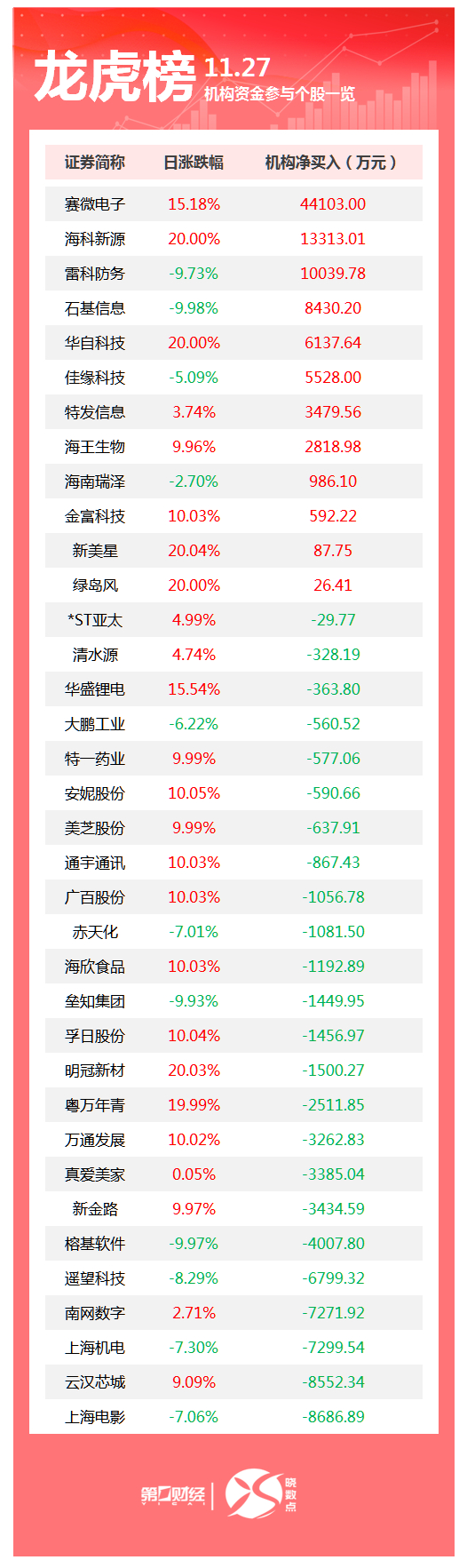
机构今日买入赛微电子等12股,卖出上海电影8687万元


3 6 Ke· 2025-11-27 10:24
Core Insights - On November 27, a total of 36 stocks were identified with institutional activity, with 12 stocks showing net buying and 24 stocks showing net selling [1] Institutional Buying - The top three stocks with the highest net institutional buying were: - Saiwei Electronics with a net buying amount of 441 million yuan - Haike Xinyuan with a net buying amount of 133 million yuan - Leike Defense with a net buying amount of 104 million yuan [1] Institutional Selling - The top three stocks with the highest net institutional selling were: - Shanghai Film with a net outflow of 86.87 million yuan - Yunhan Xincheng with a net outflow of 85.52 million yuan - Shanghai Mechanical with a net outflow of 73 million yuan [1]
龙虎榜丨机构今日买入这12股,卖出上海电影8687万元
Di Yi Cai Jing· 2025-11-27 09:36
Core Insights - On November 27, a total of 36 stocks were involved with institutional investors, with 12 showing net buying and 24 showing net selling [1] - The top three stocks with net buying by institutions were Saiwei Electronics, Haike Xinyuan, and Leike Defense, with net buying amounts of 441 million, 133 million, and 104 million respectively [1] - The top three stocks with net selling by institutions were Shanghai Film, Yunhan Xincheng, and Shanghai Mechanical, with net outflow amounts of 86.87 million, 85.52 million, and 73 million respectively [1] Institutional Buying Summary - Saiwei Electronics had a daily increase of 15.18% with a net buying of 441.03 million [2] - Haike Xinyuan experienced a 20.00% increase with a net buying of 133.13 million [2] - Leike Defense saw a decrease of 9.73% but still had a net buying of 100.39 million [2] - Other notable stocks with institutional buying included Shiji Information, Huazi Technology, and Jiayuan Technology, with net buying amounts of 84.30 million, 61.38 million, and 55.28 million respectively [2] Institutional Selling Summary - Shanghai Film had a decrease of 7.06% with a net selling of 86.87 million [3] - Yunhan Xincheng saw a 9.09% increase but had a net selling of 85.52 million [3] - Shanghai Mechanical experienced a decrease of 7.30% with a net selling of 73 million [3] - Other significant stocks with institutional selling included Yue Wanniang, New Jin Road, and Rongji Software, with net selling amounts of 25.12 million, 34.34 million, and 40.08 million respectively [3]

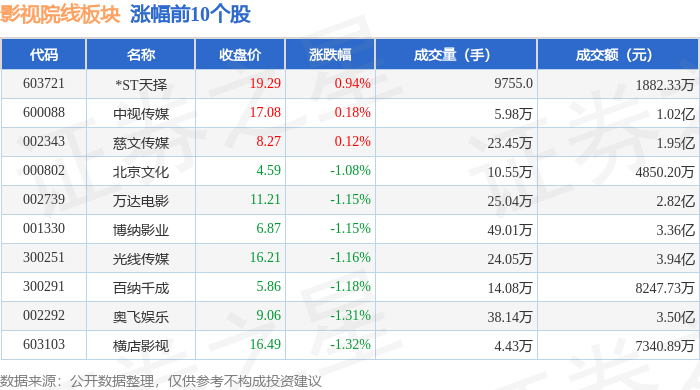
影视院线板块11月27日跌2.41%,欢瑞世纪领跌,主力资金净流出5.82亿元
Zheng Xing Xing Ye Ri Bao· 2025-11-27 09:13
Core Insights - The film and cinema sector experienced a decline of 2.41% on November 27, with Huayi Brothers leading the drop [1][2] - The Shanghai Composite Index closed at 3875.26, up 0.29%, while the Shenzhen Component Index closed at 12875.19, down 0.25% [1] Market Performance - The closing prices and percentage changes of key stocks in the film and cinema sector are as follows: - Huayi Brothers (Code: 300027) closed at 2.56, down 3.03% with a trading volume of 859,300 shares and a transaction value of 22.2 million [2] - Shanghai Film (Code: 601595) closed at 31.06, down 7.06% with a trading volume of 198,500 shares and a transaction value of 625 million [2] - ST Tianze (Code: 603721) closed at 19.29, up 0.94% with a trading volume of 9,755 shares and a transaction value of 18.82 million [1] Capital Flow - The film and cinema sector saw a net outflow of 582 million from main funds, while retail investors contributed a net inflow of 416 million [2] - The capital flow for specific stocks indicates varied investor behavior, with some stocks experiencing significant net inflows from retail investors despite overall sector declines [3]




帮主郑重:流感有机硅逆势狂欢!明天盯紧这三条线
Sou Hu Cai Jing· 2025-11-27 08:08
Core Viewpoint - The market experienced mixed performance with the ChiNext index closing down 0.44%, while the influenza and organic silicon sectors surged, indicating a divergence in market sentiment driven by specific sectoral developments [1][4]. Group 1: Influenza Sector - The influenza sector saw a significant uptick, with flu-like cases in northern provinces rising to 7.0%, markedly higher than the same period in previous years [4]. - Sales of antiviral drugs, such as Oseltamivir, surged by 237% over the past week, indicating strong demand driven by rising flu cases [4]. - Jindike has completed the production season with 1.56 million doses of its quadrivalent flu vaccine approved for release, and is ramping up production capacity to 30 million doses [4]. Group 2: Organic Silicon Sector - The organic silicon sector experienced a boost following Dow Chemical's announcement of a 10%-20% price increase on major products starting December 10, which acted as a catalyst for domestic stocks [4]. - Companies like Hongbai New Materials and Chenguang New Materials saw their stocks hit the daily limit, while Dongyue Silicon Material rose over 10% [4]. - Smart money has already positioned itself in this sector, with Chenguang New Materials seeing a net inflow of 85.14 million yuan over the past ten trading days [4]. Group 3: Underperforming Sectors - The Hainan sector faced significant declines, with companies like Jingliang Holdings and Hainan Haiyao dropping nearly 7%, highlighting the lack of performance support for regional themes [4]. - The film and content industry also struggled, with Huanrui Century hitting the daily limit down and Shanghai Film falling nearly 7%, reflecting uncertainty in the content sector [4]. Group 4: Market Sentiment and Strategy - The overall trading volume decreased by 93.5 billion yuan compared to the previous day, indicating a cautious market sentiment and a tendency for rapid sector rotation [4]. - Investment strategies suggest focusing on the influenza sector for low-entry opportunities and the organic silicon sector for potential gains, while avoiding sectors lacking performance, policy support, or growth potential [5].





AI语料板块震荡走低 上海电影跌7.39%
Mei Ri Jing Ji Xin Wen· 2025-11-27 05:48
Core Viewpoint - The AI content sector is experiencing a downturn, with significant declines in stock prices for several companies [2] Company Performance - Shanghai Film has seen a drop of 7.39% in its stock price [2] - Rongxin Culture's stock price decreased by 4.36% [2] - Dook Culture's stock price fell by 3.93% [2] - Other companies such as Zhongwen Online, Century Tianhong, and Vision China also experienced declines of over 2% [2]



刚刚,涨停潮来了!
中国基金报· 2025-11-27 04:52
Core Viewpoint - A-shares showed a collective rise in major indices, with strong performance in sectors like consumer electronics and optical modules, while some high-position stocks experienced significant declines [2][3]. Market Performance - As of the midday close, the Shanghai Composite Index rose by 0.49%, the Shenzhen Component Index increased by 0.38%, and the ChiNext Index gained 0.56% [2][3]. - The total market turnover was 1.1 trillion CNY, slightly lower than the previous day, with over 3,300 stocks rising [3]. Sector Performance - The electronic, beauty care, light industry manufacturing, and communication sectors performed well, with notable activity in consumer electronics, HBM, optical modules, and lithium battery concept stocks [3]. - The optical module sector continued to strengthen, with stocks like Tongyu Communication and Cambridge Technology hitting their daily limit [12][13]. Individual Stock Highlights - In the electronic sector, stocks such as Lian De Equipment and Saiwei Electronics reached their daily limit, with increases of 20.01% and 18.48% respectively [8][9]. - The new consumption concept stocks in the Hong Kong market also saw gains, with Pop Mart rising nearly 10% [10]. Policy Impact - A recent implementation plan from six departments, including the Ministry of Industry and Information Technology, aims to enhance the adaptability of supply and demand in consumer goods, promoting AI integration and smart product development [8].




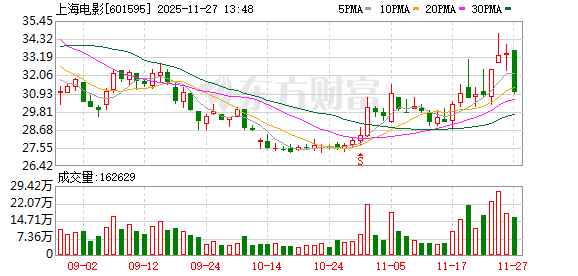
上海电影涨2.24%,成交额2.63亿元,主力资金净流出145.76万元
Xin Lang Zheng Quan· 2025-11-24 05:20
Core Viewpoint - Shanghai Film's stock has shown a significant increase this year, with a year-to-date rise of 27.70% and a recent uptick of 4.00% over the last five trading days, indicating positive market sentiment towards the company [1] Financial Performance - For the period from January to September 2025, Shanghai Film achieved a revenue of 723 million yuan, representing a year-on-year growth of 29.09%, while the net profit attributable to shareholders was 139 million yuan, reflecting a growth of 29.81% [2] - The company has distributed a total of 434 million yuan in dividends since its A-share listing, with 116 million yuan distributed over the past three years [3] Shareholder Information - As of September 30, 2025, the number of shareholders for Shanghai Film increased to 43,800, up by 75.76% from the previous period, while the average circulating shares per person decreased by 43.10% to 10,232 shares [2] - The top ten circulating shareholders include several mutual funds, with notable changes in holdings, such as an increase in shares held by Guangfa Value Leading Mixed A and new entries like Guangfa聚富 Mixed Fund [3] Market Activity - On November 24, Shanghai Film's stock price rose by 2.24% to 31.48 yuan per share, with a trading volume of 263 million yuan and a turnover rate of 1.91%, leading to a total market capitalization of 14.109 billion yuan [1] - The stock has appeared on the "Dragon and Tiger List" once this year, with the most recent occurrence on July 29, where it recorded a net buy of -51.57 million yuan [1]
影院危矣
3 6 Ke· 2025-11-24 01:12
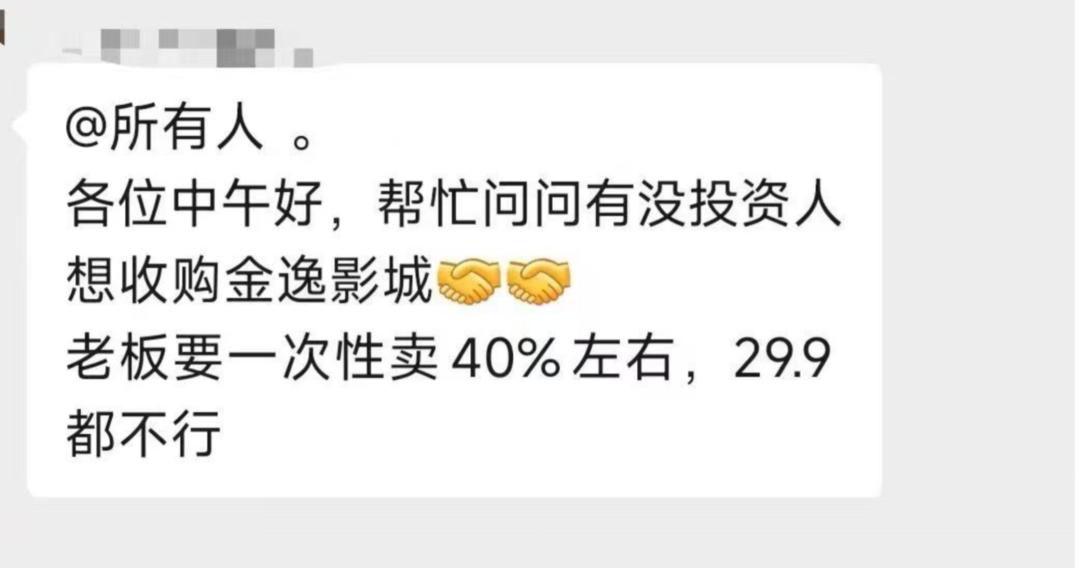
Core Insights - The film industry is facing significant challenges, particularly affecting cinemas, with a sharp decline in box office revenues and attendance rates [1][4][10] - The financial struggles of cinemas, exemplified by Jin Yi Cinema's attempts to sell a controlling stake, reflect broader systemic issues within the industry [1][4] Revenue Challenges - National cinema attendance dropped to 820 million in the first nine months of 2025, a year-on-year decline of 11.5%, with average attendance per screening halved from 28 in 2019 to 16 [4][10] - The top ten films accounted for 68% of total box office revenue in 2025, up from 45% in 2019, indicating a growing reliance on blockbuster films [10] Cost Pressures - Cinemas are facing dual pressures from fixed rents and the need for equipment upgrades, with average rent as a percentage of revenue rising to 28% in 2025 from 22% in 2019 [6][11] - Many cinemas, including Jin Yi, are unable to cover monthly rent with ticket sales, leading to closures of underperforming locations [6][11] Audience Behavior - The Z generation, which constitutes 62% of the audience, has seen a significant drop in monthly viewing frequency from 1.2 times in 2019 to 0.5 times in 2025, with many only attending for major blockbuster releases [6][10] - The shift in viewing preferences has resulted in a decline in interest for mid-budget and art films, further straining cinema revenues [6][10] Competitive Landscape - Larger cinema chains like Wanda are managing to maintain profitability and market share, with Wanda's net profit increasing by 319.92% to 708 million yuan in the first three quarters of 2025 [11][13] - Smaller cinemas are struggling to compete due to outdated equipment and lack of brand recognition, leading to a vicious cycle of declining attendance and revenue [11][15] Industry Outlook - The ongoing challenges suggest a harsh environment for smaller cinemas, with the potential for further consolidation in the industry as larger players dominate the market [1][15]


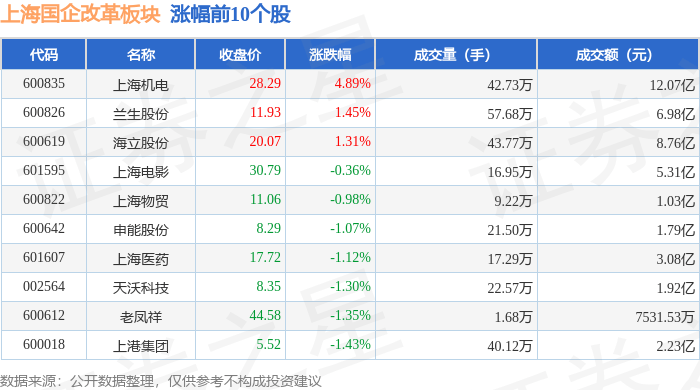
上海国企改革板块11月21日跌2.97%,西藏城投领跌,主力资金净流出25.9亿元


Sou Hu Cai Jing· 2025-11-21 09:52
Market Overview - On November 21, the Shanghai State-Owned Enterprise Reform sector fell by 2.97% compared to the previous trading day, with Tibet City Investment leading the decline [1] - The Shanghai Composite Index closed at 3834.89, down 2.45%, while the Shenzhen Component Index closed at 12538.07, down 3.41% [1] Stock Performance - Shanghai Mechanical and Electrical (600835) saw a closing price of 28.29, with an increase of 4.89% and a trading volume of 427,300 shares, amounting to a transaction value of 1.207 billion [1] - Tibet City Investment (600773) experienced a significant drop of 10.02%, closing at 12.93, with a trading volume of 473,100 shares [2] - Hydrogen Alkali Chemical (600618) and Data Port (603881) also faced declines of 9.53% and 7.83%, respectively [2] Capital Flow - The Shanghai State-Owned Enterprise Reform sector saw a net outflow of 2.59 billion yuan from institutional investors, while retail investors had a net inflow of 2.12 billion yuan [2] - The main capital flow data indicates that Shanghai Mechanical and Electrical had a net inflow of 1.20 billion yuan from institutional investors, while retail investors had a net outflow of 43.99 million yuan [3]