
CPIC(601601)

Search documents
三大险企开打非车险“终局战” ,中小险企路在何方?
阿尔法工场研究院· 2025-11-19 00:07
以下文章来源于阿尔法工场金融家 ,作者金妹妹 阿尔法工场金融家 . 追踪保险银行业圈内动态,剖析最新风向,分享有料、有价值的"内行人"洞察见解。 导语: 几乎可以确定,头部三家险企的行业集中度将继续上升。 中国保险业的监管正以前所未有的力度穿透全业务链条,在相继重塑了车险与寿险市场后,终于 指向了非车险领域。 11 月上旬,国家金融监督管理总局财险司正式下发《加强非车险业务监管有关工作指引》。 作为 10 月 10 日 36 号文的细化落实文件,该指引明确了非车险 "报行合一" 的产 品备案时间 表、保费管理规则及刚性监管要求,标志着这项制度性变革从 11 月 1 日新规实施的启动阶段全 面落地。 非车险在过去三年间快速膨胀,但增长与盈利的背离越来越大。 2025年上半年,非车险保费收入达5140亿元,同比增长5.6%,增速略高于车险,但行业经营压 力仍存。 从成本表现来看,财险业整体COR(综合成本率)降至96.61%,创近五年同期最低,但非车险 内部细分险种分化明显: 此前非车险费用率长期处于高位,部分激进险种费用率曾超40%;同时极端天气频发、产业事故 增多,叠加医疗费用通胀、赔偿标准提高等因素,导致赔 ...





保险板块11月18日跌0.85%,中国太保领跌,主力资金净流出5.91亿元
Zheng Xing Xing Ye Ri Bao· 2025-11-18 08:11
从资金流向上来看,当日保险板块主力资金净流出5.91亿元,游资资金净流入1.15亿元,散户资金净流 入4.77亿元。保险板块个股资金流向见下表: 证券之星消息,11月18日保险板块较上一交易日下跌0.85%,中国太保领跌。当日上证指数报收于 3939.81,下跌0.81%。深证成指报收于13080.49,下跌0.92%。保险板块个股涨跌见下表: | 代码 | 名称 | 收盘价 | 涨跌幅 | 成交量(手) | 成交额(元) | | --- | --- | --- | --- | --- | --- | | 601318 | 中国平安 | 59.62 | -0.35% | 44.57万 | 26.64亿 | | 601628 | 中国人寿 | 43.02 | -0.92% | 9.65万 | 4.16 Z | | 618109 | 中国人保 | 8.51 | -0.93% | 53.07万 | 4.53亿 | | 601336 | 新华保险 | 67.00 | -1.03% | 12.60万 | 8.46 Z | | 601601 | 中国太保 | 34.86 | -1.72% | 42.22万 | 14.78 ...


2026年保险行业策略报告:高弹性标签助力板块破圈,看好资负两端改善趋势-20251118
Shenwan Hongyuan Securities· 2025-11-18 06:53
Core Insights - The insurance sector is characterized by a "high elasticity" label, with a significant profit increase driven by investment performance, as evidenced by a 68% year-on-year profit growth in Q3 2025, with investment performance contributing 79% of the pre-tax profit increment for the first three quarters [3][11][12] - The "14th Five-Year Plan" emphasizes strong rule of law, strict regulation, risk mitigation, and development promotion, indicating a strategic focus on enhancing the legal framework and regulatory environment for the insurance industry [3][27][28] - The ongoing "anti-involution" policy is expected to boost dividend insurance, while property insurance is undergoing comprehensive governance to improve high-risk insurance types [3][19][27] - The strategic positioning of insurance assets is evolving, with a notable increase in stock and fund investments by listed insurance companies, projected to reach an additional 875.2 to 943.4 billion yuan in A-shares from 2025 to 2027 [3][11][19] - The insurance sector's valuation recovery is anticipated to continue, with recommendations to focus on undervalued, high-elasticity stocks such as China Life, Ping An, and others [3][19][21] Review of Performance - The insurance sector index has risen by 13.5% since the beginning of the year, underperforming the CSI 300 index by 4.1 percentage points [6][10] - In Q3 2025, the total net profit of listed insurance companies reached 426 billion yuan, a year-on-year increase of 33.5%, with significant contributions from investment performance [11][12][19] Policy Outlook - The "15th Five-Year Plan" outlines key directions for the insurance industry, focusing on high-quality development, technological independence, and comprehensive reform [24][28] - The regulatory environment is expected to remain stringent, with a focus on risk mitigation and the promotion of sustainable growth in the insurance sector [27][31] Liability and Asset Management - The "anti-involution" policy is driving a shift towards dividend insurance, while property insurance is seeing a rationalization of competition [3][19][27] - The strategic focus on asset allocation is expected to enhance the investment capabilities of insurance funds, with a projected increase in equity market allocations [3][11][19] Investment Recommendations - The report suggests maintaining a focus on undervalued, high-elasticity stocks within the insurance sector, highlighting companies such as China Life and Ping An as key investment opportunities [3][19][21]

25Q3险资提升核心权益资产配置:保险行业周报(20251110-20251114)-20251118
Huachuang Securities· 2025-11-18 04:03
Investment Rating - The industry investment rating is "Recommended," indicating an expected increase in the industry index exceeding the benchmark index by more than 5% in the next 3-6 months [22]. Core Insights - The insurance index rose by 2.62%, outperforming the market by 3.71 percentage points, with significant individual stock performance variations [1]. - As of Q3 2025, the total balance of insurance funds reached 37.5 trillion, with life insurance companies holding 33.73 trillion and property insurance companies holding 2.39 trillion [2]. - The solvency adequacy ratio for insurance companies was reported at 186.3% for comprehensive and 134.3% for core solvency, with property insurance companies showing a strong solvency position [2]. - The report highlights a shift in asset allocation, with a decrease in bond allocation and an increase in equity and fund holdings, suggesting a more aggressive investment strategy in the current market environment [5]. Summary by Sections Market Performance - The insurance sector showed a positive performance with a 2.62% increase in the index, outperforming the broader market [1]. - Individual stock performances varied, with notable increases in stocks like Taiping (+10.96%) and PICC (+3.16%) [1]. Fund Allocation - As of Q3 2025, the allocation of insurance funds was as follows: bonds 50.3%, stocks 10%, and funds 5.5%, with a slight increase in stock and fund allocations [4]. - Life insurance companies had a bond allocation of 51% and a stock allocation of 10.1%, while property insurance companies had a bond allocation of 40.6% and a stock allocation of 8.7% [4]. Company Performance - New China Life reported a cumulative premium income of 181.973 billion, a 17% year-on-year increase [2]. - China Pacific Life's cumulative premium income was 241.322 billion, reflecting a 9.9% increase, while its property insurance segment saw a modest 0.4% growth [2][3]. - ZhongAn Online reported a cumulative premium income of 29.822 billion [3]. Investment Recommendations - The report suggests a strong beta attribute for the sector in the short term, with a focus on asset performance as a key driver [5]. - Long-term recommendations include companies like China Pacific, China Life, and New China Life based on fundamental performance and valuation [10].
金改前沿|实地走访看大病保险十年成效 :百元保费托举“因病致贫”底线
Zhong Guo Jin Rong Xin Xi Wang· 2025-11-18 02:40
Core Insights - The article highlights the significant role of critical illness insurance in alleviating the financial burden of medical expenses for families in Gansu Province, particularly in the impoverished areas of Linxia Prefecture [1][2]. Group 1: Impact of Critical Illness Insurance - The critical illness insurance has provided substantial financial relief to families like that of Ma Yang, whose two sons require regular dialysis, resulting in a total reimbursement of over 210,000 yuan from basic medical insurance and 90,000 yuan from critical illness insurance [2]. - The insurance system in China is structured in a tiered manner, with basic medical insurance forming the foundation, critical illness insurance serving as a supplementary layer, and medical assistance providing a safety net, collectively reducing the financial burden on the populace [2]. Group 2: Implementation and Management - As of September 2025, the critical illness insurance in Linxia has compensated 788,300 individuals, with total payouts reaching 1.428 billion yuan, including 722 million yuan for impoverished populations [3]. - The management of critical illness insurance has been delegated to commercial insurance companies, which has enhanced service levels and market vitality. China Pacific Life Insurance has been managing this insurance since 2017, focusing on improving claim processing times and increasing public awareness of the policies [4]. Group 3: Challenges and Innovations - The implementation of critical illness insurance in remote areas faces challenges such as lengthy claim processes and low policy awareness. China Pacific Life Insurance has addressed these issues by establishing a one-stop claims system that reduces processing time from 3-15 days to just 2-3 minutes [4][6]. - The company has also deployed outreach teams to educate local populations about the insurance policies, distributing over 160,000 informational materials in local dialects to ensure understanding [4][7]. Group 4: Future Outlook - The critical illness insurance program has evolved from basic protection to precise service, becoming a crucial safety net for millions. It aims to continue enhancing service mechanisms and increasing coverage to further support families and combat poverty caused by medical expenses [5][7].

2025三季度寿险公司保险业务收入排名榜:平安增速两年超10%,新华升至第五,中邮、阳光、友邦增速超15%,大都会首破300亿!
13个精算师· 2025-11-17 15:20
Core Insights - The insurance industry has seen a significant increase in premium growth, reaching a record high due to the recent suspension of certain traditional insurance products [1][9][11] - Major players like Ping An and Xinhua Insurance have consistently reported premium growth exceeding 10% and 18% respectively, with Xinhua rising to the fifth position in the industry [1][19][21] - Companies such as Zhongyou and AIA are experiencing rapid growth, while Sunshine Life is expected to surpass 100 billion in premiums this year [1][25][26] - MetLife has achieved a milestone by surpassing 30 billion in premiums, climbing five positions to rank 18th in the industry [1][29] Premium Growth Trends - As of Q3 2025, the total premium income for life insurance companies reached 3.84 trillion, marking a substantial increase compared to earlier in the year [9][11] - The premium growth rate for the industry has exceeded 10%, the highest in nearly four years, driven by the suspension of 2.5% priced traditional insurance products [11][13] - The surge in premiums was particularly notable in July and August 2025, with growth rates reaching around 40% during these months [13][14] Company Performance - Ping An Life has maintained a premium growth rate above 10% for two consecutive years, with a current growth rate of 11.7% [21][22] - Xinhua Insurance has reported an impressive growth rate of 18.6%, making it the fastest-growing among the top six insurers [22][23] - Zhongyou Life's premium income reached 151.3 billion, with a growth rate of 17.7%, narrowing the gap with Taiping Life [25] - Sunshine Life's premium growth rate surged to 29.9%, with expectations to exceed 100 billion in total premiums by year-end [26] - AIA has maintained a consistent growth rate of over 10% for 12 consecutive years, showcasing stable performance across quarters [27] Market Dynamics - The top six insurers have shown resilience, with premium growth rates improving compared to the previous year, while smaller insurers are experiencing a slowdown [30][33] - The disparity in growth rates among insurers has widened, with many smaller firms reporting negative growth, particularly those with premiums below 300 billion [36][39] - The shift towards bancassurance channels has been a key strategy for larger firms, contributing to their premium growth while smaller firms struggle to compete [30][33]

保险板块11月17日跌1.69%,中国人保领跌,主力资金净流出4.49亿元
Zheng Xing Xing Ye Ri Bao· 2025-11-17 08:49
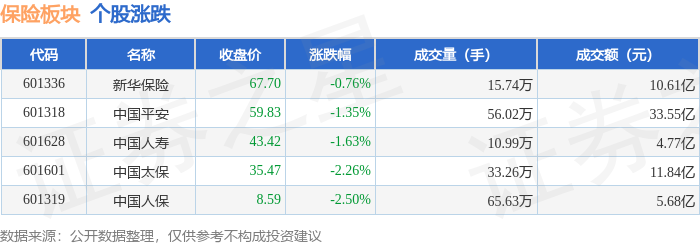
Core Insights - The insurance sector experienced a decline of 1.69% on November 17, with China Pacific Insurance leading the drop [1] - The Shanghai Composite Index closed at 3972.03, down 0.46%, while the Shenzhen Component Index closed at 13202.0, down 0.11% [1] Insurance Sector Performance - Major insurance stocks and their performance on November 17: - New China Life Insurance: Closed at 67.70, down 0.76%, with a trading volume of 157,400 shares and a turnover of 1.061 billion [1] - Ping An Insurance: Closed at 59.83, down 1.35%, with a trading volume of 560,200 shares and a turnover of 3.355 billion [1] - China Life Insurance: Closed at 43.42, down 1.63%, with a trading volume of 109,900 shares and a turnover of 477.1 million [1] - China Pacific Insurance: Closed at 35.47, down 2.26%, with a trading volume of 332,600 shares and a turnover of 1.184 billion [1] - China Reinsurance: Closed at 65.8, down 2.50%, with a trading volume of 656,300 shares and a turnover of 568.17 million [1] Capital Flow Analysis - On the same day, the insurance sector saw a net outflow of 449 million from institutional investors, while retail investors contributed a net inflow of 381 million [1] - Detailed capital flow for major insurance stocks: - New China Life Insurance: Institutional net outflow of 48.11 million, retail net inflow of 80.23 million [2] - China Reinsurance: Institutional net outflow of 59.35 million, retail net inflow of 36.53 million [2] - China Pacific Insurance: Institutional net outflow of 60.37 million, retail net inflow of 73.01 million [2] - China Life Insurance: Institutional net outflow of 66.36 million, retail net inflow of 48.20 million [2] - Ping An Insurance: Institutional net outflow of 215 million, retail net inflow of 143 million [2]
2025年三季度保险公司资金运用点评:资产配置股升债降,主动管理将更为重要
GUOTAI HAITONG SECURITIES· 2025-11-17 06:22
Investment Rating - The report maintains an "Overweight" rating for the insurance industry [3][5]. Core Insights - As of Q3 2025, the balance of insurance funds has steadily increased, with stock assets' proportion rising while bond assets' proportion has decreased. The importance of active management in investments is expected to grow [3][5]. - The insurance industry fund utilization balance reached CNY 37.5 trillion, up 12.6% year-to-date, driven by stable growth in new and renewal premiums, with an overall premium growth of 8.8% year-on-year [5][6]. - The allocation to stock assets increased to CNY 3.62 trillion, representing 10.0% of total assets, up 2.5 percentage points year-to-date [5][6]. - The report emphasizes the need for insurance companies to shift from passive to active asset management strategies to enhance investment returns [5][6]. Summary by Sections Fund Utilization - The insurance industry's fund utilization balance as of Q3 2025 is CNY 37.5 trillion, a 12.6% increase from the beginning of the year. Life insurance accounts for CNY 33.7 trillion (up 12.6%), while property insurance accounts for CNY 2.4 trillion (up 7.5%) [5][6]. - Premium growth for the insurance industry was 8.8% year-on-year, with life insurance growing by 10.2% and property insurance by 4.9% [5][6]. Asset Allocation - Stock asset allocation reached CNY 3.62 trillion, a 1.19 trillion increase year-to-date, with a 10.0% share of total assets, up 2.5 percentage points from the start of the year [5][6]. - The proportion of bond assets is 50.3%, a slight decrease of 0.8 percentage points from the previous quarter, while bank deposits decreased to 7.9% [5][6]. - Other assets, primarily non-standard assets, decreased to 18.4% [5][6]. Investment Strategy - The report highlights the need for improved active management capabilities in the investment sector, as net investment yields are declining in a low-interest-rate environment [5][6]. - It is suggested that insurance companies should adopt more flexible asset allocation strategies to optimize returns [5][6]. Stock Recommendations - The report recommends specific stocks including New China Life, Ping An Insurance, China Pacific Insurance, China Life, and China People's Insurance Group [5][6].
博尔塔拉金融监管分局同意太平洋产险阿拉山口支公司营业场所变更
Jin Tou Wang· 2025-11-17 05:28
一、同意中国太平洋财产保险股份有限公司阿拉山口支公司营业场所变更为:新疆维吾尔自治区博尔塔 拉蒙古自治州阿拉山口市天山街7号二楼203室。 2025年11月7日,博尔塔拉金融监管分局发布批复称,《关于中国太平洋财产保险股份有限公司阿拉山 口支公司变更营业场所的请示》(博太保产〔2025〕18号)收悉。经审核,现批复如下: 二、中国太平洋财产保险股份有限公司阿拉山口支公司应按照有关规定及时办理变更及许可证换领事 宜。 ...

博尔塔拉金融监管分局同意太平洋产险第五师八十六团营销服务部营业场所变更
Jin Tou Wang· 2025-11-17 05:28
一、同意中国太平洋财产保险股份有限公司第五师八十六团营销服务部营业场所变更为:新疆维吾尔自 治区双河市八十六团东城农贸综合市场3号楼18号二楼。 二、中国太平洋财产保险股份有限公司第五师八十六团营销服务部应按照有关规定及时办理变更及许可 证换领事宜。 2025年11月7日,博尔塔拉金融监管分局发布批复称,《关于中国太平洋财产保险股份有限公司第五师 八十六团营销服务部变更营业场所的请示》(双河太保产〔2025〕2号)收悉。经审核,现批复如下: ...