
CPIC(601601)

Search documents
永安期货恒生指数早报-20251114
Xin Yong An Guo Ji Zheng Quan· 2025-11-14 05:13
Market Overview - The Federal Reserve's recent hawkish comments have dampened expectations for a rate cut in December, with the probability now below 50%[8] - China's social financing growth in October hit its lowest level in over a year, with new loans at 2.19 trillion yuan (approximately $219 billion), significantly below the expected 1.2 trillion yuan[11] - The Shanghai Composite Index rose by 0.73% to 4029.5 points, marking a ten-year high, while the Shenzhen Component increased by 1.78% and the ChiNext Index by 2.55%[1] Stock Performance - The Hang Seng Index closed up 0.56% at 27073.03 points, with the Hang Seng Tech Index rising by 0.8% and the Hang Seng China Enterprises Index by 0.63%[1] - Major U.S. indices saw declines, with the Dow Jones down 1.65% at 47457.22 points, the S&P 500 down 1.66% at 6737.49 points, and the Nasdaq down 2.29% at 22870.36 points[1] Sector Highlights - The lithium sector experienced a surge, with multiple stocks hitting the daily limit up[1] - Precious metals led the market gains, alongside significant increases in innovative pharmaceuticals[1] Corporate Developments - Tencent's Q3 revenue exceeded expectations, growing by 15% year-on-year to 192.9 billion yuan (approximately $27.2 billion), with a net profit increase of about 19%[11] - Tencent has reached an agreement with Apple to handle payments for WeChat mini-games, with a 15% revenue share, resolving a long-standing dispute[11] Economic Indicators - China's October industrial output and retail sales growth are expected to slow down, reflecting weak loan demand and overall economic activity[11] - The International Energy Agency has raised its forecast for global oil supply surplus for 2026, predicting a surplus of approximately 4 million barrels per day[11]


险企开门红目标超预期,估值低位凸显配置价值,保险证券ETF(515630)交投活跃
Xin Lang Cai Jing· 2025-11-14 03:34
Core Viewpoint - The insurance sector shows positive fundamentals with long-term investment value highlighted by three key supporting arguments Group 1: Positive Outlook for Insurance Companies - The expectation for the "opening red" (a term for the first quarter performance) is optimistic, with major listed insurance companies setting targets for Q1 2026 that exceed previous market expectations, driven by competitive account support, increased cooperation with state-owned banks, and the introduction of higher-value long-term products, with anticipated new business value (NBV) growth exceeding 20% for leading companies [1] - The recovery of dividend assets and stable long-term interest rates are beneficial for insurance companies' investment returns, as recent price trends for dividend assets, represented by bank stocks, have been positive, and insurance companies have increased their holdings in these assets, leading to favorable investment returns in Q4 [1] - The performance of insurance companies appears attractive relative to their valuations, with expected return on equity (ROE) for most listed insurers reaching 15-25% for 2025-2026, while current price-to-book (PB) and price-to-earnings (PE) ratios are at 1-1.2 times and 0.5-0.7 times, respectively, which are below historical averages [1] Group 2: Index and ETF Information - The insurance securities ETF closely tracks the CSI 800 Securities Insurance Index, which selects securities from the insurance sector based on the CSI 800 Index, providing investors with diversified investment options [2] - As of October 31, 2025, the top ten weighted stocks in the CSI 800 Securities Insurance Index include China Ping An, Dongfang Caifu, CITIC Securities, Guotai Junan, China Pacific Insurance, Huatai Securities, China Life, GF Securities, China Merchants Securities, and Dongfang Securities, collectively accounting for 62.44% of the index [2]






中国太保副总裁苏罡:财富管理既是“马拉松”也是“接力赛”
Shang Hai Zheng Quan Bao· 2025-11-13 17:56
Core Viewpoint - Wealth management is described as both a "marathon" and a "relay race," emphasizing the importance of long-term planning and adaptability to different economic cycles [2][3]. Group 1: Economic Cycle and Wealth Management - Wealth management is closely tied to economic cycles, with different cycles presenting unique investment opportunities and challenges for residents [3]. - Individuals' life cycles do not always align with economic cycles, leading to potential mismatches in wealth accumulation and consumption phases [4]. - Effective wealth management requires dynamic asset allocation based on economic cycle changes, such as favoring fixed-income assets during downturns and equities during upturns [4]. Group 2: Cash Flow and Risk Management - The primary goal of wealth accumulation is to achieve sustainable cash flow rather than merely maximizing wealth [5]. - Different stages of life require tailored cash flow planning, emphasizing the importance of the time value of money and the role of compounding in wealth management [5]. - Institutional investors generally have a stronger risk-bearing capacity than individual investors, making it wiser for individuals to entrust their wealth management to capable institutions [5]. Group 3: Role of Insurance in Wealth Management - Insurance is highlighted as a crucial financial tool for wealth management, capable of enhancing residents' property income [6]. - The insurance industry can provide both risk protection and value creation, helping to prevent poverty due to unexpected events and improving financial asset returns [6]. - The development of dividend insurance and floating income products is seen as a way to enhance residents' sustainable property income [6][7]. Group 4: Investment Strategies and Asset Allocation - The investment philosophy emphasizes adaptability and proactive asset allocation in a low-interest-rate environment [8]. - The company employs a "barbell" asset allocation strategy, focusing on stable returns and flexibility to navigate market fluctuations [8]. - Long-term bonds are prioritized to extend the duration of fixed-income assets, while alternative investments are increased to enhance long-term risk-adjusted returns [8][9]. Group 5: Equity and Alternative Investments - Fixed-income assets serve as a "stabilizer" for returns, while equity investments act as a "booster" [9]. - The company is increasing its allocation to high-dividend stocks and exploring diverse alternative investments, including private equity and real estate, to improve overall portfolio returns and mitigate risks [9].

2025三季度财险公司利润榜&成本率榜:人保第一,首破300亿!平安超150亿,太保ROE高,超9成险企盈利...
13个精算师· 2025-11-13 14:46
Core Insights - The net profit of the property insurance industry in Q3 2025 has surpassed 700 billion, marking a significant increase driven by both investment income and underwriting profits [7][9][11] - The "Big Three" insurance companies continue to dominate, with notable profits from PICC exceeding 300 billion and Ping An exceeding 150 billion [26][28] - Insurers with a scale of around 300 billion have doubled their profits, with China Life exceeding 34 billion and others like ZhongAn and Sunshine surpassing 10 billion [31][33] - A total of 16 insurance companies turned losses into profits, with BYD Insurance achieving profitability largely due to a zero commission rate [34][38] Profit Performance - In Q3 2025, 86 property insurance companies reported a total net profit of 778 billion, an increase of approximately 271 billion or over 53% year-on-year [8][11][19] - The average investment return rate for these companies rose to 3.03%, up from 2.05% in the previous year [11][14] - The overall cost ratio for the industry has improved, with over 60% of companies reporting a decrease in their comprehensive cost ratio [14][28] Company Rankings - The top three companies, known as the "Big Three," accounted for 74% of the industry's net profit, with PICC contributing 115 billion alone [19][26] - The profit rankings show that PICC leads with 336.29 billion, followed by Ping An with 155.55 billion, and Taiping with 87.67 billion [21][22][26] - Companies with profits exceeding 10 billion include China Life, ZhongAn, Sunshine, and Dadi, reflecting a strong recovery in the industry [31][33] Losses and Challenges - Despite the overall positive performance, 8 companies reported losses, with Qianhai United being the most significant at -0.64 billion [40][41] - The losses are primarily concentrated in smaller insurance companies, which struggle with high cost ratios and insufficient premium income [44][45] - Companies like Longjiang and Rongsheng have faced continuous losses due to high comprehensive cost ratios, making it difficult to offset losses with investment income [44][45]

公告精选:利德曼拟17.33亿元收购先声祥瑞70%股份;康达新材终止收购北一半导体股权
Zheng Quan Shi Bao Wang· 2025-11-13 14:43
Group 1: Stock Movements and Suspensions - Companies such as 合富中国 and *ST东易 are facing stock suspensions due to significant price fluctuations, with *ST东易 starting suspension from November 14 [2] - 4连板人民同泰 is noted for a potential rapid decline in stock price, while 8连板摩恩电气 reports no major changes in operational status [2] - 华蓝集团 is planning a change in company control, leading to a stock suspension starting November 14 [2] Group 2: Mergers and Acquisitions - 利德曼 plans to acquire 70% of 先声祥瑞 for 1.733 billion yuan, entering the bioproducts sector [2] - 康达新材 has terminated its acquisition of 北一半导体 equity [2] - 国泰集团 is set to acquire 100% of 北矿爆锚 for 110 million yuan [2] Group 3: Financial Performance - 中芯国际 reported a net profit of 1.517 billion yuan for Q3, marking a 43.1% year-on-year increase [2] - 中国太保's subsidiary 太保寿险 saw a 9.9% increase in premium income for the first ten months [2] - 潞安环能's coal sales in October reached 3.78 million tons, up 3.28% year-on-year [2] Group 4: Project Developments - 中集车辆 plans to invest 100 million yuan to enhance the supply capacity of its subsidiary [3] - 吉电股份 is investing 5.698 billion yuan in the BaiCheng Phase II coal power project [3] - 佛塑科技 is forming a joint venture to establish a pilot project for battery-grade lithium sulfide [3]



中芯国际:前三季净利同比增长41.1%;康达新材:终止筹划收购北一半导体股权丨公告精选
2 1 Shi Ji Jing Ji Bao Dao· 2025-11-13 14:22
Group 1: Company Performance - SMIC reported a revenue of 17.162 billion yuan in Q3 2025, a year-on-year increase of 9.9%, with a net profit of 1.51 billion yuan, up 43.1% year-on-year. For the first three quarters, revenue reached 49.51 billion yuan, growing 18.2%, and net profit was 3.81 billion yuan, an increase of 41.1% year-on-year [1] - BoRui Pharma's BGM1812 injection has received clinical trial approval for weight loss indications, with no similar targeted formulations approved globally [2] - Li Zhong Group's subsidiaries received project confirmations for aluminum alloy wheels from major international automotive manufacturers, with expected total sales of approximately 1.135 billion yuan [4] Group 2: Corporate Actions - Kanda New Materials announced the termination of the acquisition of equity in North One Semiconductor due to unmet progress expectations and lack of consensus among parties [3] - Lide Man plans to acquire 70% of Xiansheng Xiangrui for 1.733 billion yuan, aiming to enter the bioproducts industry [9] - Arctech's controlling shareholder CSIQ expects total revenue of 1.3 to 1.5 billion USD in Q4 2025, with a gross margin of 14% to 16% [6] Group 3: Market Activity - Taihe Technology's VC project phase two construction will be adjusted based on phase one market expansion, indicating some uncertainty [5] - Hezhong China has experienced significant stock price fluctuations, with a cumulative increase of 230.84% over 12 out of 13 trading days, leading to potential application for trading suspension if abnormal price increases continue [7][8]


中国太保:两家子公司前10月原保险保费收入为4148.89亿元
Bei Jing Shang Bao· 2025-11-13 12:27
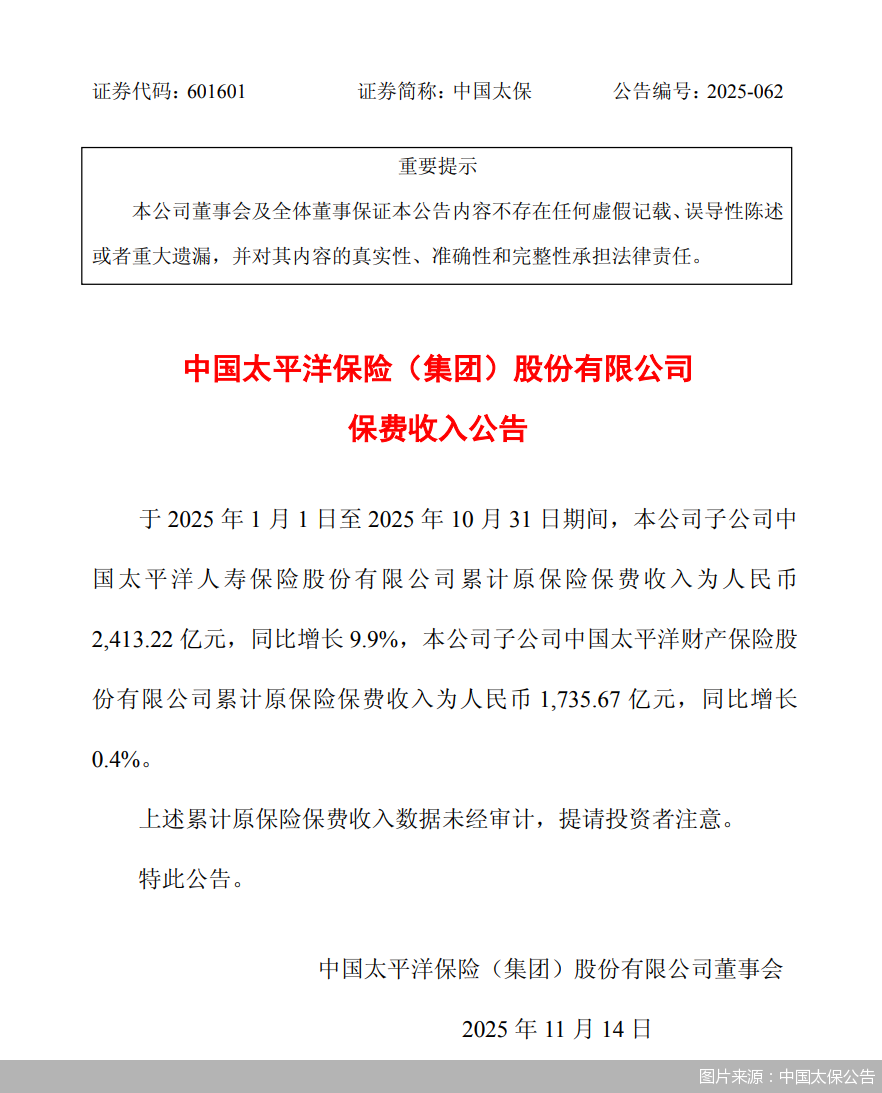
Core Viewpoint - China Pacific Insurance (Group) Co., Ltd. reported a total original insurance premium income of 414.89 billion yuan for the first ten months of 2025, reflecting a year-on-year growth of 9.9% for its life insurance subsidiary and 0.4% for its property insurance subsidiary [1] Group 1 - The life insurance subsidiary, China Pacific Life Insurance Co., Ltd., achieved an original insurance premium income of 241.32 billion yuan, marking a 9.9% increase year-on-year [1] - The property insurance subsidiary, China Pacific Property Insurance Co., Ltd., recorded an original insurance premium income of 173.57 billion yuan, showing a modest growth of 0.4% year-on-year [1] - The combined original insurance premium income for both subsidiaries reached 414.89 billion yuan for the period from January to October 2025 [1]
中国太保:前10个月原保险保费收入为4148.89亿元,同比增长5.7%
Cai Jing Wang· 2025-11-13 11:58
Core Insights - China Pacific Insurance (601601) reported a total premium income of RMB 241.32 billion from its subsidiary China Pacific Life Insurance Co., Ltd. for the period from January 1, 2025, to October 31, 2025, representing a year-on-year growth of 9.9% [1] - The subsidiary China Pacific Property Insurance Co., Ltd. recorded a total premium income of RMB 173.57 billion, with a year-on-year growth of 0.4% [1] - For the first ten months of this year, the combined original insurance premium income of both subsidiaries reached RMB 414.89 billion, showing a year-on-year increase of 5.7% [1]
【财闻联播】13天12板牛股:再异常上涨可能申请停牌!超导量子计算机传来好消息
券商中国· 2025-11-13 11:53
Macro Dynamics - As of the end of October, the broad money supply (M2) reached 335.13 trillion yuan, with a year-on-year growth of 8.2% [2] - The narrow money supply (M1) stood at 112 trillion yuan, growing by 6.2% year-on-year [2] - The currency in circulation (M0) was 13.55 trillion yuan, reflecting a year-on-year increase of 10.6% [2] - A net cash injection of 728.4 billion yuan occurred in the first ten months of the year [2] Financial Regulation - The Financial Regulatory Bureau is set to release a revised "Commercial Bank Merger Loan Management Measures" to support mergers and restructuring, including for tech enterprises [3] - The Bureau is collaborating with other departments to develop policies that promote high-quality development in technology insurance, providing better economic support for tech activities [3] Market Data - On November 13, the Shanghai Composite Index rose by 0.73%, reaching a ten-year high, with over 100 stocks hitting the daily limit [9] - The Shenzhen Component Index increased by 1.78%, and the ChiNext Index rose by 2.55% [9] - The total trading volume in the Shanghai and Shenzhen markets was 2.04 trillion yuan, an increase of 969 billion yuan from the previous trading day [9] Company Dynamics - China Pacific Insurance reported a premium income of 241.32 billion yuan for its life insurance subsidiary from January to October, a year-on-year increase of 9.9% [7] - Tencent Holdings announced third-quarter revenue of 192.87 billion yuan, a 15% year-on-year increase, with net profit attributable to shareholders rising by 19% [12] - Bilibili reported a third-quarter adjusted net profit of 786 million yuan, a significant increase of 233% year-on-year, with total revenue reaching 7.69 billion yuan [14] - Semiconductor manufacturer SMIC reported a net profit growth of 41.1% year-on-year for the first three quarters, with revenue of 49.51 billion yuan [15] - Kanda New Materials announced the termination of its acquisition of North One Semiconductor due to unmet expectations in transaction progress [18]

11月13日晚间重要公告一览
Xi Niu Cai Jing· 2025-11-13 10:11
Group 1 - China Pacific Insurance's subsidiary, China Pacific Life, reported a cumulative premium income of 241.32 billion yuan for the first ten months, a year-on-year increase of 9.9% [1] - China Pacific Property Insurance, another subsidiary, achieved a cumulative premium income of 173.57 billion yuan, with a year-on-year growth of 0.4% [1] - Nocera Biopharma reported a net loss of 64.41 million yuan for the first three quarters, despite a revenue increase of 59.85% to 1.115 billion yuan [1] Group 2 - Founder Securities received approval from the China Securities Regulatory Commission to issue short-term corporate bonds not exceeding 5 billion yuan [1] - Haicheng Bonda's director plans to reduce his stake by up to 0.97%, equating to 198,400 shares [1] - Yuyuan Group intends to repurchase shares worth between 200 million and 300 million yuan, with a maximum price of 8.60 yuan per share [1] Group 3 - Huaren Shuanghe's subsidiary passed the GMP compliance inspection for a specific diabetes medication [4] - Lichong Group received project notifications from three international automotive manufacturers, with expected sales amounting to approximately 1.135 billion yuan [6] - Deyang Co. is planning to issue H-shares and list on the Hong Kong Stock Exchange to enhance its global strategy [7] Group 4 - Longxin General announced the transfer of its entire stake in a subsidiary for 105.6 million yuan, and also plans to divest another stake for 1 yuan due to poor performance [16] - Kangda New Materials decided to terminate the acquisition of a semiconductor company due to unsatisfactory due diligence progress [17] - Lu'an Environmental reported a 3.28% year-on-year increase in coal sales for October, totaling 3.78 million tons [18] Group 5 - Shanghai Port Group plans to invest 2 billion yuan to establish a new holding company with several state-owned enterprises [20] - Borui Pharmaceutical's new drug for obesity treatment has received clinical trial approval [23] - Silver Dragon Co. has completed the registration of a new energy industry fund focusing on high-growth potential projects [24] Group 6 - Hengrui Medicine received approval for a clinical trial of a prostate cancer drug [11] - Baiji Shenzhou reported a net profit of 1.139 billion yuan for the first three quarters, marking a turnaround from losses [36] - Huasheng Pharmaceutical's special medical food product has received registration certification [60]


