
CPIC(601601)

Search documents
保险板块10月27日涨0.84%,新华保险领涨,主力资金净流入5.02亿元
Zheng Xing Xing Ye Ri Bao· 2025-10-27 08:25
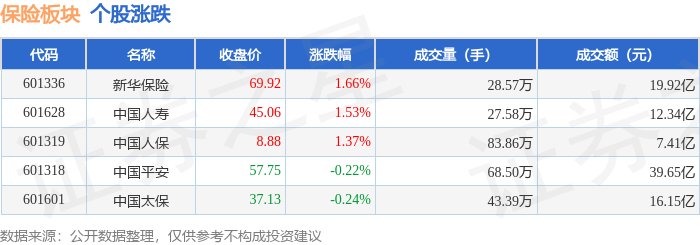
证券之星消息,10月27日保险板块较上一交易日上涨0.84%,新华保险领涨。当日上证指数报收于 3996.94,上涨1.18%。深证成指报收于13489.4,上涨1.51%。保险板块个股涨跌见下表: 从资金流向上来看,当日保险板块主力资金净流入5.02亿元,游资资金净流出4.07亿元,散户资金净流出 9561.63万元。保险板块个股资金流向见下表: | 代码 | 名称 | 主力净流入 (元) | 主力净占比 游资净流入 (元) | | 游资净占比 散户净流入 (元) | | 散户净占比 | | --- | --- | --- | --- | --- | --- | --- | --- | | 601318 中国平安 | | 3.62亿 | 9.12% | -3.78亿 | -9.54% | 1653.11万 | 0.42% | | 601601 | 中国太保 | 1.05 Z | 6.50% | -1.17 乙 | -7.25% | 1219.41万 | 0.76% | | 601336 新华保险 | | 4300.38万 | 2.16% | 5613.65万 | 2.82% | -9914.03万 | -4 ...






中国太保马欣:构建多层次养老保障需明确政府市场社会三方角色
Quan Jing Wang· 2025-10-27 01:44
Core Insights - The discussion at the 2025 Bund Annual Conference highlighted the need for a well-defined multi-tiered pension security system, emphasizing the roles of government, market, and society in this framework [1][2] - The insurance industry is urged to enhance its core capabilities in protection, investment, and service to address the current pension supply-demand imbalance [1] Group 1: Roles in Pension Security System - The government serves as the safety net for basic security with a focus on fairness and inclusivity [1] - The market acts as a provider of diversified solutions tailored to demand [1] - Society plays a supplementary role through mutual assistance and service participation [1] Group 2: Development of Pension Pillars - The second pillar's main task is to "expand coverage," with suggestions to implement automatic enrollment mechanisms for enterprise annuities in Xiong'an New Area [1] - The third pillar should focus on "professional development," encouraging financial institutions to establish specialized pension finance entities [1] Group 3: Insurance Industry's Focus Areas - The insurance sector should enhance its ability to manage longevity and disability risks through innovative annuity plans and commercial long-term care insurance products [1] - There is a need to strengthen long-term and stable investment capabilities, balancing absolute and relative returns [1] - The industry should improve its ability to integrate diverse services, leveraging the long-term nature of insurance funds to develop a comprehensive pension service ecosystem [1]
加速布局在线运动赛道,保险公司也要打造自己的“Keep”?
Sou Hu Cai Jing· 2025-10-26 13:09
Core Insights - Insurance companies are transitioning from traditional risk compensators to active participants in customers' daily lives through health management and fitness tracking [3][4][9] - Ping An Health Insurance has upgraded its app to "Ping An Happy Health," which quantifies health behaviors into redeemable points for insurance benefits [3][4] - Other companies like China Pacific Insurance and Zhonghong Insurance have launched similar fitness apps, indicating a collective industry shift towards integrating health and insurance services [4][10] Group 1: Industry Trends - The health insurance sector is increasingly focusing on integrating health management with insurance products, driven by the growing number of fitness participants in China, which has reached 540 million, accounting for over 38.5% of the population [5][6] - The shift towards online fitness platforms allows insurance companies to collect and analyze user data, enhancing risk assessment and product pricing [4][6] - The regulatory environment is also evolving, with guidelines promoting the integration of health management into insurance services, emphasizing prevention and proactive health management [5][9] Group 2: User Engagement and Benefits - Customers can earn points through health activities, which can be redeemed for benefits like lower deductibles and premium discounts, thus incentivizing healthier lifestyles [3][9] - The integration of fitness data into insurance models allows for the development of customized insurance products, enhancing customer loyalty and retention [9][10] - The approach aims to transform low-frequency insurance interactions into high-frequency health management engagements, increasing customer stickiness [4][9] Group 3: Challenges and Considerations - Insurance companies face challenges related to data security and compliance, particularly concerning sensitive health information [7][8] - Establishing a balance between data collection and user privacy is crucial, with recommendations for tiered data access and anonymization techniques [7][8] - Despite these challenges, the potential for creating a sustainable user relationship through integrated health and insurance services is significant [6][9]

非银金融行业周报:3季报有望超预期,非银板块攻守兼备-20251026
KAIYUAN SECURITIES· 2025-10-26 11:41
Investment Rating - The industry investment rating is "Overweight" (maintained) [1] Core Viewpoints - The third quarter reports are expected to exceed expectations, indicating a balanced offensive and defensive stance in the non-bank financial sector [5] - The China Securities Regulatory Commission emphasizes the need to deepen comprehensive reforms in investment and financing, enhancing the capital market's inclusiveness and competitiveness [5] - The upcoming financial forum is anticipated to highlight the positive outlook for the third quarter reports of brokerage and insurance companies [5] Summary by Relevant Sections Brokerage Sector - Daily average trading volume for equity funds is 2.33 trillion, down 16.2% week-on-week, but market recovery is driving new fund launches [6] - Major brokerage firms like CITIC Securities and Oriental Fortune reported strong third-quarter results, with CITIC's net profit up 52% year-on-year and Oriental Fortune's up 78% [6] - The outlook for brokerage firms remains positive, with expected improvements in investment banking, derivatives, and public fund businesses, alongside low valuations and significant institutional underweight [6] Insurance Sector - Recent third-quarter earnings forecasts from major insurers indicate substantial growth, with China Life expecting a net profit increase of 50% to 70% year-on-year [7] - The stabilization of long-term interest rates and improved asset yields are expected to enhance insurers' return on equity (ROE) [7] - Recommended stocks include China Life, China Pacific Insurance, and Ping An, with a focus on undervalued companies [7]





打开财险行业未决赔款准备金黑箱第七季!已发生赔款负债相关履约现金流量的有利变动,影响头部产险公司综合成本率大约4.5个百分点!
13个精算师· 2025-10-24 11:02
Core Viewpoint - The insurance industry is experiencing significant changes in the structure and estimation of incurred but not reported (IBNR) reserves, which are crucial for understanding the financial health of insurance companies. The IBNR reserves for 2024 are estimated at approximately 248 billion, accounting for 37.5% of the total reserves, remaining stable compared to the previous year [11][13][16]. Group 1: IBNR Reserves - IBNR reserves are primarily composed of three parts: reported but not settled claims, unreported claims, and claims handling expense reserves. The estimation of IBNR involves predicting future claims based on historical data and actuarial models, which introduces a degree of uncertainty [10][11]. - The proportion of IBNR reserves to total reserves has increased from 15.4% in 2010 to 39.4% in 2022, but has shown signs of a recent decline [13]. - For major insurance companies in 2024, the IBNR proportion of total reserves is as follows: People's Insurance Company of China (35.3%), Ping An Property & Casualty (39.9%), and China Pacific Insurance (35.8%), with the latter showing a decrease of 4.3 percentage points compared to the previous year [16][18]. Group 2: Cash Flow and Cost Ratios - A new accounting standard for insurance contracts has introduced a metric for changes in cash flow related to incurred claims liabilities. This metric reflects the difference between actual and estimated claim payments, impacting the book value of insurance liabilities [5][24]. - The ratio of changes in incurred claims liabilities to insurance service revenue for 2024 is projected to be -4.5%, indicating favorable changes that have led to a reduction in the comprehensive cost ratio for eight major insurance companies by approximately 4.5 percentage points [7][29]. - The total incurred claims liabilities for eight companies adopting the new accounting standard represent about 75% of the market share in the property and casualty insurance sector [24]. Group 3: Industry Trends and Comparisons - The average IBNR proportion across the industry for 2024 is 37.5%, with a simple average of 46.3% and a median of 43.2%. Ten companies have an IBNR proportion exceeding 70% [14]. - The ratio of total reserves to earned premiums for 2024 is 44.1%, reflecting a year-on-year increase of approximately 1 percentage point, with top three companies at 43.8% and smaller companies at 44.6% [13]. - The report highlights the differences in IBNR proportions among companies, which can be attributed to business structure and claims efficiency improvements [14][16].

保险板块10月24日跌0.56%,中国太保领跌,主力资金净流出3.69亿元
Zheng Xing Xing Ye Ri Bao· 2025-10-24 08:27
Core Insights - The insurance sector experienced a decline of 0.56% on October 24, with China Pacific Insurance leading the drop [1] - The Shanghai Composite Index closed at 3950.31, up 0.71%, while the Shenzhen Component Index closed at 13289.18, up 2.02% [1] Insurance Sector Performance - China Ping An (601318) closed at 57.88, with a slight increase of 0.14% and a trading volume of 558,200 shares, totaling a transaction value of 32.40 billion [1] - New China Life Insurance (601336) closed at 68.78, down 0.03%, with a trading volume of 200,000 shares and a transaction value of 1.368 billion [1] - China Life Insurance (601628) closed at 44.38, down 0.20%, with a trading volume of 191,900 shares and a transaction value of 850 million [1] - China Property & Casualty Insurance (601319) closed at 8.76, down 0.23%, with a trading volume of 580,800 shares and a transaction value of 507 million [1] - China Pacific Insurance (601601) closed at 37.22, down 0.32%, with a trading volume of 199,200 shares and a transaction value of 741 million [1] Fund Flow Analysis - The insurance sector saw a net outflow of 369 million from institutional investors, while retail investors had a net inflow of 385 million [1] - New China Life Insurance had a net inflow of 7.105 million from institutional investors, but a net outflow of 19.212 million from retail investors [2] - China Property & Casualty Insurance experienced a significant net outflow of 53.2675 million from institutional investors, with a net inflow of 49.3297 million from retail investors [2] - China Life Insurance had a net outflow of 85.7896 million from institutional investors, with a net inflow of 68.5680 million from retail investors [2] - China Pacific Insurance faced a net outflow of 87.024 million from institutional investors, while retail investors contributed a net inflow of 41.1788 million [2]
险资红利策略2.0
HTSC· 2025-10-24 05:24
Core Insights - The insurance capital's dividend strategy has accelerated, with an increase in allocation to dividend stocks exceeding 320 billion RMB in the first half of 2025, surpassing the total allocation for the previous year [1][4] - The insurance capital is increasingly reliant on dividend stocks to maintain cash investment returns due to declining cash yields, but rising valuations and decreasing dividend yields pose challenges to this strategy [2][13] - The estimated under-allocation of dividend stocks in the insurance sector is between 0.8 to 1.6 trillion RMB, which may be completed in the next two to three years [4][41] Group 1: Dividend Strategy Transition - The insurance capital's dividend strategy is transitioning from a "buy and hold" phase to a more selective "picking the best" phase, focusing on balancing stable cash returns and minimizing capital loss risks [2][13] - The focus on dividend stocks is driven by the need to maintain cash yields amidst high fixed liability costs, with the average net investment yield for listed insurance companies dropping to 3.0% in the first half of 2025, nearing the fixed liability cost of around 3% [14][33] - The selection criteria for dividend stocks have narrowed, with three main standards: stable dividends per share (DPS), low capital loss probability, and meeting a certain dividend yield threshold [3][15] Group 2: Market Dynamics and Stock Selection - The potential pool of dividend stocks has significantly decreased, particularly in the Hong Kong market, where the free float market capitalization of potential dividend stocks dropped from 3.4 trillion HKD to 1.6 trillion HKD [3][17] - In contrast, the number of potential dividend stocks in the A-share market remains stable at 57, with a total free float market capitalization of 3.8 trillion RMB [17] - The insurance capital's focus on bank stocks as a key component of its dividend strategy has led to a notable increase in stock prices and valuations since early 2024, although the correlation between DPS stability and stock price movements is not strong [5][16] Group 3: Future Outlook and Recommendations - The insurance sector is expected to continue increasing its allocation to high-yield stocks, with an estimated annual increase of 300 to 500 billion RMB in the next few years to address the cash yield gap [4][41] - The report recommends focusing on resilient balance sheets and balanced growth companies such as Ping An Insurance, China Pacific Insurance, China Life Insurance, and China Reinsurance [1][9] - The overall investment ratio in dividend stocks for the insurance industry is projected to be suitable at over 5%, indicating a need for further allocation to meet this target [41][43]
温州监管分局同意撤销太保寿险温州中心支公司瓯海区营销服务部
Jin Tou Wang· 2025-10-24 04:00
Core Viewpoint - The Wenzhou Regulatory Bureau of the National Financial Supervision Administration has approved the dissolution of the marketing service department of China Pacific Life Insurance Co., Ltd. in the Ouhai District [1] Group 1 - The approval includes the agreement to revoke the marketing service department of China Pacific Life Insurance Co., Ltd. in Wenzhou [1] - Following the approval, the company is required to return its license to the Wenzhou Financial Regulatory Bureau within 15 working days and complete the necessary legal procedures [1]
2025上半年财险公司保费排名榜:平安增速超7%,泰康、大家等排名上升,比亚迪、众惠、三星等持续超高速增长
13个精算师· 2025-10-23 14:43
Core Insights - The property insurance industry is experiencing a slowdown in growth, with non-auto insurance business contributions surpassing auto insurance [1][10][11] - Ping An Property & Casualty has outpaced the market with a growth rate of 7.1%, driven by both auto and non-auto insurance segments [18][20] - Companies like Taikang and others have seen their rankings rise, with premium growth exceeding 20% for firms like BYD and Samsung [25][27] Group 1: Industry Overview - In the first half of 2025, the property insurance sector reported a premium income of 964.5 billion, showing a slight slowdown in growth [11][15] - The growth rate of non-auto insurance has decreased, with health insurance growth dropping from double digits to single digits [14][15] - The overall premium growth for the property insurance industry is expected to be below 5% when excluding the impact of new entrants like Sheneng Insurance [15][17] Group 2: Company Performance - Ping An Property & Casualty's premium income reached 1,804.88 million, with a growth rate of 6.9%, contributing significantly to the overall market [1][20] - Sheneng Insurance, in its first year, achieved a premium of over 80 billion, ranking 12th among property insurers [10][14] - Other companies such as Dadi and Zhong'an have also reported premium growth rates exceeding the market average, with non-auto segments contributing significantly [22][23] Group 3: Growth Drivers - The shift towards non-auto insurance is evident, with many companies reporting high growth rates in segments like health and agricultural insurance [21][24] - Companies with premium growth exceeding 20% are primarily smaller firms, indicating a trend where smaller insurers are capturing market share through rapid growth [27][28] - The regulatory environment is evolving, with new guidelines aimed at enhancing the quality of non-auto insurance business, which may further influence growth dynamics [22][23]

高盛:料市场关注内险股收入及股息指引 维持对中国平安、中国太保及中国财险的“买入”评级
Zhi Tong Cai Jing· 2025-10-23 09:09
Core Viewpoint - Goldman Sachs reports that domestic insurance stocks have generally released third-quarter earnings forecasts, with many companies' profits for the first three quarters significantly exceeding expectations, even surpassing full-year market predictions [1] Group 1: Earnings Performance - The preliminary performance of third-quarter earnings is believed to be largely reflected in stock price movements [1] - Major insurance companies are set to announce their third-quarter results at the end of the month, with expectations that the risk-return profile of domestic insurance stocks has improved [1] Group 2: Future Outlook - It is anticipated that the profit performance for the first three quarters will exceed market expectations, and the new business value is expected to maintain double-digit growth through 2026 [1] - Goldman Sachs maintains a "buy" rating for China Ping An (601318), China Pacific Insurance (601601), and China Property & Casualty Insurance (02328) [1]