
CPIC(601601)

Search documents
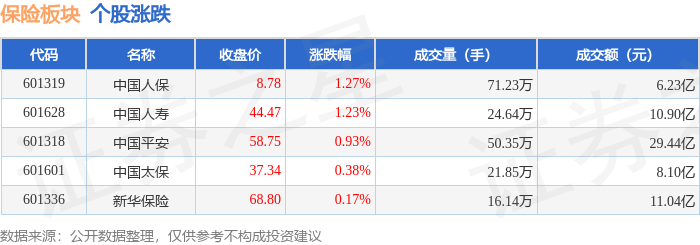
保险板块10月23日涨0.99%,中国人保领涨,主力资金净流出3105.42万元
Zheng Xing Xing Ye Ri Bao· 2025-10-23 08:20
Core Insights - The insurance sector experienced a rise of 0.99% on October 23, with China Pacific Insurance leading the gains [1] - The Shanghai Composite Index closed at 3922.41, up 0.22%, while the Shenzhen Component Index closed at 13025.45, also up 0.22% [1] Insurance Sector Performance - China Life Insurance closed at 44.47, up 1.23% with a trading volume of 246,400 shares [1] - China Ping An closed at 58.75, up 0.93% with a trading volume of 503,500 shares [1] - China Taiping Insurance closed at 37.34, up 0.38% with a trading volume of 218,500 shares [1] - New China Life Insurance closed at 68.80, up 0.17% with a trading volume of 161,400 shares [1] Fund Flow Analysis - The insurance sector saw a net outflow of 31.05 million yuan from institutional investors and 145 million yuan from speculative funds, while retail investors contributed a net inflow of 176 million yuan [1] - China Ping An had a net inflow of 51.83 million yuan from institutional investors, while it faced a net outflow of 102 million yuan from speculative funds [2] - China Life Insurance experienced a net outflow of 55.30 million yuan from institutional investors, with a net inflow of 29.04 million yuan from speculative funds [2]






保险业深度报告:负债端景气延续,资产端驱动估值修复
Dongguan Securities· 2025-10-23 07:19
Investment Rating - The report maintains an "Overweight" rating for the insurance industry [1] Core Viewpoints - The life insurance sector is expected to continue its growth momentum, driven by effective cost control and product optimization, which will enhance the new business value margin (NBVM) and new business value (NBV) [3][5] - Non-auto insurance is emerging as a new growth driver, with increasing premium contributions and regulatory support expected to improve underwriting performance [3][5] - Investment strategies will be crucial for valuation recovery, with a focus on long-term interest rates and equity market performance [3][5] Summary by Sections 1. Policy and Market Overview - The insurance sector has seen a significant increase in stock prices, with the Shenwan Insurance Index rising by 18.79% year-to-date, outperforming the CSI 300 Index [11] - Regulatory policies are encouraging long-term capital inflows into the market, with insurance companies' investment in stocks and equity funds exceeding 4.4 trillion yuan, accounting for 12% of their total investments [12][15] 2. Asset Side: Stability in Fixed Income, Growth in Equity - The net investment yield for major insurance companies has faced pressure, with varying total investment returns across firms [27][28] - The insurance industry is expected to increase its allocation to equity assets, with an average investment weight of 13.75% in stocks and funds as of mid-2025, reflecting a 1.07 percentage point increase from 2024 [34][38] 3. Liability Side: Easing Cost Pressures and Expanding Spread - Life insurance companies have reported positive growth in new premium income, particularly in the bancassurance channel, while the individual insurance channel has faced challenges [44][46] - The shift towards participating insurance products is evident, with significant increases in their share of new premiums, indicating a strategic response to lower interest rates [51]
险企执行新会计准则倒计时,怎么看?
CAITONG SECURITIES· 2025-10-23 05:59
Report Industry Investment Rating No information provided in the report. Core Viewpoints - Listed insurance companies have implemented new accounting standards (IFRS 17 and IFRS 9) since 2023, while non - listed ones will implement them in 2026. It is estimated that after the remaining insurance companies implement the new standards in 2026, the re - classification scale of financial assets of affected insurance companies may account for about 20% [3][62]. - After the implementation of the new standards, more insurance assets may be classified into the FVTPL category, increasing the profit volatility of insurance companies. Insurance companies are more cautious about bank capital bonds and increase the allocation of ultra - long bonds. The proportion of insurance funds invested in bonds is rising [3][5][63]. Summary According to the Table of Contents 1. New Accounting Standards Gradually Implemented - IFRS 9 adjusts the classification of financial assets from "four - category" to "three - category": FVTPL, FVOCI, and AC. More assets may be classified into FVTPL, making insurance company profits more volatile. Insurance companies have an incentive to allocate more assets to AC or FVOCI [9][10]. - IFRS 17 changes the discount rate for traditional insurance reserves. Insurance companies can use the OCI option to reduce profit fluctuations, which may lead to significant differences in net profit under the old and new standards [12]. - From the operating data of insurance companies that have implemented the new standards in advance, there is an increase in net profit and a decrease in net assets [16]. - Among bond - issuing insurance companies, the financial investment of those that have implemented the new standards accounted for 74.4% of the total as of the end of 2024. It is estimated that the proportion of financial asset re - classification of the remaining insurance companies in 2026 may be about 20% [3][62]. 2. Changes in Insurance Institution Behavior 2.1 Insurance Asset Allocation Observation - As of the end of Q2 2025, the balance of insurance funds in use was 36.23 trillion yuan, with life insurance companies accounting for 90% [23]. - The proportion of bonds in the asset allocation of life and property insurance is increasing. As of the end of Q2 2025, the bond proportion of life insurance increased from 41% to 52%, with a balance of 16.9 trillion yuan; that of property insurance increased from 21% to 40%, with a balance of 0.95 trillion yuan [25]. - The investment proportion of life and property insurance in stocks is relatively stable, but the growth rate has accelerated since Q1 last year. In Q2 this year, the cumulative year - on - year growth rates of stock investment were 47.9% and 42.8% respectively [31]. 2.2 Insurance Secondary Market Observation 2.2.1 Bank - to - Bank - As of the end of August 2025, the total bond custody scale of insurance institutions in CCDC and SHCHE was 5033.311 billion yuan. Interest - rate bonds accounted for 77.9%, with local bonds accounting for 49.3% [34]. - Insurance has been increasing its allocation of local bonds. As of the end of August this year, the net increase in local bond custody was 3776 billion yuan, approaching last year's level. Insurance has been reducing its holdings of commercial bank bonds since March last year [39][58]. 2.2.2 Exchange - As of the end of September, the scale of corporate bonds held by insurance in SSE and SZSE was 931.8 billion yuan and 181.6 billion yuan respectively. After Q2 this year, the allocation of credit bonds by insurance has increased [52]. 3. Understanding the Impact of the New Standards - Insurance institutions will further increase their demand for ultra - long bonds due to stable premium income growth, the "Second - Generation Solvency" regulations guiding the passive allocation of fixed - income assets, and increased liability - side volatility under the new insurance contract standards [55]. - Under the new financial tool accounting standards, insurance will be more cautious about bank secondary and perpetual bonds that do not pass SPPI and are included in FVTPL [58]. 4. Summary - In 2026, after the remaining insurance companies implement the new accounting standards, the re - classification scale of financial assets of affected insurance companies may account for about 20% [3][62]. - After the implementation of the new standards, insurance company profits may become more volatile. Insurance will be more cautious about bank capital bonds and increase the allocation of ultra - long bonds. The proportion of bonds in insurance asset allocation is rising [5][63].
海西金融监管分局同意太平洋产险海西州都兰营销服务部变更营业场所
Jin Tou Wang· 2025-10-23 03:31
Core Viewpoint - The Haixi Financial Regulatory Bureau has approved the relocation of the marketing service department of China Pacific Property Insurance Co., Ltd. in Dulan County, Haixi Prefecture, Qinghai Province [1] Group 1 - The marketing service department's new location is specified as No. 6, South of Cultural Square, East of Hope Road, Chasu Town, Dulan County, Haixi Mongolian and Tibetan Autonomous Prefecture, Qinghai Province [1] - The company is required to handle the change and obtain the necessary permits in accordance with relevant regulations [1]

大行评级丨高盛:预期内险股风险回报水平改善 维持中国平安、太保等“买入”评级
Ge Long Hui· 2025-10-23 03:20
Core Viewpoint - Goldman Sachs reports that domestic insurance stocks have generally announced third-quarter earnings forecasts, with many companies exceeding expectations for the first three quarters and even surpassing full-year market predictions. The initial performance impact of the third-quarter results is believed to be largely reflected in stock prices, and future investor focus will shift to revenue and dividend guidance [1] Group 1: Earnings Performance - Many domestic insurance companies have reported third-quarter earnings that are significantly higher than expected [1] - The preliminary performance for the first three quarters is anticipated to exceed market expectations [1] Group 2: Future Outlook - Goldman Sachs expects the risk-return profile of domestic insurance stocks to have improved [1] - The new business value is projected to maintain double-digit growth through 2026 [1] Group 3: Stock Ratings - Goldman Sachs maintains a "Buy" rating on China Ping An, Taikang Life, and China Pacific Insurance [1]
从“人海战术”到价值驱动的转型升级之路:中国个险渠道三十年
Soochow Securities· 2025-10-22 13:24
Investment Rating - Maintain "Buy" rating for the insurance sector [1] Core Insights - The individual insurance channel in China has undergone significant transformation over the past 30 years, evolving from a "mass recruitment" strategy to a focus on value-driven growth [2][9] - The current phase emphasizes quality improvement over mere scale expansion, with a notable decline in the number of agents from 912 million in 2019 to 264 million by the end of 2024, a reduction of 71.1% [2][39] - The report highlights the importance of professional, technological, and service upgrades as key directions for the future of the individual insurance channel [2][39] Summary by Sections 1. Individual Insurance as a Pillar Channel - The individual insurance channel is defined as the direct sale of insurance products to consumers through personal agents, which can be categorized into exclusive and independent agents [7][8] - The development of the individual insurance channel began in 1992 with the introduction of the agent system by AIA, marking a shift from group insurance sales to individual marketing [11][14] 2. Development Stages of Individual Insurance Channel - The individual insurance channel has experienced four main stages: 1. Introduction and Initial Phase (1992-2002) 2. Intensified Competition with Bank Insurance (2003-2014) 3. Rapid Expansion Phase (2015-2019) 4. Quality Transformation Phase (2020-Present) [9][10] 3. Current Challenges and Future Directions - The individual insurance channel faces several challenges, including the need for professionalization and technological integration to enhance service quality [2][39] - The report suggests that the future of the individual insurance channel will not rely on a single sales channel but will embrace a multi-channel approach [2][39]
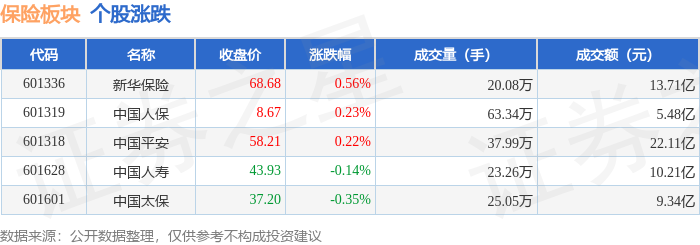
保险板块10月22日涨0.03%,新华保险领涨,主力资金净流出2.59亿元
Zheng Xing Xing Ye Ri Bao· 2025-10-22 08:19
Core Insights - The insurance sector experienced a slight increase of 0.03% on October 22, with Xinhua Insurance leading the gains [1] - The Shanghai Composite Index closed at 3913.76, down 0.07%, while the Shenzhen Component Index closed at 12996.61, down 0.62% [1] Insurance Sector Performance - Xinhua Insurance (601336) closed at 68.68, up 0.56% with a trading volume of 200,800 shares and a transaction value of 1.371 billion [1] - China Pacific Insurance (601601) closed at 37.20, down 0.35% with a trading volume of 250,500 shares and a transaction value of 934.7 million [1] - China Life Insurance (601628) closed at 43.93, down 0.14% with a trading volume of 232,600 shares and a transaction value of 1.021 billion [1] - China Ping An (601318) closed at 58.21, up 0.22% with a trading volume of 379,900 shares and a transaction value of 2.211 billion [1] - China Reinsurance (601319) closed at 8.67, up 0.23% with a trading volume of 633,400 shares and a transaction value of 548 million [1] Capital Flow Analysis - The insurance sector saw a net outflow of 259 million from institutional investors, while retail investors contributed a net inflow of 253 million [1] - Xinhua Insurance had a net inflow of 75.31 million from institutional investors, but a net outflow of 73.70 million from retail investors [2] - China Ping An experienced a significant net outflow of 168 million from institutional investors, while retail investors contributed a net inflow of 172 million [2] - China Life Insurance and China Pacific Insurance also saw net outflows from institutional investors, with retail investors offsetting some of these losses [2]
银保合作:从“切蛋糕”走向“做蛋糕”
Jin Rong Shi Bao· 2025-10-22 06:19
Core Insights - The core viewpoint of the articles highlights the significant growth and strategic evolution in the collaboration between banks and insurance companies, particularly in the life insurance sector, with a notable increase in premium income and a shift towards value-driven partnerships [1][2][4]. Group 1: Premium Income and Growth - In the first half of the year, China's life insurance companies achieved original insurance premium income of 27,705 billion yuan, representing a year-on-year growth of 5.4% [1]. - The bank and postal channels generated premium income of 11,695 billion yuan, with a year-on-year increase of 9.3%, significantly outpacing the overall industry growth [1]. - The bank and postal channels contributed 42.4% to total premiums, second only to the individual insurance channel at 47.4% [1]. Group 2: Strengthening Cooperation - The bond between banks and insurance companies is deepening, with increasing cooperation potential stemming from changes in cooperation models, foundations, and ecosystems [2]. - Banks view insurance distribution as a crucial component of their non-interest income, helping to alleviate pressure from narrowing net interest margins [2]. - Insurance companies benefit from banks' customer base and credibility, facilitating customer acquisition and providing implicit credit support [2]. Group 3: Improved Cooperation Ecosystem - The strict implementation of "reporting and banking integration" has accelerated the deep transformation of bank-insurance business, shifting from a fee-driven model to a customer service-centered value co-creation phase [3]. - Insurance companies are increasingly focusing on service ecosystem development, while banks recognize the value of the service resources provided by insurance companies [3]. - This shift has cleared obstacles to the healthy development of bank-insurance cooperation, enhancing the business value attributes of the bank and postal channels [3]. Group 4: Trends and Future Outlook - The bank-insurance channel is undergoing a profound transformation from a scale-oriented approach to a value-oriented one [4]. - It is anticipated that complex insurance products will occupy a larger share of the market, with bank-insurance new single premiums expected to approach 70% by year-end [4]. - The demand for risk protection and wealth management products is increasing, with a growing preference for long-term savings and complex insurance products among bank customers [6]. Group 5: Performance of Leading Insurance Companies - In the first half of the year, major listed insurance companies reported significant growth in premium income from bank-insurance channels, with New China Life Insurance achieving a 65.1% year-on-year increase [5]. - The contribution of bank-insurance channels to total premium income for New China Life rose from 28.3% to 38.1% [5]. - Other leading companies also reported substantial growth in bank-insurance channel premiums, with the lowest growth rate at 37.5% for Ping An Life and Health Insurance [5]. Group 6: Role of Technology - Technology is expected to empower the entire bank-insurance operational chain, with advancements in big data and artificial intelligence reshaping operations [6]. - Enhanced data connectivity will facilitate precise marketing, team management, customer service, and compliance risk control [6]. - The focus on service quality and customer engagement will be critical for maintaining customer loyalty in the evolving bank-insurance landscape [6]. Group 7: Market Dynamics and Competition - The bank-insurance channel is likely to experience a "Matthew Effect," where leading insurance companies will continue to strengthen their market positions while smaller firms face multiple constraints [7]. - The competitive advantages of leading firms in brand, value-added services, capital strength, risk resistance, and product innovation will become more pronounced [7]. - The market share of leading insurance companies in the bank-insurance channel is expected to continue increasing [7].
保险业全力护航 黄淮海秋粮抢收攻坚战
Jin Rong Shi Bao· 2025-10-22 06:15
Core Insights - The article highlights the severe impact of continuous heavy rainfall on the autumn harvest in the Huanghuaihai region and other provinces, posing significant challenges to agricultural production and food security [1][7] - The government has allocated 484 million yuan in disaster relief funds to support affected provinces in agricultural recovery efforts [1] - Insurance companies are actively implementing emergency response plans to expedite disaster claims and support farmers [2][3][4] Government Response - The Ministry of Finance and the Ministry of Agriculture and Rural Affairs have jointly issued 484 million yuan for disaster relief to seven provinces [1] - The funds are aimed at facilitating rapid harvesting, drying of crops, drainage of fields, and wet sowing of winter wheat [1] - A meeting was held to emphasize the importance of timely insurance claims processing for affected farmers [1] Insurance Industry Actions - Multiple insurance companies have activated emergency plans to establish a disaster claims system, ensuring the protection of farmers' interests [2] - China Life Insurance and other firms are utilizing technology such as drones and satellite imagery to enhance damage assessment and claims processing efficiency [4][6] - Insurance companies have reported significant payouts, with 1.41 billion yuan already disbursed for various crop losses as of October 13 [1][3] Local Initiatives - Local insurance branches are collaborating with agricultural experts to conduct on-site assessments and provide timely advice to farmers [5][6] - In regions like Shandong and Anhui, insurance companies are actively involved in coordinating harvesting and drying efforts to minimize crop losses [4][5] - The use of technology and data analysis is being emphasized to monitor crop conditions and guide farmers in disaster prevention [6] Overall Impact - The efficiency of agricultural insurance claims is crucial for ensuring farmers' financial recovery and maintaining national food security [7] - The insurance sector is committed to providing rapid responses and effective measures to support the autumn harvest and mitigate losses [7]
偏好新经济领域 险资加速掘金港股
Bei Jing Shang Bao· 2025-10-21 15:35
Core Viewpoint - The Hong Kong IPO market has seen significant activity this year, with insurance capital becoming a notable force as cornerstone investors in new listings, reflecting a shift in investment strategy towards stable returns in the context of favorable market conditions [1][2]. Group 1: Insurance Capital Participation - Insurance institutions have participated as cornerstone investors in 7 Hong Kong IPOs this year, with a total subscription amount of approximately 34.4 billion HKD, which is more than three times the total of less than 10 billion HKD from the previous year [1]. - The participation of insurance capital in Hong Kong IPOs is driven by the need for stable investment returns, the relatively low valuations in the market, and supportive regulatory policies encouraging long-term investments [1][2]. Group 2: Active Insurance Institutions - Among the most active insurance institutions in the Hong Kong IPO market are Taikang Life and China Pacific Insurance, with Taikang Life participating in 6 IPOs, while China Pacific Insurance and its subsidiaries have appeared twice as cornerstone investors [3]. - Other participants include Zhongyou Insurance and Dajia Life, each participating in one IPO as cornerstone investors [3]. Group 3: Investment Preferences - Insurance capital shows a preference for sectors such as technology, consumer goods, and new energy, including industries like automotive, home appliances, semiconductors, and energy storage [3]. - This investment strategy aligns with the growth potential of new economy sectors and the national industrial development direction, indicating a focus on high-growth and quality assets [3].