
CHINA TELECOM(601728)

Search documents
中国电信中标:湖州市中心医院云主机服务采购项目成交结果公告(非政府采购项目)
Sou Hu Cai Jing· 2025-08-15 02:47
证券之星消息,根据天眼查APP-财产线索数据整理,根据湖州市中心医院月8日12发布的《湖州市中心 医院云主机服务采购项目成交结果公告(非政府采购项目)》内容显示,中国电信股份有限公司中标, 详情如下: 以上内容为证券之星据公开信息整理,由AI算法生成(网信算备310104345710301240019号),不构成 投资建议。 标题:湖州市中心医院云主机服务采购项目成交结果公告(非政府采购项目) 采购方:湖州市中心医院 供应商:中国电信股份有限公司湖州分公司 中标金额:212800.0 地区:浙江省 发布日期:2025-08-12 通过天眼查大数据分析,中国电信股份有限公司共对外投资了88家企业,参与招投标项目118820次;财 产线索方面有商标信息285条,专利信息17151条,著作权信息7388条;此外企业还拥有行政许可72个。 数据来源:天眼查APP ...

中国电信招标结果:【四川】中国电信股份有限公司成都分公司2025年某客户医疗软件开发采购项目直接采购公示
Sou Hu Cai Jing· 2025-08-15 02:47
数据来源:天眼查APP 以上内容为证券之星据公开信息整理,由AI算法生成(网信算备310104345710301240019号),不构成 投资建议。 采购方:中国电信股份有限公司成都分公司 供应商:四川影捷众联科技有限公司 中标金额: 地区:四川省 发布日期:2025-08-12 证券之星消息,根据天眼查APP-财产线索数据整理,中国电信股份有限公司成都分公司8月12日发布 《【四川】中国电信股份有限公司成都分公司2025年某客户医疗软件开发采购项目直接采购公示》,详 情如下: 标题:【四川】中国电信股份有限公司成都分公司2025年某客户医疗软件开发采购项目直接采购公示 通过天眼查大数据分析,中国电信股份有限公司共对外投资了88家企业,参与招投标项目118820次;财 产线索方面有商标信息285条,专利信息17151条,著作权信息7388条;此外企业还拥有行政许可72个。 ...
中国电信中标:江陵县马家寨乡财政管理所业务合同
Sou Hu Cai Jing· 2025-08-15 02:47
数据来源:天眼查APP 以上内容为证券之星据公开信息整理,由AI算法生成(网信算备310104345710301240019号),不构成 投资建议。 采购方:江陵县马家寨乡财政所 供应商:中国电信股份有限公司江陵分公司 中标金额:42000.0 地区:湖北省 发布日期:2025-08-12 证券之星消息,根据天眼查APP-财产线索数据整理,根据江陵县马家寨乡财政所月8日12发布的《江陵 县马家寨乡财政管理所业务合同》内容显示,中国电信股份有限公司中标,详情如下: 标题:江陵县马家寨乡财政管理所业务合同 通过天眼查大数据分析,中国电信股份有限公司共对外投资了88家企业,参与招投标项目118820次;财 产线索方面有商标信息285条,专利信息17151条,著作权信息7388条;此外企业还拥有行政许可72个。 ...
中国电信中标:娄底分行与冷水江市人民医院医疗场景建设项目结果公示
Sou Hu Cai Jing· 2025-08-15 02:47
数据来源:天眼查APP 证券之星消息,根据天眼查APP-财产线索数据整理,根据中国银行股份有限公司湖南省分行月8日12发 布的《娄底分行与冷水江市人民医院医疗场景建设项目结果公示》内容显示,中国电信股份有限公司中 标,详情如下: 标题:娄底分行与冷水江市人民医院医疗场景建设项目结果公示 通过天眼查大数据分析,中国电信股份有限公司共对外投资了88家企业,参与招投标项目118820次;财 产线索方面有商标信息285条,专利信息17151条,著作权信息7388条;此外企业还拥有行政许可72个。 以上内容为证券之星据公开信息整理,由AI算法生成(网信算备310104345710301240019号),不构成 投资建议。 采购方:中国银行股份有限公司湖南省分行 供应商:中国电信股份有限公司娄底分公司 中标金额: 地区:湖南省 发布日期:2025-08-12 ...
中国电信上半年营收增长净利润增长,研发投入助力业绩提升
Xin Lang Cai Jing· 2025-08-15 02:47
Core Insights - China Telecom reported a revenue of RMB 2,694.22 billion for the first half of 2025, representing a year-on-year growth of 1.30% [1][2] - The net profit attributable to the parent company was RMB 230.17 billion, with a year-on-year increase of 5.53% [1][2] - The growth in revenue was primarily driven by an increase in service revenue, particularly mobile communication services, which reached RMB 1,066 billion, also growing by 1.3% year-on-year [1][2] Revenue Breakdown - Total service revenue amounted to RMB 2,491 billion, reflecting a year-on-year growth of 1.2% [2] - Fixed-line and smart home service revenue reached RMB 641 billion, with a slight increase of 0.2% [2] - The revenue from industrial digitalization business was RMB 749 billion, indicating strong performance [1][2] User Metrics - The penetration rate of 5G network users increased by 6.1 percentage points compared to the end of the previous year [1][2] - The average revenue per user (ARPU) for mobile users reached RMB 46.0 [1][2] - The broadband comprehensive ARPU was RMB 48.3 [2] Technological Advancements - China Telecom is advancing its "5G+AI+Cloud+Applications" integrated product system, launching products like the 5G industrial control intelligent body [2][3] - The company has developed nearly 500,000 new integrated gateways [2] - Over 80 industry models and 30 industry intelligent bodies have been launched, along with the Starry MaaS platform and Starry Industry Agent platform [2] Infrastructure Development - The total number of 5G base stations reached 4.549 million, and the number of internet broadband access ports was 1.234 billion [3] - Significant progress has been made in new infrastructure construction, particularly in 5G-A network capability upgrades and industrial digitalization [3] Strategic Focus - The company emphasizes the importance of artificial intelligence, computing services, and cloud business as key development directions [3] - There is a commitment to enhancing research and development efficiency and strengthening the transformation of innovative results [3] - The company aims to build a talent center and innovation hub to support its strategic emerging businesses and future industries [3]
海洋经济大消息,融资客加仓多股(名单)
Zheng Quan Shi Bao Wang· 2025-08-15 01:24
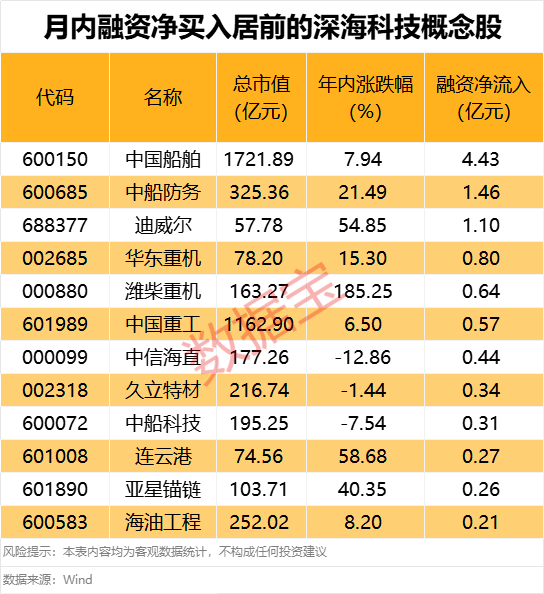
Group 1: Company Performance - China Telecom (601728) reported a revenue of 2694.22 billion yuan for the first half of the year, a year-on-year increase of 1.3% [1] - The net profit attributable to shareholders was 230.17 billion yuan, reflecting a year-on-year growth of 5.53% [1] - The company plans to distribute an interim cash dividend of 0.1812 yuan per share (tax included) [1] Group 2: Industry Trends - The National Development and Reform Commission is preparing the "14th Five-Year" marine economy development plan, focusing on innovation-driven growth and the transformation of traditional marine industries [2] - The marine economy's total production value is expected to exceed 10 trillion yuan for the first time in 2024, doubling since 2012 [2] - The marine economy is recognized as a strategic priority, with an emphasis on deep-sea technology and the integration of marine communication as a key infrastructure for future 6G networks [2] Group 3: Stock Market Activity - Several marine technology concept stocks have seen significant inflows from financing clients, with major stocks like Jili Rigging and Weichai Heavy Industry showing substantial price increases [3][4] - China Shipbuilding's net profit is projected to be between 28 billion and 31 billion yuan, marking a year-on-year increase of 98.25% to 119.49% [4] - Financing net inflows for key stocks include China Shipbuilding at 4.43 billion yuan, China Ship Defense at 1.46 billion yuan, and Diweier at 1.1 billion yuan [5][6]


财经早报:8月15日
Xin Hua Cai Jing· 2025-08-15 00:17
Group 1: Regulatory Changes and Economic Measures - The State Council of China has announced the introduction of a new K visa for foreign young scientific and technological talents, effective from October 1, 2025 [1] - The People's Bank of China will conduct a 500 billion yuan reverse repurchase operation with a fixed quantity and interest rate, set for August 15, 2025, with a term of 182 days [1] Group 2: Industry Growth and Performance - China's digital infrastructure has seen significant development during the 14th Five-Year Plan period, with 5G base stations reaching 4.55 million and gigabit broadband users totaling 226 million by June 2025 [1] - The data industry in China is expected to grow rapidly, with over 400,000 data companies projected by 2024 and an industry scale reaching 5.86 trillion yuan, a 117% increase from the end of the 13th Five-Year Plan [1] - The postal industry in China reported a cumulative delivery volume of 122.3 billion items in the first seven months, a year-on-year increase of 16.2% [1] Group 3: Company Financial Performance - JD Group reported a revenue of 356.7 billion yuan (approximately 49.8 billion USD) for Q2 2025, a 22.4% increase compared to Q2 2024 [1][7] - China Telecom's half-year report for 2025 showed a revenue of 269.4 billion yuan, a 1.3% year-on-year increase, with a net profit of 23 billion yuan, up 5.5% [1][7] - Cambrian Technology announced that its stock price has deviated significantly due to misleading information regarding large orders and revenue forecasts [1][7]



业绩连增4个季度,A股公司半年报拟分红总额突破1000亿元
Zheng Quan Shi Bao· 2025-08-14 23:57
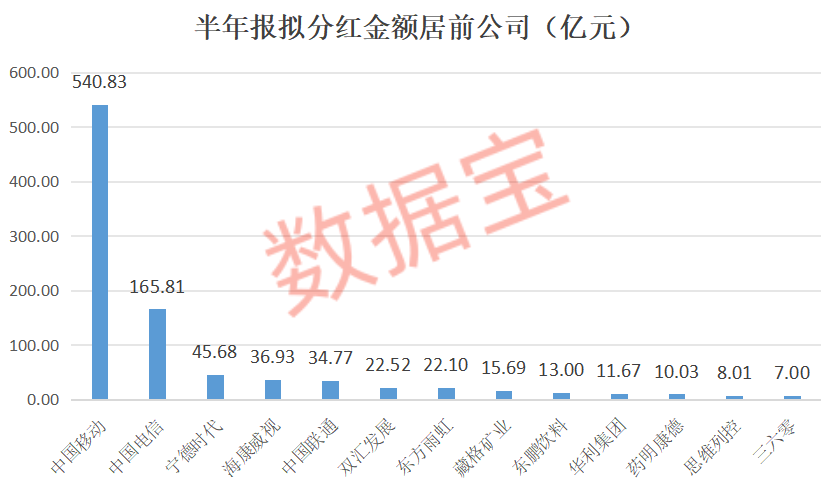
Group 1: Dividend Announcements - In the first half of 2025, companies listed on the A-share market announced a total dividend amount exceeding 100 billion yuan, reaching approximately 100.5 billion yuan [3] - China Telecom reported a revenue of 269.4 billion yuan for the first half of 2025, a year-on-year increase of 1.3%, and a net profit of 23 billion yuan, up 5.5% year-on-year [2] - China Telecom plans to distribute a cash dividend of 0.1812 yuan per share, which is 72% of its net profit attributable to shareholders, totaling 16.581 billion yuan [2] Group 2: Industry Performance - A total of 77 companies have announced dividends based on their semi-annual reports, with 13 companies announcing dividends exceeding 17.5 billion yuan [2][3] - The electronic industry, particularly the CPO and PCB sectors, is experiencing high growth, with several companies reporting continuous profit increases over four consecutive quarters [7] - The demand for high-end optical modules is driving significant revenue growth in the CPO sector, with companies like NewEase and Zhongji Xuchuang reporting net profit increases exceeding 320% and 160%, respectively [8] Group 3: Market Trends - The PCB industry is also benefiting from the growth of artificial intelligence, with AI servers requiring significantly more advanced PCB technology compared to traditional products [8] - Companies such as NewEase and Fuda have seen their stock prices double this year, reflecting strong market performance and investor interest [9] - Institutional research has increased for companies with strong performance, indicating heightened investor engagement and confidence in their growth prospects [9]
国资央企加力布局人工智能赛道
Zhong Guo Zheng Quan Bao· 2025-08-14 20:16
Core Insights - The central enterprises in China are significantly increasing their investments in the artificial intelligence (AI) sector, with a focus on high-quality development and capital operations to create new industry advantages and foster new growth drivers [1][2][3] Group 1: AI Revenue and Growth - China Mobile reported AI-related revenue in the "tens of billions" range for the first half of the year, indicating strong growth in the sector [2] - China Telecom's AIDC revenue grew by 7.4% year-on-year, while Tianyi Cloud revenue reached 573 billion [2] - China Unicom's smart network business revenue reached 454 billion, with a 60% year-on-year increase in AIDC contract value [2] Group 2: Development of AI Models - Major state-owned enterprises have launched significant AI models, such as the "Qingyuan" model by the National Energy Group and the "Xiaomiao" model by China National Building Material Group [3] - The industry is witnessing a shift from self-use to output, transforming cloud and energy computing capabilities into tradable public services [3] Group 3: Local Government Initiatives - Local state-owned enterprises are actively creating application scenarios for AI, with Guangzhou showcasing 60 AI application scenarios and over 30 AI professional parks [4] - Shenzhen has introduced a "rolling release" model for selecting high-quality application scenarios, while Zhejiang has published a list of 26 "AI+" open scenarios across various sectors [4] Group 4: Strategic Development and Ecosystem - The State-owned Assets Supervision and Administration Commission (SASAC) emphasizes the need for strategic high-value applications and the integration of AI with the real economy [5] - There is a call for the establishment of a supportive industrial ecosystem that integrates funding, industry, and data resources to foster innovation and competitiveness [6]



中国电信股份有限公司2025年半年度报告摘要
Shang Hai Zheng Quan Bao· 2025-08-14 18:34
Core Viewpoint - The company emphasizes its commitment to high-quality development and innovation, particularly in the context of artificial intelligence and digital transformation, while also focusing on shareholder returns through dividend distribution. Financial Performance - In the first half of 2025, the company's operating revenue reached RMB 269.4 billion, a year-on-year increase of 1.3%, with service revenue at RMB 249.1 billion, up 1.2% [4][24] - The net profit attributable to shareholders was RMB 23.02 billion, reflecting a growth of 5.5%, with basic earnings per share at RMB 0.25 [4][24] - Capital expenditure amounted to RMB 34.2 billion [4] Business Segments - Mobile communication service revenue was RMB 106.6 billion, up 1.3%, while fixed-line and smart home service revenue reached RMB 64.1 billion, a slight increase of 0.2% [5] - The company reported a mobile user base of 433 million and broadband users of 199 million, with mobile ARPU at RMB 46.0 and broadband ARPU at RMB 48.3 [5] - Revenue from industrial digitalization reached RMB 74.9 billion, with AIDC revenue growing by 7.4% [5] Shareholder Returns - The board approved a profit distribution plan, proposing a cash dividend of RMB 0.1812 per share (including tax), totaling RMB 16.58 billion, which is 72% of the net profit for the first half of 2025 [2][6][44] Strategic Initiatives - The company is advancing its "AI+" initiative, integrating artificial intelligence across various sectors to enhance operational efficiency and customer service [7][9] - It has established a comprehensive intelligent cloud system, providing integrated services across IaaS, PaaS, DaaS, and SaaS layers [7][8] - The company is focusing on green development, achieving a significant reduction in carbon emissions and promoting energy-efficient technologies [15] Innovation and Technology - The company has made significant strides in quantum technology, with over 6 million users of quantum communication services and multiple applications in various sectors [11][12] - It continues to enhance its AI capabilities, developing over 160 AI applications across 21 key areas, which have improved operational efficiency [10][12] Governance and Corporate Responsibility - The company has been recognized for its corporate governance and social responsibility, receiving multiple awards for its investor relations and sustainability efforts [21][20] - It is committed to modernizing its governance structure and enhancing its operational capabilities to support high-quality development [19][24]