
CHINA TELECOM(601728)

Search documents
黄土高原,崛起一个算力重镇
投资界· 2025-09-24 07:56
Core Viewpoint - The article highlights the transformation of Qingyang from a traditional energy city to a key hub in China's computing power landscape, driven by the "East Data West Computing" national strategy, with a focus on attracting AI and digital economy enterprises [2][4][12]. Group 1: Industry Transformation - Qingyang is emerging as one of the eight major computing power hubs in China, leveraging its abundant renewable energy resources to establish a national data center cluster [4][10]. - By August 2025, Qingyang's computing power scale is expected to exceed 66,000 PFlops, with projections to surpass 100,000 PFlops by the end of the year, positioning it among the top tier of national computing power clusters [4][10]. - Over 300 digital economy enterprises have gathered in Qingyang, with half being leading companies in the AI sector [4][10]. Group 2: Investment and Infrastructure - Significant investments have been made in Qingyang's computing infrastructure, including projects from China Telecom, China Mobile, and China Energy, with total investments reaching billions [11]. - In 2023, China Telecom invested approximately 4.47 billion yuan in the first phase of its smart recovery center, while China Energy committed 5.5 billion yuan to a zero-carbon big data industrial park [11]. - The establishment of a 1 billion yuan computing power voucher policy aims to reduce R&D costs for enterprises by 30%, attracting major AI companies to set up training bases [7][16]. Group 3: Emerging Sectors - Qingyang is also developing a low-altitude economy, with investments in drone technology and related industries, positioning itself as the first "low-altitude economy city" in the province [12][14]. - The city has introduced a 10 billion yuan industrial development guidance fund to support emerging industries such as AI and low-altitude economy, leveraging a "fiscal + financial" model to attract social capital [14][16]. - The establishment of a comprehensive planning system for low-altitude economic development is underway, ensuring orderly progress in this sector [16]. Group 4: Challenges and Future Outlook - Despite the advancements, challenges remain, including an incomplete supporting industrial chain and difficulties in attracting high-end talent [16]. - The article expresses optimism for Qingyang's future as it continues to develop its computing power capabilities and explore new industrial narratives [17].





独家:中国电信安全业务前7月收入近30亿元同比增幅达双位数增长
Xin Lang Cai Jing· 2025-09-24 06:09
Group 1 - The core viewpoint is that China Telecom's security business has shown significant growth in the first seven months of the year, with revenue approaching 3 billion yuan and a double-digit year-on-year growth rate [1][3] - In the first seven months, the cumulative revenue of China Telecom's security business reached over 2.9 billion yuan, with a notable increase from over 1 billion yuan in the first three months and over 1.6 billion yuan in the first five months [3] - The year-on-year growth rate of the security business revenue exceeded 15% in the first seven months, surpassing previous months' growth rates, which included single-digit growth in the first three months and negative growth in the first five months [3] Group 2 - The rapid growth is attributed to the revenue from China Telecom's cloud security product, which reached over 2.3 billion yuan, accounting for over 80% of the total security business revenue, with a year-on-year growth of over 45% [3] - In July, however, the security business revenue experienced a significant decline of approximately 30% year-on-year, marking one of the largest drops this year, with the specific reasons for this decline remaining unclear [3] - The management team of Tianyi Security Technology Company, a subsidiary of China Telecom, is noted to be strong, including General Manager Liu Ziqian and Deputy General Managers Wang Chao, Yang Yang, and Liu Changbo [3]
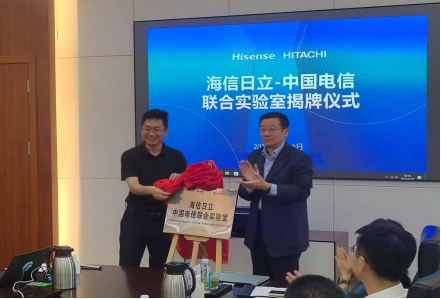
中国电信-海信日立联合实验室揭牌,共筑智慧家电产业新高地
Qi Lu Wan Bao· 2025-09-24 01:28
Group 1 - The establishment of a joint laboratory between China Telecom Shandong, Tianyi IoT Technology, and Hisense Hitachi marks a new phase of strategic cooperation and deep integration among the three parties [1][5] - Key leaders from the involved companies participated in the unveiling ceremony and engaged in detailed discussions about the cooperation [3] - The collaboration aims to respond to national technology innovation strategies through deep integration in technology and product development [5] Group 2 - The joint laboratory will focus on core technology research and innovative applications in the home appliance IoT sector, leveraging China Telecom's cloud-network integration and AI capabilities alongside Hisense Hitachi's extensive user base [6] - The cooperation will cover areas such as IoT collaborative innovation, joint laboratory construction, and joint research based on cloud AI modules, aiming to support the smart upgrade of traditional home appliances [6] - The partnership will enhance the design and delivery capabilities of all-intelligent scenario solutions in the home appliance sector, promoting the nationwide rollout of smart appliances based on RISC-V architecture [7] Group 3 - China Telecom Shandong will actively implement the "cloud transformation and digital intelligence" strategy, utilizing resource advantages to drive the construction of the joint laboratory and promote industrial upgrades [8]
中国电信相关公司新增一项122.00万元的招标项目
Xin Lang Cai Jing· 2025-09-23 14:25
Group 1 - China Tower Corporation Limited, a subsidiary of China Telecom, announced a tender for a project titled "Research Services for Digital and Visual Systems in the Indoor Distribution Market Based on GIS" on September 23, 2025, with a budget of 1.22 million yuan [1] - China Telecom holds a 20.50% stake in China Tower Corporation Limited, according to equity penetration data from Kuaicha [1]


到2030年,发展卫星通信用户超千万——卫星直联,将带来哪些新变化?
Ren Min Ri Bao Hai Wai Ban· 2025-09-23 08:52
Core Viewpoint - The satellite communication industry is rapidly advancing towards mainstream adoption, with the Chinese government setting ambitious goals for user growth and application development by 2030 [1][5]. Group 1: Industry Developments - The Ministry of Industry and Information Technology has issued guidelines to promote the development of the satellite communication industry, aiming for over 10 million users by 2030 [1][5]. - China Satcom has launched consumer-grade satellite internet products, enhancing applications in high-throughput satellite communication, navigation, and remote sensing [2][4]. - The introduction of direct satellite connectivity for smartphones and vehicles is expected to drive innovation across various sectors, including automotive, maritime, and IoT [3][4]. Group 2: Market Expansion - The guidelines encourage the expansion of satellite communication applications from specialized fields to the general public, with a focus on providing diverse network access in remote areas [5][6]. - The market is expected to see a surge in new business models and applications as the industry becomes more open and competitive [5][7]. - The integration of satellite communication with emerging technologies like AI, big data, and cloud computing is anticipated to transform various industries [2][6]. Group 3: Consumer Applications - Direct satellite connectivity for smartphones has been successfully demonstrated, allowing users to make calls and send messages without traditional cellular networks [1][4]. - The automotive sector is seeing the introduction of satellite communication features, enhancing safety and connectivity for vehicles in remote areas [8][9]. - Consumer interest in satellite communication is growing, with expectations for more affordable pricing and enhanced functionalities [7][9].


通信行业2025年二季度行业研究:技术和政策驱动行业变革升级,行业格局或向“强者恒强”演化
Da Gong Guo Ji· 2025-09-23 06:09
Investment Rating - The report indicates a positive outlook for the communication industry, suggesting a potential shift towards a "stronger gets stronger" dynamic due to technological and capital barriers [1]. Core Insights - The communication industry is experiencing a transformation driven by technology and policy support, with a shift in demand from traditional to emerging services [1][39]. - The industry is expected to enter a recovery phase in Q3 2025, with capital expenditure expansion driven by technological breakthroughs and new infrastructure initiatives [39]. - The demand for AI computing power, accelerated commercialization of 5G-A, breakthroughs in 6G technology, and the rise of the "low-altitude economy" are key factors driving the industry's upgrade [1][39]. Supply Capacity Analysis - The report highlights the growth in the optical communication sector, particularly in high-speed optical modules, driven by AI computing demand and increased capital expenditure from global cloud service providers [3][10]. - The domestic penetration rate of traditional optical fiber and cable is nearing saturation, prompting companies to accelerate international expansion [5][4]. - The communication equipment integration market is recovering, with the Asia-Pacific region leading in 5G system integration and services [6]. Demand Matching Capability Analysis - The demand for optical modules, especially high-speed products for data centers, is robust, with a projected shipment increase from 6.4 million units in 2023 to over 31.9 million units by 2025 [3]. - The communication equipment market is experiencing strong growth, with a year-on-year revenue increase of 18.9% in Q2 2025, despite a contraction in 5G investment [11]. - The telecommunications service sector is seeing a shift towards emerging businesses, with significant growth in AI computing and quantum communication services [15][30]. Industry Chain Position Analysis - The communication industry is characterized by a high degree of market concentration, particularly among leading companies in optical communication and equipment integration [24][27]. - The report notes that traditional communication services are facing saturation, with new business areas becoming the core of competitive differentiation [28]. Innovation Capability Analysis - The report emphasizes the importance of policy support for technological advancements, particularly in AI, 6G, and satellite communication [31][32]. - Significant R&D investments are being directed towards AI and 6G technologies, with major companies like China Mobile leading initiatives in these areas [34]. Credit Rating Situation Analysis - The communication industry is witnessing a favorable credit environment, with a total bond issuance of 17.35 billion yuan in Q2 2025, primarily from leading companies [36][37]. - The report indicates that the dual barriers of technology and capital for leading firms will become more pronounced, reinforcing the trend towards market consolidation [36]. Cycle Development Outlook - The communication industry is expected to see revenue and profit growth, with cash flow recovery anticipated in Q3 2025 [38]. - The report forecasts a transition to an expansion phase driven by new infrastructure investments and a focus on domestic demand [39]. Key Segment Development Trends - The optical communication sector is evolving towards ultra-high-speed, intelligent, and integrated solutions, supporting the AI computing network [40]. - The commercialization of 5G-A and advancements in 6G technology are expected to enhance the capabilities of communication equipment integrators [41]. - Telecommunications services are anticipated to diversify, with new opportunities arising from the low-altitude economy and satellite internet developments [42].



苏州电信5G-A产品首发
Su Zhou Ri Bao· 2025-09-23 00:41
Core Viewpoint - China Telecom's Suzhou branch launched 5G-A personal packages and venue packages, marking the city's entry into the commercial era of 5G-A, focusing on enhanced network capabilities in various sectors such as smart energy, telemedicine, industrial internet, and sports events [1][2]. Group 1: 5G-A Network Development - Suzhou Telecom has built over 2,300 5G-A base stations, achieving continuous coverage in key areas of Suzhou, including the Industrial Park and High-tech Zone [1]. - The company plans to cover 80% of high-traffic areas in the next three years, maintaining its leading position in national 5G-A construction [2]. Group 2: New Product Offerings - The newly launched 5G-A personal package offers high upload and download speeds, suitable for travel, live streaming, gaming, and venue usage, along with various benefits [2]. - The introduction of venue packages and monthly data plans lowers user entry barriers and highlights the core advantages of 5G-A's high speed [2]. Group 3: Application Scenarios - 5G-A solutions for large sports venues support multiple ultra-high-definition live broadcasts, immersive VR/AR experiences, and high concurrent user access, enhancing audience experience and event management [3]. - In smart manufacturing, 5G-A enables wireless connections, remote control, and AI quality inspection, significantly improving production flexibility and efficiency [3]. - Collaborations in the low-altitude economy facilitate drone operations, high-precision positioning, and tracking, providing integrated network support for urban security, logistics, and emergency response [3]. Group 4: Partnerships and Future Outlook - Suzhou Telecom officially commercialized 5G-A and signed agreements with three representative companies, indicating a commitment to expanding its service offerings [3].

首个6G计费项目获3GPP批准
Ge Long Hui· 2025-09-22 15:45
Core Insights - China Telecom's "6G System Charging Research" project has been officially approved at the 109th TSG SA meeting of 3GPP, marking it as the first 6G charging project within the organization [1] Group 1: Project Overview - The project aims to design new charging models for 6G services, focusing on innovative commercial charging models and metrics [1] - It will explore a charging architecture and mechanism that spans across networks, services, and resources for 6G [1] - The project intends to provide feasible charging solutions for key 6G services such as AI, integrated sensing, and space-ground integration [1]
6G新进展:中国电信牵头 首个6G计费项目获3GPP批准
Xin Jing Bao· 2025-09-22 15:45
Group 1 - The core viewpoint of the article is that China Telecom has initiated a project focused on developing a new charging model for 6G services, which is the first of its kind approved by 3GPP [1][3] - The project aims to explore new commercial charging models and dimensions for 6G, as well as to research the charging architecture and mechanisms that span across networks, services, and resources [1][3] - The initiative will provide feasible charging solutions for key 6G services such as AI, sensing, and integrated terrestrial and space communication [1]
6G新进展:中国电信牵头,首个6G计费项目获3GPP批准
Xin Jing Bao· 2025-09-22 15:40
Group 1 - The core point of the article is that China Telecom's "6G System Charging Research" project has been officially approved at the 109th TSG SA plenary meeting of 3GPP, marking it as the first 6G charging project within 3GPP [2] - The project aims to design new charging models for 6G services, exploring new commercial charging models and dimensions specific to 6G [2] - It will research the charging architecture and mechanisms that span across networks, services, and resources, providing feasible charging solutions for key 6G services such as AI, sensing, and integrated space-ground systems [2]