CHINA TELECOM(601728)

Search documents
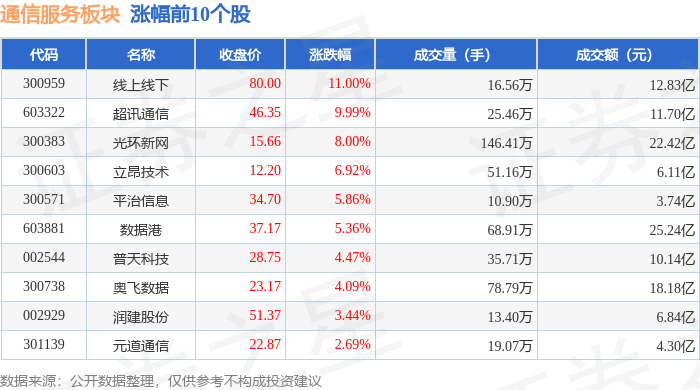
通信服务板块9月22日涨0.57%,线上线下领涨,主力资金净流入7.35亿元
Zheng Xing Xing Ye Ri Bao· 2025-09-22 08:53
Core Insights - The communication services sector experienced a rise of 0.57% on September 22, with significant contributions from both online and offline segments [1] - The Shanghai Composite Index closed at 3828.58, up 0.22%, while the Shenzhen Component Index closed at 13157.97, up 0.67% [1] Stock Performance - Notable gainers in the communication services sector included: - Online and Offline: Closed at 80.00, up 11.00% with a trading volume of 165,600 shares and a transaction value of 1.283 billion [1] - ChaoXun Communication: Closed at 46.35, up 9.99% with a trading volume of 254,600 shares and a transaction value of 1.170 billion [1] - GuangHuan New Network: Closed at 15.66, up 8.00% with a trading volume of 1,464,100 shares and a transaction value of 2.242 billion [1] Capital Flow - The communication services sector saw a net inflow of 735 million from institutional investors, while retail investors experienced a net outflow of 202 million [2] - The capital flow for key stocks included: - GuangHuan New Network: Net inflow of 212 million, with a 9.46% share of institutional investment [3] - ChaoXun Communication: Net inflow of 211 million, with an 18.02% share of institutional investment [3] - Data Port: Net inflow of 129 million, with a 5.13% share of institutional investment [3]






OCS市场乘AI东风而起,海内外量子计算领域布局加速,看好相关产业链投资机会
Great Wall Securities· 2025-09-22 06:37
Investment Rating - The report maintains a "Buy" rating for multiple companies in the communication sector, including 沪电股份, 美格智能, 中际旭创, 天孚通信, 鸿日达, 中国移动, 工业富联, 中国电信, 新亚电子, and 鼎通科技 [1][2][3] Core Insights - The OCS (Optical Circuit Switch) market is accelerating due to advancements in AI and is expected to see significant growth, with a projected market size increase from $72.78 million in 2020 to $366.47 million by 2024, reflecting a CAGR of 49.80% [2][16][35] - The quantum computing sector is experiencing rapid development, with significant investments from major tech companies, including a commitment of over £31 billion from Microsoft, Nvidia, Google, and OpenAI to enhance AI infrastructure and quantum technology in the UK [3][6][17] - The report highlights the potential for large-scale applications of OCS technology across various fields, driven by the increasing demand for high-speed, low-energy optical switching solutions [2][35] Summary by Sections OCS Market Insights - The OCS technology is positioned as a mainstream direction for next-generation switching technology, showcasing advantages such as high bandwidth capacity and low energy consumption [2][21] - The global OCS switch market is expected to reach $2,022.21 million by 2031, with a CAGR of 17.12% from 2025 to 2031 [16][32] - The report identifies key OCS technology solutions, including MEMS, digital liquid crystal (DLC), and direct beam steering (DBS) [24][27] Quantum Computing Developments - The quantum computing market is projected to grow from $1.1 billion in 2022 to $7.6 billion by 2027, with a CAGR of 48.1% [19][51] - Significant advancements in quantum computing architecture have been achieved, including the development of the AshN instruction set architecture, which enhances operational efficiency and reduces error accumulation [18][37] - The report emphasizes the ongoing acceleration of quantum computing technology and its potential for diverse applications [19][51] Communication Industry Dynamics - The communication sector index increased by 0.52% during the week of September 15-19, 2025, outperforming the broader market [11][12] - Key recommended stocks in the communication sector include 中国移动, 中国电信, and 中际旭创, among others [20][8] - The report notes the competitive landscape in the OCS market, with major players like Google expected to dominate the market share [29][32]





国家算力互联网服务平台 | 首个百公里级大模型训推高性能网络协议验证正式启动
Huan Qiu Wang· 2025-09-22 05:37
Group 1 - The "National Computing Power Internet Service Platform" seminar focused on the verification of long-distance RDMA protocol for large model training, marking a significant milestone for the construction of the computing power internet trial network [1][2] - The seminar was attended by leaders from Shanghai Communications Administration, China Academy of Information and Communications Technology, COSCO Shipping Technology, Shanghai Telecom, and Huawei, highlighting the collaborative effort in advancing the computing power internet initiative [1][2] - The initiative aims to enhance the stability and security of long-distance data transmission for large model training, replacing traditional data transfer methods with advanced RDMA protocol [3] Group 2 - The construction of the computing power internet trial network is expected to strengthen China's competitive advantage in the information and communication industry, optimize national computing resource allocation, and support technological innovation in fields like artificial intelligence [4] - Future plans include exploring more verification scenarios and testing innovative technologies to continuously support the development of the computing power internet trial network [4]

通信行业周报(20250915-20250921):华为全联接大会落幕,卫星互联网技术试验卫星正式发射,建议关注国产算力及卫星板块-20250921
Huachuang Securities· 2025-09-21 12:58
Investment Rating - The report maintains a "Recommendation" rating for the communication industry, expecting the industry index to outperform the benchmark index by more than 5% in the next 3-6 months [27]. Core Insights - The communication industry has shown a significant increase of 64.09% year-to-date, outperforming the Shanghai and Shenzhen 300 index by 49.68 percentage points [8][9]. - Huawei's recent announcements at the All-Connect Conference focus on "super nodes + cluster scaling" and self-developed HBM technology, aiming to meet the demands of large model training and inference [15][16]. - The successful launch of the satellite internet technology test satellite indicates a growing opportunity in the satellite industry chain, with a recommendation to focus on key players in the satellite communication sector [20]. Summary by Sections Industry Overview - The communication industry consists of 123 listed companies with a total market capitalization of approximately 49,248.97 billion and a circulating market value of about 23,006.93 billion [3]. - The industry has ranked 9th in weekly performance among all primary sectors, while it ranks 1st for the year [9]. Stock Performance - The communication sector's absolute performance over the past month, six months, and twelve months is 8.7%, 18.6%, and 30.5% respectively, with a relative performance of 4.9%, 11.2%, and 13.5% [4]. - The top five gainers in the communication sector this week include Dekeli (+59.09%), Junsheng Electronics (+44.25%), and Changfei Fiber (+35.07%) [12]. Key Recommendations - Key operators recommended include China Mobile, China Telecom, and China Unicom [21]. - In the satellite communication sector, recommended companies include Haige Communication, Shanghai Hanhua, and Qiyi Two [21]. - The report suggests focusing on companies in the domestic computing power sector, such as Huawei, Alibaba, and Cambrian [17].

失约的iPhoneAir,焦急的运营商
Xin Lang Ke Ji· 2025-09-21 06:43
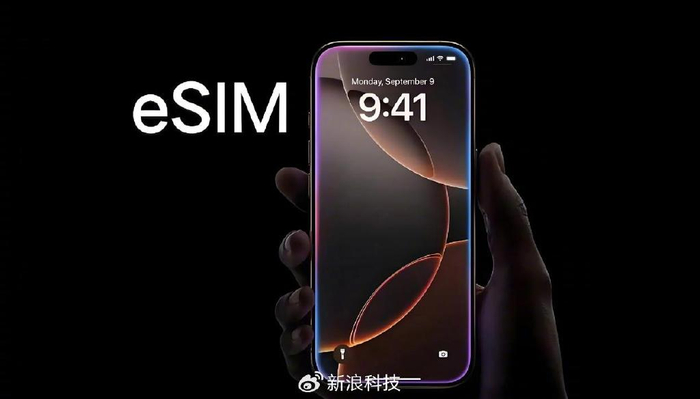
Core Viewpoint - The launch of Apple's iPhone Air in China has been delayed due to regulatory issues surrounding eSIM technology, which is not yet supported by local telecom operators [2][3][4]. Group 1: iPhone Air Launch - The iPhone Air, Apple's lightest flagship smartphone, is currently not available for sale in China, with its release status marked as "to be updated" on official platforms [2]. - The iPhone Air only supports eSIM, which requires regulatory approval for telecom operators in China to offer eSIM services [2][3]. - Apple has indicated that the iPhone Air will only be supported by China Unicom for eSIM activation, requiring users to visit physical stores for identity verification [5][6]. Group 2: eSIM Technology and Regulatory Environment - eSIM technology is seen as a future trend in the telecom industry, but its adoption in China is hindered by regulatory and compliance challenges [3][11]. - Chinese telecom operators are prepared to offer eSIM services but are awaiting formal approval from regulatory bodies [4][11]. - The complexity of eSIM activation processes and the need for stringent security measures have led to delays in service rollout [8][9][14]. Group 3: Industry Perspectives - Industry analysts believe that the widespread adoption of eSIM in China is inevitable, but it will follow a cautious and phased approach [3][11]. - The telecom sector is currently focused on enhancing security measures for eSIM technology to address concerns over user privacy and fraud [8][9][14]. - Companies like China Unicom are exploring advanced technologies, such as blockchain, to improve the security of eSIM services [14].



通信行业周报:重视华为AI链、OCS、国产算力等AI板块-20250921
KAIYUAN SECURITIES· 2025-09-21 02:12
Investment Rating - Industry investment rating: Positive (maintained) [1] Core Insights - Huawei's Ascend roadmap was released, projecting a tenfold increase in computing power over the next decade, with AI storage capacity expected to grow 500 times by 2035, accounting for over 70% of total storage needs [14][15] - Microsoft announced the construction of the world's most powerful AI data center, Fairwater, with an initial investment of $3.3 billion, expected to be operational by early 2026, which will significantly boost demand for optical modules and switches [5][16] - The report emphasizes the importance of the Huawei AI chain, OCS, and domestic computing sectors, recommending various stocks across these segments [6][11] Summary by Sections 1. Investment Outlook - Huawei's new Ascend chip series will be launched in phases from 2026 to 2028, with significant improvements in bandwidth and computing power [11][12] - The report suggests focusing on seven key investment areas, including network equipment, AIDC construction, IT equipment, computing leasing, cloud computing platforms, AI applications, and satellite internet & 6G [17][18] 2. Communication Data Tracking - As of July 2025, China had 4.598 million 5G base stations, with 1.137 billion 5G mobile users, reflecting a year-on-year growth of 19.68% [25][27] - The report notes a decline in 5G smartphone shipments in June 2025, with a total of 18.436 million units shipped, a year-on-year decrease of 16.7% [25][32] 3. Operator Performance - In the first half of 2025, China Mobile's cloud revenue reached 56.1 billion yuan, a year-on-year increase of 11.3%, while China Telecom's cloud revenue was 57.3 billion yuan, up 3.8% [40][41] - The ARPU values for the three major operators remained stable, with slight decreases noted for China Mobile and China Unicom [40][44]




失约的iPhone Air,焦急的运营商
经济观察报· 2025-09-20 14:44
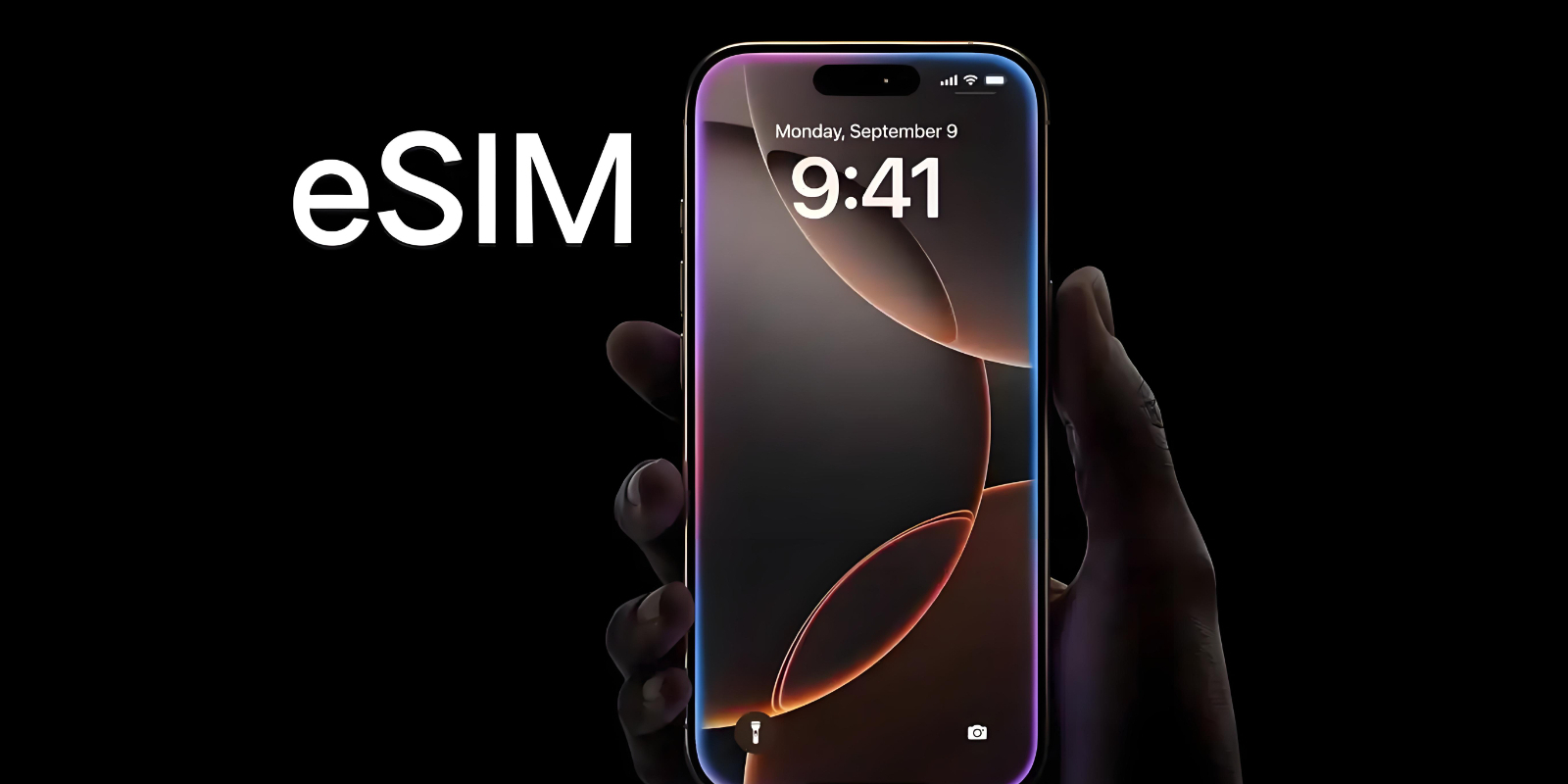
Core Viewpoint - The release of the iPhone Air in China is delayed due to the lack of eSIM service approval from local telecom operators, which is crucial for its market entry [1][5][13]. Group 1: eSIM Service Status - The iPhone Air, which only supports eSIM, is currently not available for sale in China as telecom operators await regulatory approval for eSIM services [5][8]. - China Mobile has completed the system upgrades necessary for eSIM services and is awaiting formal approval from the Ministry of Industry and Information Technology (MIIT) to launch the service [8][12]. - China Unicom has launched an eSIM service section on its website, but it currently only supports wearables and not smartphones [9][10]. Group 2: Regulatory and Security Considerations - The regulatory environment in China is cautious regarding eSIM technology due to concerns over data sovereignty, privacy protection, and the need for robust security measures [5][16]. - The MIIT has implemented strict standards for eSIM services to prevent telecom fraud and ensure user privacy, which has delayed the rollout of eSIM for smartphones [17][19]. - The telecom industry is under pressure to demonstrate the security of eSIM technology, with operators exploring blockchain for identity verification to enhance security [26][27]. Group 3: Market Dynamics and Future Outlook - The adoption of eSIM technology in China is seen as inevitable, with operators preparing for its eventual rollout despite current regulatory hurdles [7][21]. - Industry experts believe that the push for eSIM services is not just limited to Apple but includes domestic manufacturers who are also testing eSIM-enabled flagship products [13][29]. - The collaboration between telecom operators and device manufacturers is crucial for the successful implementation of eSIM services, with a focus on ensuring a seamless user experience [28][29].

失约的iPhone Air,焦急的运营商
Jing Ji Guan Cha Wang· 2025-09-20 12:26
Core Viewpoint - The launch of Apple's iPhone Air in China has been delayed due to regulatory issues surrounding eSIM technology, which is not yet supported by local telecom operators [2][3][7]. Group 1: iPhone Air Launch - The iPhone Air, Apple's lightest flagship smartphone, was expected to be released on September 19, but its availability has been postponed with the website indicating "to be updated" [2]. - The iPhone Air is designed to support only eSIM technology, which is not currently available for consumers in China due to regulatory hurdles [3][5]. Group 2: eSIM Technology and Regulatory Environment - eSIM technology allows for remote activation of mobile services, but China has not yet approved eSIM services for smartphones, leading to a cautious approach from Apple regarding the iPhone Air's release [3][4]. - Telecom operators in China, including China Mobile, China Unicom, and China Telecom, are preparing to offer eSIM services but are awaiting regulatory approval [4][8]. Group 3: Telecom Operators' Readiness - China Mobile has completed system upgrades to support eSIM services and is expecting formal approval from the Ministry of Industry and Information Technology (MIIT) soon [4]. - China Unicom has launched an eSIM section on its website but has not yet made eSIM services available for smartphones [4][6]. Group 4: Industry Perspectives - Analysts believe that the adoption of eSIM technology in China is inevitable, but the timeline is contingent on regulatory approvals and the readiness of telecom operators [4][14]. - The security concerns surrounding eSIM technology have led to a cautious regulatory approach, with the government prioritizing user privacy and fraud prevention [10][11][19]. Group 5: Future Outlook - There is a consensus that once regulatory hurdles are cleared, eSIM technology will be widely adopted across various devices, including smartphones and wearables [21]. - The industry is actively working on enhancing the security of eSIM technology to meet regulatory standards, with some operators exploring blockchain for identity verification [18][20].
中国电信发布天翼智屏
Jing Ji Ri Bao· 2025-09-20 09:10
Core Viewpoint - China Telecom has launched the Tianyi Smart Screen, an innovative product that embodies the company's strategy to embrace artificial intelligence and promote digital transformation, aiming to enhance the quality of life through smart technology [1] Group 1: Product Features - The Tianyi Smart Screen is designed with a vision of "Smart and Beautiful Home," leveraging China Telecom's self-developed AI technology and ecological advantages [1] - Key functionalities include safety monitoring and health management, with features such as AI gas stove monitoring that proactively alerts users to potential risks [1] - The device supports various smart applications for daily needs, allowing users to easily access information related to travel, communication, and entertainment through voice commands [1] Group 2: Market Positioning - The product launch reflects the rapid advancement of AI technology, which is driving the transformation of various industries and enhancing daily life for consumers [1] - China Telecom aims to meet consumer expectations for a smarter, more secure, and environmentally friendly lifestyle through the introduction of the Tianyi Smart Screen [1]
AI重塑网络安全边界 运营商探索“绝对安全”
Zhong Guo Jing Ying Bao· 2025-09-19 18:49
Core Viewpoint - The annual National Cybersecurity Awareness Week emphasizes the importance of cybersecurity for the public and highlights the need for community involvement in safeguarding high-quality development through advanced security measures [2] Group 1: Cybersecurity Landscape - China has built the world's largest fiber optic and mobile broadband network but faces significant security challenges, including an increase in intelligent fraud methods and attacks on critical infrastructure [2] - The cybersecurity market in China is projected to approach 100 billion yuan by 2025, driven by the rapid evolution of AI-driven attack technologies [2] - The integration of AI into cybersecurity has transformed attacks from simple point-based threats to complex, unpredictable multi-dimensional threats [3] Group 2: Threats and Risks - The cost of launching cyberattacks has dramatically decreased, increasing security risks; for instance, renting 50,000 IoT botnet devices to launch an 8 Tbps attack costs only 50 yuan [4] - AI has escalated the social harm of telecom fraud, enabling attackers to mimic voices and faces, and target vulnerable groups with precision [4] - The rapid development of AI poses risks such as potential data leaks during training and the possibility of malicious instructions leading to incorrect decision-making [4] Group 3: Operator Responses - Major telecom operators are shifting focus from abstract capabilities to practical usability in cybersecurity solutions, emphasizing user-friendly features [5] - China Mobile has launched a comprehensive anti-fraud service that combines AI technology with insurance compensation to protect vulnerable groups [5] - China Telecom has developed an intelligent terminal capable of identifying fraud with over 90% success and established a training base to enhance public awareness of fraud [6] Group 4: Technological Innovations - The integration of quantum communication and AI is being promoted by telecom operators, with China Telecom's 400G quantum dedicated line marking a significant advancement [6] - Domestic innovations are being accelerated, including the development of the UniYAK technology stack by China Unicom and the launch of the Jiutian model by China Mobile, ensuring end-to-end control of telecom network security [7] - The global trend indicates that AI-enabled cybersecurity is gaining momentum, with international companies intensifying their efforts in this area [7] Group 5: Policy and Future Directions - The continuous improvement of the policy ecosystem is providing strong momentum for innovation in cybersecurity, with various government bodies emphasizing AI and data infrastructure development [8] - The 2025 National Cybersecurity Awareness Week showcases not only technological breakthroughs but also the commitment to "security for the people," indicating a shift from passive defense to proactive protection [8]