
CHINA TELECOM(601728)

Search documents
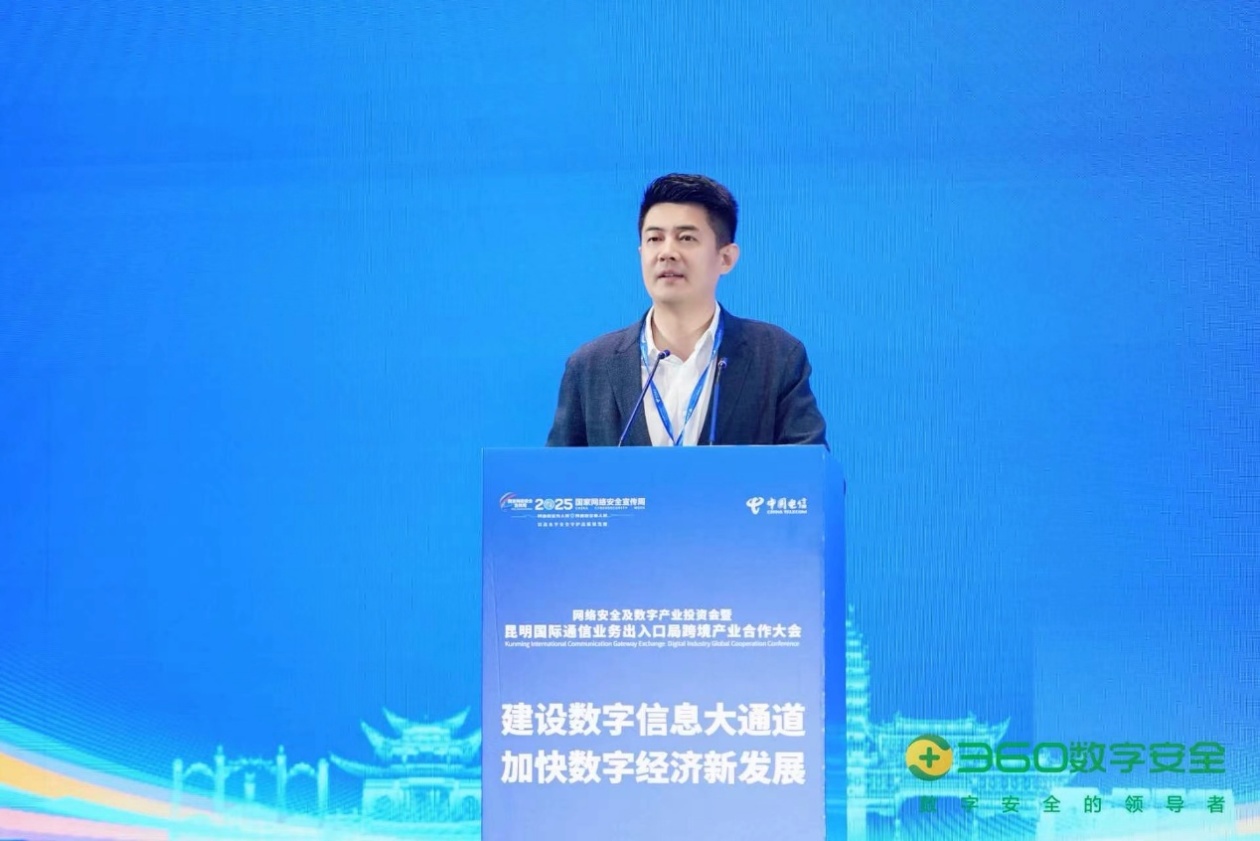
360联合云南电信发布跨境业务安全服务平台
Bei Jing Shang Bao· 2025-09-16 13:35
Core Viewpoint - The collaboration between 360 and China Telecom Yunnan Branch aims to enhance security in cross-border business through the launch of a "Cross-Border Business Security Service Platform" that integrates AI security systems with international communication resources [1] Group 1 - The platform provides comprehensive protection across the entire data lifecycle, including generation, transmission, storage, and application [1] - It addresses key issues in various sectors such as cross-border e-commerce, finance, and computing services, focusing on content review, AI fraud prevention, and data transmission security [1]


360胡振泉:共建跨境AI安全生态,联合云南电信筑牢数字丝路防线
Huan Qiu Wang· 2025-09-16 11:09
Core Insights - The current landscape of cross-border AI services has become a critical area for AI security governance, as highlighted by the collaboration between 360 Digital Security Group and China Telecom Yunnan Branch to launch a "Cross-Border Business Security Service Platform" aimed at ensuring the security of cross-border data flow [1][4] Group 1: AI Security Challenges - AI has transitioned from a potential risk to a real threat, with internal vulnerabilities such as programmability and the ability to generate false information, while external threats include state-level cyber warfare targeting AI systems [2] - In cross-border business scenarios, AI services must navigate complex issues including regional management requirements, security assessments, and content compliance, with content safety being deemed the "lifeline" of cross-border operations [2] Group 2: AI Security Framework - 360 has proposed a comprehensive AI security framework based on the "model governance" concept, integrating four key intelligent security agents: content safety, AI agent security, software security, and risk assessment, to achieve reliable and controllable AI governance [3] - The content safety agent monitors AI-generated content for false information and compliance, while the AI agent security agent protects against unauthorized access and operational risks [3] Group 3: Cross-Border Business Security Service Platform - The newly launched Cross-Border Business Security Service Platform combines 360's AI security technology with international communication resources from China Telecom, providing end-to-end protection for data generation, transmission, storage, and application [4] - This platform aims to address security challenges in sectors such as cross-border e-commerce, finance, and computing services, enhancing the safety of data transmission and preventing AI-related fraud [4]

解读京津冀上市公司品牌价值:4年增长超万亿元,哪行涨得最猛?
Mei Ri Jing Ji Xin Wen· 2025-09-16 10:55
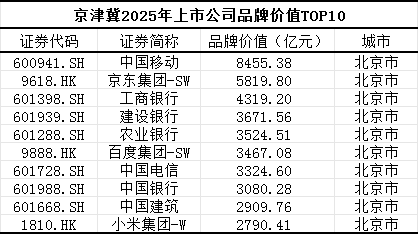
Core Insights - The Beijing-Tianjin-Hebei region achieved a GDP of 5.7 trillion yuan in the first half of 2025, reflecting a year-on-year growth of 5.4% [1] - The region has seen continuous improvement in overall strength over the past 11 years, crossing six trillion yuan milestones, becoming a strong driver for high-quality national development [1] - The analysis of brand value among listed companies in the region highlights the need for enhanced industrial collaboration and innovation, particularly in nurturing emerging industries and upgrading traditional sectors [1] Company Brand Value - China Mobile ranks first in brand value within the region, valued at 845.54 billion yuan [2][3] - The top ten companies in the Beijing-Tianjin-Hebei region are all based in Beijing, primarily consisting of state-owned enterprises and well-known internet companies [2][3] - The total brand value of 416 listed companies in the region reached 99,581.76 billion yuan, with Beijing accounting for 93.81% of this total [4] Year-on-Year Brand Value Changes - Beijing's brand value increased from 67,310.05 billion yuan in 2022 to 93,417.65 billion yuan in 2025, marking a growth of 26,107.60 billion yuan over four years [5] - In contrast, cities like Tianjin and Hebei cities showed minimal growth or declines in brand value, indicating a disparity in economic development [5] - The number of listed companies in Beijing decreased from 347 in 2022 to 329 in 2025, while Tianjin saw a slight increase [6] Industry Insights - The telecommunications sector experienced significant growth, with brand value increasing by over 1 trillion yuan over four years, largely driven by China Mobile's return to the A-share market [10][11] - The leisure industry faced a decline, with a reduction of 10 companies and a total brand value drop of 534.59 billion yuan, attributed to cyclical fluctuations in consumer markets [10][11] - Other sectors like finance, oil, and construction also showed notable brand value increases, while industries such as real estate and retail faced challenges [10][11] Recommendations for Regional Development - To address the imbalance in development within the region, it is suggested that leading companies in Beijing and Tianjin extend high-value segments of their operations to Hebei [13] - Hebei is encouraged to focus on transforming traditional industries towards high-end, intelligent, and green practices, while fostering a local digital economy [13] - The establishment of collaborative innovation platforms among enterprises, universities, and research institutions is recommended to enhance regional brand image and competitiveness [13]





通信服务板块9月16日跌0.43%,三维通信领跌,主力资金净流出6.57亿元
Zheng Xing Xing Ye Ri Bao· 2025-09-16 08:52
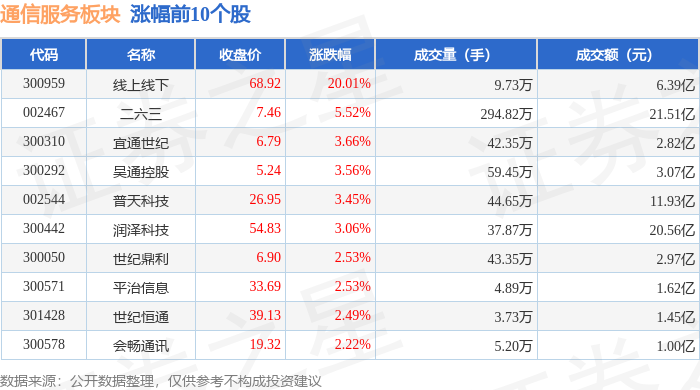
Market Overview - On September 16, the communication services sector declined by 0.43%, with Sanwei Communication leading the drop [1] - The Shanghai Composite Index closed at 3861.87, up 0.04%, while the Shenzhen Component Index closed at 13063.97, up 0.45% [1] Stock Performance - Notable gainers in the communication services sector included: - Online Offline (300959) with a closing price of 68.92, up 20.01% on a trading volume of 97,300 shares and a transaction value of 639 million yuan [1] - Erli San (002467) closed at 7.46, up 5.52% with a trading volume of 2.9482 million shares and a transaction value of 2.151 billion yuan [1] - Major decliners included: - Sanwei Communication (002115) with a closing price of 12.30, down 3.61% on a trading volume of 2.0376 million shares and a transaction value of 2.517 billion yuan [2] - China Telecom (601728) closed at 7.00, down 1.82% with a trading volume of 1.9182 million shares and a transaction value of 1.348 billion yuan [2] Capital Flow - The communication services sector experienced a net outflow of 655.7 million yuan from institutional investors, while retail investors saw a net inflow of 663 million yuan [2] - Detailed capital flow for specific stocks showed: - Erli San (002467) had a net inflow of 1.42 million yuan from institutional investors, while retail investors had a net outflow of 7.88687 million yuan [3] - Runze Technology (300442) saw a net inflow of 1.08 million yuan from institutional investors, with retail investors experiencing a net outflow of 8.56009 million yuan [3]


iPhone Air仅支持eSIM?三大运营商回应
Xi Niu Cai Jing· 2025-09-16 06:31
Group 1 - Apple has launched the iPhone Air, which is the thinnest iPhone ever, featuring eSIM technology to save internal space, raising consumer interest in eSIM mobile services in China [2] - The iPhone Air can only be activated via eSIM, and only certain carriers in mainland China support eSIM, with specific support depending on carrier dynamics [2] Group 2 - On September 10, the three major Chinese telecom operators responded regarding eSIM services for mobile phones [3] - China Unicom has commercialized eSIM for smartwatches and tablets and plans to conduct commercial trials for mobile eSIM when conditions permit, with rumors suggesting they will leverage the iPhone Air to launch mobile eSIM services [3] - China Mobile currently does not support mobile eSIM but plans to offer related services in the future, with indications that they have already been approved to handle eSIM mobile services once officially notified [3] - China Telecom has not received official notification for mobile eSIM services but has submitted applications to the Ministry of Industry and Information Technology, with expectations of approval being a matter of time, and they are prepared to launch eSIM services for devices including the iPhone 17 soon after approval [3]


中企助力打造“阿曼眼”
人民网-国际频道 原创稿· 2025-09-16 05:51
中国电信非洲中东公司总经理董自瑜表示,"阿曼眼"是中国电信"视联出海"战略的新实践,展现了中方在云、AI、终端及服务生态的一体化整合能力。 未来,中企将与全球伙伴共同推进视频技术的智能化、安全化与应用创新,共建数字未来。 人民网迪拜9月16日电 (记者管克江)近日,在第34届阿曼国际信息与通信技术展览会上,中国电信国际公司、天翼视联公司和阿曼电信联合推出 的"阿曼眼"视联网平台正式亮相。 据介绍,"阿曼眼"具备多项创新功能,可通过交互式地图实现全域监管点位的可视化管理和实时画面调度,有效提升阿曼相关部门的指挥与决策效率。 同时,平台支持多场景视频预览与自定义巡查,可广泛适用于企业楼宇、园区等不同场景。平台的AI应用也是一大亮点。在现场演示过程中,区域入侵秒 级告警、车牌识别与布控、人流统计与安全预警等功能,赢得了与会代表的好评。 中阿代表交流"阿曼眼"应用。 中国电信国际公司供图 与会多位嘉宾表示,"阿曼眼"将为深化阿中数字经济合作注入新动能。 ...

中国电信跌2.10%,成交额9.30亿元,主力资金净流出3.18亿元
Xin Lang Cai Jing· 2025-09-16 05:48
Core Viewpoint - China Telecom's stock has experienced a decline of 2.10% on September 16, with a current price of 6.98 CNY per share and a total market capitalization of 638.72 billion CNY [1] Company Overview - China Telecom, established on September 10, 2002, and listed on August 20, 2021, is primarily engaged in telecommunications and related services, providing integrated information services including fixed-line and mobile telecommunications, internet access, and value-added services [1] - The company's revenue composition includes: mobile communication services (39.56%), industrial digital services (27.78%), fixed-line and smart home services (23.80%), sales of goods and other income (7.54%), and other services (1.32%) [1] Financial Performance - For the first half of 2025, China Telecom reported operating revenue of 269.42 billion CNY, reflecting a year-on-year growth of 1.30%, and a net profit attributable to shareholders of 23.02 billion CNY, which is a 5.53% increase compared to the previous year [2] - Since its A-share listing, China Telecom has distributed a total of 95.19 billion CNY in dividends, with 68.65 billion CNY distributed over the past three years [3] Shareholder Information - As of June 30, 2025, China Telecom had 222,800 shareholders, a decrease of 7.09% from the previous period, with an average of 0 shares per shareholder [2] - Among the top ten circulating shareholders, Hong Kong Central Clearing Limited is the ninth largest, holding 555 million shares as a new shareholder [3]
2025年上半年通信行业业绩表现亮眼,光模块景气度机遇显著,通信ETF(159695)调整蓄势
Sou Hu Cai Jing· 2025-09-16 03:36
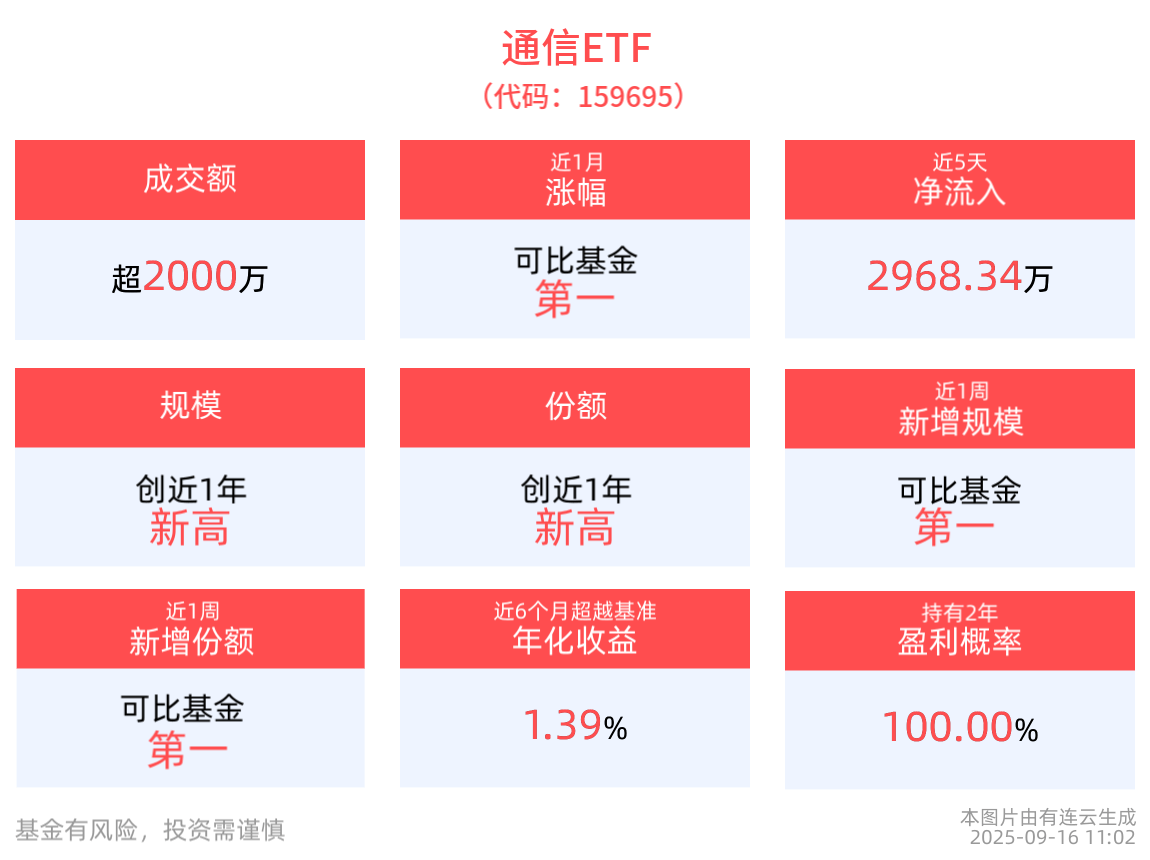
Group 1 - The National Communication Index decreased by 1.14% as of September 16, 2025, with mixed performance among constituent stocks, led by Cambridge Technology with a rise of 9.65% [1] - The Communication ETF (159695) experienced a cumulative increase of 5.45% over the past week, ranking first among comparable funds [1] - The Communication ETF's latest scale reached 299 million yuan, marking a one-year high and also ranking first among comparable funds [3] Group 2 - The communication industry showed strong performance in the first half of 2025, with significant growth in revenue and net profit, and record high gross and net profit margins since 2022 [4] - The top ten weighted stocks in the National Communication Index accounted for 64.43% of the index as of August 29, 2025, with notable companies including New Yisheng, Zhongji Xuchuang, and ZTE [4] - The Communication ETF achieved a net value increase of 109.34% over the past year, ranking 189 out of 3013 index stock funds, placing it in the top 6.27% [3]



中国电信9月15日获融资买入9788.22万元,融资余额9.06亿元
Xin Lang Cai Jing· 2025-09-16 01:32
Group 1 - On September 15, China Telecom's stock fell by 1.38% with a trading volume of 1.133 billion yuan [1] - The financing data shows that on the same day, China Telecom had a financing purchase amount of 97.8822 million yuan and a financing repayment of 72.9327 million yuan, resulting in a net financing purchase of 24.9495 million yuan [1] - As of September 15, the total balance of margin trading for China Telecom was 909 million yuan, with the financing balance at 906 million yuan, accounting for 0.16% of the market capitalization, indicating a high level compared to the past year [1] Group 2 - China Telecom, established on September 10, 2002, and listed on August 20, 2021, primarily engages in telecommunications and related services [2] - The company's revenue composition includes mobile communication services (39.56%), industrial digital services (27.78%), fixed-line and smart home services (23.80%), sales of goods and other income (7.54%), and other services (1.32%) [2] - For the first half of 2025, China Telecom reported operating revenue of 269.422 billion yuan, a year-on-year increase of 1.30%, and a net profit attributable to shareholders of 23.017 billion yuan, up by 5.53% [2] Group 3 - Since its A-share listing, China Telecom has distributed a total of 95.186 billion yuan in dividends, with 68.649 billion yuan distributed in the last three years [3] - As of June 30, 2025, the number of shareholders for China Telecom was 222,800, a decrease of 7.09% from the previous period [3] - Hong Kong Central Clearing Limited is the ninth largest circulating shareholder, holding 555 million shares as a new shareholder [3]
从脑机接口到罕见病防治 央企发力攻坚医疗健康新高地
Zhong Guo Zheng Quan Bao· 2025-09-15 22:33
Core Insights - The article highlights the significant advancements and contributions of central enterprises in China towards healthcare and technology innovation during the "14th Five-Year Plan" period, emphasizing their role in improving public welfare and healthcare services [1] Group 1: Technological Innovations in Healthcare - China Electronics has launched the first domestic non-invasive brain-machine interface headset, with nearly 200,000 units in procurement interest and over 100,000 contracts signed within a month [2] - The China Weapon Industry Group has developed a series of domestic brain-machine interface products, including flexible electrodes and high-precision EEG chips, promoting their application in industrial and medical settings [3] - The market for brain-machine interfaces is projected to exceed 3.8 billion yuan by 2025 and 5.5 billion yuan by 2027, with an annual growth rate of around 20% [3] Group 2: Smart Wearable Technology - China National Building Materials has successfully adapted micro-light night vision technology for smart wearables, enabling accurate health monitoring in consumer devices [4] - The project has led to the application for 17 patents and generated indirect economic benefits exceeding 1 billion yuan [4] Group 3: AI and Mobile Healthcare Solutions - A mobile "smart hospital" equipped with 5G and AI technology is transforming healthcare access in remote areas, having conducted over 2,880 cloud consultations and served over 110,000 people [6] - The "Yikang Manager" AI health app developed by China National New Health focuses on improving healthcare access for specific worker groups, achieving over 10,000 uses since its launch [6] Group 4: Addressing Rare Diseases and Elderly Care - China National Pharmaceutical Group is increasing investment in rare disease drug development, aiming to alleviate medication shortages for patients [8] - General Technology Group has established a home-based elderly care service system, serving over 100,000 individuals and innovating in emergency medical rescue services [9] Group 5: Future Directions and Strategic Goals - The State-owned Assets Supervision and Administration Commission plans to deepen the "AI+" initiative, aiming to create benchmarks in artificial intelligence applications across various sectors, including healthcare [7] - Central enterprises are positioned as key drivers of innovation in the healthcare sector, with a focus on enhancing their influence and competitiveness in the biopharmaceutical field [9]
