CHINA TELECOM(601728)

Search documents
算力专题:算力城域网白皮书(2025版)
Sou Hu Cai Jing· 2025-09-06 03:13
Core Insights - The report titled "Computing Power Metropolitan Area Network White Paper (2025 Edition)" focuses on the explosive demand for computing power driven by generative AI and outlines the development path and technical directions for computing power metropolitan networks [1][9][10]. Group 1: Industry Development and Policy Trends - The rapid growth of computing power demand is attributed to advancements in AI, particularly large models like DeepSeek, which significantly reduce training and inference costs [9][17]. - By 2025, China's intelligent computing power is expected to reach 1037 EFLOPS, with a projected CAGR of 46.2% until 2028, when it may reach 2782 EFLOPS [1][17]. - The Chinese government has introduced various policies to optimize computing power infrastructure, including the "Digital China Construction 2025 Action Plan" and the "Computing Power Interconnection Action Plan" [17][18]. Group 2: Computing Power Metropolitan Network Demand - The computing power metropolitan network aims to provide efficient services for local users by integrating computing resources and ensuring high-speed, lossless data transmission [19][21]. - Key requirements for the network include handling massive data transfers (TB/PB level), supporting remote training with minimal performance degradation, and enabling cross-cluster collaborative training [22][23]. - The network must also facilitate cloud-edge collaboration and real-time inference delivery, ensuring high reliability and low latency [22][30]. Group 3: Network Architecture and Key Technologies - The architecture of the computing power metropolitan network includes components such as computing PODs, cloud network POPs, and export functional areas, utilizing technologies like SRv6 and EVPN [1][21]. - Key technologies identified include elastic bandwidth allocation (100 Mbps to 100 Gbps), ultra-high throughput capabilities, and wide-area lossless transmission [1][21]. - The network is designed to support high-capacity links (400G/800G) and ensure efficient resource utilization while maintaining high reliability and low latency [29][30]. Group 4: Typical Applications - The report outlines several application scenarios, including efficient data entry for massive datasets, remote training with data separation, and collaborative training across clusters [22][24]. - Specific use cases highlight the need for high-performance computing services in sectors such as government, finance, and healthcare, emphasizing the importance of data security and compliance [19][30]. - The computing power metropolitan network is positioned to accelerate digital transformation and support the rapid development of the digital economy [21][22].



中国电信全资子公司新增一项106.00万元的招标项目
Xin Lang Cai Jing· 2025-09-05 17:41
Group 1 - China Telecom's subsidiary, China Telecom Artificial Intelligence Technology (Beijing) Co., Ltd., announced a tender for advertising service procurement on September 5, 2025, with a budget of 1.06 million yuan [1] - The project is titled "Headquarters China Telecom Artificial Intelligence Technology Co., Ltd. 2025 Advertising Service Agency Procurement Project - Package 06 Material Production Service Tender Announcement" [1] - The company is fully owned by China Telecom, indicating a strong backing from the parent company [1]


签约项目超2000亿!机器人、智能汽车集中亮相|直击2025智博会
Xin Lang Cai Jing· 2025-09-05 14:45
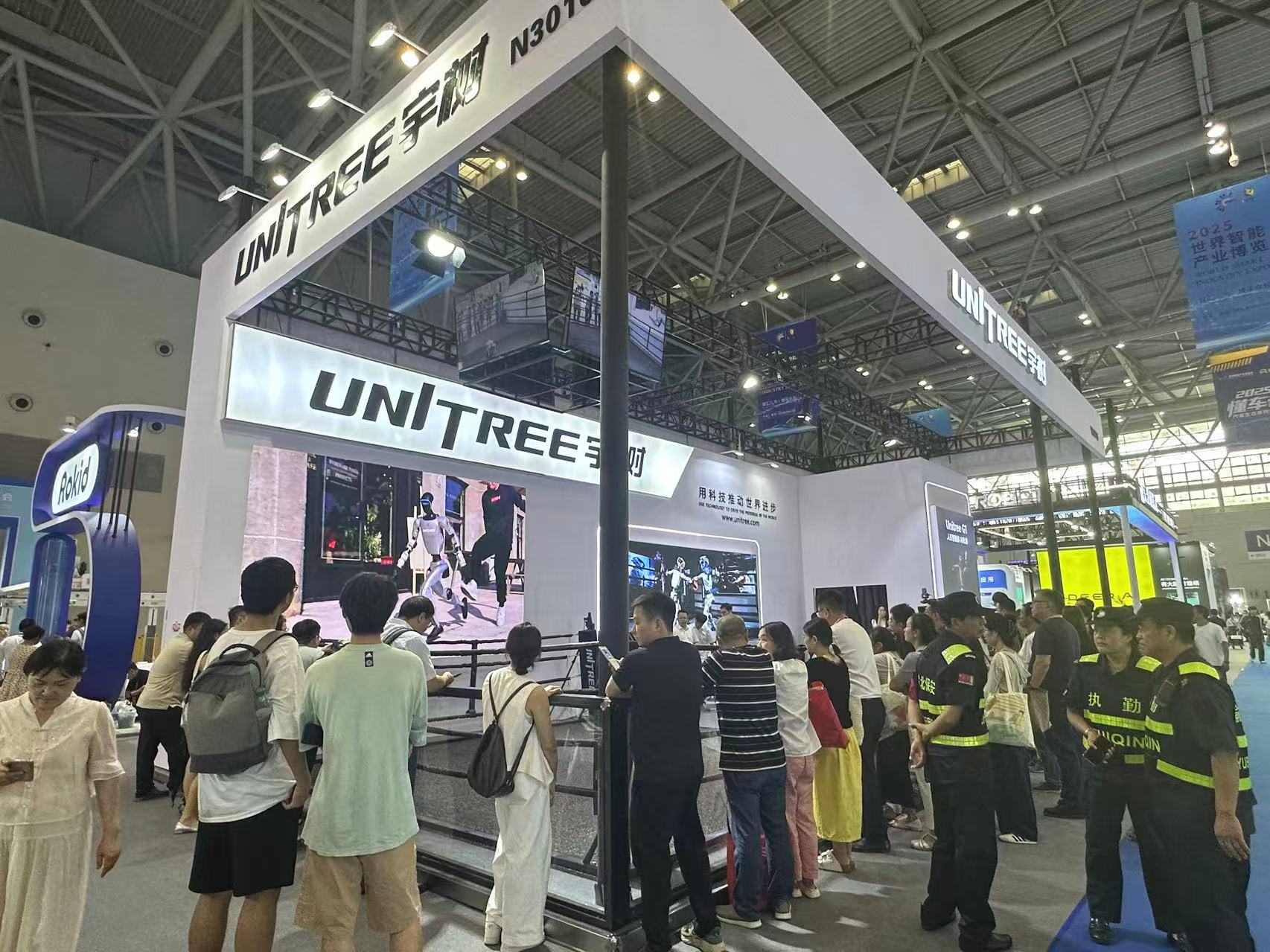
Group 1 - The 2025 World Intelligent Industry Expo (智博会) opened in Chongqing, focusing on "Artificial Intelligence+" and "Intelligent Connected New Energy Vehicles" [1] - Investment project contracts signed during the event exceeded 200 billion yuan, with over 120 billion yuan in concentrated on-site contracts [1] - Key projects include the Wanfu Aotexi Western Low-altitude Economy Base Project, Geely Technology Industry Manufacturing Project, and Huqing Semiconductor Material Production and Packaging Project [1] Group 2 - The expo featured five major sectors: Intelligent Connected New Energy Vehicles, Digital Cities, Intelligent Robots, Low-altitude Economy, and Smart Home, with over 550 domestic and international companies showcasing more than 3,000 innovative products across an exhibition area of over 100,000 square meters [1] - Local companies such as Yushu Technology, Yundongchu, Qiangnao Technology, and Qunhe Technology participated in the expo [1][3][4][5][6] Group 3 - Seven Teng Robotics, a local company, showcased third-generation explosion-proof quadruped and wheeled robots, focusing on emergency safety [11] - The company is exploring embodied intelligence in industrial chemical scenarios, utilizing Huawei's Ascend AI platform for its inspection robots [13] - Huawei's exhibition highlighted smart governance, smart economy, and smart society practices, along with core technologies like AI and ICT [13] Group 4 - The Sairus Group, a local enterprise, presented its exhibition area of over 10,000 square meters, featuring new energy vehicle products and advanced technologies [14] - Sairus demonstrated its "Automotive Industry Brain" ecosystem, showcasing a smart factory with over 3,000 robots and 100% automation in key processes [18] - The chairman of Sairus emphasized the profound impact of AI technology on the automotive industry across product forms, production methods, management models, and business logic [20] Group 5 - Tencent set up an interactive experience area featuring robots powered by its TAIROS platform, which integrates various AI models for industrial applications [20][22] - Major telecom operators, including China Telecom, China Mobile, and China Unicom, participated in the expo, showcasing advancements in AI and low-altitude economy services [22][25] - China Telecom's exhibition focused on cloud computing, AI, quantum technology, and digital industrial applications, with a notable computing power scale of 866 PFLOPS established by 2025 [23][26]




通信行业双周报:前7个月电信业务收入超万亿元-20250905
Dongguan Securities· 2025-09-05 13:00
Investment Rating - The report maintains an "Overweight" rating for the communication industry, expecting the industry index to outperform the market index by more than 10% in the next six months [2][48]. Core Viewpoints - The communication industry has shown stable operation in the first seven months of 2025, with telecom business revenue exceeding 1 trillion yuan, reflecting a year-on-year growth of 0.7%. The total telecom business volume, calculated at constant prices from the previous year, has increased by 8.9% [24]. - The report highlights that the communication industry is in a period of technological iteration and policy dividends, with new growth drivers from AI, quantum communication, and low-altitude economy. The demand for communication facilities such as base stations, optical cables, and data centers is expected to continue growing [24][45]. Summary by Sections 1. Communication Industry Market Review - The communication sector has seen a cumulative increase of 7.58% over the past two weeks (August 22 to September 4), outperforming the CSI 300 index by 5.78 percentage points. Year-to-date, the sector has risen by 50.22%, surpassing the CSI 300 index by 39.29 percentage points [10][14]. 2. Industry News - The Ministry of Industry and Information Technology and the State Administration for Market Regulation have issued a plan to enhance the electronic information manufacturing industry, focusing on major projects and equipment updates [16]. - Juniper Research predicts that global cellular IoT connection revenue will exceed $30 billion by 2030, a 74% increase from $18 billion in 2025, driven by rising demand for operational efficiency and automation [19]. - The global 6G wireless communication standardization work has officially begun, marking a significant step in the development of 6G technology [20]. 3. Company Announcements - ZTE Corporation reported a net profit of 5.058 billion yuan for the first half of 2025, with a revenue of 71.553 billion yuan, reflecting a year-on-year growth of 14.51% [26]. - Meige Intelligent announced a net profit increase of 151% year-on-year for the first half of 2025, with revenue of 1.886 billion yuan, up 44.50% [28]. 4. Industry Data Updates - As of July 2025, the number of mobile phone users reached approximately 1.815 billion, a year-on-year increase of 2.68% [30]. - The total number of 5G base stations reached 4.598 million, with a net increase of 348,000 from the end of the previous year, accounting for 36% of all mobile base stations [40]. 5. Communication Sector Weekly Viewpoint - The report suggests focusing on companies that align with the three main themes of "technology commercialization, policy catalysis, and performance certainty," recommending stocks such as China Mobile, China Telecom, and FiberHome [45].
9月8日起中国电信被纳入恒生指数成分股
Zheng Quan Ri Bao Wang· 2025-09-05 10:44
Core Viewpoint - The inclusion of China Telecom in the Hang Seng Index starting September 8, 2025, is expected to enhance the company's reputation, investor confidence, and stock liquidity, with an estimated passive fund inflow of approximately $160 million [1]. Group 1: Company Transformation and Performance - China Telecom is transitioning from a traditional telecom operator to a service-oriented, technology-driven, and secure enterprise, achieving steady operational performance and high-quality development [2]. - The company is embracing artificial intelligence and has upgraded its strategy from "cloud transformation" to "intelligent cloud transformation," focusing on building an intelligent cloud system and integrating AI applications across various sectors [2]. - In the first half of 2025, China Telecom's service revenue grew by 1.2% year-on-year, while net profit increased by 5.5%, with significant growth in key products such as Tianyi Cloud, which generated revenue of 57.3 billion yuan, and intelligent services, which reached 6.3 billion yuan, marking a year-on-year growth of 89.4% [2]. Group 2: Market Value Management - China Telecom is actively enhancing its market value management, which complements its high-quality development, by engaging with investors and maintaining a high dividend payout ratio of 72% for the mid-2025 period [3]. - The company has received numerous accolades for its performance, including being recognized as "Asia's Most Admired Companies" for 14 consecutive years and winning awards for corporate social responsibility and information disclosure [3].
“充话费自由”去哪了?
Guan Cha Zhe Wang· 2025-09-05 09:54
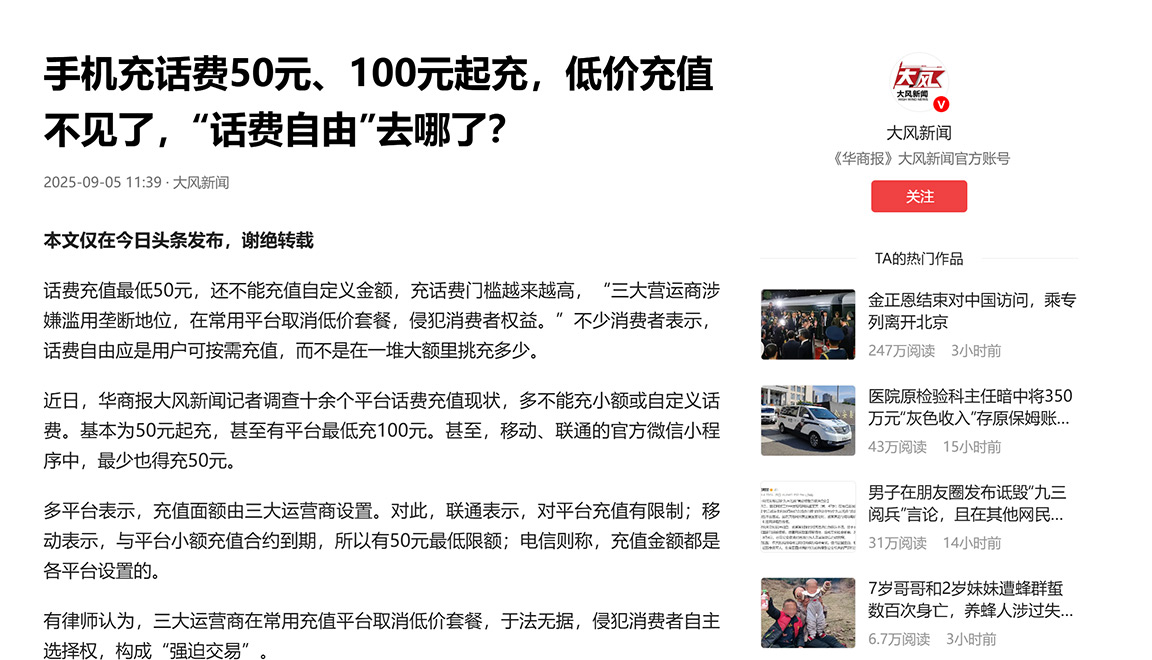
Core Viewpoint - Recent changes in mobile recharge platforms have eliminated small denomination options like 10 yuan and 20 yuan, raising the minimum recharge amount to 50 yuan or even 100 yuan, which restricts consumer flexibility and autonomy in managing their communication expenses [1][3][8] Group 1: Consumer Impact - The increase in minimum recharge amounts disregards the basic rights and diverse needs of Chinese consumers, particularly affecting students and elderly users who typically require lower amounts for their communication needs [3][10] - Users who previously managed their expenses with small recharges now face a financial burden, as they are forced to pay larger sums upfront, which limits their financial flexibility [3][11] Group 2: Responsibility and Accountability - Payment platforms and telecom operators are deflecting responsibility for the new recharge limits, with each party blaming the other for the changes, indicating a lack of accountability in addressing consumer concerns [8][10] - Despite the technical capability to allow for custom recharge amounts, operators and platforms are unwilling to provide these options, suggesting a prioritization of profit over consumer rights [9][10] Group 3: Legal and Regulatory Considerations - The practice of setting high minimum recharge amounts may violate consumer protection laws, as it limits consumer choice and could be seen as a form of forced consumption [10][11] - Regulatory bodies are urged to investigate the situation thoroughly and take appropriate actions to ensure consumer rights are upheld, emphasizing the importance of consumer autonomy in the digital age [11]

通信行业双周报(2025、8、22-2025、9、4):前7个月电信业务收入超万亿元-20250905
Dongguan Securities· 2025-09-05 09:44
Investment Rating - The report maintains an "Overweight" rating for the communication industry, expecting the industry index to outperform the market index by more than 10% in the next six months [2][48]. Core Insights - The communication industry has shown stable performance in the first seven months of 2025, with telecom business revenue exceeding 1 trillion yuan, reflecting a year-on-year growth of 0.7%. The total telecom business volume, calculated at constant prices from the previous year, increased by 8.9% [24]. - The report highlights that the communication sector is currently in a phase of technological iteration and policy benefits, with new growth drivers emerging from AI, quantum communication, and low-altitude economy. The demand for communication facilities such as base stations, optical cables, and data centers is expected to continue growing [24][45]. Summary by Sections 1. Communication Industry Market Review - The communication sector index rose by 7.58% over the past two weeks (8/22-9/4), outperforming the CSI 300 index by 5.78 percentage points, ranking second among 31 primary industries. However, the index fell by 7.75% in September, underperforming the CSI 300 index by 4.83 percentage points. Year-to-date, the communication sector has increased by 50.22%, surpassing the CSI 300 index by 39.29 percentage points [3][10][14]. 2. Industry News - The Ministry of Industry and Information Technology and the State Administration for Market Regulation have issued a plan to enhance efforts in CPU and high-performance AI server development, aiming to promote the high-end, intelligent, and green development of the electronic information manufacturing industry [16]. - Juniper Research forecasts that global revenue from cellular IoT connections will exceed $30 billion by 2030, a 74% increase from $18 billion in 2025, driven by rising demand for operational efficiency and automation [19]. - The global standardization work for 6G wireless communication has officially begun, marking a significant step in the development of next-generation communication technology [20]. 3. Company Announcements - ZTE Corporation reported a net profit of 5.058 billion yuan for the first half of 2025, with a revenue of 71.553 billion yuan, reflecting a year-on-year growth of 14.51% [26]. - Longfly Optical reported a revenue of 6.384 billion yuan for the first half of 2025, a year-on-year increase of 19.38% [27]. - Meige Intelligent announced a net profit growth of 151% year-on-year for the first half of 2025, with a revenue of 1.886 billion yuan [28]. - Zhongji Xuchuang reported a net profit increase of 69.4% year-on-year for the first half of 2025, with a revenue of 14.789 billion yuan [29]. 4. Industry Data Updates - As of July 2025, the number of mobile phone users reached approximately 1.815 billion, a year-on-year increase of 2.68% [30]. - The total number of 5G base stations reached 4.598 million, with a net increase of 348,000 compared to the end of the previous year, accounting for 36% of all mobile base stations [40]. 5. Investment Recommendations - The report suggests focusing on companies that align with the three main themes of "technological commercialization, policy catalysis, and performance certainty." Recommended stocks include China Mobile, China Telecom, FiberHome Technologies, Longfly Optical, and Weisheng Information [45].
通信服务板块9月5日跌0.16%,三维通信领跌,主力资金净流出1.53亿元
Zheng Xing Xing Ye Ri Bao· 2025-09-05 09:07
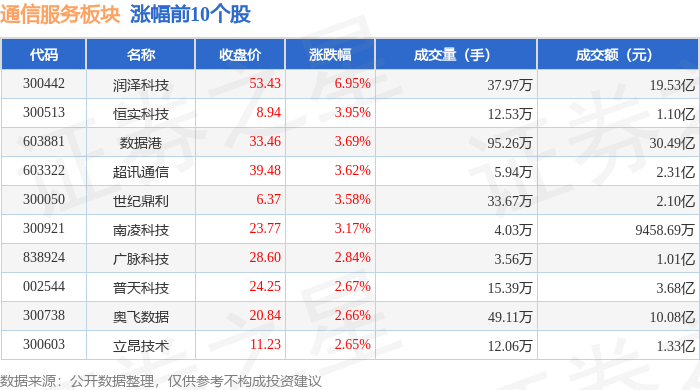
Group 1 - The communication services sector experienced a decline of 0.16% on September 5, with Sanwei Communication leading the drop [1] - The Shanghai Composite Index closed at 3812.51, up 1.24%, while the Shenzhen Component Index closed at 12590.56, up 3.89% [1] - Notable gainers in the communication services sector included Runze Technology, which rose by 6.95% to a closing price of 53.43, and Hengshi Technology, which increased by 3.95% to 8.94 [1] Group 2 - Sanwei Communication saw a significant decline of 7.92%, closing at 11.05, with a trading volume of 3.1039 million shares and a transaction value of 3.444 billion [2] - Major players like China Telecom and China Mobile also experienced slight declines of 1.89% and 0.20%, respectively, with closing prices of 7.26 and 106.54 [2] - The communication services sector had a net outflow of 153 million in main funds, while retail investors saw a net inflow of 73.39 million [2]


通信行业资金流入榜:新易盛等10股净流入资金超亿元
Zheng Quan Shi Bao Wang· 2025-09-05 08:54
Market Overview - The Shanghai Composite Index rose by 1.24% on September 5, with 30 industries experiencing gains, led by the power equipment and communication sectors, which increased by 7.19% and 5.49% respectively [1] - The banking sector was the only industry to decline, with a drop of 0.99% [1] - Overall, there was a net inflow of 44.53 billion yuan into the market, with 20 industries seeing net inflows [1] Sector Performance - The power equipment industry had the highest net inflow of funds, totaling 21.02 billion yuan, contributing to its 7.19% increase [1] - The electronics sector also performed well, with a daily increase of 4.35% and a net inflow of 10.78 billion yuan [1] - Conversely, the retail trade sector saw the largest net outflow of funds, amounting to 1.595 billion yuan, followed closely by the banking sector with a net outflow of 1.553 billion yuan [1] Communication Industry Insights - The communication sector experienced a 5.49% increase, with a total net inflow of 1.249 billion yuan [2] - Out of 125 stocks in the communication sector, 115 rose, while 9 fell, including 1 that hit the daily limit down [2] - The top three stocks with the highest net inflow in the communication sector were Xinyi Technology (5.42 billion yuan), Runze Technology (3.14 billion yuan), and Zhongtian Technology (2.67 billion yuan) [2] Communication Sector Outflows - The communication sector also had notable outflows, with the top three stocks experiencing significant net outflows being Sanwei Communication (-4.53 billion yuan), China Unicom (-1.32 billion yuan), and Changxin Bochuang (-1.11 billion yuan) [3] - Sanwei Communication saw a decline of 7.92%, while China Unicom remained unchanged [3]


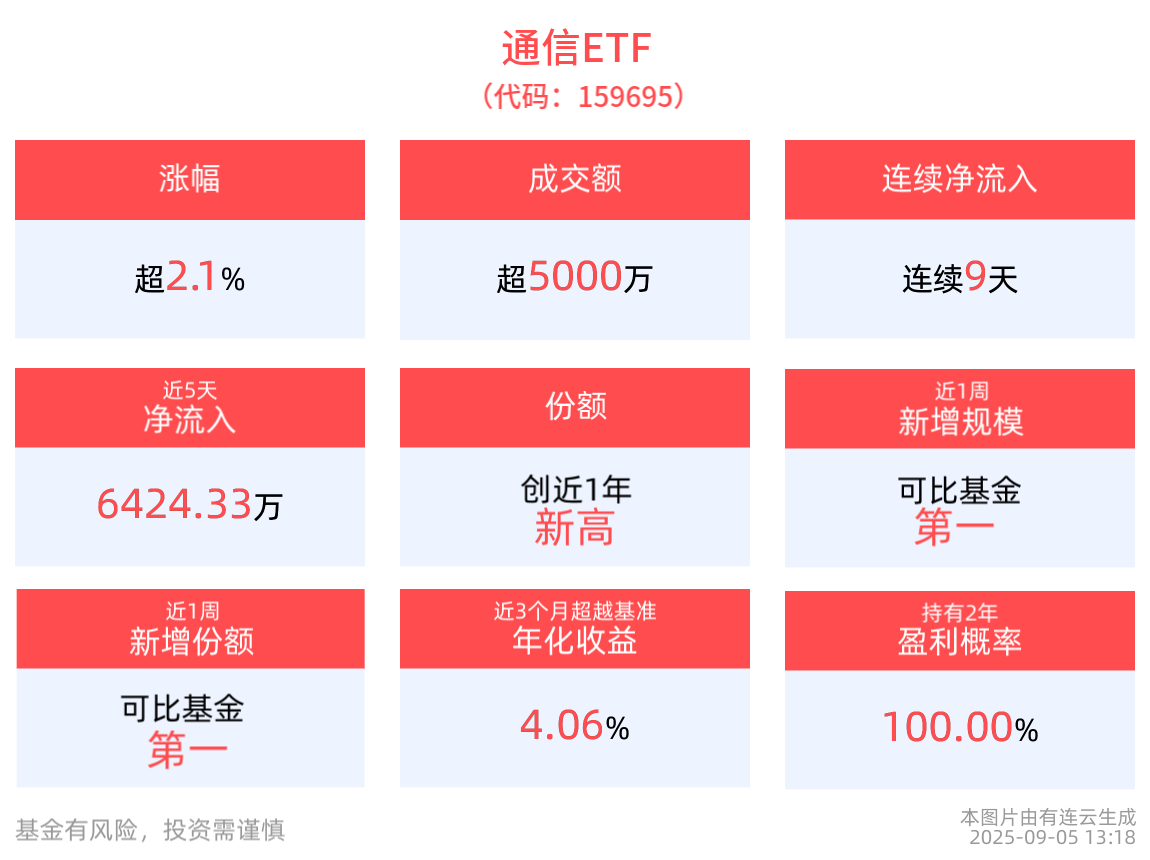
通信ETF(159695)午后上涨2.20%,近9天连续“吸金”超亿元
Xin Lang Cai Jing· 2025-09-05 06:05
Core Viewpoint - The communication sector is experiencing significant growth, with the National Communication Index rising by 1.90% and notable increases in individual stocks such as Dekoli and Zhongci Electronics [1][4]. Group 1: ETF Performance - The Communication ETF (159695) has increased by 2.20%, with a cumulative rise of 7.77% over the past two weeks as of September 4, 2025 [1][4]. - The ETF's trading volume was active, with a turnover rate of 23.05% and a transaction value of 57.993 million yuan [4]. - The ETF's scale grew by 31.8469 million yuan over the past week, ranking first among comparable funds, with the latest share count reaching 139 million, a one-year high [4]. Group 2: Financial Metrics - Leading optical module companies achieved a total revenue of 27.682 billion yuan in the first half of 2025, marking an 83.54% year-on-year increase, and a net profit of 8.837 billion yuan, up 127.88% [5]. - The gross margin for these companies was reported at 43.4%, with a net profit margin of 32.82% [5]. - The market for optical modules is expanding, with predictions indicating a 21% market share in Scale-up networks by 2030 [5]. Group 3: Key Stocks and Weightings - The top ten weighted stocks in the National Communication Index account for 64.43% of the index, with significant players including Xinyi, Zhongji Xuchuang, and ZTE [5]. - Notable stock performances include Zhongji Xuchuang rising by 3.35% and Xinyi increasing by 5.13%, while China Telecom and China Mobile saw declines of 2.03% and 0.35%, respectively [7].