
SRCB(601825)

Search documents
银行研思录25:银行股息率排名与中期分红进度梳理-20251114
CMS· 2025-11-14 03:02
Investment Rating - The report does not explicitly state an investment rating for the banking sector, but it provides detailed insights into dividend yields and distribution processes, which can inform investment decisions. Core Insights - The report outlines the latest dividend yields and mid-term dividend processes for A and H shares of listed banks, emphasizing the importance of accurately calculating dynamic dividend yields to avoid discrepancies across periods [1][2]. - It details the two processes for mid-term dividends following the 2023 revision of the regulatory guidelines, highlighting the conventional and simplified processes for implementing mid-term dividends [2]. - The report provides a comprehensive overview of key dates related to dividend distribution for both A and H shares, including the importance of purchasing shares before the ex-dividend date to qualify for dividends [3][4]. Summary by Sections Dynamic Dividend Yield Calculation - A simplified yet accurate method for calculating dynamic dividend yield is introduced, defined as "rolling 12-month EPS * cash dividend rate / share price," which helps avoid issues related to overlapping or missing annual and mid-term dividends [1]. - The report calculates the cash dividend rate using a standardized approach across different banks, resulting in a clear comparison of dividend yields as of November 13, 2025 [1]. Mid-Term Dividend Processes - The report explains the two processes for mid-term dividends: the conventional process requiring shareholder approval and a simplified process allowing for quicker implementation [2]. - The simplified process is designed to enhance flexibility for companies in distributing mid-term dividends, thereby improving shareholder returns [2]. Dividend Distribution Key Dates - For A shares, investors must purchase shares before the ex-dividend date to receive dividends on the same day, while H shares typically see a delay of about one month for dividend payments [3][4]. - The report outlines the differences in the dividend distribution timeline between A and H shares, emphasizing the need for investors to be aware of these timelines to maximize their returns [3][4]. Mid-Term Dividend Progress - As of November 13, 2025, 31 A-share banks have confirmed mid-term dividends, while 11 H-share banks have also confirmed their dividend distributions [9][11]. - The report categorizes banks based on their dividend status, detailing those that have implemented dividends, those that are pending, and those that have opted not to distribute dividends [9][10][11]. - It highlights that the end of 2025 and early 2026 is expected to be a peak period for mid-term dividend distributions, suggesting potential investment opportunities for dividend-seeking investors [11].






这些银行,悄悄发力理财代销
3 6 Ke· 2025-11-14 01:09
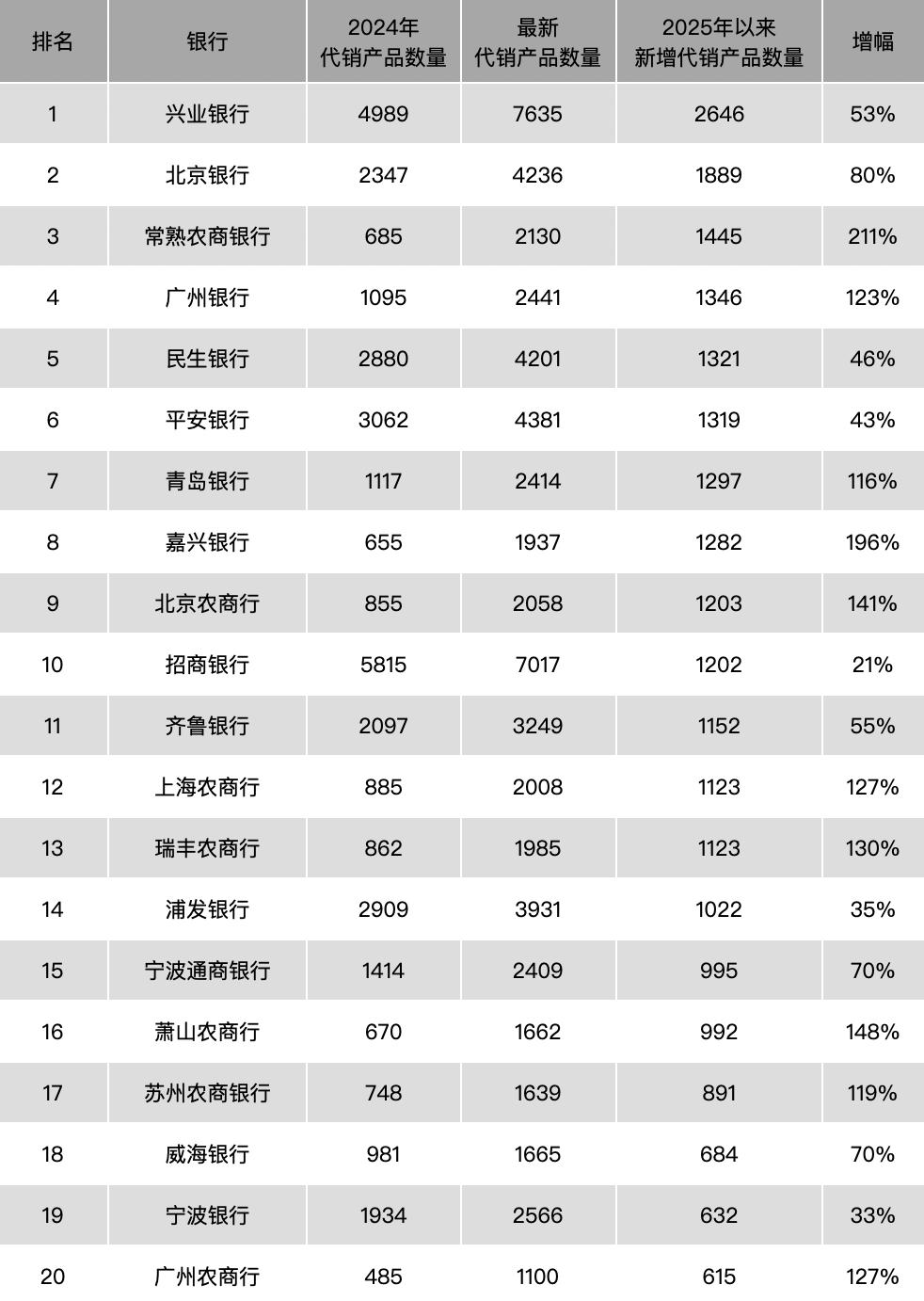
Core Insights - The banking wealth management distribution market has seen significant growth since 2025, with many banks rapidly increasing the number of wealth management products they distribute [2][3]. Distribution Growth - From the top 20 banks by incremental growth, at least 14 banks have added over 1,000 new wealth management products, with 10 banks doubling their product offerings compared to the end of last year, and some even exceeding a 200% increase [3][4]. - Notable banks include: - Industrial Bank: 7,635 products, a 53% increase [4] - Beijing Bank: 4,236 products, an 80% increase [4] - Changshu Rural Commercial Bank: 2,130 products, a 211% increase [4]. Performance Metrics - The wealth management distribution revenue for major banks has also increased significantly: - China Merchants Bank reported a wealth management distribution income of 7.014 billion yuan, an 18.14% year-on-year increase [8]. - Beijing Bank's distribution scale has exceeded last year's total, with a fee income growth of over 10% [8]. - Changshu Rural Commercial Bank's commission income grew over 57% in the third quarter, attributed to increased fees from agency wealth management services [8]. Market Dynamics - The wealth management distribution market has reached a new high, surpassing 32 trillion yuan, with 139 million investors holding wealth management products, a 12.7% year-on-year increase [10]. - The average annualized yield for cash management products is 1.33%, while fixed-income products yield 2.42%, indicating a competitive advantage over traditional savings [11]. Regulatory Changes - The implementation of the "Commercial Bank Agency Sales Business Management Measures" on October 1 has clarified standards and processes for distribution business [16]. - The market is witnessing a shift as many banks, especially smaller ones, are aggressively entering the wealth management distribution space to capture market opportunities amid narrowing interest margins [9][10]. Future Trends - The demand for retirement wealth management products is expected to grow, especially following the recent expansion of pilot programs for retirement financial products across the country [24][27]. - The market is preparing for increased competition as banks look to enhance their service capabilities and product offerings in response to evolving customer needs [23][24].





上海农商银行将在11月14日至15日开展官方网站系统维护工作
Jin Tou Wang· 2025-11-13 04:23
Core Points - Shanghai Rural Commercial Bank announced a system maintenance period from November 14, 2025, 21:00 to November 15, 2025, 03:00 to enhance service capabilities and customer experience [1] Summary by Sections - **System Maintenance Details** - The official website will undergo maintenance, affecting various services including wealth management, funds, structured deposits, insurance, counter bonds, electronic maps, foreign exchange rates, interest rates, and customer contact sections [1] - Users may experience temporary unavailability of certain functionalities and brief page lag during the maintenance period [1] - **Customer Advisory** - Customers are advised to plan accordingly and avoid conducting business during the maintenance window [1] - The bank expresses apologies for any inconvenience caused by the system maintenance [1]
上海农商银行将开展35家村镇银行官方网站系统维护工作
Jin Tou Wang· 2025-11-13 04:23
Core Points - Shanghai Rural Commercial Bank announced a system maintenance for 35 rural bank websites from November 14, 2025, 22:00 to November 15, 2025, 06:00 [1] - During the maintenance period, the websites of the 35 rural banks will be temporarily unavailable for external services [1] - The bank expressed apologies for any inconvenience caused and encouraged customers to plan accordingly [1]
沪农商行11月12日获融资买入928.45万元,融资余额1.51亿元
Xin Lang Cai Jing· 2025-11-13 01:34
Summary of Key Points Core Viewpoint - Shanghai Rural Commercial Bank (沪农商行) shows a mixed performance in financing activities, with a slight decline in stock price and a low financing balance compared to historical levels, indicating potential investment opportunities and risks in the current market environment [1][2]. Financing Activities - On November 12, the bank's stock price decreased by 0.33%, with a trading volume of 134 million yuan. The financing buy-in amount was 9.28 million yuan, while the financing repayment was 10.47 million yuan, resulting in a net financing outflow of 1.19 million yuan [1]. - The total financing and securities balance as of November 12 was 16 million yuan, with the current financing balance at 15.1 million yuan, accounting for 0.18% of the market capitalization, which is below the 30th percentile of the past year, indicating a low level [1]. - In terms of securities lending, the bank repaid 14,800 shares and sold 26,700 shares on November 12, with a selling amount of 241,400 yuan. The securities lending balance was 8.55 million yuan, exceeding the 70th percentile of the past year, indicating a relatively high level [1]. Financial Performance - As of September 30, the number of shareholders increased to 74,000, a rise of 0.81%. The average circulating shares per person decreased by 0.19% to 126,678 shares [2]. - For the period from January to September 2025, the bank reported zero operating income but achieved a net profit attributable to shareholders of 10.57 billion yuan, reflecting a year-on-year growth of 0.78% [2]. Dividend Distribution - Since its A-share listing, the bank has distributed a total of 18.845 billion yuan in dividends, with 13.444 billion yuan distributed over the past three years [3].
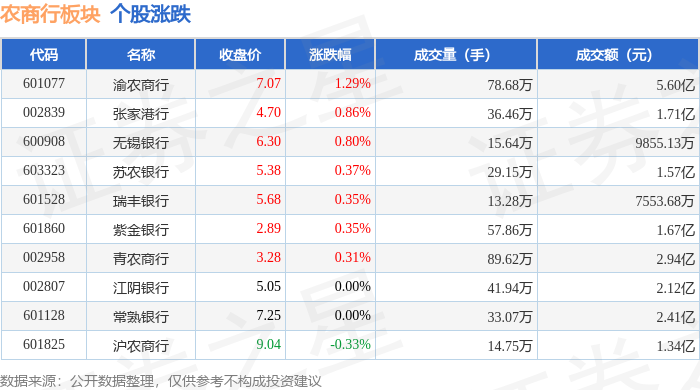
农商行板块11月12日涨0.34%,渝农商行领涨,主力资金净流出2619.33万元
Zheng Xing Xing Ye Ri Bao· 2025-11-12 08:49
Core Viewpoint - The rural commercial bank sector experienced a slight increase of 0.34% on November 12, with Yunnan Rural Commercial Bank leading the gains, while the Shanghai Composite Index fell by 0.07% and the Shenzhen Component Index decreased by 0.36% [1] Group 1: Market Performance - The closing price of Yunnan Rural Commercial Bank was 7.07, with an increase of 1.29% and a trading volume of 786,800 shares, amounting to a transaction value of 560 million yuan [1] - Zhangjiagang Bank closed at 4.70, up 0.86%, with a trading volume of 364,600 shares and a transaction value of 171 million yuan [1] - Wuxi Bank's closing price was 6.30, reflecting an increase of 0.80%, with a trading volume of 156,400 shares and a transaction value of approximately 98.55 million yuan [1] - Su Nong Bank closed at 5.38, up 0.37%, with a trading volume of 291,500 shares and a transaction value of 157 million yuan [1] - Ruifeng Bank's closing price was 5.68, with a 0.35% increase, trading 132,800 shares for a total value of approximately 7.55 million yuan [1] - Zijin Bank closed at 2.89, up 0.35%, with a trading volume of 578,600 shares and a transaction value of 167 million yuan [1] - Qingnong Bank closed at 3.28, reflecting a 0.31% increase, with a trading volume of 896,200 shares and a transaction value of 294 million yuan [1] - Jiangyin Bank's closing price was 5.05, unchanged, with a trading volume of 419,400 shares and a transaction value of 212 million yuan [1] - Changshu Bank closed at 7.25, unchanged, with a trading volume of 330,700 shares and a transaction value of 241 million yuan [1] - Shanghai Rural Commercial Bank closed at 9.04, down 0.33%, with a trading volume of 147,500 shares and a transaction value of 134 million yuan [1] Group 2: Fund Flow Analysis - The rural commercial bank sector saw a net outflow of 26.19 million yuan from main funds, while speculative funds experienced a net inflow of 34.43 million yuan, and retail investors had a net outflow of 8.24 million yuan [1]



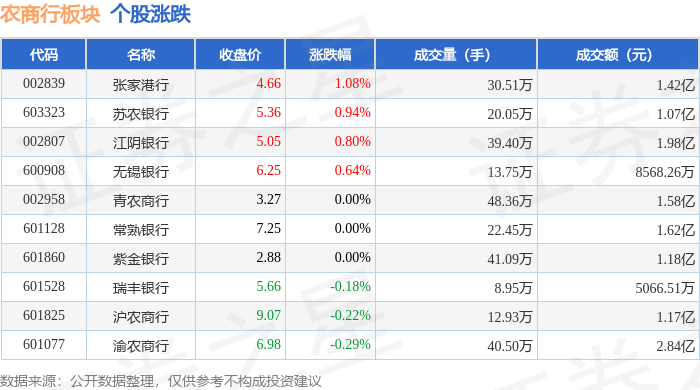
农商行板块11月11日涨0.01%,张家港行领涨,主力资金净流出1.4亿元
Zheng Xing Xing Ye Ri Bao· 2025-11-11 08:46
Core Insights - The rural commercial bank sector experienced a slight increase of 0.01% on November 11, with Zhangjiagang Bank leading the gains [1] - The Shanghai Composite Index closed at 4002.76, down 0.39%, while the Shenzhen Component Index closed at 13289.0, down 1.03% [1] Stock Performance - Zhangjiagang Bank (002839) closed at 4.66, up 1.08% with a trading volume of 305,100 shares and a transaction value of 1.42 billion [1] - Su Nong Bank (603323) closed at 5.36, up 0.94% with a trading volume of 200,500 shares and a transaction value of 107 million [1] - Jiangyin Bank (002807) closed at 5.05, up 0.80% with a trading volume of 394,000 shares and a transaction value of 1.98 billion [1] - Wuxi Bank (600908) closed at 6.25, up 0.64% with a trading volume of 137,500 shares and a transaction value of 85.68 million [1] - Qingnong Commercial Bank (002958) and Changshu Bank (601128) remained unchanged at 3.27 and 7.25 respectively [1] Fund Flow Analysis - The rural commercial bank sector saw a net outflow of 140 million from institutional investors, while retail investors contributed a net inflow of 79.48 million [1] - Zhangjiagang Bank had a net inflow of 6.31 million from institutional investors, but a net outflow of 4.63 million from retail investors [2] - Wuxi Bank experienced a net inflow of 2.46 million from institutional investors, with retail investors contributing a net inflow of 3.07 million [2] - Qingnong Commercial Bank faced a significant net outflow of 23.40 million from institutional investors, while retail investors contributed a net inflow of 20.09 million [2] - Yunnan Agricultural Bank (601077) had the highest net outflow of 87.93 million from institutional investors, with retail investors contributing a net inflow of 47.76 million [2]
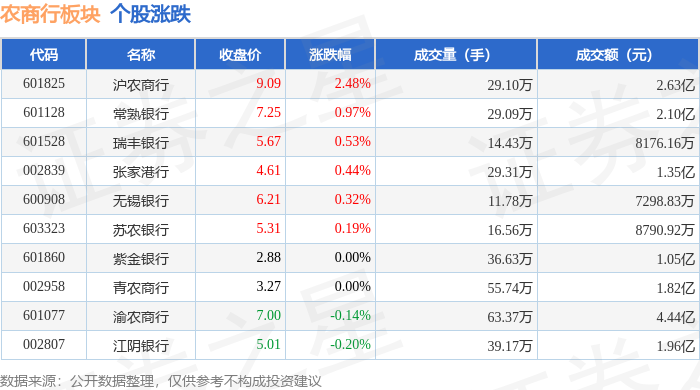
农商行板块11月10日涨0.92%,沪农商行领涨,主力资金净流出2.1亿元
Zheng Xing Xing Ye Ri Bao· 2025-11-10 08:48
Core Insights - The agricultural commercial bank sector experienced a rise of 0.92% on November 10, with Shanghai Agricultural Commercial Bank leading the gains [1] - The Shanghai Composite Index closed at 4018.6, up 0.53%, while the Shenzhen Component Index closed at 13427.61, up 0.18% [1] Sector Performance - Shanghai Agricultural Commercial Bank (601825) closed at 60.6, with a gain of 2.48% and a trading volume of 291,000 shares, amounting to a transaction value of 263 million yuan [1] - Changshu Bank (601128) closed at 7.25, up 0.97%, with a trading volume of 290,900 shares and a transaction value of 210 million yuan [1] - Ruifeng Bank (601528) closed at 5.67, up 0.53%, with a trading volume of 144,300 shares and a transaction value of 81.76 million yuan [1] - Zhangjiagang Bank (002839) closed at 4.61, up 0.44%, with a trading volume of 129,300 shares and a transaction value of 135 million yuan [1] - Yuanxi Bank (600908) closed at 6.21, up 0.32%, with a trading volume of 117,800 shares and a transaction value of 72.99 million yuan [1] - Shinan Bank (603323) closed at 5.31, up 0.19%, with a trading volume of 165,600 shares and a transaction value of 87.91 million yuan [1] - Zijin Bank (601860) closed at 2.88, unchanged, with a trading volume of 366,300 shares and a transaction value of 105 million yuan [1] - Qingnong Commercial Bank (002958) closed at 3.27, unchanged, with a trading volume of 557,400 shares and a transaction value of 182 million yuan [1] - Yunnan Agricultural Commercial Bank (601077) closed at 7.00, down 0.14%, with a trading volume of 633,700 shares and a transaction value of 444 million yuan [1] - Jiangyin Bank (002807) closed at 5.01, down 0.20%, with a trading volume of 391,700 shares and a transaction value of 196 million yuan [1] Fund Flow Analysis - The agricultural commercial bank sector saw a net outflow of 210 million yuan from main funds, while retail funds experienced a net inflow of 118 million yuan [1] - The main fund flow for Shanghai Agricultural Commercial Bank was a net inflow of 9.12 million yuan, while retail funds saw a net outflow of 197,440 yuan [2] - Ruifeng Bank had a main fund net inflow of 4.43 million yuan, but retail funds experienced a net outflow of 763.71 million yuan [2] - Zhangjiagang Bank had a significant main fund net outflow of 16.33 million yuan, while retail funds saw a net inflow of 1.77 million yuan [2] - Changshu Bank experienced a main fund net outflow of 21.87 million yuan, with retail funds seeing a net inflow of 26.42 million yuan [2] - Qingnong Commercial Bank had a main fund net outflow of 32.17 million yuan, while retail funds had a net inflow of 20.39 million yuan [2] - Yunnan Agricultural Commercial Bank faced a substantial main fund net outflow of 143 million yuan, but retail funds had a net inflow of 59.38 million yuan [2]


从增量扩面到提质控险 银行业普惠金融迈向差异化精准服务
2 1 Shi Ji Jing Ji Bao Dao· 2025-11-10 04:21
Core Insights - The report highlights the significant growth and development of inclusive finance in China, particularly focusing on small and micro enterprises and rural areas, with a notable annual growth rate of over 20% in inclusive micro loans during the 14th Five-Year Plan period [1][2] - As of June 2025, the balance of inclusive micro loans reached 36 trillion yuan, which is 2.3 times that of the end of the 13th Five-Year Plan, with a decrease in interest rates by 2 percentage points [1][2] - The average interest rate for newly issued inclusive micro loans was 3.48% as of June 2025, reflecting a decrease of 66 basis points year-on-year [1][2] Group 1: Digital Empowerment - Digital technology has been a key driver for the development of inclusive finance, with banks utilizing big data and AI to enhance loan approval efficiency and reduce financing costs [2][7] - The market structure among banks is changing, with large commercial banks holding a 45.11% share of inclusive micro loans, while rural financial institutions have seen a decline in their market share [2][3] - The average growth rate of inclusive micro loans has been slowing down, with a decrease from 30.9% in 2020 to 12.3% by mid-2025 [2][3] Group 2: Performance of Listed Banks - Among listed banks, Agricultural Bank of China, Industrial and Commercial Bank of China, and Beijing Bank reported the highest growth rates in inclusive micro loans at 18.50%, 17.30%, and 17.27% respectively [3][4] - In contrast, some banks, including Shanghai Bank and Zhengzhou Bank, experienced negative growth rates of -3.97% and -2.06% [3][4] - The performance of different banks varies significantly, with state-owned banks generally showing stronger growth in inclusive micro loans compared to smaller banks [3][4] Group 3: Interest Rates and Risk Management - The interest rates for newly issued inclusive micro loans have decreased across various banks, with the highest rate at 4.20% and the lowest at 2.94% [7][8] - The gap in interest rates between large and small banks is narrowing, with some large banks' rates aligning closely with those of smaller banks [8][9] - The report emphasizes the importance of risk management in the inclusive finance sector, with several banks focusing on improving asset quality and managing non-performing loans [9][10]


沪农商行赋能进博企业 提供数字化跨境金融解决方案
Xin Hua Cai Jing· 2025-11-10 02:28
Core Insights - Shanghai Rural Commercial Bank has established a strategic partnership with New Zealand New Cloud (Shanghai) E-commerce Co., Ltd. during the 8th China International Import Expo, enhancing digital cross-border financial solutions for participating enterprises [1][2] - The collaboration follows the bank's launch of two new cross-border remittance products, "Xin Yi Xian Su Da" and "Xin Yi Bai Bi Tong," aimed at improving financial services for import businesses [1] - The partnership exemplifies the bank's commitment to financial innovation and support for enterprises like New Zealand, facilitating the rapid delivery of fresh milk from New Zealand to China within 72 hours [1] Group 1 - The strategic cooperation aims to provide comprehensive digital cross-border financial solutions to a range of enterprises participating in the expo [1] - Shanghai Rural Commercial Bank has been a consistent participant in the Import Expo for eight consecutive years, showcasing its dedication to supporting businesses through financial innovation [1] - The bank's initiatives include optimizing remittance paths and managing currency risks, effectively addressing financial bottlenecks in the import cold chain food trade [1] Group 2 - The bank positions itself as a "financial bridge" connecting global markets with opportunities in China, focusing on innovative and high-potential enterprises like New Zealand [2] - It aims to create an international, comprehensive, and digital financial service system, providing integrated financial solutions across the entire lifecycle and industry chain [2] - The partnership contributes to the ongoing development of Shanghai as an international trade center, injecting sustained momentum into its growth [2]