养老理财

Search documents
投顾周刊:1月信贷投放实现“开门红”
Wind万得· 2026-02-14 22:20
Group 1 - The core viewpoint of the article highlights the significant growth in credit issuance in January, with a record social financing scale of 7.22 trillion yuan, indicating strong support from a moderately loose monetary policy for the economy's stable start in 2026 [1][2] - The anticipated visit of U.S. President Trump to China in April is expected to ease bilateral trade tensions, potentially extending the "truce" in U.S.-China trade relations and providing stability to global supply chains [1][2] - The launch of ByteDance's AI video model Seedance 2.0 has positively impacted the media sector, leading to a notable recovery in the net value of several media-themed funds [1][2] Group 2 - The bank wealth management market is showing strong recovery, with an expected increase of 1 trillion yuan in February, driven by declining deposit rates and year-end bonuses [2] - The expansion of pension wealth management trials nationwide, with increased fundraising limits for institutions, is expected to provide investors with more robust pension growth tools [2] Group 3 - The Federal Reserve's meeting minutes indicate a hawkish stance, with expectations for interest rate cuts being pushed back, leading to a strengthening of the dollar index [4] - The "AI panic trading" in technology stocks has caused significant market fluctuations, with funds shifting towards value stocks, particularly in the Chinese internet sector and high-dividend assets [4] Group 4 - Global stock markets showed mixed performance, with the Chinese market indices such as the Shanghai Composite Index and Shenzhen Component Index experiencing slight increases, while U.S. indices faced declines [5][6] - The bond market showed varied performance, with the 1-year Chinese government bond yield rising slightly, while longer-term yields decreased [9][10] Group 5 - In the commodity market, gold and silver prices increased, while international oil prices continued to adjust downwards [12][13] - The dominance of fixed-income plus funds in the bank financing products indicates a strong market presence, with 477 such funds accounting for 56.79% of new products and 69.17% of total scale [14][15]


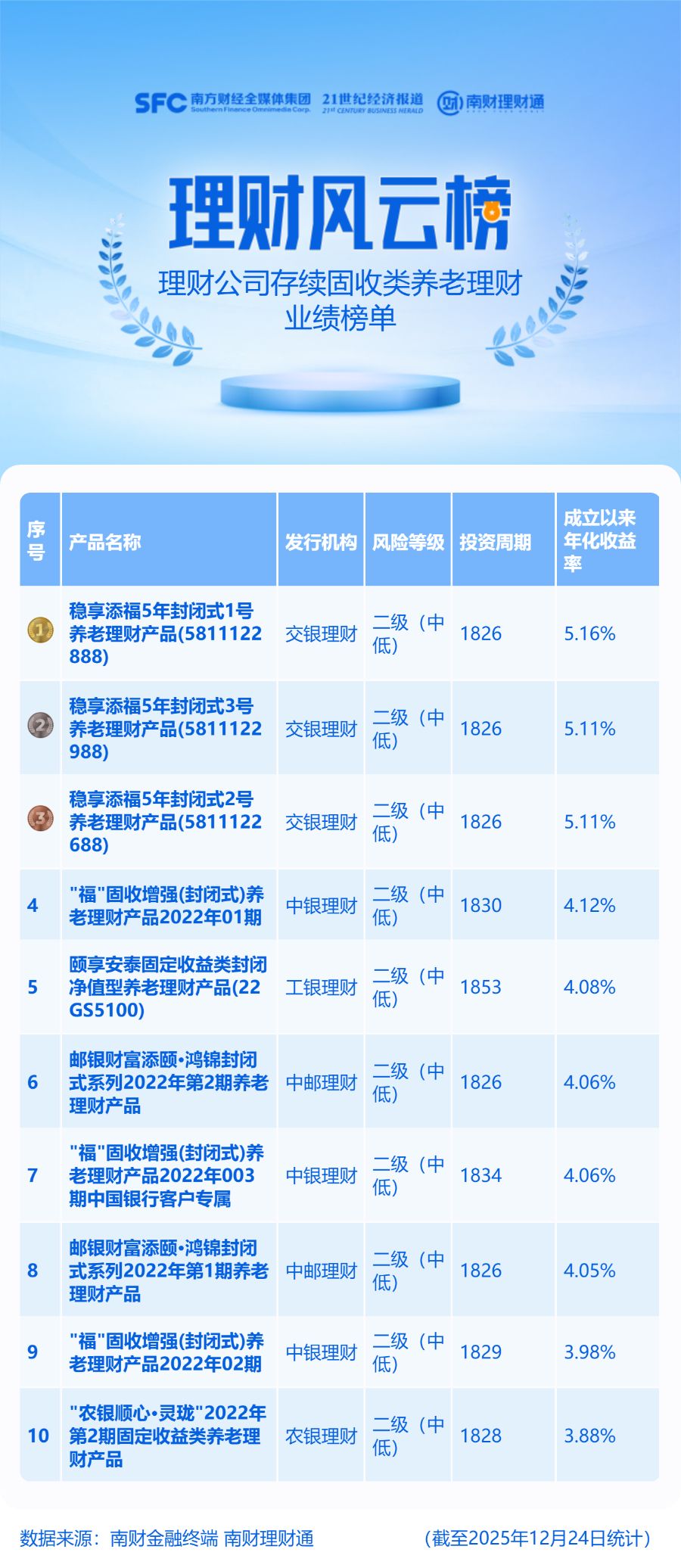
规模突破千亿,平均年化3.74%!养老理财产品该不该买?
2 1 Shi Ji Jing Ji Bao Dao· 2025-12-25 05:17
Core Viewpoint - The notice issued by the National Financial Supervision Administration promotes the development of pension financial products nationwide, marking a significant expansion of the pilot program aimed at addressing aging population issues and enhancing individual retirement savings [1][2]. Group 1: Definition and Importance of Pension Financial Products - Pension financial products are designed to help individuals save for retirement, utilizing professional investment strategies to achieve stable long-term returns while managing risks [1]. - The development of pension financial products is a strategic response to the aging population and serves as a crucial tool for individuals to supplement their retirement income beyond the basic pension [2]. Group 2: Characteristics of Pension Financial Products - Long-term nature: These products typically have a duration of over five years, aligning with the long-term investment needs of individuals saving for retirement [3]. - Inclusivity: The low entry threshold (starting from as little as 0.1 yuan) allows a wide range of individuals to participate, regardless of profession or age [3]. - Low fees: Most pension financial products charge minimal fees, primarily fixed management and custody fees, with no sales or subscription fees [3]. - Risk management: A risk protection mechanism is in place to safeguard pension funds, including risk reserves and independent third-party custody [3]. - Liquidity: Many products offer early redemption options for investors facing significant life events, enhancing liquidity [3]. Group 3: Development Status of Pension Financial Products - As of October 2025, the market for pension financial products has grown steadily, with a total scale exceeding 106.4 billion yuan and 51 active products from 11 pilot institutions [4]. - The majority of these products are "fixed income plus" types, with 96% rated as medium-low risk [4]. Group 4: Performance of Pension Financial Products - The average annualized return of pension financial products since inception is 3.74%, with 17 products exceeding a 4% return, although all products fall short of the average benchmark of 6.63% [5]. - The maximum drawdown across all products averages 1.48%, indicating effective risk control [5]. Group 5: Challenges and Considerations - The low interest rate environment limits asset allocation options, and there is a significant issue with product homogeneity, which may not meet diverse investor needs [12]. - Tax incentives for these products are currently insufficient, affecting their attractiveness [12]. Group 6: Purchasing Pension Financial Products - Investors can purchase these products through bank apps or personal pension accounts, which also offer tax benefits for contributions [12][13]. - It is essential for investors to consider risk-return alignment, investment duration, and the issuing institution's expertise when selecting pension financial products [13].
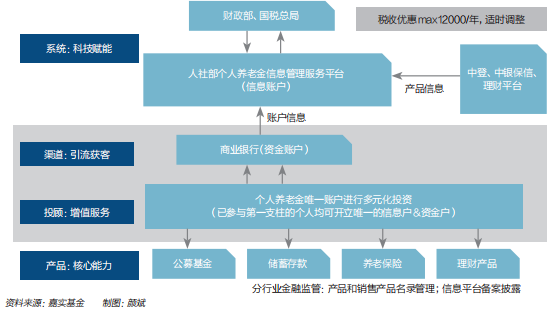
银行理财如何助力个人养老金发展
Xin Lang Cai Jing· 2025-12-19 13:18
Core Insights - The development of personal pensions in China serves as a significant supplement to the first and second pillars of the pension system, with a rapid increase in account openings since 2018, yet the overall scale remains insufficient compared to the aging population [1] - The personal pension market is growing quickly, alleviating the pressure of expanding fiscal subsidy gaps, but faces challenges in differentiating its functions from public pensions and enterprise annuities, as well as linking investment operations with wealth management [1][2] Group 1: Policy and Implementation - The National Financial Regulatory Administration has expanded the pilot areas for pension financial products nationwide, aligning with the personal pension system's implementation, and extended the trial period by three years [2] - The comprehensive implementation of the personal pension system is set to begin on December 15, 2024, following the release of guidelines aimed at optimizing product supply and improving management services [3] Group 2: Market Performance - As of June 15, 2025, over 150 million personal pension accounts have been opened, with a diverse range of financial products available, including savings, commercial pension insurance, and public funds [4] - Despite the increase in account openings, actual contribution rates are low, with only 22% of account holders making contributions and only 25% of the maximum tax-advantaged contribution limit being utilized [4][5] Group 3: Challenges and Incentives - The low contribution levels are attributed to insufficient tax incentives, as the current tax benefits primarily favor higher-income households, leaving lower-income groups with limited access to these advantages [5][6] - The development model and functional positioning of personal pensions in China differ from successful international models, such as the U.S. and Germany, which utilize stronger tax incentives and matching contributions to encourage participation [6][7] Group 4: Investment Strategies - The operational model for personal pensions in China is shifting towards an investment-led approach, with banks expected to play a leading role in managing personal pension accounts and providing diverse asset management options [9][16] - Successful international pension management practices suggest three main asset allocation models: alternative investment-led, target risk allocation, and target date strategies, which could inform the development of China's personal pension investment strategies [17][21][24] Group 5: Future Directions - Banks are encouraged to transition into wealth management institutions, enhancing their advisory roles and optimizing service delivery to improve customer engagement and understanding of pension products [25][26] - There is a need for banks to innovate product offerings, increase the variety of pension investment options, and collaborate with asset management companies to meet diverse customer needs [27][28]
养老理财产品试点扩容长期资金入市可期
Zheng Quan Ri Bao· 2025-12-02 16:17
Core Viewpoint - The recent discussions and notifications from the National Financial Regulatory Administration aim to expand the pilot program for pension financial products, enhancing the design and management of these products to better meet the diverse needs of investors [1][2][3] Group 1: Regulatory Developments - The Banking Wealth Management Registration and Custody Center held discussions on expanding the pilot program for pension financial products, involving various financial institutions and regulatory bodies [1] - The National Financial Regulatory Administration issued a notification with 22 articles focusing on the sustainable development of pension financial services, including expanding product trials and improving risk management [1] Group 2: Market Impact - As of October 2025, the scale of pilot pension financial products is projected to reach 106.4 billion, with individual pension financial products at 16.7 billion, totaling over 120 billion [2] - The notification encourages the issuance of long-term pension financial products with maturities of over 10 years or minimum holding periods of over 5 years, allowing for flexible design in purchasing and redeeming these products [2] Group 3: Industry Perspectives - Multiple institutions believe the notification will invigorate the banking sector's approach to pension financial products, providing high-quality and diverse services to the public [3] - The release of the notification is expected to increase the enthusiasm of wealth management companies in developing personal pension financial products, leading to an expansion of long-term investment options [3]
理财登记中心:截至10月底试点期养老理财产品规模为1064亿元
Bei Jing Shang Bao· 2025-12-01 10:02
Core Insights - The National Financial Regulatory Administration has issued a notification to promote the sustainable and healthy development of pension financial products [1][2] - The expansion of the pension financial pilot program is crucial for addressing the challenges posed by an aging population and enhancing the third pillar of pension support [2] Group 1: Notification and Implementation - The notification aims to guide financial institutions in product design, investment management, sales management, and investor suitability management [1] - A meeting was held to discuss the implementation of the notification, involving representatives from various financial institutions and regulatory bodies [1][2] Group 2: Industry Impact and Statistics - The pension financial product scale reached 1,064 billion yuan, while personal pension financial products totaled 167 billion yuan, with over 1,200 billion yuan issued in total as of October 2025 [2] - The regulatory body emphasizes the importance of the notification for supporting the development of personal pension businesses and enhancing the quality of the financial industry [2]
夯实养老保障金融支撑
Sou Hu Cai Jing· 2025-11-23 22:52
Core Insights - The National Financial Supervision Administration has expanded the pilot scope of pension financial products nationwide for three years, aiming to enhance the multi-tiered pension insurance system and address the aging population issue [1] - The development of pension finance in China follows a path of "pilot first, steady progress, and innovation-driven," with the recent nationwide expansion marking a significant leap in this process [1] - As of now, there are 51 existing pension financial products with a total scale of approximately 106.5 billion, indicating increased market recognition and awareness among residents regarding retirement investments [1] Group 1: Market Development - The innovation in product forms and service upgrades in pension financial products is a core direction for the deepening development of China's pension finance industry, with a focus on "long-term" orientation and "inclusive" characteristics [2] - Pension financial funds are participating in sectors like smart elderly care and health management through equity and debt investments, which supports both the silver economy and the real economy [2] - Despite the progress, there are still shortcomings in the market, such as a lack of diverse pension financial products compared to public funds, and a need for better investor education on long-term investment concepts [2] Group 2: International Experience - International experiences from mature pension finance markets provide valuable references, such as Germany's "Riester Plan" and the U.S. 401(k) plan, which highlight the importance of policy incentives and diverse market offerings [3] - These international practices emphasize the role of policy guidance in activating market vitality and the significance of diverse supply in meeting public pension needs [3] Group 3: Recommendations for Development - To address existing shortcomings and achieve sustainable development in pension finance, collaboration among policies, market institutions, and investors is essential [3] - Financial companies should enhance R&D efforts to innovate products that meet pension needs, including long-term products and solutions integrated with health management [4] - Policy improvements should focus on reducing participation barriers for residents, such as fee reductions and tax incentives for pension financial products [4] - Investor education should evolve from knowledge dissemination to habit formation, promoting a scientific approach to retirement planning and long-term investment awareness [4] - Continuous improvement of regulatory frameworks is necessary to balance innovation and safety, ensuring transparent risk disclosures and enhancing the research capabilities of financial companies [4]
证券时报社党委委员、副总编辑江日辉:三大趋势正重塑券商资管行业生态
Zheng Quan Shi Bao Wang· 2025-11-19 05:54
Core Insights - The Chinese securities asset management industry has undergone significant transformation, resulting in a more rational business structure and enhanced operational standards, thereby increasing competitiveness in the broader asset management landscape [1] Group 1: Industry Trends - Three major trends are reshaping the securities asset management ecosystem: 1. Digital empowerment, with AI and large model technologies permeating the entire chain from investment research to customer service 2. Demand upgrade, where new needs such as retirement finance and green investment are driving product innovation 3. Capability reconstruction, necessitating a shift from traditional investment management to comprehensive solution provision [1][1][1] Group 2: Strategic Recommendations - For the securities asset management industry, leveraging the collaborative advantages of securities groups is essential. This includes deepening industry research and promoting synergy between asset management, wealth management, investment banking, and research sectors to enhance active management capabilities and customer service levels, ensuring precise alignment with market demands to stand out in a competitive market [1][1][1]
从稳健到养老 银行理财如何抓住低利率时代的增量市场? ——专访贝莱德建信理财总经理张鹏军
Zhong Guo Jing Ying Bao· 2025-11-15 10:20
Core Insights - The banking wealth management sector in China has reached a record scale of 32.13 trillion yuan by the end of Q3 2025, indicating a positive trend in the industry as it undergoes regulatory transformation [1] - The low interest rate environment presents both opportunities and challenges for wealth management products, particularly for individual investors who traditionally rely on savings [2][3] - The expansion of pension wealth management products nationwide offers a significant opportunity for joint venture wealth management companies to leverage their unique advantages [5][6] Group 1: Opportunities in Wealth Management - The decline in bond market yields since 2025 is prompting individual investors to seek higher returns through asset management products, positioning bank wealth management as a preferred choice for conservative investors [2] - Wealth management companies can utilize various stable investment tools and product structures to enhance returns, potentially leading to rapid growth in industry scale [1][2] Group 2: Challenges in Wealth Management - Clients' expectations for stable returns may be disrupted by fluctuations in net value and actual returns, necessitating a focus on finding new stable asset bases to meet these demands [2] - The low interest rate environment increases investment pressure on wealth management companies, requiring them to adjust their investment strategies while educating clients about product performance [2] Group 3: Investment Strategies and Product Development - Wealth management companies should leverage their broad investment scope and flexible strategies to identify innovative low-volatility assets, while also enhancing research on traditional fixed-income assets [4] - The positioning of wealth management products as alternatives to deposits, with a focus on maintaining competitive yields, is essential for solidifying market presence [4] Group 4: Pension Wealth Management - Joint venture wealth management companies can capitalize on their overseas resources and experience in pension investment to offer differentiated products tailored to local market needs [5][6] - The integration of overseas investment strategies with local insights can create unique pension investment experiences for clients, addressing their primary concerns of low risk and stable returns [5][6]
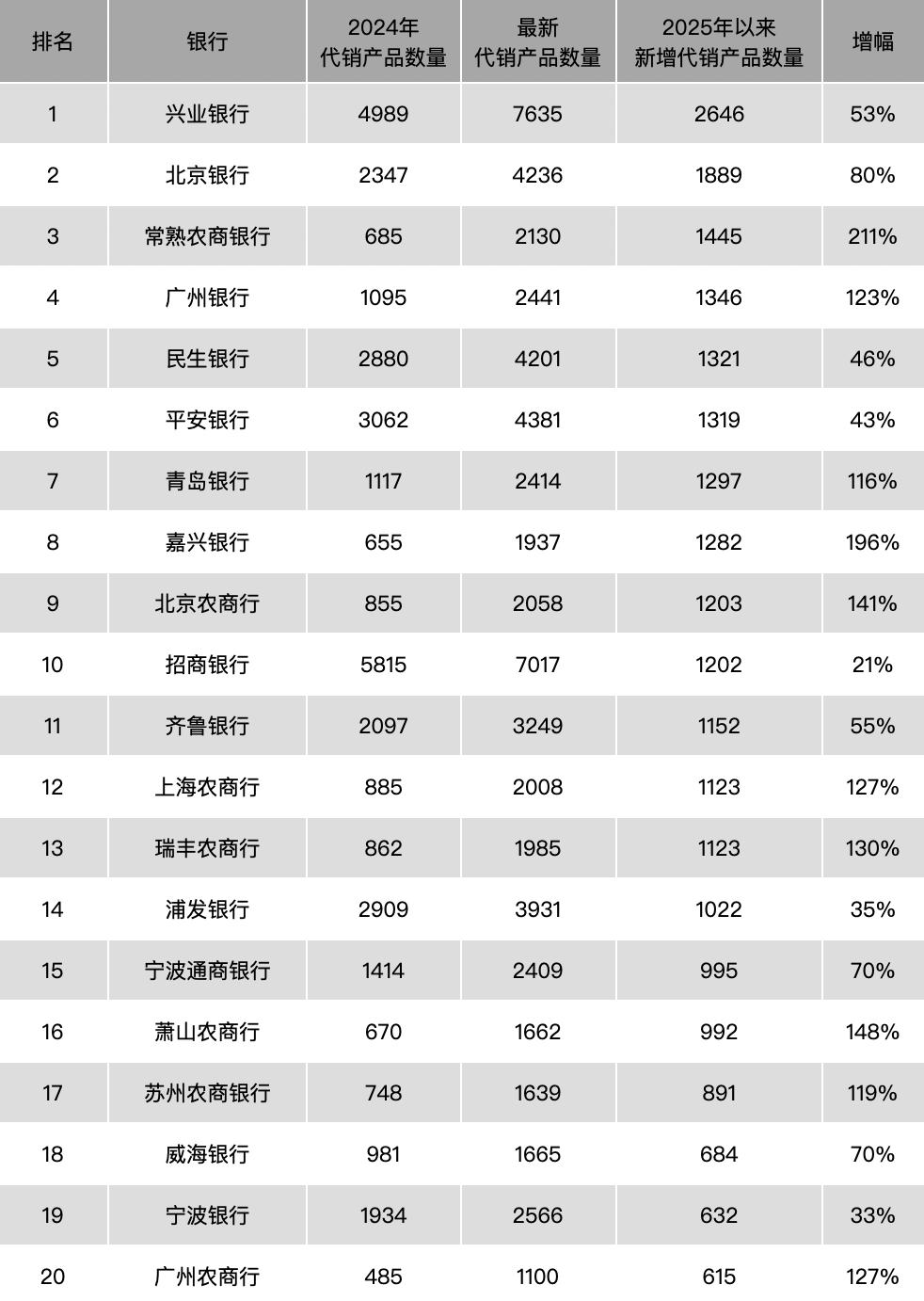
这些银行,悄悄发力理财代销
3 6 Ke· 2025-11-14 01:09
Core Insights - The banking wealth management distribution market has seen significant growth since 2025, with many banks rapidly increasing the number of wealth management products they distribute [2][3]. Distribution Growth - From the top 20 banks by incremental growth, at least 14 banks have added over 1,000 new wealth management products, with 10 banks doubling their product offerings compared to the end of last year, and some even exceeding a 200% increase [3][4]. - Notable banks include: - Industrial Bank: 7,635 products, a 53% increase [4] - Beijing Bank: 4,236 products, an 80% increase [4] - Changshu Rural Commercial Bank: 2,130 products, a 211% increase [4]. Performance Metrics - The wealth management distribution revenue for major banks has also increased significantly: - China Merchants Bank reported a wealth management distribution income of 7.014 billion yuan, an 18.14% year-on-year increase [8]. - Beijing Bank's distribution scale has exceeded last year's total, with a fee income growth of over 10% [8]. - Changshu Rural Commercial Bank's commission income grew over 57% in the third quarter, attributed to increased fees from agency wealth management services [8]. Market Dynamics - The wealth management distribution market has reached a new high, surpassing 32 trillion yuan, with 139 million investors holding wealth management products, a 12.7% year-on-year increase [10]. - The average annualized yield for cash management products is 1.33%, while fixed-income products yield 2.42%, indicating a competitive advantage over traditional savings [11]. Regulatory Changes - The implementation of the "Commercial Bank Agency Sales Business Management Measures" on October 1 has clarified standards and processes for distribution business [16]. - The market is witnessing a shift as many banks, especially smaller ones, are aggressively entering the wealth management distribution space to capture market opportunities amid narrowing interest margins [9][10]. Future Trends - The demand for retirement wealth management products is expected to grow, especially following the recent expansion of pilot programs for retirement financial products across the country [24][27]. - The market is preparing for increased competition as banks look to enhance their service capabilities and product offerings in response to evolving customer needs [23][24].





【银行理财】银行理财大事记:养老理财试点扩全国,数据基建升级迈新阶——2025年10月银行理财市场月报
华宝财富魔方· 2025-11-11 10:39
Core Insights - The article highlights the significant developments in the banking wealth management sector in October, including regulatory approvals, product innovations, and market trends [3][4][5]. Regulatory and Industry Dynamics - Xingyin Wealth Management received regulatory approval to increase its registered capital by 5 billion yuan, enhancing its risk resilience and compliance capabilities [3]. - The Global Wealth Management Forum discussed multi-asset allocation and overseas investment strategies among wealth management executives [3]. - The National Financial Supervision Administration issued guidelines to promote the development of pension wealth management, expanding pilot programs nationwide [3][4]. - Agricultural Bank and Agricultural Bank Wealth Management updated their central data exchange agreement, improving data governance capabilities [3][4]. Market Performance - The total market size of wealth management products reached 31.60 trillion yuan in October, a month-on-month increase of 1.16% and a year-on-year increase of 7.50% [4][9]. - Cash management products saw a near 7-day annualized yield of 1.29%, a decrease of 2.73 basis points, while pure fixed-income products had an annualized yield of 3.09%, an increase of 1.60 percentage points [4][9]. - The market's net asset value ratio was 3.10%, down 2.3 percentage points from the previous month [4]. New Product Launches - Huibin Wealth Management launched a multi-purchase wealth management product to address the issue of staggered fund arrivals and improve fund utilization efficiency [3][7]. - Zhaoyin Wealth Management introduced a self-selected account date product, allowing investors to set their preferred fund arrival dates [3][7]. - ICBC Wealth Management participated as a cornerstone investor in the IPO of Cambridge Technology, strategically positioning itself in the AI computing power industry [3][7]. Product Structure and Trends - The product structure remains dominated by fixed-income and cash management products, with cash products accounting for 6.62 trillion yuan and fixed-income products showing steady growth [9][10]. - The trend indicates a continuous shrinkage of cash management products since 2024, while fixed-income products maintain steady expansion, reflecting a balance between liquidity and yield demands from investors [9][10]. Pension Wealth Management - The expansion of pension wealth management products to a national level aims to enhance the pension system's sustainability and resilience, aligning with the broader economic strategy [3][4][6]. - The new regulations simplify the approval process for pension wealth management products, promoting a more integrated approach to personal pension accounts [3][4][6]. Data Governance and Technology Upgrades - The banking wealth management sector is enhancing its data governance and operational efficiency through the implementation of new data exchange systems [3][4][6]. - The upgrades aim to improve the accuracy and control of data reporting, thereby strengthening investor protection and regulatory compliance [3][4][6].