CZBANK(601916)

Search documents
【金融兴辽】浙商银行沈阳分行深耕辽沈助力东北振兴
Zhong Guo Jin Rong Xin Xi Wang· 2025-06-04 07:54
Core Viewpoint - The article highlights the proactive role of Zheshang Bank Shenyang Branch in supporting the revitalization of Northeast China, particularly in Liaoning province, by providing tailored financial services to boost the local economy and key industries [1][2]. Group 1: Financial Services and Support - Zheshang Bank Shenyang Branch is committed to serving the real economy, focusing on traditional industries such as steel, chemicals, and equipment manufacturing by establishing a comprehensive and refined financial service network [1]. - The bank has developed customized financial solutions for specialized and innovative enterprises, covering their entire lifecycle from startup to maturity, particularly increasing credit support for technology innovation during the critical year of Liaoning's revitalization [1]. - The branch has become the first bank in Liaoning to obtain special long-term government bond funding supervision qualifications, providing significant loan support for new projects, including the expansion of experimental and assembly workshops [1]. Group 2: Future Strategies - The bank plans to continuously optimize its financial service offerings by enhancing communication with enterprises and providing differentiated financial services and personalized products [2]. - It aims to focus on key industries for Liaoning's revitalization, innovating financial service models and leveraging financial technology to simplify service processes and expand online service scenarios [2]. - The bank's leadership emphasizes a commitment to improving service quality and efficiency to contribute to the high-quality development of Liaoning's economy and society [2].

发挥票据功能:从全链条到全周期
Jin Rong Shi Bao· 2025-06-04 04:01
Core Insights - The article focuses on the role of the bill market in connecting the real economy with the financial system, highlighting how commercial banks and financial companies innovate to serve technology enterprises through bill financing [1] Group 1: Demand-Driven Innovations - The high R&D costs and long return cycles have led to a funding shortage for technology enterprises, making bill financing a crucial tool for optimizing cash flow and ensuring R&D investments [2] - Financial institutions have developed innovative bill products such as ICBC's "Gongyin Xiangtie" series, SPD Bank's "Puyin e-bill," and Zhejiang Bank's "Discounting Service," which cater specifically to the needs of specialized and technology-driven enterprises [2][3] - These innovations are not merely theoretical but are closely aligned with market demands, providing comprehensive financial support throughout the enterprise lifecycle [2][3] Group 2: Scene Integration - Financial institutions aim to deeply integrate bill financing with the growth needs of enterprises, embedding services into business operations and ensuring relevance to specific scenarios [4] Group 3: Practical Applications - Zhejiang Bank's collaboration with a high-tech subsidiary of State Grid to launch the "Electric e-bill" product exemplifies how bill financing can be integrated into various industry scenarios, allowing companies to use electronic bank acceptance bills for utility payments [5] Group 4: Financial Company Innovations - Financial companies, such as the Weapon Equipment Group's finance company, focus on building risk management systems that include bill management, enhancing data connectivity, and monitoring overdue payments and counterparties [6] Group 5: Institutional Foundations - The article emphasizes the need for a comprehensive institutional framework for bills, including tiered access mechanisms for innovative products and differentiated rules based on application characteristics [7][8] - Recent initiatives, such as the collaboration between SPD Bank's Suzhou branch and the People's Bank of China, aim to enhance support for technology enterprises through bill financing, with significant amounts already disbursed [8]
债券承销哪家强
Jin Rong Shi Bao· 2025-06-03 14:07
Core Viewpoint - The recent evaluation results from the China Interbank Market Dealers Association highlight the performance of 72 main underwriters in the non-financial corporate debt financing tools market, emphasizing the importance of continuous assessment for maintaining high standards in underwriting practices [1][3]. Group 1: Evaluation Mechanism - The evaluation mechanism includes both initial assessments and annual evaluations, which are crucial for determining the ongoing business qualifications of main underwriters [1][3]. - The latest evaluation categorized the institutions into four tiers: A, B, C, and D, with 17 institutions achieving A grade, while three banks were rated D [1][5]. - The evaluation focuses on core business capabilities such as pricing, sales, and market-making, aiming to shift the market from a "scale-driven" to a "capability-driven" model [3][4]. Group 2: Encouraging Professional Development - The "positive incentive + negative constraint" mechanism encourages underwriters to enhance their professional skills and avoid short-sighted behaviors that prioritize business expansion over capability building [2][7]. - A new feature of the evaluation mechanism is the introduction of a D tier, which will lead to the disqualification of institutions rated D for two consecutive years, thereby promoting a dynamic adjustment of the underwriting team [4][6]. Group 3: Differentiated Competition - The evaluation results revealed a diverse composition of the 72 participating institutions, including 26 national banks, 28 local banks, and 18 securities companies, fostering differentiated competition [5]. - The association plans to introduce a specialized evaluation mechanism for underwriters excelling in pricing, inclusive finance, market development, and service capabilities, with specific institutions recognized for their strengths in these areas [6][8]. Group 4: Feedback Mechanism - A "one institution, one feedback" system has been established to provide tailored guidance to underwriters with subpar evaluation results, promoting a cycle of evaluation, feedback, and improvement [8]. - This innovative approach aims to integrate the evaluation system with national strategies such as technological innovation and green development, enhancing the role of underwriters in supporting the high-quality development of the real economy [8].




中证浙江国资创新发展指数上涨1.29%,前十大权重包含小商品城等
Jin Rong Jie· 2025-06-03 13:10
Core Points - The China Securities Index for Zhejiang State-owned Enterprises rose by 1.29% to 2293.62 points, with a trading volume of 12.048 billion yuan [1] - Over the past month, the index has increased by 6.85%, by 7.04% over the last three months, and by 8.54% year-to-date [1] Index Composition - The index consists of 50 representative listed companies with high state-owned shareholding, large market capitalization, strong profitability, and high R&D intensity, reflecting the overall performance of Zhejiang's state-owned listed companies [1] - The top ten weighted stocks in the index are: Hangzhou Bank (11.67%), Ningbo Bank (10.41%), Small Commodity City (9.72%), Zheshang Bank (8.39%), Juhua Co. (8.34%), Zheshang Securities (4.54%), Caitong Securities (4.19%), Zhejiang Energy Power (4.05%), Zhejiang Shuzi Culture (3.02%), and Wuchan Zhongda (2.75%) [1] Market Segmentation - The index's holdings are primarily listed on the Shanghai Stock Exchange (76.04%) and the Shenzhen Stock Exchange (23.96%) [1] - In terms of industry distribution, the index shows a significant allocation to finance (41.21%), followed by industrials (24.00%), materials (13.16%), communication services (6.30%), healthcare (5.86%), utilities (5.83%), consumer discretionary (2.44%), and consumer staples (1.21%) [2] Index Adjustment Mechanism - The index samples are adjusted biannually, with adjustments occurring on the next trading day after the second Friday of June and December [2] - Weight factors are generally fixed until the next scheduled adjustment, with special circumstances allowing for temporary adjustments [2]





浙商银行原董事长沈仁康被查,任期内连踩新光、康美、北大方正等大雷
Ge Long Hui· 2025-06-02 01:20
"清廉浙江"2月6日发布消息称,浙商银行原党委书记、董事长沈仁康目前正在接受调查。 沈仁康被查早有先兆。 |1| 早前有媒体报道称,浙商银行原一把手被有关部门带走调查。2月1日左右,浙商银行内部小范围通报了沈仁康被查的消息。 此外,去年1月11日,浙商银行公告称,免去沈仁康浙商银行党委书记、委员职务,不再担任浙商银行董事长、董事职务。 当时沈仁康刚满59岁,距离60岁退休年龄只有一年时间,突遭换任,颇显得不同寻常。 除了沈仁康,浙商银行这些年还有多位高管被查,比如上海分行行长顾清良、深圳分行行长邹建旭、前任董秘张淑卿、资本市场部副总经理邹建旭等。 针对沈仁康被查一事,浙商银行2月6日回应称:"我行原董事长沈仁康已卸任一年多,其接受审查调查对我行经营没有影响。" 公开信息显示,沈仁康出生于1963年1月,2014年出任浙商银行党委委员,书记前,一直从政,他上任后,浙商银行的资产规模快速扩张。 |2| 张长弓曾是浙银资本法人代表、董事长兼总经理。浙商银行通过浙银资本,绕开《商业银行法》的"银行资金不能入市"等规定,做了很多投行业务。 2013年,浙商银行总资产仅有4881.17亿,2015年就达到10316.5亿 ...


涉房地产不良率再攀升,浙商银行“沉疴”难愈?
Ge Long Hui· 2025-06-02 01:19
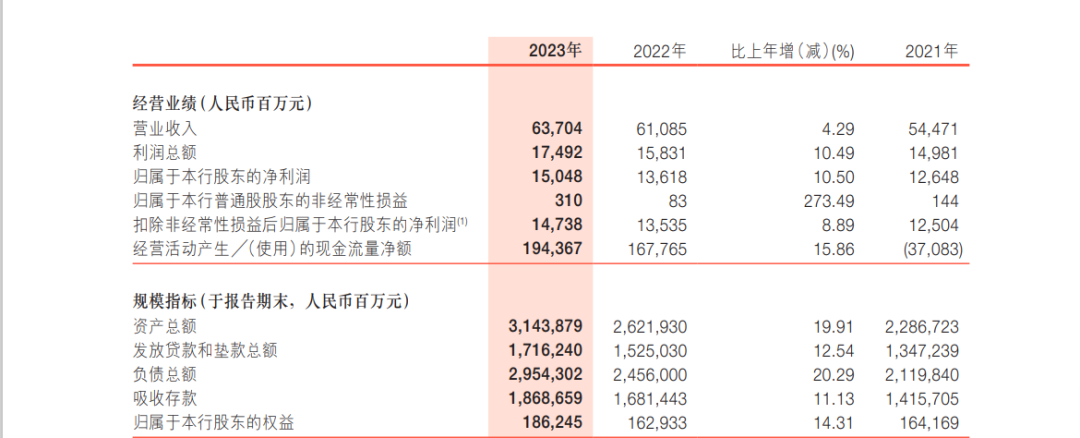
Core Viewpoint - In 2023, China's banking sector faced pressure from narrowing net interest margins, with Zhejiang Commercial Bank maintaining a net interest margin of 2.01%, which is commendable in the current environment [1][2]. However, the bank's aggressive expansion strategy in previous years has led to significant asset quality concerns, particularly in the real estate sector, which poses risks to its future growth [1][10]. Financial Performance - Zhejiang Commercial Bank reported a revenue of 63.704 billion RMB in 2023, a year-on-year increase of 4.29%, and a net profit attributable to shareholders of 15.048 billion RMB, up 10.5% [2][3]. The bank's net interest income was 47.528 billion RMB, growing by 0.99%, while non-interest income rose by 15.35% to 16.176 billion RMB, indicating a strong contribution from non-interest sources [2][3]. Asset Quality and Risks - As of the end of 2023, the bank's non-performing loan (NPL) amount reached 24.596 billion RMB, an increase of 22.43 billion RMB from the previous year, with an NPL ratio of 1.44% [8][10]. The real estate sector's NPL rate rose to 2.48%, significantly impacting the bank's overall asset quality [10][12]. The bank's exposure to high-risk sectors has raised concerns about its financial stability [13][14]. Capital Adequacy - The core Tier 1 capital adequacy ratio of Zhejiang Commercial Bank was reported at 8.22%, which is above the regulatory minimum of 7.5% but reflects ongoing pressure on capital adequacy [6][7]. The bank's total assets reached 3.143879 trillion RMB, with total liabilities of 2.954302 trillion RMB, indicating substantial growth in its balance sheet [6][7]. Internal Control and Compliance Issues - The bank has faced numerous regulatory penalties, with over 280 million RMB in fines in 2023 alone, highlighting significant compliance issues [16][19]. High levels of customer complaints and frequent changes in senior management have raised questions about the bank's internal control mechanisms [15][19]. The bank's management instability, with 14 executives leaving since January 2021, has further complicated its operational challenges [19][20].
殷剑峰:一揽子金融政策满足适当宽松要求,商业银行应推再贷款有效落地
Zhong Guo Xin Wen Wang· 2025-05-30 12:40
Group 1 - The core viewpoint is that recent financial policies aim to enhance liquidity, support technology innovation enterprises, activate capital markets, boost the real estate market, and ensure people's livelihoods, aligning with the central economic work conference's requirements for a more proactive fiscal policy and moderately loose monetary policy [1][2] - The newly introduced structural tools, including an increase of 1.1 trillion yuan in relending quotas, are seen as strong measures to support the real economy, but their effectiveness relies on the cooperation of commercial banks [2][3] - The focus of policies is shifting from merely providing funds to establishing a risk-sharing mechanism involving the central bank, fiscal authorities, and the market, aiming to create a comprehensive support system for technology innovation [2] Group 2 - The financial service committee has initiated a three-month campaign to ensure the implementation of the new financial policies, focusing on areas such as promoting common prosperity, alleviating difficulties for private enterprises, optimizing the business environment, and stabilizing the real estate and stock markets [2][3] - Experts indicate that the response from commercial banks and financial professionals is crucial in releasing strong signals for stabilizing the economy and market expectations, contributing to the financial supply-side reform [3]

浙商银行推出20条举措落实一揽子政策,重点领域信贷投放目标披露
2 1 Shi Ji Jing Ji Bao Dao· 2025-05-30 11:50
Core Viewpoint - The People's Bank of China, along with other financial regulatory bodies, has launched a comprehensive financial policy package aimed at stabilizing the market and expectations, with a focus on enhancing consumption, supporting foreign trade enterprises, and promoting technological innovation [1][2]. Group 1: Policy Implementation - Multiple local financial regulatory departments are convening meetings to ensure the effective implementation of the new financial policies [2]. - The Zhejiang branch of the Bank of China plans to introduce 20 measures across eight areas to implement the financial policy, focusing on technology, foreign trade, and consumption [2]. Group 2: Financial Targets - The Zhejiang branch aims for a net increase of 10 billion yuan in technology finance loans by 2025, with a total of 17 billion USD in cross-border financing for private enterprises, 10 billion yuan in personal credit consumption loans, and 160 billion yuan for small and micro enterprises [2][4][6]. Group 3: Support for Technological Innovation - The Zhejiang branch has launched the "Shan Ke Accompanying Plan" to enhance its technology finance service system, aiming for a net increase of 10 billion yuan in technology finance loans by 2025 [3]. - As of the end of 2024, the bank served 30,712 technology enterprises with a financing balance of 367.4 billion yuan [3]. Group 4: Foreign Trade Support - The bank has introduced special support policies for foreign trade, including flexible repayment arrangements and financial advisory services to alleviate the financial pressures on foreign trade enterprises [4]. - The goal is to achieve a total of 17 billion USD in cross-border financing for private enterprises by 2025 [4]. Group 5: Consumer Loan Initiatives - The bank plans to issue over 10 billion yuan in personal consumption loans this year, with additional subsidies for consumer incentives [6]. - A consumption loan doubling plan will target new citizens and college graduates, with increased loan limits and extended terms [6]. Group 6: Support for Small and Micro Enterprises - The bank will implement a no-repayment renewal policy for small and micro enterprises, aiming for a cumulative credit amount of 180 billion yuan and a cumulative loan amount of 160 billion yuan by the end of 2025 [7].
@2026届毕业生 银行喊你暑期实习啦
Jin Rong Shi Bao· 2025-05-30 08:40
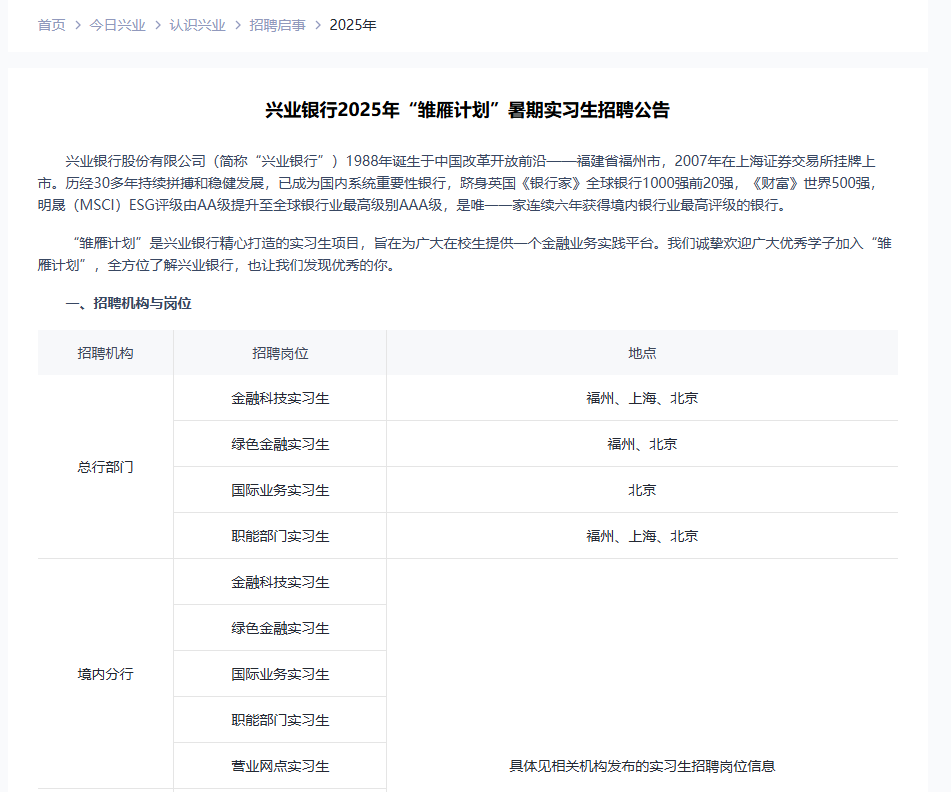
Group 1 - The core viewpoint of the articles highlights the competitive recruitment landscape among banks for summer interns, particularly targeting the 2026 graduating class [1][4] - Several banks, including China Merchants Bank and Industrial Bank, have initiated summer internship programs to attract talented master's students across various departments such as retail finance, corporate finance, investment banking, and financial markets [1][4] - The recruitment efforts are not limited to commercial banks; wealth management subsidiaries are also participating, with programs like the "Qingping Plan" from Xinyin Wealth Management focusing on digital finance, marketing, and investment trading [4][5] Group 2 - The internship positions offered by Industrial Bank include roles in financial technology, green finance, international business, and functional departments, with locations in major cities like Fuzhou, Shanghai, and Beijing [3][4] - Zhejiang Commercial Bank is also actively recruiting for summer internships, targeting master's degree graduates from domestic and international universities, with positions in business sectors and technology departments [3][4] - Shanghai Bank emphasizes the importance of candidates with a background in information technology, mathematical analysis, and economics, particularly those with a dual expertise in technology and finance [8][10] Group 3 - The trend indicates a growing preference for multi-disciplinary talents among banks, with a focus on candidates from STEM fields and international business backgrounds [4][9] - The report from Ernst & Young notes that banks are optimizing their talent structure during digital transformation, aiming to enhance the reserve of technology and business hybrid talents [9][10] - As of 2024, over 160,000 technology personnel are reported to be employed across 27 listed banks, reflecting a structured talent pipeline moving towards a combination of platform architects, business analysts, and algorithm engineers [10]


贯彻落实一揽子金融政策,浙江金融“及时雨”注入共富新动能
Sou Hu Cai Jing· 2025-05-29 12:35
Core Viewpoint - The recent release of a comprehensive financial policy package by the People's Bank of China and the Financial Regulatory Administration aims to stabilize the market and boost confidence, addressing various aspects such as monetary policy, financial regulation, and capital market openness [1][3]. Group 1: Financial Policy Package - The financial policy package emphasizes not only the continuation of previous measures like interest rate cuts and stabilization of the real estate and stock markets but also focuses on boosting consumption, stabilizing foreign trade, alleviating corporate burdens, and supporting technological innovation [3][5]. - The policy is characterized by its significant strength, rapid implementation, and broad coverage, exceeding market expectations in terms of intensity and pace [3]. Group 2: Financial Advisory System - The Zhejiang Financial Advisory System, launched in 2018, has evolved from a "single-point breakthrough" to a "systematic reconstruction," serving over 100,000 enterprises and facilitating financing exceeding 1 trillion yuan by April 2025 [5]. - The "County Comprehensive Financial Ecosystem Construction 3386 Model" has been replicated in 43 cities across 22 provinces, showcasing its effectiveness [5]. Group 3: Support for Enterprises - The financial advisory committee calls for leveraging the "1+N" mechanism of the financial advisory system to focus on foreign trade enterprises affected by tariffs, private enterprises undergoing transformation, small and micro enterprises, and manufacturing companies [5]. - A comprehensive service package, including special relief loans and cross-border settlement services, will be introduced to assist struggling enterprises [5][6]. - Zhejiang Bank has committed to allocating 10 billion yuan in credit to support distressed foreign trade and private enterprises, contributing to market stability and economic growth [6].