
BANK OF CHINA(601988)

Search documents
中国银行被罚9790万元 治理、贷款、同业、票据、资产质量、不良资产处置等业务管理不审慎
Mei Ri Jing Ji Xin Wen· 2025-10-31 09:33
每经AI快讯,10月31日,国家金融监督管理总局发布行政处罚信息公示列表,其中,对中国银行股份 有限公司罚款9790万元。对陈梓、刘伶俐、张惠娟、何春耕、余荣刚警告并罚款合计30万元。主要违法 违规行为:相关公司治理、贷款、同业、票据、资产质量、不良资产处置等业务管理不审慎。 (文章来源:每日经济新闻) ...


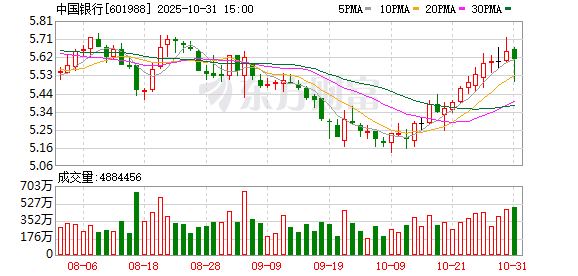
国有大型银行板块10月31日跌1.01%,邮储银行领跌,主力资金净流出1.16亿元
Zheng Xing Xing Ye Ri Bao· 2025-10-31 08:42
Core Insights - The state-owned large bank sector experienced a decline of 1.01% on October 31, with Postal Savings Bank leading the drop [1] - The Shanghai Composite Index closed at 3954.79, down 0.81%, while the Shenzhen Component Index closed at 13378.21, down 1.14% [1] Bank Performance Summary - **Bank of Communications (601328)**: Closed at 7.18, up 1.27%, with a trading volume of 2.2054 million shares and a transaction value of 1.571 billion [1] - **Bank of China (601988)**: Closed at 5.61, down 0.71%, with a trading volume of 4.8845 million shares and a transaction value of 2.717 billion [1] - **Industrial and Commercial Bank of China (601398)**: Closed at 7.78, down 0.77%, with a trading volume of 3.6933 million shares and a transaction value of 2.862 billion [1] - **China Construction Bank (601939)**: Closed at 9.13, down 1.19%, with a trading volume of 1.3 million shares and a transaction value of 1.188 billion [1] - **Agricultural Bank of China (601288)**: Closed at 7.96, down 1.24%, with a trading volume of 3.8286 million shares and a transaction value of 3.036 billion [1] - **Postal Savings Bank (601658)**: Closed at 5.75, down 2.71%, with a trading volume of 2.3636 million shares and a transaction value of 1.361 billion [1] Capital Flow Analysis - The state-owned large bank sector saw a net outflow of 116 million in main funds, while retail funds experienced a net outflow of 8.1972 million [1] - **Bank of Communications**: Main funds net inflow of 224 million, retail funds net outflow of 63.839 million [2] - **Bank of China**: Main funds net outflow of 760.85 thousand, retail funds net outflow of 1.64165 million [2] - **China Construction Bank**: Main funds net outflow of 310.645 thousand, retail funds net inflow of 2.39997 million [2] - **Industrial and Commercial Bank of China**: Main funds net outflow of 519.931 thousand, retail funds net inflow of 1.39323 million [2] - **Postal Savings Bank**: Main funds net outflow of 893.268 thousand, retail funds net outflow of 1.0489 million [2] - **Agricultural Bank of China**: Main funds net outflow of 1.607 million, retail funds net inflow of 4.46154 million [2]




工行、农行、中行、建行、交行、邮储银行公布!
Jin Rong Shi Bao· 2025-10-31 08:16
Core Insights - The six major state-owned banks in China reported growth in both operating income and net profit for the first three quarters of 2025, with total assets also showing steady growth [1][2][3] Group 1: Bank Performance - Industrial and Commercial Bank of China (ICBC) achieved operating income of 640.03 billion yuan, a year-on-year increase of 2.17%, and net profit of 269.91 billion yuan, up 0.33% [1] - Agricultural Bank of China (ABC) reported operating income of 550.88 billion yuan, a 1.97% increase, and net profit of 220.86 billion yuan, growing by 3.03% [1] - Bank of China (BOC) recorded operating income of 491.20 billion yuan, a 2.69% increase, and net profit of 177.66 billion yuan, up 1.08% [2] - China Construction Bank (CCB) posted operating income of 573.70 billion yuan, a 0.82% increase, and net profit of 257.36 billion yuan, growing by 0.62% [2] - Bank of Communications (BCOM) achieved operating income of 199.64 billion yuan, a 1.80% increase, and net profit of 69.99 billion yuan, up 1.90% [2] - Postal Savings Bank of China (PSBC) reported operating income of 265.08 billion yuan, a 1.82% increase, and net profit of 76.56 billion yuan, growing by 0.98% [3] Group 2: Asset and Loan Quality - ICBC's total assets reached 52.81 trillion yuan, an increase of 399.17 billion yuan or 8.18%, with a non-performing loan (NPL) ratio of 1.33%, down 0.01 percentage points [1] - ABC's total assets were 48.14 trillion yuan, up 489.73 billion yuan or 11.33%, with an NPL ratio of 1.27%, down 0.03 percentage points [1] - BOC's total assets amounted to 37.55 trillion yuan, increasing by 248.89 billion yuan or 7.10%, with an NPL ratio of 1.24%, down 0.01 percentage points [2] - CCB's total assets reached 45.37 trillion yuan, up 479.79 billion yuan or 11.83%, with an NPL ratio of 1.32%, down 0.02 percentage points [2] - BCOM's total assets were 15.50 trillion yuan, increasing by 59.91 billion yuan or 4.02%, with an NPL ratio of 1.26%, down 0.05 percentage points [2] - PSBC's total assets reached 18.61 trillion yuan, up 152.07 billion yuan or 8.90%, with an NPL ratio of 0.94%, up 0.04 percentage points [3] Group 3: Provision Coverage - ICBC's provision coverage ratio stood at 217.21%, an increase of 2.30 percentage points [1] - ABC's provision coverage ratio was 295.08%, down 4.53 percentage points [1] - BOC's provision coverage ratio was 196.60%, down 4.00 percentage points [2] - CCB's provision coverage ratio was 235.05%, up 1.45 percentage points [2] - BCOM's provision coverage ratio was 209.97%, an increase of 8.03 percentage points [2] - PSBC's provision coverage ratio was 240.21%, down 45.94 percentage points [3]

外资眼中的投资机遇 陆家嘴金融沙龙第33期顶级投资人对话精彩落幕
财联社· 2025-10-31 06:50
Core Viewpoint - The article discusses the significant investment opportunities in China as highlighted by the "14th Five-Year Plan," emphasizing the strategic focus on technology, consumption, green initiatives, and security as key investment themes for global capital [3][14]. Group 1: Investment Opportunities - The "14th Five-Year Plan" is seen as a guiding framework for China's development over the next five years, attracting global capital interest [14]. - Experts agree that the shift from "going out" to becoming "global enterprises" represents a major investment opportunity, with Chinese companies achieving world-leading capabilities in industrial and technological sectors [14]. - The demand for risk asset allocation has notably increased, as evidenced by the rapid growth of multi-asset allocation strategies [9]. Group 2: Market Dynamics - The relationship between Hong Kong and A-share markets is characterized by a complementary and mutually beneficial development pattern, with Hong Kong's ECM financing reaching $76 billion since 2025, making it the largest globally [12]. - The current bull market is transitioning from being liquidity-driven to being supported by institutional reforms and fundamental improvements [12]. - The "capital bridge" strategy is emphasized, showcasing the role of foreign institutions in facilitating cross-border investments and enhancing market connectivity [9][10]. Group 3: Strategic Insights - The decline of "American exceptionalism" is prompting global capital to focus on China, with concerns about U.S. fiscal deficits and regulatory uncertainties [6]. - The strategic partnership between foreign and Chinese financial institutions is crucial for promoting the development of capital markets and enhancing financial infrastructure connectivity [10]. - A clear and sustainable planning approach is highlighted as a unique advantage for both enterprises and governments, reinforcing the attractiveness of the Chinese market [15]. Group 4: Recommendations for Investors - Experts recommend a long-term investment philosophy to navigate market volatility, advocating for diversified strategies to mitigate risks [16]. - The low percentage of stock allocation among Chinese households (11%) indicates significant potential for growth in equity investments [16]. - The emphasis on consumer spending and the creation of new consumption scenarios is seen as a key driver for economic growth under the "14th Five-Year Plan" [15].


金价波动银行出新招:积存金起点金额启动“浮动”机制
Zhong Guo Jing Ying Bao· 2025-10-31 05:08
Core Viewpoint - The recent volatility in gold prices has led banks to increase the investment threshold for gold accumulation services, with some institutions adjusting the minimum investment amount to fluctuate with gold prices, enhancing market responsiveness and risk management [1][2][8]. Group 1: Market Adjustments - Banks like the Bank of Communications and Agricultural Bank of China are shifting their gold accumulation plans to a model where the minimum investment amount is tied to real-time gold prices, requiring that the investment amount be greater than or equal to the current gold price [2][3]. - The new model allows for dynamic adjustments to the investment threshold, addressing the lag in pricing that occurs with traditional fixed-amount models [4][5]. Group 2: Characteristics of the New Model - The "floating with gold prices" model is characterized by three main features: dynamism, flexibility, and risk diversification, allowing for real-time adjustments to the investment threshold based on market fluctuations [4][5]. - The model also maintains a flexible trading unit, accommodating both small investors and risk management, which helps reduce operational complexity and liquidity management pressures for banks [4][5]. Group 3: Future Market Environment - The gold accumulation business is expected to face a more complex market environment, with increased volatility driven by international political situations, economic data, and dollar movements [8][9]. - Investor demand is anticipated to become more differentiated, with a growing emphasis on the long-term value of gold as a hedge against inflation, while short-term speculative behaviors may lead to losses due to price fluctuations [8][9]. Group 4: Regulatory and Competitive Landscape - Regulatory bodies and banks are focusing on risk prevention, with dynamic adjustments to investment thresholds and improved redemption rules to protect investor interests [9]. - Increased competition may drive product innovation, with some banks exploring mechanisms to enhance attractiveness, potentially integrating digital tools to improve transaction efficiency and transparency [9].


六大行前三季度赚了多少钱?
第一财经· 2025-10-31 04:11
Core Viewpoint - The six major state-owned banks in China reported positive year-on-year growth in both operating income and net profit for the first three quarters of 2025, despite a decline in net interest margins [3][4]. Financial Performance - The six major banks achieved approximately 2.73 trillion yuan in operating income, a year-on-year increase of 1.87%, and a net profit attributable to shareholders of about 1.72 trillion yuan, up 1.22% year-on-year [3][4]. - Among these banks, Bank of China and Industrial and Commercial Bank of China led in revenue growth rates at 2.69% and 2.17%, respectively, while Agricultural Bank of China had a net profit growth rate exceeding 3% at 3.03% [5][6]. - The absolute profit figures for the banks were as follows: Industrial and Commercial Bank earned approximately 269.9 billion yuan, Construction Bank 257.4 billion yuan, and Agricultural Bank 220.9 billion yuan [6]. Net Interest Margin and Income Structure - Net interest income continued to decline, with only the Transportation Bank showing a year-on-year increase of 1.46% in net interest income; the other five banks experienced varying degrees of decline, with Construction Bank and Bank of China seeing declines exceeding 3% [6][7]. - The net interest margin for the banks showed a downward trend, with the decline in margin narrowing significantly compared to the first half of the year [6][7]. Asset Quality and Growth - As of the end of the third quarter, total assets of the six banks approached 218 trillion yuan, reflecting a growth of approximately 1.85% since mid-year [3][8]. - The total loan amount exceeded 127 trillion yuan, with a growth of around 9 trillion yuan compared to the end of the previous year, and the fastest loan growth was seen in Bank of China, Postal Savings Bank, and Agricultural Bank, all exceeding 8% [8][9]. - Asset quality showed an overall improvement, with five banks reporting a decrease in non-performing loan ratios compared to the end of the previous year, while Postal Savings Bank saw a slight increase [9][10]. Market Capitalization - As of October 30, Agricultural Bank led in total market capitalization at 2.74 trillion yuan, followed by Industrial and Commercial Bank at 2.59 trillion yuan [10].

中国银行三季度业绩稳中向好 多维发力赋能实体经济
Zhong Guo Xin Wen Wang· 2025-10-31 03:44
Core Viewpoint - The financial reports of state-owned banks for the third quarter of 2025 indicate a steady improvement in key financial indicators and asset quality, laying a solid foundation for better service to the real economy [1] Financial Performance - Bank of China reported a revenue of 492.1 billion yuan for the first three quarters, a year-on-year increase of 2.72%, while net profit reached 189.6 billion yuan, reflecting a growth of 1.12% [3][4] - In Q3 alone, Bank of China achieved a revenue of 162.2 billion yuan, up 0.58% year-on-year, with a net profit of 60.1 billion yuan, marking a significant increase of 5.09% [4] - The net interest margin for the first three quarters was 1.26%, remaining stable compared to the first half of the year [4] Asset Quality - The overall asset quality of Bank of China remained stable, with a non-performing loan ratio of 1.24%, a slight decrease of 0.01 percentage points from the beginning of the year, and a provision coverage ratio of 196.60% [4] Support for Real Economy - Bank of China has increased financial resource allocation to key sectors, with domestic RMB loans rising by 1.67 trillion yuan, a growth of 9.15% year-to-date [6] - Loans to the manufacturing sector reached 3.34 trillion yuan, up 12.10% from the end of the previous year, while loans to strategic emerging industries grew by 26.29% to 3.12 trillion yuan [6] - Personal consumption loans increased by 26.11%, and the transaction volume of debit card quick payment exceeded 6 trillion yuan [6] Green and Technological Finance - Bank of China has maintained a leading position in green finance, with green loan balances exceeding 4.66 trillion yuan, a year-on-year growth of 20.11% [8] - The bank's technology loans reached approximately 4.7 trillion yuan, supporting over 160,000 clients, and has provided over 830 billion yuan in comprehensive technology financial services [8] Globalization and Cross-Border Services - Bank of China has strengthened its global presence, with international trade settlement business growing steadily and cross-border RMB settlement reaching 13.2 trillion yuan, a year-on-year increase of over 17% [10][11] - The bank's cross-border e-commerce settlement business reached nearly 850 billion yuan, growing by over 47% [11]
研报掘金丨华泰证券:微升中国银行AH股目标价 息差企稳助力利润增长动能修复
Ge Long Hui A P P· 2025-10-31 03:30
Core Viewpoint - Huatai Securities reported that Bank of China (BOC) experienced a year-on-year increase in net profit attributable to shareholders by 1.1% and revenue by 2.7% for the first nine months, while pre-provision operating profit decreased by 0.2% [1] Financial Performance - For the first nine months, annualized ROA and ROE decreased by 0.06 percentage points and 0.57 percentage points to 0.7% and 8.98% respectively [1] - Credit growth remained stable, with a marginal stabilization in interest margins, and the decline in net interest income narrowed, although non-interest income showed some volatility [1] - The marginal improvement in profit growth was primarily due to a slight improvement in the effective tax rate [1] Future Projections - The bank forecasts net profit attributable to shareholders for 2025, 2026, and 2027 to be CNY 241.3 billion, CNY 246.7 billion, and CNY 252.9 billion respectively, with year-on-year growth rates of 1.5%, 2.2%, and 2.5% [1] Valuation and Target Price - BOC's internationalization and comprehensive characteristics are expected to command a certain valuation premium, but recent fluctuations in overseas bank credit risks may impact market sentiment [1] - The target price for H-shares has been adjusted from HKD 5.84 to HKD 5.86, with a rating of "Buy"; the target price for A-shares has been adjusted from CNY 6.68 to CNY 6.70, with a rating of "Accumulate" [1]

六大行前三季度赚了多少钱?营收净利增速全面回正,息差压力仍在
Di Yi Cai Jing· 2025-10-31 03:13
Core Insights - The six major state-owned banks in China reported a year-on-year increase in both operating income and net profit for the first three quarters of 2025, with operating income reaching approximately 2.73 trillion yuan and net profit around 1.72 trillion yuan, reflecting growth rates of 1.87% and 1.22% respectively [1][2] Financial Performance - All six banks achieved positive year-on-year growth in revenue and net profit, with Bank of China and Industrial and Commercial Bank of China leading in revenue growth rates of 2.69% and 2.17% respectively [2] - Agricultural Bank of China reported a net profit growth rate exceeding 3%, specifically at 3.03%, while other banks like Bank of Communications and Bank of China also showed net profit growth above 1% [2] - The absolute profit figures for the banks were significant, with Industrial and Commercial Bank of China earning approximately 269.9 billion yuan, followed by China Construction Bank at 257.4 billion yuan and Agricultural Bank of China at 220.9 billion yuan [2] Net Interest Margin - The net interest margin (NIM) for most banks continued to decline, with only Bank of Communications showing a year-on-year increase in net interest income of 1.46% [3] - The decline in NIM was less severe compared to the first half of the year, with quarterly declines ranging from 0.01 to 0.04 percentage points [3] Asset Quality and Growth - By the end of the third quarter, total assets of the six banks approached 218 trillion yuan, marking a growth of approximately 1.85% since mid-year [1][4] - The total loan amount exceeded 127 trillion yuan, with a growth of around 9 trillion yuan compared to the end of the previous year, particularly driven by Bank of China, Postal Savings Bank, and Agricultural Bank of China, all showing growth rates above 8% [4] Provision Coverage - The overall asset quality showed improvement, with five banks reporting a decrease in non-performing loan ratios compared to the end of the previous year, while Postal Savings Bank experienced a slight increase [4] - The provision coverage ratio for Agricultural Bank of China remained the highest among the banks, although it decreased from approximately 299.61% to 295.08% [5] Market Capitalization - As of October 30, Agricultural Bank of China led in market capitalization at approximately 2.74 trillion yuan, followed by Industrial and Commercial Bank of China at about 2.59 trillion yuan [5] - Agricultural Bank of China was noted as the only major state-owned bank with a price-to-book (PB) ratio recovering to above 1 [5]
中行上海市分行“惠”聚八方,全力支持进博会贸易投资对接会
Xin Lang Cai Jing· 2025-10-31 03:08
Core Insights - The China International Import Expo (CIIE) Trade and Investment Matchmaking Conference has been co-hosted by the Bank of China, the China International Import Expo Bureau, and the National Exhibition and Convention Center (Shanghai) since 2018, aiming to promote global enterprises to share in China's high-quality opening-up opportunities and vast market [1] - The upcoming eighth CIIE Trade and Investment Matchmaking Conference is expected to attract nearly 1,000 overseas exhibitors and around 3,000 domestic purchasers, providing a platform for efficient negotiations and precise matching of supply and demand [2] Group 1 - The conference has cumulatively recruited over 31,000 enterprises and facilitated approximately 5,300 cooperation intentions with a total intended amount exceeding $50 billion [1] - The Bank of China Shanghai Branch will innovate in matchmaking, trade negotiations, and government-enterprise exchanges to enhance global economic cooperation [1][2] - A "Hui Chat" trade negotiation area will be set up to facilitate one-on-one and multi-round negotiations among global enterprises [1] Group 2 - The Bank of China Shanghai Branch will provide comprehensive financial services, including inclusive finance, mobile banking, and digital RMB, to support trade negotiation outcomes [2] - The "Hui Living Room" investment promotion area will host nearly 100 specialized activities to foster cooperation between Chinese and foreign enterprises across various chains [3] - The conference will continue to establish an "Invest in China" area to showcase China's favorable business environment and attract foreign investment [3] Group 3 - An industry-focused exhibition group will be formed to enhance the efficiency of matching exhibitors and purchasers through direct communication and immersive experiences [4] - The conference will innovate by creating exhibition groups focused on future industries and finance, covering advanced equipment, medical devices, new materials, and biotechnology [4] - The Bank of China Shanghai Branch aims to leverage its cross-border service expertise to promote innovation and optimize on-site services for high-level opening-up [4]