
CNCB(601998)

Search documents
第二届中信财富管理大会召开 共探财富管理行业转型路径与全球配置新机遇
Zhong Zheng Wang· 2025-10-17 07:41
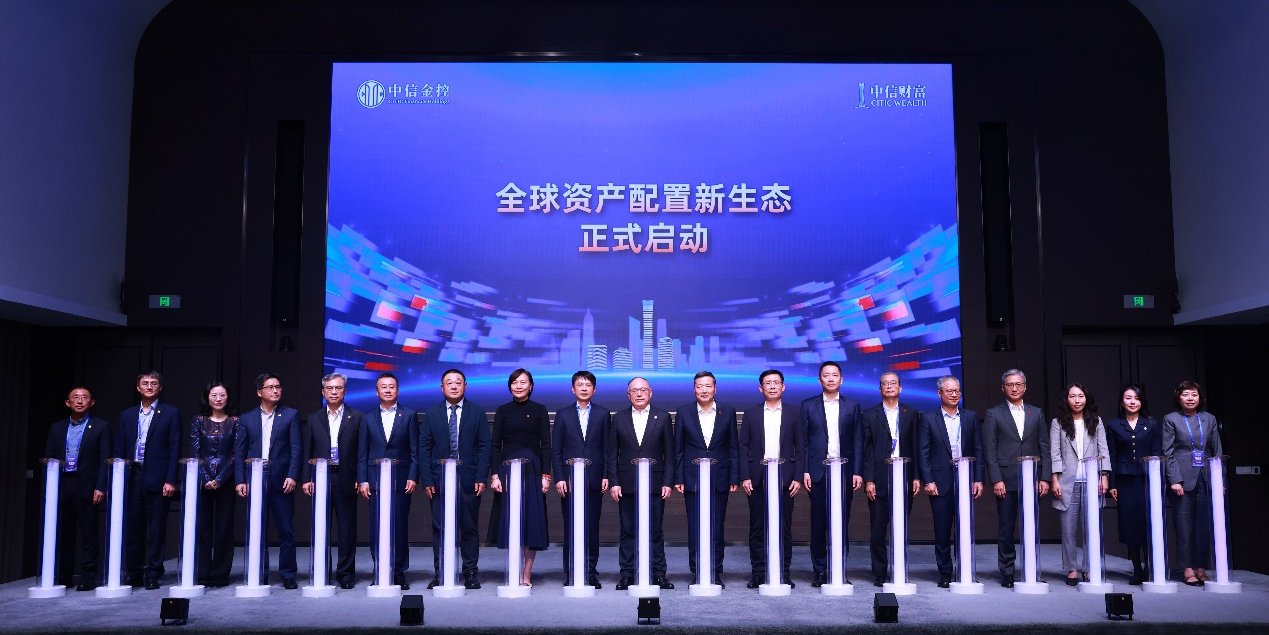
Group 1 - The second CITIC Wealth Management Conference was held in Beijing, focusing on the theme "Integration and Development: Co-creating New Value in Wealth Management" [1] - The conference attracted over 200 participants from 42 leading institutions, including public funds, wealth management, insurance, and global asset management [1] - CITIC Group's leadership emphasized the historical opportunities in the wealth management industry due to the deepening transformation of the asset management sector and the increasing demand for wealth preservation and appreciation among residents [1] Group 2 - CITIC Financial Holdings aims to align with national strategies such as technological innovation, green low-carbon initiatives, and rural revitalization, directing financial resources to key areas of social development [2] - The investment strategies of asset management institutions are evolving from single asset focus to "fixed income plus," multi-asset strategies, and overseas allocations [2] - A collaborative ecosystem among public funds, securities asset management, insurance asset management, trusts, and wealth management institutions is accelerating [2]



多家银行上调代销基金风险评级
Zhong Guo Jing Ying Bao· 2025-10-17 07:13
Core Viewpoint - Recent adjustments in risk ratings for fund distribution by banks are closely related to market changes, with increased asset risk and a shift from static to dynamic risk management practices [1][2][3] Group 1: Risk Rating Adjustments - Multiple banks, including CITIC Bank, have raised the risk ratings of 15 out of 17 asset management products, indicating a trend towards higher risk assessments in response to market conditions [2][5] - The adjustments are part of a broader regulatory requirement for banks to independently conduct risk ratings and ensure consistency with fund managers' ratings [3][4] - The adjustments reflect a need to align risk ratings with the actual risk profiles of funds, particularly for equity and pension-themed funds, which have shown structural changes in risk characteristics [6][7] Group 2: Regulatory and Market Influences - The implementation of the "Commercial Bank Agency Sales Business Management Measures" starting October 1, 2025, mandates banks to independently assess risk ratings, influencing recent adjustments [3][4] - Data analysis revealed a mismatch between clients' risk profiles and the actual risk levels of funds they held, prompting banks to raise ratings to mitigate overexposure to risk [3][6] - Market volatility, particularly in the A-share market, has led to increased risk for equity funds, necessitating adjustments in their risk ratings [6][7] Group 3: Investor Risk Assessment Changes - Some banks, like Jiangnan Rural Commercial Bank, have revised their investor risk assessment rules to enhance consumer protection and ensure appropriate risk evaluations [4] - The new rules limit the frequency of risk assessments and establish a one-year validity period for assessment results, emphasizing the importance of timely evaluations in light of changing financial circumstances [4] - The overall trend indicates that banks are striving to improve their suitability management practices to better protect investors' interests [4][5]

中国成为全球第二大财富管理市场
2 1 Shi Ji Jing Ji Bao Dao· 2025-10-17 06:39
Core Insights - The Chinese wealth management market is experiencing a historic opportunity driven by economic development and wealth accumulation [2][4] - The demand for wealth management is entering a high-growth phase as the middle-income group expands and total investable assets exceed 300 trillion yuan [4][5] - The second "CITIC Wealth Management Conference" highlighted the importance of wealth management institutions in bridging the gap between the real economy and residents' wealth [2][4] Industry Scale and Growth - The asset management scale in China surpassed 170 trillion yuan as of June 2025, making it the second-largest wealth management market globally [4][8] - CITIC Group has adopted a differentiated approach in wealth management, leveraging its comprehensive financial licenses and multi-field collaboration [4][5] - CITIC's subsidiaries have impressive core data, with CITIC Bank's personal wealth management scale nearing 5 trillion yuan and CITIC Securities' asset management scale reaching 1.56 trillion yuan [5] Cross-Border Investment Trends - Cross-border investment has shifted from an optional choice to a necessity for wealth management, with significant participation in cross-border financial products [7][8] - As of July 2025, the "Cross-Border Wealth Management Connect" attracted 164,600 individual investors, with cross-border remittance amounts exceeding 120 billion yuan [7] - Institutions are actively building service systems to meet the growing demand for cross-border investment, with CITIC focusing on "interconnectivity" to link domestic and international markets [7] Future Outlook - The collaboration among different asset management institutions is evolving, driven by the increasing scale of the asset management market and the rising investable assets [8] - The next phase of growth in the wealth management industry will be fueled by cross-institutional collaboration, technological integration, and cross-border expansion [8]


聚合42家头部力量!这场财富管理大会破题全球配置与行业协同
Zheng Quan Shi Bao Wang· 2025-10-17 06:37
Core Insights - The second "CITIC Wealth Management Conference" was held in Beijing, focusing on the theme "Integration and Development: Co-creating New Value in Wealth Management" with participation from 42 leading institutions and over 200 attendees [1] - CITIC Group's Vice Chairman Zhang Wenwu highlighted the historical opportunities in the wealth management industry due to the deepening transformation of the asset management sector, the acceleration of long-term patient capital cultivation, the expansion of cross-border capital markets, and disruptive breakthroughs in technology such as artificial intelligence [1] - CITIC Group's subsidiaries, including CITIC Bank, CITIC Securities, and CITIC Trust, are leading in their respective fields, with significant asset management scales [1] Group 1 - CITIC Bank's personal wealth management scale is nearly 50 trillion yuan, while CITIC Securities' asset management scale exceeds 1.56 trillion yuan [1] - CITIC Trust has an asset balance of 2.6 trillion yuan, and Huaxia Fund's asset management scale is over 3 trillion yuan [1] - Xie Zhibin, Vice President of CITIC Bank, emphasized the need for wealth management institutions to focus on customer demand, product supply, and institutional services, leveraging big data and AI technology [3] Group 2 - CITIC Group plans to align with national strategies such as technological innovation and green low-carbon initiatives, directing financial resources to key areas of social development [2] - The conference discussed how wealth management and asset management institutions in China can capture global market opportunities and serve as a bridge between the real economy and residents' wealth [2] - The launch of the "Global Asset Allocation New Ecology" initiative aims to assist individual and corporate investors in seizing investment opportunities globally [2]

中信银行提示黄金价格波动风险 建议客户理性购买积存金和实物金产品
Ge Long Hui· 2025-10-17 03:56
Core Viewpoint - CITIC Bank has issued a risk alert regarding the potential for increased volatility in gold prices due to escalating international political and economic risks [1] Group 1 - Recent international political and economic risks have heightened the likelihood of significant fluctuations in gold prices [1] - CITIC Bank recommends that clients assess their risk tolerance and funding needs to prepare for potential risks [1] - The bank advises a rational approach to gold asset allocation, including the purchase of accumulated gold and physical gold products [1]
中国成为全球第二大财富管理市场,跨境投资成行业新焦点
2 1 Shi Ji Jing Ji Bao Dao· 2025-10-17 03:53
Core Insights - The Chinese wealth management market is experiencing a historic opportunity, with total asset management scale exceeding 170 trillion yuan, making it the second-largest wealth management market globally [1][2] - The growth is driven by the expansion of the middle-income group and the increasing total investable assets of residents, which have surpassed 300 trillion yuan [1][2] - The "CITIC Wealth Management Conference" highlighted the importance of wealth management institutions acting as a bridge between the real economy and residents' wealth [2] Industry Growth - The asset management industry has maintained an average annual growth rate of around 8% over the past five years, with public funds, bank wealth management, trusts, and insurance asset management all contributing to this growth [1] - As of June 2025, CITIC Group's wealth management total scale reached 31 trillion yuan, with asset management scale at 9.8 trillion yuan, serving over 200 million individual and corporate clients [3] Cross-Border Investment - Cross-border investment has shifted from an optional strategy to a necessity for wealth management, with significant participation in cross-border financial products [4] - By July 2025, the "Cross-Border Wealth Management Connect" attracted 164,600 individual investors, with cross-border remittance amounts exceeding 120 billion yuan [4] Collaborative Ecosystem - The wealth management industry is evolving towards a collaborative ecosystem among various asset management institutions, driven by the need for complementary cooperation and technological integration [6] - Institutions are focusing on providing comprehensive, platform-based, and global asset management services, emphasizing the importance of research services, investment delegation, and customer service [5][6]
中信携手42家资产管理机构,共建财富管理新生态
Jing Ji Guan Cha Wang· 2025-10-17 03:03
Core Insights - The conference "Integration and Development: Co-creating New Value in Wealth Management" was held in Beijing, focusing on global asset allocation and social responsibility initiatives [2][4] - CITIC Group's wealth management scale is approximately 31 trillion yuan, with asset management reaching 9.3 trillion yuan, serving over 200 million individual and corporate clients [4][6] - The Chinese asset management market has surpassed 170 trillion yuan, becoming the second-largest globally, with an average annual growth rate of 8% over the past five years [6] Group 1 - The conference was attended by over 200 representatives from leading asset management institutions, emphasizing collaboration in global asset allocation [2] - CITIC Group aims to enhance professional capabilities and expand global perspectives in wealth management through partnerships with top asset management firms [4] - The "Xincheng Growth" charity platform was launched, with a goal to donate over 10 million yuan by 2025, reflecting CITIC's commitment to social responsibility [2] Group 2 - Wealth management institutions are shifting from single asset allocation to diversified strategies, leveraging big data and AI technologies [5] - Investment opportunities are emerging in sectors such as green economy, healthcare, and domestic substitution, indicating a healthy ecosystem for Chinese stocks and bonds [5] - As of June 2025, CITIC Bank's personal wealth management scale is nearly 5 trillion yuan, ranking second among peers, while CITIC Securities leads the brokerage industry with a market share of 12.8% [6]
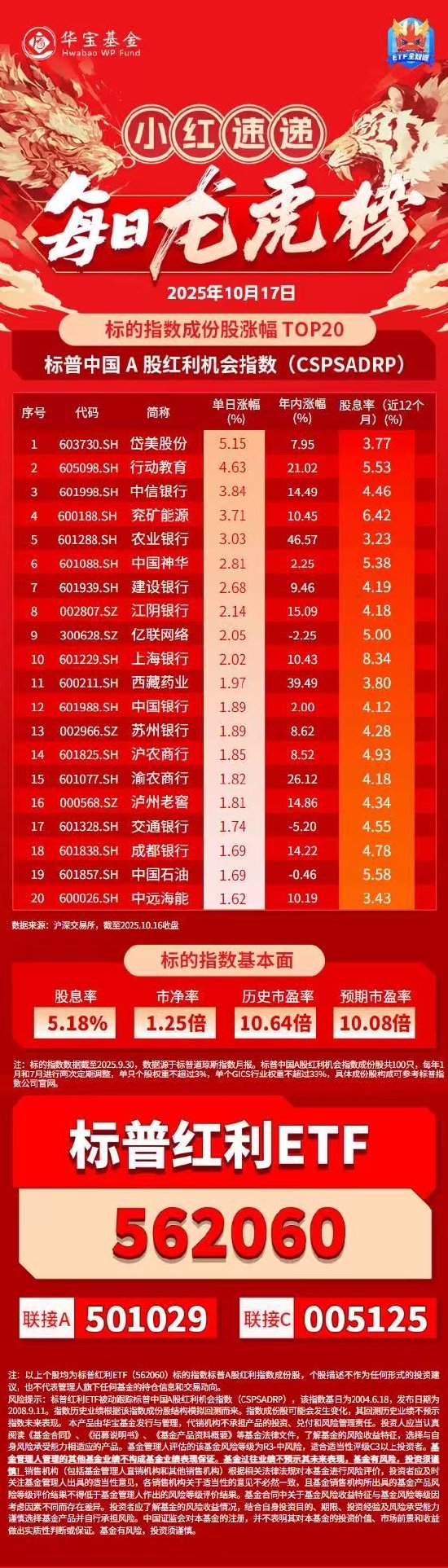
小红日报|标普红利ETF(562060)标的指数微跌0.12%,银行股集体走强
Xin Lang Ji Jin· 2025-10-17 01:27
Core Insights - The article highlights the top-performing stocks in the S&P China A-Share Dividend Opportunity Index, showcasing significant price increases and dividend yields for various companies [1]. Group 1: Stock Performance - The top stock, Dai Mei Co., Ltd. (603730.SH), experienced a daily increase of 5.15% and a year-to-date increase of 7.95%, with a dividend yield of 3.77% [1]. - Action Education (605098.SH) saw a daily rise of 4.63% and a remarkable year-to-date increase of 21.02%, with a dividend yield of 5.53% [1]. - CITIC Bank (H5'866T09) reported a daily increase of 3.84% and a year-to-date increase of 14.49%, with a dividend yield of 4.46% [1]. Group 2: Dividend Yields - Yanzhou Coal Mining Company (600188.SH) had a daily increase of 3.71% and a year-to-date increase of 10.45%, with a dividend yield of 6.42% [1]. - Agricultural Bank of China (601288.SH) showed a daily increase of 3.03% and an impressive year-to-date increase of 46.57%, with a dividend yield of 3.23% [1]. - China Shenhua Energy (601088.SH) recorded a daily increase of 2.81% and a year-to-date increase of 2.25%, with a dividend yield of 5.38% [1].




中信携手42家资产管理机构 共建财富管理新生态
Zheng Quan Ri Bao Zhi Sheng· 2025-10-17 00:57
Core Insights - The conference "Integration and Development: Co-creating New Value in Wealth Management" was held in Beijing, focusing on global asset allocation and social responsibility in wealth management [1] - CITIC Group's wealth management total scale is approximately 31 trillion yuan, with asset management reaching 9.3 trillion yuan, serving over 200 million individual and corporate clients [2] - The asset management market in China has surpassed 170 trillion yuan, making it the second-largest wealth management market globally, with an annual growth rate of 8% over the past five years [3] Group 1 - The conference was attended by over 200 representatives from leading asset management institutions, emphasizing the importance of wealth management in serving the real economy and promoting common prosperity [1][2] - CITIC Group aims to enhance professional capabilities and expand global perspectives in wealth management by collaborating with leading asset management institutions [2] - The investment strategies of asset management institutions are evolving towards multi-asset and overseas allocations, reflecting a shift in market opportunities [3] Group 2 - As of June 2025, CITIC Bank's personal wealth management scale is nearly 5 trillion yuan, ranking second among peers, while CITIC Securities' asset management scale exceeds 1.56 trillion yuan, holding a market share of 12.8% [4] - The collaboration among various asset management institutions is evolving, creating a complementary ecosystem that enhances service offerings [3][4] - CITIC Financial Holdings and its subsidiaries are positioned to seize historical opportunities in the transformation and upgrading of the wealth management industry [4]
中信银行郑州分行开展金融知识宣教校园行活动
Huan Qiu Wang· 2025-10-16 08:49
Core Viewpoint - The article highlights the efforts of CITIC Bank's Zhengzhou branch in promoting financial literacy among youth through educational activities in schools, aiming to enhance their understanding of financial rights and risk prevention [1] Group 1: Financial Education Initiatives - CITIC Bank's Zhengzhou branch volunteers conducted financial knowledge education activities at Changyuan No.1 High School and a primary school in Luoyang [1] - Volunteers acted as "financial lecturers," using engaging presentations and relatable case studies to teach students about rational consumption, avoiding illegal campus loans, and preventing fraud [1] Group 2: Targeted Educational Content - In the high school, the focus was on instilling correct consumption concepts, particularly in popular areas like online shopping and celebrity-related spending, emphasizing the importance of budgeting and responsible spending [1] - At the primary school, volunteers introduced first-grade students to the knowledge of Renminbi, using physical currency to help them recognize different denominations and their features [1] Group 3: Broader Financial Literacy Campaign - The financial knowledge education initiative is part of CITIC Bank's broader campaign to promote financial literacy across various communities, including schools, enterprises, and rural areas [1] - The bank aims to innovate its promotional methods continuously to enhance financial knowledge and contribute to a stable financial order [1]