
CNCB(601998)

Search documents
寓教于乐学反假 童心同行勇反诈
Zhong Guo Jin Rong Xin Xi Wang· 2025-07-25 07:33
Core Viewpoint - The event organized by Citic Bank's Zunyi Xinpu branch aims to enhance financial safety awareness among children aged 8-12, focusing on recognizing anti-counterfeiting features of the Renminbi and preventing telecom fraud [1][5]. Group 1: Event Overview - Citic Bank conducted an interactive educational activity in the Xinpu Street community children's home, utilizing a "lecture + interaction + practice" format to teach basic financial safety skills [1]. - The event included a "real money treasure hunt" game, where children learned to identify seven anti-counterfeiting features of the 2015 version of Renminbi banknotes [1][2]. Group 2: Educational Methods - An innovative teaching method called "one look, two touches, three comparisons" was employed to engage children in learning about the anti-counterfeiting features of the Renminbi [1]. - A "little teacher classroom" segment was included, allowing children to explain anti-counterfeiting features, reinforcing their learning through peer teaching [1]. Group 3: Fraud Awareness - The bank addressed common scams targeting elementary school students, such as the phone watch scam and game recharge traps, using real-life examples to educate children [1][5]. - Children were taught the "three no" principles: not trusting unknown calls or online information, not disclosing personal information or verification codes, and not transferring money to unverified accounts [1]. Group 4: Engagement and Impact - The event engaged over 30 community children and staff, distributing 40 anti-fraud manuals, and fostering a lively atmosphere for learning [4]. - The community children's home director praised the event for its professional explanations and engaging methods, indicating a desire for future collaboration with Citic Bank to enhance financial safety education [5].



中信证券资产管理有限公司关于中信证券六个月滚动持有债券型集合资产管理计划延长存续期限并修改资产管理合同、招募说明书的公告
Zhong Guo Zheng Quan Bao - Zhong Zheng Wang· 2025-07-25 00:36
Core Viewpoint - Citic Securities Asset Management Company has decided to extend the duration of its six-month rolling bond collective asset management plan until December 31, 2025, while ensuring the protection of existing investors' interests [1][3]. Summary by Sections Extension of Duration - The duration of the product is extended from July 31, 2025, to December 31, 2025, effective from the date the asset management contract amendment takes effect, which is August 22, 2019 [1][3]. Modifications to Contracts and Prospectus - The modifications to the asset management contract and the prospectus are detailed in an attachment that compares the changes before and after [2][12]. Updates to Product Information - The product manager will update the relevant sections of the product information summary based on the changes mentioned [3][13]. Future Plans for the Product - The company has agreed with Huaxia Fund Management to change the product manager to Huaxia Fund and register it as a public fund. A meeting for the product's investors was organized but could not be held due to insufficient attendance. A new meeting will be scheduled to discuss the management change [4][15]. Other Matters - The announcement focuses solely on the extension of the product's duration. Investors can find detailed information on the company's website regarding the asset management contract and prospectus [5][16].

积极响应!这些银行纷纷“放大招”
Jin Rong Shi Bao· 2025-07-24 10:16
Group 1 - The core viewpoint of the articles emphasizes that consumption has become a key engine for economic growth in China, especially under the new normal of economic development [1] - Multiple commercial banks are actively responding to the government's guidance on boosting consumption by innovating financial products and enhancing service capabilities [1][2] - China Minsheng Bank has introduced a detailed implementation plan to support consumption, focusing on credit support, scene discounts, and green incentives to lower consumer costs and enhance willingness to spend [1] Group 2 - China Bank has launched the "Bank Renewal Consumption Loan," offering loans with a maximum term of 5 years and interest rates as low as 3%, with loan amounts up to 500,000 yuan [2] - China Bank has also invested over 100 million yuan in tourism consumption subsidies, covering various aspects of the cultural and tourism consumption chain [2] - Other banks, such as Everbright Bank, are focusing on new business models like "national subsidies combined with installment discounts" to stimulate consumption [2] Group 3 - The service consumption sector remains a shortfall in China's overall consumption landscape, but recent policies have aimed to inject financial support into this area [2][3] - For instance, China Construction Bank is utilizing consumption and elderly care re-loan policies to support the expansion and upgrading of local elderly care facilities [2] - The China Banking Research Institute anticipates that the growth in consumption in the second half of the year will be driven by policy enhancements and the release of service consumption potential [3]


中信银行大跌2.37%!易方达基金旗下1只基金持有
Sou Hu Cai Jing· 2025-07-24 09:47
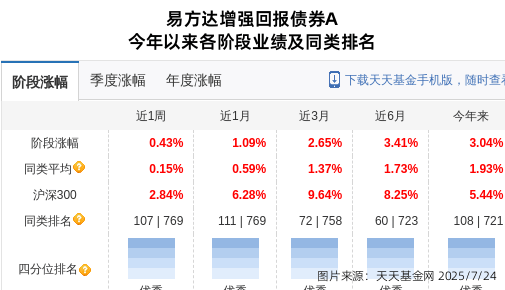
Core Viewpoint - CITIC Bank's stock closed down 2.37% on July 24, 2023, amid changes in its shareholder structure, with E Fund's Enhanced Return Bond A entering the top ten shareholders for the second quarter of this year [1]. Group 1: Company Overview - CITIC Bank was established in 1987 and is headquartered in Beijing, primarily engaged in monetary financial services [1]. - The registered capital of CITIC Bank is approximately 48.93 billion RMB [1]. Group 2: Shareholder Changes - E Fund's Enhanced Return Bond A has newly entered CITIC Bank's top ten shareholders in the second quarter of this year [1]. - The fund has achieved a year-to-date return of 3.04%, ranking 108 out of 721 in its category [1]. Group 3: Fund Performance - The fund's performance over various periods includes a 0.43% increase over the past week, 1.09% over the past month, and 3.04% year-to-date [2]. - The average return for similar funds is lower, with year-to-date performance at 1.93% [2]. Group 4: Fund Manager Profile - The fund manager of E Fund's Enhanced Return Bond A is Wang Xiaocheng, who has extensive experience in fixed income investment [4][5]. - Wang has been managing the fund since August 15, 2011, and has held various positions within E Fund Management Company [4][5].
中信银行广州分行率先落地“南沙金融 30条”金融租赁公司外币直贷业务
Zhong Guo Jin Rong Xin Xi Wang· 2025-07-24 07:56
Group 1 - The core viewpoint of the articles highlights the successful implementation of foreign currency direct lending by CITIC Bank's Guangzhou branch, which aligns with the "Nansha Financial 30 Measures" policy [1][2] - CITIC Bank Guangzhou branch established a dedicated service team to support the ship leasing business of CITIC Financial Leasing in Nansha, providing comprehensive assistance from policy interpretation to foreign exchange account setup [1] - The bank facilitated a direct loan of $8.9 million to the project company, addressing previous challenges such as complex processes and slow fund turnover, thereby enhancing funding efficiency and reducing financing costs [1] Group 2 - CITIC Bank Guangzhou branch aims to leverage the strategic positioning of the Nansha Free Trade Zone as a pilot for financial reform and opening up, focusing on collaborative efforts within CITIC Group and policy application [2] - The bank is committed to building a leading foreign exchange service bank and contributing to the development of the Nansha Free Trade Zone as a demonstration window for financial openness and innovation [2] - The initiative is expected to inject "CITIC strength" into the construction of the Guangdong-Hong Kong-Macao Greater Bay Area [2]
“反内卷”如何影响信贷脉冲?
NORTHEAST SECURITIES· 2025-07-24 06:14
Investment Rating - The report maintains an "Outperform" rating for the banking sector, consistent with the previous rating [6]. Core Insights - The impact of the current "anti-involution" trend on credit is expected to be small overall, but slightly greater than the effects observed during the supply-side reform period from 2015 to 2017 [11][12]. - Credit management is a crucial tool for banks in responding to supply-side reforms, primarily through reducing credit exposure to overcapacity industries and refining client lists to limit loan amounts [12][13]. - The report suggests that the current banking environment is facing a credit slowdown, which may amplify the impact of "anti-involution" on credit growth [13]. Summary by Sections Investment Suggestions - The report recommends focusing on banks such as Xiamen Bank, Chongqing Bank, Yucheng Rural Commercial Bank, Shanghai Bank, and Shanghai Agricultural Bank, as well as major state-owned banks [2][57]. Historical Context and Data Analysis - During the supply-side reform period, the year-on-year growth rates of RMB credit were 14%, 13.5%, and 13.5% from 2015 to 2017, with social financing growth rates of 12.5%, 12.6%, and 14.8% respectively, indicating limited impact on credit pulses [12][13]. - The analysis shows that the impact of supply-side reform on credit was less than 1%, with a more significant effect on joint-stock banks compared to state-owned banks [18][22]. Credit Management and Asset Quality - Credit management during the supply-side reform led to a notable increase in non-performing loan (NPL) ratios in overcapacity industries, with a significant rise in overall NPL ratios for listed banks in the second half of 2016 [13][32]. - The report indicates that the "anti-involution" trend may lead to a similar, albeit slightly larger, impact on credit quality compared to the previous reforms, particularly affecting private enterprises more than state-owned ones [11][45]. Industry Trends and Projections - The report highlights that the proportion of private enterprises in the affected industries has increased compared to the supply-side reform period, suggesting that credit control measures may disproportionately impact these firms [45]. - It notes that the current banking sector is experiencing a degree of asset scarcity, which could further exacerbate the effects of credit management policies [45][46].

债务周期视角下,目前银行资产质量处于什么阶段?
Orient Securities· 2025-07-24 02:15
Investment Rating - The report maintains a "Positive" investment rating for the banking industry [7] Core Insights - The overall non-performing loan (NPL) ratio of listed banks has shown a steady decline since 2021, with a potential hidden NPL ratio of approximately 5 basis points by the end of 2024 [4][10] - Credit costs have been decreasing, leading to a robust provisioning buffer, with the provisioning coverage ratio and loan-to-provision ratio standing at 238% and 2.93% respectively as of Q1 2025 [4][10] - The report emphasizes that the current asset quality pressure on banks is expected to be better than in previous cycles, primarily due to the diversified nature of household loans and supportive regulatory policies [9][10] Summary by Sections Understanding the Relationship Between Economic Debt Cycles and Banking Risk Cycles - The report discusses how the debt of the real economy corresponds to the assets of banks, with credit expansion flowing from banks to the economy and risk exposure arising from debt risks in the economy [9][16] Historical Overview of Excess Capacity and Non-Performing Loans - From 2008 onwards, the banking sector experienced a cycle of rising non-performing loans, particularly in the corporate sector, driven by excess capacity and deteriorating profitability [21][27] - The macro leverage ratio increased significantly during 2009 and 2012-2014, with corporate sectors being the main contributors to this leverage [21][25] Current Debt Cycle and Asset Quality - The report indicates that while household sector risks are still evolving, the asset quality pressure on banks is expected to be more manageable compared to previous cycles [9][10] - The provisioning levels remain robust, with a significant decline in credit costs, indicating a strong safety net for banks [4][10] Investment Recommendations - The report suggests focusing on high-dividend banks in anticipation of a potential reduction in insurance premium rates, recommending banks such as China Construction Bank and Industrial and Commercial Bank of China [10] - It also highlights the strong performance of small and medium-sized banks, suggesting continued interest in banks like Industrial Bank and CITIC Bank based on various factors including valuation and dividend yield [10]




二季度公募基金增持银行股 持仓总市值环比增长约27%
Zheng Quan Ri Bao· 2025-07-23 17:06
Core Viewpoint - The banking sector has seen significant inflows from institutional funds, particularly public funds, in 2023, indicating a positive market sentiment towards bank stocks driven by various factors including policy effects and a focus on underweighted sectors [1][3]. Group 1: Fund Inflows and Holdings - As of the end of Q2 2023, public funds' total market value of holdings in bank stocks reached 205.37 billion yuan, a 27% increase from 161.61 billion yuan in Q1 2023 [2]. - China Merchants Bank remains the top holding among public funds, with 966 funds holding shares worth 75.82 billion yuan; other significant holdings include Industrial Bank, Industrial and Commercial Bank of China, and Jiangsu Bank, each exceeding 10 billion yuan in total market value [2]. - Public funds have notably increased their holdings in several national joint-stock banks, with Minsheng Bank seeing the largest increase of 582 million shares, followed by Industrial Bank and CITIC Bank with increases of 332 million shares and 260 million shares, respectively [2]. Group 2: Market Conditions and Strategies - The increase in public fund holdings in bank stocks is attributed to two main factors: the gradual realization of policy effects leading to asset price stabilization and a renewed focus on underweighted sectors following the release of the "Action Plan for Promoting High-Quality Development of Public Funds" in May [3]. - Active equity funds and passive index funds have both increased their holdings in bank stocks, with active equity funds holding 4.87% of bank stocks by the end of Q2 2023, the highest level since Q2 2021, reflecting a significant increase of 1.12 percentage points from Q1 2023 [3]. Group 3: Performance and Outlook - The banking sector index has risen over 18% year-to-date as of July 23, 2023, with some individual stocks showing even greater gains, indicating strong market support for bank stocks [5]. - Analysts believe that the banking sector's valuation is likely to continue recovering, supported by stable market conditions and improving fundamentals, with a focus on the banks' net interest margins and asset quality [5][6]. - The overall stability of core banking operations is expected to support the sector's fundamentals, with positive signals from interest margin and funding costs anticipated to reflect in the sector's revenue performance [6].


7月23日信用债异常成交跟踪
SINOLINK SECURITIES· 2025-07-23 15:39
1. Report Industry Investment Rating - No relevant content provided 2. Core Viewpoints of the Report - Among bonds with discounted transactions, "20 Huainan Jianfa MTN003" had a relatively large deviation in bond valuation price. Among bonds with rising net - price transactions, "25 Changde Jingjian MTN002" ranked high in terms of valuation price deviation. Among secondary and perpetual bonds with rising net - price transactions, "20 CITIC Bank Secondary" had a relatively large deviation in valuation price; among commercial financial bonds with rising net - price transactions, "22 Industrial Bank 04" ranked high in terms of valuation price deviation. Among individual bonds with a transaction yield higher than 6%, real - estate bonds ranked high. Credit bond valuation yield changes were mainly distributed in the (0,5] interval. Non - financial credit bond transaction terms were mainly distributed between 2 and 3 years, with the 3 - 4 - year - term variety having the highest proportion of discounted transactions; secondary and perpetual bond transaction terms were mainly distributed between 4 and 5 years. By industry, bonds in the communication industry had the largest average valuation price deviation [2]. 3. Summaries According to Relevant Catalogs 3.1 Discounted Transaction Tracking - Bonds such as "20 Huainan Jianfa MTN003" had discounted transactions, with different remaining terms, valuation price deviations, and transaction scales. For example, "20 Huainan Jianfa MTN003" had a remaining term of 0.28 years, a valuation price deviation of - 0.59%, and a transaction scale of 8,053 yuan [4]. 3.2 Tracking of Bonds with Rising Net - Price Transactions - Bonds like "25 Changde Jingjian MTN002" had rising net - price transactions, with different remaining terms, valuation price deviations, and transaction scales. For instance, "25 Changde Jingjian MTN002" had a remaining term of 4.96 years, a valuation price deviation of 0.16%, and a transaction scale of 5,000 yuan [5]. 3.3 Tracking of Secondary and Perpetual Bond Transactions - Secondary and perpetual bonds such as "20 CITIC Bank Secondary" were tracked. "20 CITIC Bank Secondary" had a remaining term of 0.06 years, a valuation price deviation of - 0.01%, and a transaction scale of 35,046 yuan [6]. 3.4 Tracking of Commercial Financial Bond Transactions - Commercial financial bonds like "22 Industrial Bank 04" were tracked. "22 Industrial Bank 04" had a remaining term of 0.03 years, a valuation price deviation of 0.00%, and a transaction scale of 16,004 yuan [7]. 3.5 Tracking of Individual Bonds with a Transaction Yield Higher than 6% - Real - estate bonds such as "23 Vanke MTN002" had a transaction yield higher than 6%. "23 Vanke MTN002" had a remaining term of 0.80 years, a valuation price deviation of 0.07%, and a transaction scale of 7,781 yuan [8]. 3.6 Distribution of Credit Bond Transaction Valuation Deviations on the Day - Credit bond valuation yield changes were mainly distributed in the (0,5] interval [2][10]. 3.7 Distribution of Non - Financial Credit Bond Transaction Terms on the Day - Non - financial credit bond transaction terms were mainly distributed between 2 and 3 years, with the 3 - 4 - year - term variety having the highest proportion of discounted transactions [2][12]. 3.8 Distribution of Secondary and Perpetual Bond Transaction Terms on the Day - Secondary and perpetual bond transaction terms were mainly distributed between 4 and 5 years [2][15]. 3.9 Discounted Transaction Proportion and Transaction Scale of Non - Financial Credit Bonds in Each Industry - Bonds in the communication industry had the largest average valuation price deviation, and different industries had different transaction scales [2][17].

25Q2银行板块持仓数据点评:资金增配银行股,主动型基金青睐低估值股份行和高成长性城商行
Orient Securities· 2025-07-23 10:42
Investment Rating - The report maintains a "Positive" outlook on the banking industry [6] Core Insights - Active equity funds have increased their holdings in A-share banks, with a total of 4.90% of their heavy positions in the banking sector as of Q2 2025, up by 1.14 percentage points from Q1 2025 [10][12] - Passive funds have also seen an increase, with their heavy positions in A-share banks rising to 11.15%, an increase of 2.02 percentage points [10][19] - The report highlights a preference for low-valuation joint-stock banks and high-growth city commercial banks among active funds [12] Summary by Sections Active Equity Funds - As of Q2 2025, active equity funds held 4.90% of their heavy positions in banks, with a total of 49.17 billion shares, an increase of 6.64 billion shares from Q1 2025 [10][12] - The market value of these holdings reached 640.78 billion yuan, up by 135.08 billion yuan [10][12] - The top five stocks favored by active funds include China Merchants Bank (1.01%), Jiangsu Bank (0.54%), Ningbo Bank (0.51%), Hangzhou Bank (0.45%), and Chengdu Bank (0.41%) [10][12] Passive Equity Funds - Passive funds increased their holdings to 71.47 billion shares, a rise of 16.23 billion shares from Q1 2025 [10][19] - The market value of these holdings reached 1,332.61 billion yuan, an increase of 288.32 billion yuan [10][19] - Key stocks with significant inflows include China Merchants Bank and Industrial Bank, while Bank of China and Qingdao Bank saw reductions in holdings [10][19] Investment Recommendations - The report suggests focusing on two main investment lines: 1. High-dividend banks in anticipation of a potential reduction in insurance premium rates, recommending stocks like China Construction Bank, Industrial and Commercial Bank of China, and Chongqing Rural Commercial Bank [10][12] 2. Strong-performing small and medium-sized banks, with recommendations for Industrial Bank, CITIC Bank, Nanjing Bank, Jiangsu Bank, and Hangzhou Bank [10][12]