CNCB(601998)

Search documents
小红日报 | 顾家家居、南山铝业领涨!标普A股红利ETF华宝(562060)标的指数收涨0.74%续创新高两连阳
Xin Lang Cai Jing· 2026-01-21 01:03
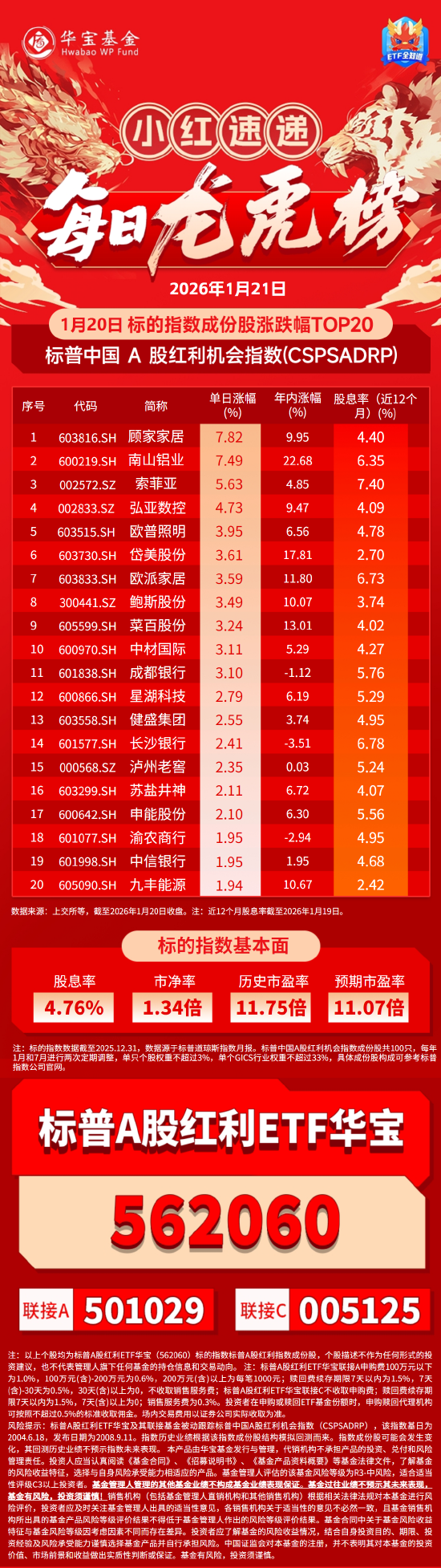
Core Insights - The article highlights the top-performing stocks in the S&P China A-Share Dividend Opportunity Index as of January 20, 2026, showcasing significant daily and year-to-date gains along with dividend yields [1][5]. Group 1: Stock Performance - The top stock, Gujia Home Furnishing (603816.SH), experienced a daily increase of 7.82% and a year-to-date increase of 9.95%, with a dividend yield of 4.40% [1][5]. - Nanshan Aluminum (600219.SH) ranked second with a daily rise of 7.49% and a year-to-date increase of 22.68%, offering a dividend yield of 6.35% [1][5]. - Other notable performers include Jia Fei Industry (002572.SZ) with a daily increase of 5.63% and a year-to-date increase of 4.85%, and Hongya CNC (002833.SZ) with a daily rise of 4.73% and a year-to-date increase of 9.47% [1][5]. Group 2: Dividend Yields - The average dividend yield for the index is reported at 4.76%, with historical and expected price-to-earnings ratios at 1.34 times and 11.75 times, respectively [2]. - The dividend yields of the top stocks range from 2.42% for Jiufeng Energy (605090.SH) to 7.40% for Jia Fei Industry (002572.SZ) [1][5]. Group 3: Technical Indicators - The article mentions the formation of a MACD golden cross signal, indicating a positive trend for the stocks listed [4][8].





A股银行年度盘点:2025告别普涨,2026拥抱分化
3 6 Ke· 2026-01-21 00:59
Core Insights - In 2025, A-share listed banks in China experienced a significant shift in development logic, moving from scale competition to value creation, focusing on core business and providing precise financial services to support high-quality economic development [1][2] Group 1: Market Performance - The A-share banking sector showed notable structural differentiation in 2025, with the Shanghai Composite Index and Shenzhen Component Index rising by 18.41% and 29.87% respectively, while the banking sector index increased by 12.04% [1] - By the end of 2025, the total market capitalization of A-share banks reached 14.65 trillion yuan, with 35 out of 42 listed banks seeing their stock prices rise, and 19 banks experiencing gains exceeding 10% [1] - In contrast to the broad market rally in 2024, where the banking sector index rose by 43.56%, 2025 marked a transition to a more selective investment environment [1] Group 2: Performance of Major Banks - Agricultural Bank of China led the sector with a stock price increase of 52.66% in 2025, while other major banks like Industrial Bank, China Construction Bank, and Bank of China saw increases of 21.54%, 12.87%, and 10.75% respectively [4] - The total market capitalization of the four major state-owned banks remains dominant, with Industrial Bank at 2.63 trillion yuan and Agricultural Bank at 2.61 trillion yuan [4] - The performance of other major banks was hindered by large capital increases, as several banks announced plans to raise a total of 520 billion yuan through stock issuance [4][5] Group 3: Performance of Joint-Stock Banks - Joint-stock banks exhibited further performance differentiation in 2025, with Shanghai Pudong Development Bank leading with a 24.56% increase, while banks like Huaxia Bank, Everbright Bank, and Minsheng Bank saw declines of 9.82%, 5.59%, and 3.09% respectively [6][7] - The decline in stock prices for these banks can be attributed to poor operating performance, with Huaxia Bank and Everbright Bank reporting revenue and profit declines [8] - Regulatory penalties also impacted these banks, with Huaxia Bank facing over 120 million yuan in fines, indicating ongoing compliance pressures [10][12] Group 4: Regional and Cooperative Banks - City and rural commercial banks showed mixed performance, with Xiamen Bank rising by 35.78%, while others like Zhengzhou Bank and Beijing Bank experienced declines [11] - Regulatory penalties for city commercial banks were significant, with Shanghai Bank and Beijing Bank facing fines exceeding 3.8 million yuan and 3.6 million yuan respectively [12] Group 5: Investment Outlook for 2026 - The investment logic for bank stocks is expected to evolve towards value reassessment, with a focus on performance growth and compliance levels becoming critical for individual stock performance [19] - The banking sector is anticipated to transition from a "growth weak cycle" to a "reform deep water zone," suggesting a dual strategy of holding stable, high-dividend large banks while selectively investing in high-potential regional banks [18][19] - The average price-to-book ratio for the banking sector was approximately 0.73, indicating a structural recovery, with Agricultural Bank exceeding 1.0, while others remained below this threshold [13]






黄金投资带火银行“小众”业务
Zheng Quan Ri Bao· 2026-01-20 23:20
Core Insights - The demand for bank safe deposit boxes is surging due to the increasing interest in gold investments among residents, leading to a significant supply-demand imbalance in the market [1][4][5] - Many banks are experiencing a shortage of available safe deposit boxes, with waiting times for larger boxes extending up to 3 to 5 years [2][3][5] - The safe deposit box rental business, traditionally a niche service, is gaining mainstream attention as more customers seek to store physical gold and other valuables [3][4] Demand Factors - The rising trend of gold investment among residents has led to a marked increase in the demand for safe deposit boxes to store physical gold and precious metals [4][5] - Customers prefer physical gold over other investment products due to its perceived stability and security [4] Supply Factors - The supply of safe deposit boxes is constrained by the fixed capacity of bank facilities, making it difficult to expand the number of available boxes [5][6] - The rental process is slow, with many customers opting for long-term leases, which further limits the turnover of available boxes [5][6] Business Dynamics - The safe deposit box rental service is characterized by high initial investment and ongoing operational costs, which may deter banks from expanding this service [6][7] - Some banks have ceased offering safe deposit box services due to business adjustments and the high costs associated with maintaining security standards [6][7] Technological Advancements - The integration of digital and intelligent technologies is revitalizing the traditional safe deposit box business, enhancing security and customer experience [7][8] - Innovations such as biometric verification and automated safe deposit boxes are being introduced, allowing for more efficient and secure access [7][8]


ETF复盘资讯|化工、贵金属逆市爆发!化工ETF(516020)劲涨1.27%续创阶段新高!电力ETF(159146)上市首日开门红!
Sou Hu Cai Jing· 2026-01-20 13:47
Market Overview - Major Asia-Pacific indices showed a collective decline, with the A-share market also experiencing consolidation, as the Shanghai Composite Index fluctuated while the Shenzhen Component and ChiNext indices performed weakly. The total trading volume in Shanghai, Shenzhen, and Beijing reached 2.8 trillion yuan, an increase of 72 billion yuan compared to the previous day [1] Real Estate Sector - The real estate sector rebounded strongly, with a notable increase in the price of a real estate ETF (159707) by 3.22%, marking multiple consecutive gains. According to the National Bureau of Statistics, the sales price of newly built commercial residential properties in first-tier cities decreased by 0.3% month-on-month in December 2025, with Shanghai seeing a slight increase of 0.2% [1] Chemical Sector - The chemical sector experienced a significant rally, with the chemical ETF (516020) reaching a new high since August 2022, closing up 1.27%. Major companies in the sector, such as BASF and Dow, have been raising prices across Europe, Asia, and the Middle East. The ETF attracted 1.148 billion yuan in the last ten days [1][4] - The chemical ETF has seen substantial net inflows, with over 5.8 billion yuan in net subscriptions in the last five trading days and 11 billion yuan in the last ten days. The Ministry of Industry and Information Technology has set guidelines for zero-carbon factory construction, which may limit new capacity in the chemical sector [6][7] Banking Sector - The banking sector showed resilience amid market volatility, with a significant number of bank stocks rising. The top bank ETF (512800) closed up 0.77%, ending a four-day losing streak. Historical data indicates that the banking sector has a high probability of generating absolute and excess returns before the Spring Festival, with an average return of 4.4% from 2017 to 2025 [8][11][14] - The banking sector is expected to benefit from continued growth in credit, supported by stable growth policies and a favorable low-interest-rate environment. The latest dividend yield for the banking index stands at 4.78%, significantly higher than the 10-year government bond yield of 1.84% [14][15] AI and Technology Sector - The AI and technology sectors faced a downturn, with the entrepreneurial AI ETF (159363) experiencing a four-day decline. Despite this, the sector remains attractive for future investments, particularly in light of ongoing developments in AI applications and infrastructure [16][18] - The communication and semiconductor industries are expected to see increased attention due to their potential for earnings upgrades, with significant growth anticipated in the coming years [18][20]




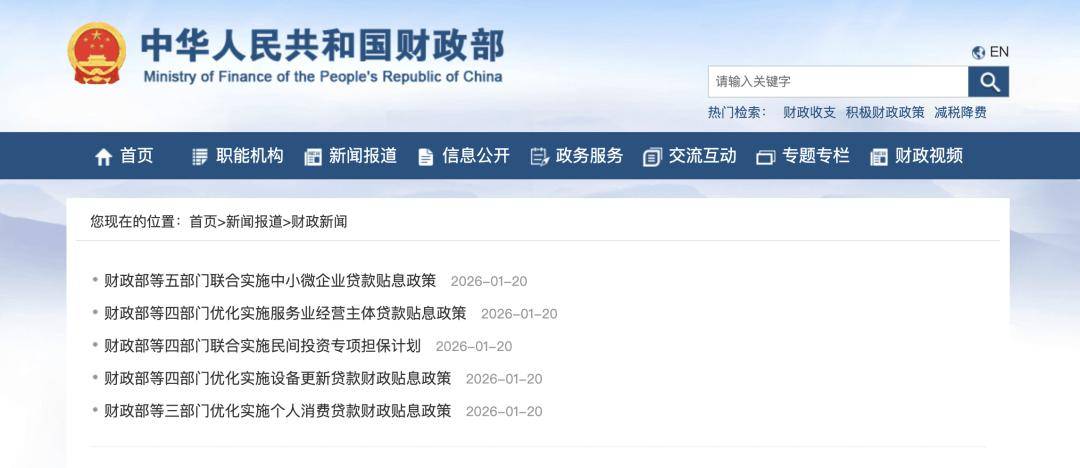
财政部连发多份重要文件,事关贷款贴息、民间投资贷款担保等 一揽子政策全文公布
Sou Hu Cai Jing· 2026-01-20 09:03
Group 1 - The core viewpoint of the news is the implementation of a financial subsidy policy for equipment renewal loans to support businesses in reducing financing costs and promoting effective investment [3][4][5] - The policy includes a 1.5% interest subsidy on fixed asset loans for equipment renewal projects, applicable for a maximum of two years, and is effective until December 31, 2026 [3][4] - The scope of support has been expanded to include various sectors such as construction, aviation, digital technology, and green energy, emphasizing high-end, intelligent, and digital equipment updates [4][6] Group 2 - A total of 26 banks are designated as eligible for processing the interest subsidy loans, including major national banks and several regional banks [4][5] - The subsidy process has been optimized to include a "pre-allocation + settlement" method, streamlining the application and approval process for banks and provincial financial departments [5][6] - The policy aims to enhance the experience of businesses by ensuring timely communication regarding subsidy payments through modern technology [6][7] Group 3 - The policy for small and micro enterprises includes a 1.5% interest subsidy on fixed asset loans, with a maximum loan amount of 50 million yuan, effective from January 1, 2026 [8][9] - The targeted sectors for this subsidy include new energy vehicles, medical equipment, and various service industries, aiming to stimulate investment and production [9][10] - The operational mechanism involves a "total-to-total" model for coordination between financial institutions and fiscal departments to ensure efficient processing of subsidy funds [11][12] Group 4 - The service industry loan subsidy policy has been extended until December 31, 2026, with an increased maximum loan amount of 10 million yuan and a 1% interest subsidy for one year [16][17] - New sectors such as digital, green, and retail have been added to the support scope, enhancing the policy's relevance to current economic trends [17][18] - The funding allocation process has been refined to improve efficiency and reduce redundancy in the approval process [18][19] Group 5 - A special guarantee plan for private investment has been introduced with a total quota of 500 billion yuan over two years, aimed at supporting small and micro enterprises [22][24] - The plan includes risk-sharing mechanisms where banks bear at least 20% of the loan risk, while the government guarantee fund covers up to 80% [24][25] - The initiative encourages innovative financing models and aims to enhance the capital strength of the government guarantee fund to support private investments effectively [26][27]


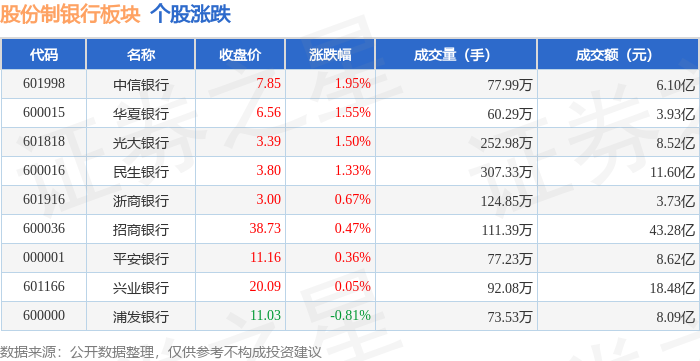
股份制银行板块1月20日涨0.54%,中信银行领涨,主力资金净流入3.9亿元
Zheng Xing Xing Ye Ri Bao· 2026-01-20 08:56
Core Viewpoint - The banking sector saw a slight increase of 0.54% on January 20, with CITIC Bank leading the gains, while the Shanghai Composite Index experienced a minor decline of 0.01% [1] Group 1: Stock Performance - CITIC Bank closed at 7.85, up by 1.95% with a trading volume of 779,900 shares and a transaction value of 610 million yuan [1] - Huaxia Bank closed at 6.56, up by 1.55% with a trading volume of 602,900 shares and a transaction value of 393 million yuan [1] - Everbright Bank closed at 3.39, up by 1.50% with a trading volume of 2,529,800 shares and a transaction value of 852 million yuan [1] - Minsheng Bank closed at 3.80, up by 1.33% with a trading volume of 3,073,300 shares and a transaction value of 1.16 billion yuan [1] - Zhejiang Commercial Bank closed at 3.00, up by 0.67% with a trading volume of 1,248,500 shares and a transaction value of 373 million yuan [1] - China Merchants Bank closed at 38.73, up by 0.47% with a trading volume of 1,113,900 shares and a transaction value of 4.33 billion yuan [1] - Ping An Bank closed at 11.16, up by 0.36% with a trading volume of 772,300 shares and a transaction value of 862 million yuan [1] - Industrial Bank closed at 20.09, up by 0.05% with a trading volume of 920,800 shares and a transaction value of 1.85 billion yuan [1] - Shanghai Pudong Development Bank closed at 11.03, down by 0.81% with a trading volume of 735,300 shares and a transaction value of 809 million yuan [1] Group 2: Capital Flow - The banking sector experienced a net inflow of 390 million yuan from institutional investors, while retail investors contributed a net inflow of 169 million yuan [1] - The sector saw a net outflow of 558 million yuan from speculative funds [1] - Specific capital flows for major banks include: - China Merchants Bank: 14.2 million yuan net inflow from institutional investors, 259 million yuan net inflow from retail investors [2] - Minsheng Bank: 11.2 million yuan net inflow from institutional investors, with net outflows from both speculative and retail investors [2] - Industrial Bank: 68.9 million yuan net inflow from institutional investors, with significant net outflows from speculative investors [2] - Everbright Bank: 38.9 million yuan net inflow from institutional investors, with net outflows from retail investors [2] - Huaxia Bank: 38.3 million yuan net inflow from institutional investors, with net outflows from retail investors [2] - Zhejiang Commercial Bank: 20.2 million yuan net inflow from institutional investors, with net outflows from retail investors [2] - CITIC Bank: 17.7 million yuan net inflow from institutional investors, with net outflows from both speculative and retail investors [2] - Ping An Bank: 4.9 million yuan net inflow from institutional investors, with net outflows from retail investors [2] - Shanghai Pudong Development Bank: 53.2 million yuan net outflow from institutional investors, with a net inflow from speculative investors [2]


银行板块震荡走高,成都银行涨超3%
Xin Lang Cai Jing· 2026-01-20 05:44
Group 1 - The banking sector experienced a significant upward movement, with Chengdu Bank rising over 3% [1] - Other banks such as Chongqing Rural Commercial Bank, CITIC Bank, and Changshu Bank saw increases of over 2% [1] - Additionally, Chongqing Bank and Qilu Bank also followed the upward trend [1]
盘中,涨停!A股,突然异动!
Zhong Guo Ji Jin Bao· 2026-01-20 04:23
Market Overview - A-shares opened high but closed lower, with the Shanghai Composite Index down 0.3% at 4101.62 points, Shenzhen Component down 1.22%, and ChiNext Index down 1.83% [1] - The total trading volume in the Shanghai and Shenzhen markets reached 1.85 trillion yuan, an increase of 568 billion yuan compared to the previous trading day [2] Sector Performance - The communication equipment, aerospace military, electronic components, basic metals, and energy equipment sectors experienced significant declines [2] - The banking and insurance sectors saw a notable rise, with food and beverage, real estate, and semiconductor sectors also performing well [2] Banking and Insurance Sector - The banking and insurance sector showed resilience, with major insurance stocks like China Life and Ping An rising over 1% [3] - Key banking stocks such as CITIC Bank increased by over 2%, while other banks like China Construction Bank and Bank of China rose by over 1% [5] - A report from China Galaxy Securities indicated that structural monetary policy tools and a marginal improvement in RMB credit could support bank lending [5] Food and Beverage Sector - The food and beverage sector was active, with food processing stocks leading the gains, including Hongmian Co., Jingji Zhino, and Weizhi Xiang, all hitting the daily limit [6] - Notable performers included Hongmian Co. with a 10.13% increase and Jingji Zhino with a 10.01% increase [7] Real Estate Sector - The real estate sector showed a rebound, with stocks like Dayue City and Chengtou Holdings hitting the daily limit, and others like China Merchants Shekou and Binjiang Group rising over 5% [8] - Recent data from the National Bureau of Statistics indicated a slight decrease in new residential sales prices in first-tier cities, which may influence market sentiment [10] Aerospace and Military Sector - The aerospace and military sector faced significant declines, with stocks like Tongyu Communication and Aerospace Power hitting the daily limit down, and Aerospace Hongtu dropping 13% [11] - Other companies in the sector, such as China Satellite and China Aerospace, also saw declines exceeding 6% [12]





科技贷款余额增幅两位数!湖南银行业这样服务新质生产力
Bei Ke Cai Jing· 2026-01-20 03:47
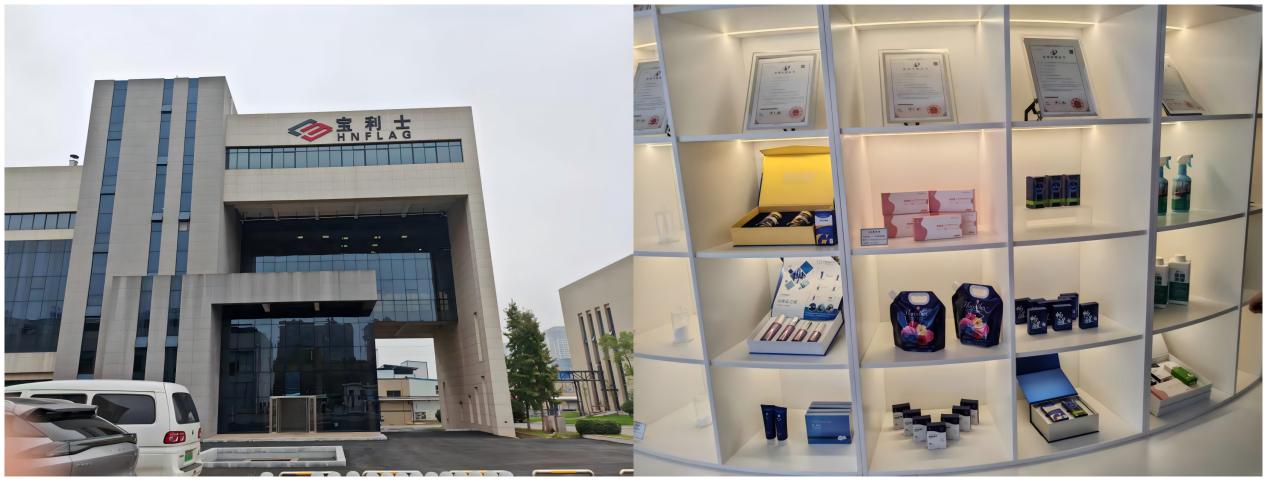
Core Insights - Hunan Province is experiencing a rise in technological innovation, with significant growth in R&D investment and the number of high-tech enterprises, indicating a strong shift towards a knowledge-based economy [1][18]. Group 1: R&D and Innovation Growth - Since the start of the 14th Five-Year Plan, Hunan's total R&D investment has grown at an annual rate of 11.61%, reaching 139.46 billion yuan [1]. - The number of high-tech enterprises in Hunan has surpassed 17,500, doubling in size [1]. - Hunan's regional innovation capability ranking has improved from 12th to 9th in the nation [1]. Group 2: Financial Support for Tech Enterprises - Hunan Bank provided a comprehensive "financing + intelligence" service to Baolisi Biotechnology Co., which faced significant funding challenges for its new production line project [5][6]. - The bank's tailored financial solutions were based on an in-depth understanding of the company's technology and market needs, demonstrating a shift towards supporting innovation-driven companies [6][11]. - Chichip Semiconductor faced typical financing difficulties due to high R&D costs and lack of collateral, prompting a re-evaluation of credit assessment models by banks [7][10]. Group 3: Long-term Partnerships and Support - Hunan Huya Optical Technology Co. established a trusting relationship with Postal Savings Bank, which provided a 3 million yuan credit loan and later a 13.8 million yuan loan, significantly boosting the company's operational capacity [12][13]. - The partnership with Changsha Rural Commercial Bank has supported Liyu Group's growth through a four-phase service plan, enhancing the company's capabilities and financial stability over seven years [14][17]. - Liyu Group's asset scale increased by 285%, revenue by 589%, and workforce by 294%, showcasing the effectiveness of long-term financial support [17].
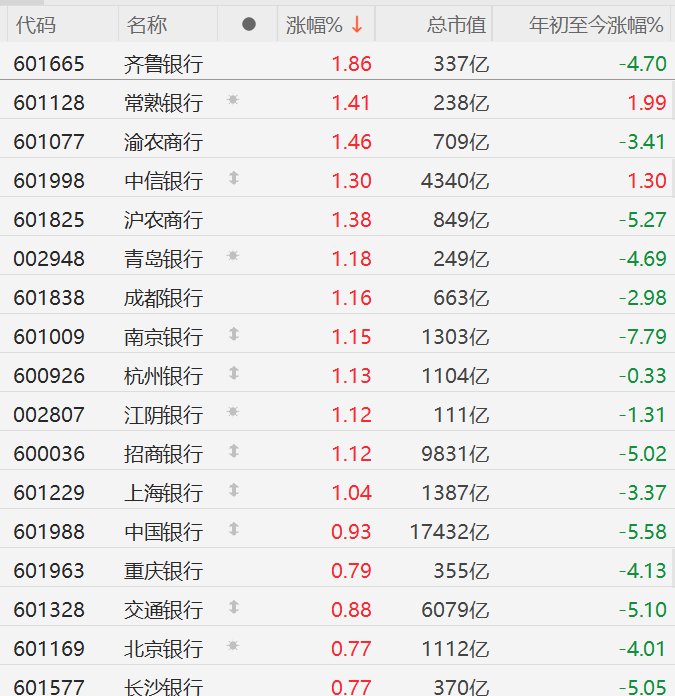
银行股逆势普涨,齐鲁银行涨近2%
Ge Long Hui· 2026-01-20 03:06
Group 1 - The A-share market saw a significant increase in bank stocks, with Qilu Bank rising nearly 2% and several other banks, including Changshu Bank and Chongqing Rural Commercial Bank, increasing by over 1% [1] - The total market capitalization of Qilu Bank is 33.7 billion, while Changshu Bank has a market cap of 23.8 billion [2] - Year-to-date performance shows that Qilu Bank has decreased by 4.70%, while Changshu Bank has increased by 1.99% [2] Group 2 - Other banks that experienced gains include Yunnan Rural Commercial Bank (1.46%), CITIC Bank (1.30%), and Shanghai Bank (1.04%) [2] - The total market capitalization of CITIC Bank is 434 billion, and it has a year-to-date performance of 1.30% [2] - Despite the gains, many banks still show negative year-to-date performance, such as Shanghai Bank (-3.37%) and China Bank (-5.58%) [2]