WuXi AppTec(603259)

Search documents
药明康德(02359) - 海外监管公告
2025-09-23 11:44
香港交易及結算所有限公司及香港聯合交易所有限公司對本公告之內容概不負責,對其準確 性或完整性亦不發表任何聲明,並明確表示,概不對因本公告全部或任何部分內容而產生或 因依賴該等內容而引致之任何損失承擔任何責任。 WUXI APPTEC CO., LTD. * 無錫藥明康德新藥開發股份有限公司 (於中華人民共和國註冊成立的股份有限公司) (股份代號:2359) 海外監管公告 承董事會命 無錫藥明康德新藥開發股份有限公司 董事長 李革博士 香港,2025年9月23日 截至本公告日期,本公司董事會包括執行董事李革博士、陳民章博士、楊青博士及張朝暉先生; 非執行董事童小幪先生及吳亦兵博士;以及獨立非執行董事盧韶華女士、俞衛博士、張新博士、 詹智玲女士及冷雪松先生。 * 僅供識別 FANGDA PARTNERS http://www.fangdalaw.com 本海外監管公告乃由本公司根據香港聯合交易所有限公司證券上市規則第 13.10B條作出。 茲載列本公司在上海證券交易所網站刊登的以下資料中文全文,僅供參閱。 2025 年第二次临时股东大会的法律意见书 致:无锡药明康德新药开发股份有限公司 上海市方达(北京)律师事务 ...
药明康德(02359) - 海外监管公告
2025-09-23 11:42
香港交易及結算所有限公司及香港聯合交易所有限公司對本公告之內容概不負責,對其準確 性或完整性亦不發表任何聲明,並明確表示,概不對因本公告全部或任何部分內容而產生或 因依賴該等內容而引致之任何損失承擔任何責任。 WUXI APPTEC CO., LTD. * 無錫藥明康德新藥開發股份有限公司 (於中華人民共和國註冊成立的股份有限公司) (股份代號:2359) 海外監管公告 本海外監管公告乃由本公司根據香港聯合交易所有限公司證券上市規則第 13.10B條作出。 茲載列本公司在上海證券交易所網站刊登的以下資料中文全文,僅供參閱。 承董事會命 無錫藥明康德新藥開發股份有限公司 董事長 李革博士 香港,2025年9月23日 截至本公告日期,本公司董事會包括執行董事李革博士、陳民章博士、楊青博士及張朝暉先生; 非執行董事童小幪先生及吳亦兵博士;以及獨立非執行董事盧韶華女士、俞衛博士、張新博士、 詹智玲女士及冷雪松先生。 * 僅供識別 证券代码:603259 证券简称:药明康德 公告编号:临 2025-064 无锡药明康德新药开发股份有限公司 2025年第二次临时股东大会决议公告 本公司董事会及全体董事保证本公告内容不存在 ...
药明康德(02359) - 章程
2025-09-23 11:13
無錫藥明康德新藥開發股份有限公司 章程 (2025年第二次修訂) 無錫藥明康德新藥開發股份有限公司章程 第一章 總則 第一條 為維護公司、股東、職工和債權人的合法權益,規範無錫藥明康德新藥開發股 份有限公司(以下簡稱「公司」或「本公司」)的組織和行為,根據《中華人民共和國公司法》 (以下簡稱「《公司法》」)、《中華人民共和國證券法》(以下簡稱「《證券法》」)、《境內企業 境外發行證券和上市管理試行辦法》、《上市公司章程指引》、《上海證券交易所股票上 市規則》(以下簡稱「《上交所上市規則》」)、《香港聯合交易所有限公司證券上市規則》(以 下簡稱「《香港上市規則》」)和其他有關規定,制定本章程。 第二條 公司係依照《公司法》及中國境內其他法律法規、規範性文件成立的股份有限 公司。 公司係由無錫藥明康德新藥開發有限公司整體改制變更,以發起設立的方式設立,於 2017年3月1日在無錫市工商行政管理局註冊登記,取得公司營業執照,統一社會信用代 碼為91320200724183068U。 第三條 公司於2018年4月13日經中國證券監督管理委員會批准(以下簡稱「中國證監 會」),首次向社會公眾發行人民幣普通股10,419 ...
药明康德(02359) - (1)临时股东大会投票结果;(2)取消监事会;及(3)修订公司章程
2025-09-23 11:08
香港交易及結算所有限公司及香港聯合交易所有限公司對本公告的內容概不負責,對其準確 性或完整性亦不發表任何聲明,並表明概不就因本公告全部或任何部份內容而產生或因倚賴 該等內容而引致的任何損失承擔任何責任。 WUXI APPTEC CO., LTD. * 無錫藥明康德新藥開發股份有限公司 (於中華人民共和國註冊成立的股份有限公司) (股份代號:2359) (1)臨時股東大會投票結果; (2)取消監事會; 及 (3)修訂公司章程 茲提述(i)無錫藥明康德新藥開發股份有限公司(「本公司」)於2025年9月3日刊發 的通函(「通函」);(ii)於2025年9月3日刊發的臨時股東大會通告(「通告」);及(iii) 本公司於2025年9月2日刊發的公告(「公告」)。除非文義另有所指,否則本公告 已界定的詞語在通函、通告及公告中具有相同涵義。 本公司董事(「董事」)會(「董事會」)欣然宣佈於2025年9月23日舉行的臨時股東 大會(「臨時股東大會」)的投票結果。 關於臨時股東大會所審議決議案的詳細內容,各位股東可參見通告及通函。 1. 會議召開及出席情況 臨時股東大會於2025年9月23日(星期二)下午二時三十分假座中國上海 ...
药明康德(603259) - 2025年第二次临时股东大会决议公告
2025-09-23 10:45
证券代码:603259 证券简称:药明康德 公告编号:临 2025-064 无锡药明康德新药开发股份有限公司 2025年第二次临时股东大会决议公告 本公司董事会及全体董事保证本公告内容不存在任何虚假记载、误导性陈述 或者重大遗漏,并对其内容的真实性、准确性和完整性承担法律责任。 重要内容提示: 本次会议是否有否决议案:无 一、 会议召开和出席情况 (一)股东大会召开的时间:2025 年 9 月 23 日 (二)股东大会召开的地点:上海淳大万丽酒店,上海市浦东新区迎春路 719 号 (三)出席会议的普通股股东及其持有股份情况: | 1、出席会议的股东和代理人人数 | 3,595 | | --- | --- | | 其中:A 股股东人数 | 3,594 | | 境外上市外资股股东人数(H 股) | 1 | | 2、出席会议的股东所持有表决权的股份总数(股) | 1,534,470,554 | | 其中:A 股股东持有股份总数 | 1,295,231,165 | | 境外上市外资股股东持有股份总数(H 股) | 239,239,389 | | 3、出席会议的股东所持有表决权股份数占公司有表决权股 | 51.9894 ...
药明康德(603259) - 上海市方达(北京)律师事务所关于无锡药明康德新药开发股份有限公司2025年第二次临时股东大会的法律意见书
2025-09-23 10:32
FANGDA PARTNERS http://www.fangdalaw.com 中国北京市朝阳区光华路一号 电子邮件 E-mail: email@fangdalaw.com 北京嘉里中心北楼 27 层 电 话 Tel.: 86-10-5769-5600 邮政编码:100020 传 真 Fax: 86-10-5769-5788 27/F,North Tower, Beijing Kerry Centre 1 Guanghua Road, Chaoyang District Beijing 100020, PRC 上海市方达(北京)律师事务所 关于无锡药明康德新药开发股份有限公司 2025 年第二次临时股东大会的法律意见书 致:无锡药明康德新药开发股份有限公司 上海市方达(北京)律师事务所(以下简称"本所")是具有中华人民共和国 境内法律执业资格的律师事务所。根据相关法律顾问协议,本所指派律师出席无 锡药明康德新药开发股份有限公司(以下简称"药明康德"或"公司")2025 年第二 次临时股东大会(以下简称"本次股东大会"),并就本次股东大会的召集和召开 程序、参与表决和召集会议人员的资格、表决程序和表决结果等有 ...
药明康德(603259) - 无锡药明康德新药开发股份有限公司章程(2025年第二次修订)
2025-09-23 10:31
无锡药明康德新药开发股份有限公司 章 程 (2025年第二次修订) 第一条 为维护公司、股东、职工和债权人的合法权益,规范无锡药明康德新 药开发股份有限公司(以下简称"公司"或"本公司")的组织和行为,根据《中华人 民共和国公司法》(以下简称"《公司法》")、《中华人民共和国证券法》(以下简称 "《证券法》")、《境内企业境外发行证券和上市管理试行办法》、《上市公司章程指 引》、《上海证券交易所股票上市规则》(以下简称"《上交所上市规则》")、《香港 联合交易所有限公司证券上市规则》(以下简称"《香港上市规则》")和其他有关 规定,制定本章程。 第二条 公司系依照《公司法》及中国境内其他法律法规、规范性文件成立的 股份有限公司。 第四条 公司注册名称 中文名称:无锡药明康德新药开发股份有限公司 无锡药明康德新药开发股份有限公司章程 第一章 总则 公司系由无锡药明康德新药开发有限公司整体改制变更,以发起设立的方式 设立,于2017年3月1日在无锡市工商行政管理局注册登记,取得公司营业执照, 统一社会信用代码为91320200724183068U。 第三条 公司于2018年4月13日经中国证券监督管理委员会批准( ...
医药生物行业资金流出榜:药明康德等18股净流出资金超亿元
Zheng Quan Shi Bao Wang· 2025-09-23 09:59
Market Overview - The Shanghai Composite Index fell by 0.18% on September 23, with five industries experiencing gains, led by the banking and coal sectors, which rose by 1.52% and 1.11% respectively [1] - The social services and retail trade sectors saw the largest declines, down by 3.11% and 2.90% respectively [1] - The pharmaceutical and biotechnology industry also declined by 1.93% [1] Capital Flow Analysis - The main capital outflow from the two markets totaled 996.85 billion yuan, with only three industries seeing net inflows: banking (14.00 billion yuan), construction and decoration (1.69 billion yuan), and coal (399.41 million yuan) [1] - The electronics industry experienced the largest net outflow, totaling 200.43 billion yuan, followed by the computer industry with a net outflow of 166.60 billion yuan [1] Pharmaceutical and Biotechnology Sector - The pharmaceutical and biotechnology sector saw a net outflow of 81.15 billion yuan, with 474 stocks in the sector; 32 stocks rose while 441 fell [2] - The top net inflow stocks in this sector included Amgen Pharmaceuticals-U with a net inflow of 114.11 million yuan, followed by China National Pharmaceutical and Guangsheng Tang with inflows of 74.18 million yuan and 73.03 million yuan respectively [2] - The sector's outflow leaderboard featured WuXi AppTec with a net outflow of 65.79 million yuan, followed by Bory Pharmaceutical and Sunflower with outflows of 56.65 million yuan and 49.46 million yuan respectively [4]



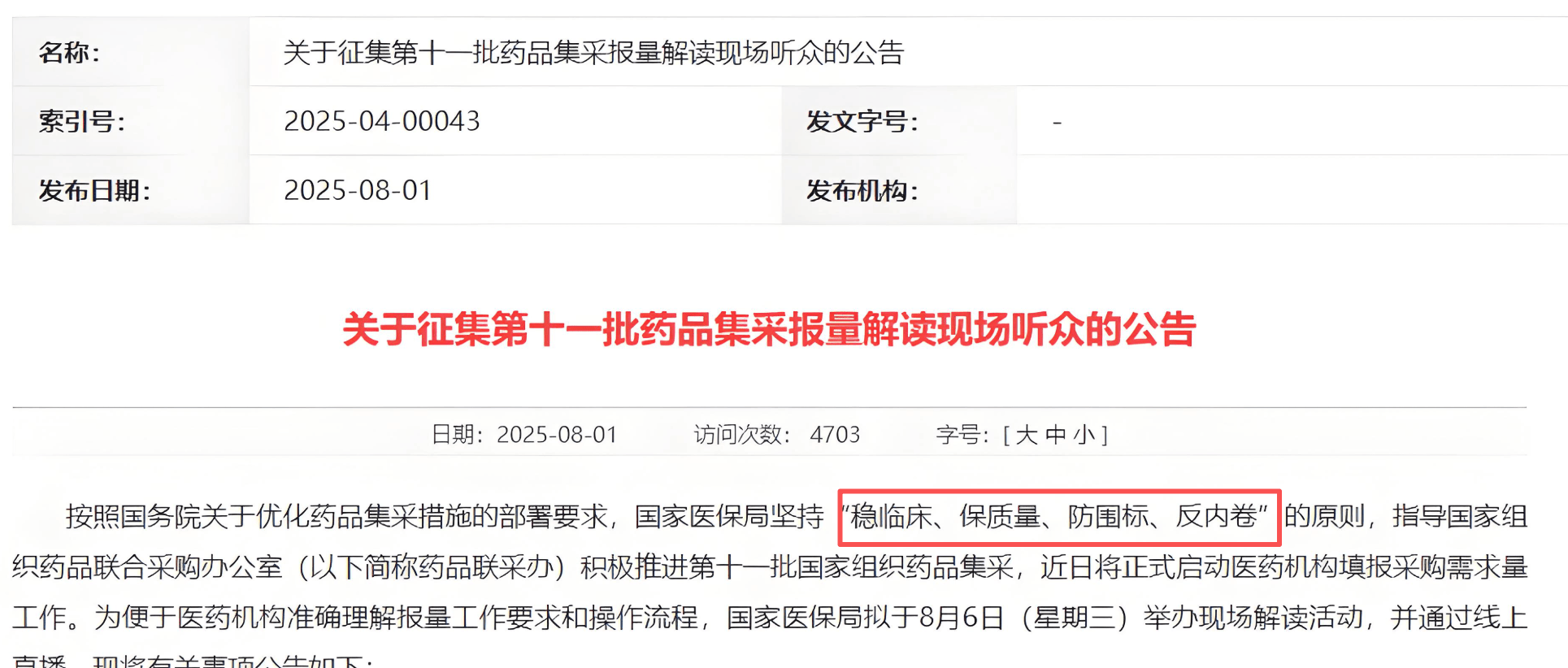
“反内卷”的风终于吹到了医药集采,五类医药主题基金谁将受益?
Sou Hu Cai Jing· 2025-09-23 07:53
Core Viewpoint - The disparity in performance between Hong Kong and A-share pharmaceutical stocks is attributed to the perceived growth potential in overseas markets, while the domestic market faces challenges due to past centralized procurement practices [1][2]. Group 1: Centralized Procurement Impact - Centralized procurement is viewed as a significant challenge for A-share pharmaceutical companies, with the recent announcement of the 11th batch of drug procurement emphasizing a "reverse inward competition" approach [2][5]. - The new procurement rules aim to prevent companies from quoting abnormally low prices, ensuring that selected companies can maintain profitability [5][12]. - The focus of this procurement round is to improve the pricing mechanism, benefiting large leading companies with better cost control [5][6]. Group 2: Beneficiaries of Procurement Changes - The companies likely to benefit from the new procurement rules include domestic pharmaceutical leaders, companies previously affected by procurement issues in medical devices and vaccines, and innovative drug companies [5][6]. - The market sentiment is expected to improve for innovative drug ETFs, with a potential for valuation recovery driven by enhanced profitability in the pharmaceutical sector [6][8]. Group 3: ETF Performance and Market Trends - The performance of various pharmaceutical ETFs is analyzed, with innovative drug ETFs showing a strong recovery potential due to market sentiment [6][8]. - The biopharmaceutical ETF category is broad, encompassing various sectors, and is expected to benefit from the new procurement policies [8][10]. - Medical device ETFs are highlighted for their growth potential, although they carry higher risks due to their sensitivity to procurement changes [10][11]. Group 4: Traditional Chinese Medicine (TCM) Insights - The impact of centralized procurement on TCM is limited, with more significant opportunities arising from fluctuations in raw material prices rather than procurement policies [14][17]. - The valuation of the TCM sector is currently low, presenting a potential opportunity for stable investors [14][17].


新“新三样”领跑,接力中国资产重估
21世纪经济报道· 2025-09-23 06:19
Core Viewpoint - The article emphasizes the emergence of a new paradigm in China's economy, termed the "new new three samples," which includes robotics, artificial intelligence (AI), and innovative pharmaceuticals, as key drivers for high-quality economic development and a shift from traditional growth models to technology-led advancements [1][4][29]. Robotics Sector - The robotics sector has seen significant market capitalization growth, with companies like Huichuan Technology exceeding 200 billion yuan and several stocks doubling in price within the year [2][13]. - The market for industrial robots in China is projected to reach 302,000 units in 2024, maintaining its position as the largest industrial robot market globally [30]. - Key challenges include reliance on imported high-end servo motors and precision components, which need to be addressed to enhance domestic capabilities [33]. Artificial Intelligence Sector - The AI sector is characterized by a large number of high-value companies, with six firms exceeding a market cap of 100 billion yuan, including Cambricon and Hikvision [19]. - The demand for AI capabilities has surged, particularly in large model applications, leading to significant revenue growth for companies like Industrial Fulian and Cambricon, with year-on-year increases of 35.58% and 4347.82%, respectively [20]. - The sector is supported by national policies aimed at integrating AI into various industries, with a comprehensive action plan released to enhance AI's role in economic development [22]. Innovative Pharmaceuticals Sector - The innovative pharmaceuticals sector is represented by major players like Heng Rui Medicine, which is nearing a market cap of 500 billion yuan, and BeiGene, which recently achieved profitability [24][28]. - Recent policy measures have been introduced to support the development of innovative drugs, including streamlined approval processes and enhanced reimbursement mechanisms [27]. - The sector is witnessing a shift from loss-making to profitability, with companies like BeiGene demonstrating the commercial viability of innovative drug models [28]. Strategic Importance - The "new new three samples" signify a transition from scale-driven manufacturing to technology-driven innovation, crucial for enhancing China's global competitiveness and economic resilience [7][9][31]. - The collaboration among robotics, AI, and innovative pharmaceuticals creates a synergistic effect that strengthens overall productivity and fosters new business models [8][31]. - Addressing the "bottleneck" issues in these sectors is essential for sustaining growth and achieving leadership in global technology competition [32][33]. Policy Recommendations - To enhance competitiveness, policies should focus on data openness, regulatory reforms, and infrastructure development to support AI and innovative pharmaceuticals [35][38]. - Establishing a robust talent pipeline and fostering interdisciplinary education will be critical for sustaining innovation in these sectors [37][38]. - Encouraging public-private partnerships and international collaboration will further strengthen China's position in the global market [39].