
OmniVision Integrated Circuits Group(603501)

Search documents
“芯片首富”虞仁荣再次征战资本市场,1500亿巨头赴港IPO
3 6 Ke· 2025-07-09 09:41
Core Viewpoint - The recent capital activities of Yu Renrong, known as the "Chip King," include the successful IPO of his investment, New Henghui Electronics, and the renaming of his company, Weier Co., to "Haowei Group" [1][2]. Company Overview - Haowei Group, founded in 1995, specializes in image sensor solutions and has expanded through the acquisition of Haowei Technology in 2019. Yu Renrong serves as the chairman and executive director [2]. - The company operates under a Fabless model, focusing on the design, research, and sales of semiconductor products, ranking among the top ten Fabless semiconductor companies globally by 2024 revenue [2]. Business Segments - Haowei Group's primary product lines include: - Image Sensor Solutions: Comprising CIS, CameraCubeChip, LCOS, and ASIC products [3]. - Display Solutions: Including LCD-TDDI, OLED DDIC, and integrated display driver chips [4]. - Analog Solutions: Encompassing PMIC, TVS, and MOSFET [5]. Market Position - By 2024, Haowei Group is projected to be the third-largest supplier of smartphone CIS with a market share of 10.5% and the largest supplier of automotive CIS with a market share of 32.9% [8]. Financial Performance - Revenue for Haowei Group was 20 billion RMB in 2022, increasing to 21 billion RMB in 2023, and projected to reach 25.7 billion RMB in 2024. Net profit decreased from 951 million RMB in 2022 to 544 million RMB in 2023, with a recovery expected to 3.28 billion RMB in 2024 [9][10]. - The gross margin for the years 2022, 2023, and 2024 was 23.7%, 19.9%, and 28.2%, respectively, indicating a decline in 2023 due to inventory management challenges [9][10]. Inventory and Supply Chain - The company has faced high inventory levels, with balances of 12.4 billion RMB, 6.3 billion RMB, and 7 billion RMB for the respective years [11]. - Approximately 85% of revenue in 2024 is expected to come from regions outside mainland China, highlighting potential exposure to international trade dynamics [10]. Research and Development - Haowei Group has invested around 9.4 billion RMB in R&D over the past three years, with R&D expenses accounting for 12.6%, 10.7%, and 10.4% of revenue in the respective years [13]. Future Outlook - The semiconductor industry is characterized by rapid technological advancements, necessitating continuous product and service updates from the company [12]. - The ability to manage inventory effectively and navigate market fluctuations will be critical for the company's future performance [13].


电子行业周报:算力与端侧创新呈现共振行情,业绩期内电子有望延续强势-20250708
Guoxin Securities· 2025-07-08 14:09
Investment Rating - The report maintains an "Outperform" rating for the electronic industry, indicating expected performance above the market index by more than 10% [1][35]. Core Viewpoints - The electronic industry is expected to continue its strong performance driven by the resonance of computing power and edge-side innovations, with a notable rebound in the consumer electronics supply chain linked to AI innovations [1]. - The demand for servers is projected to grow, particularly in enterprise-level storage, with a forecasted increase in eSSD contract prices by 5% to 10% in the third quarter [2]. - AI infrastructure development remains a high-growth investment theme, with significant advancements in AI server systems, such as the GB300 NVL72 from CoreWeave, which shows up to 10 times faster user response and 5 times higher throughput per watt compared to previous generations [3]. - The lifting of export restrictions on EDA software by the US BIS for major companies like Siemens, Synopsys, and Cadence does not alter the long-term trend towards domestic semiconductor industry self-sufficiency [4]. - The IPO applications of two domestic GPU companies signal a positive outlook for the development of the entire AI industry chain in China [5]. Summary by Sections Market Performance - The Shanghai Composite Index rose by 1.40%, while the electronic sector increased by 0.74%, with components rising by 6.82% and semiconductors declining by 1.18% over the past week [10]. Key Companies and Recommendations - The report recommends several companies for investment, including Industrial Fulian, Huadian Technology, Jianghai Technology, and Xiaomi Group, among others, based on their potential in the current market environment [1][9]. Company Earnings Forecasts and Investment Ratings - Semiconductor companies like SMIC and Aojie Technology are rated as "Outperform," with projected earnings per share (EPS) for 2025 estimated at 0.52 and -0.98 respectively, indicating a strong outlook despite current challenges [9].


北京数字经济产业创新指数位居全国第一,数字经济ETF(560800)红盘上扬,近3月规模增长显著
Xin Lang Cai Jing· 2025-07-08 03:56
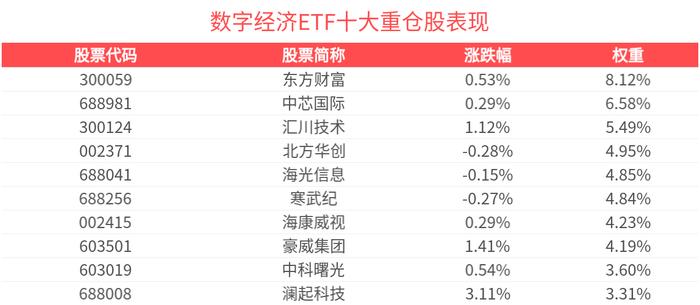
Group 1 - The core viewpoint of the news highlights the performance and growth of the digital economy sector in China, particularly through the rise of the China Securities Digital Economy Theme Index and its associated ETF [1][2] - As of July 8, 2025, the China Securities Digital Economy Theme Index (931582) increased by 0.83%, with notable gains from constituent stocks such as Langchao Information (000977) up 3.76% and Lanke Technology (688008) up 3.11% [1] - The digital economy ETF (560800) saw a price increase of 0.53%, with a trading volume of 373.61 million yuan and a turnover rate of 0.5% [1] Group 2 - The digital economy ETF has experienced significant growth, with a scale increase of 31.27 million yuan over the past three months, ranking it in the top half among comparable funds [1][2] - The ETF's share count rose by 8 million shares in the past week, also placing it in the top half of comparable funds [1][2] - The Global Digital Economy Conference held in Beijing from July 2 to 5, 2025, focused on building globally friendly digital cities, showcasing the importance of digital economy initiatives [1] Group 3 - The top ten weighted stocks in the China Securities Digital Economy Theme Index as of June 30, 2025, include Dongfang Wealth (300059) and SMIC (688981), collectively accounting for 51.3% of the index [2] - The index is designed to reflect the overall performance of listed companies involved in digital economy infrastructure and high levels of digitalization [2]





趋势研判!2025年中国CMOS图像传感器行业产业链、出货量、市场规模、竞争格局及未来趋势:智能手机等终端市场持续推动,CMOS图像传感器规模突破500亿元大关[图]
Chan Ye Xin Xi Wang· 2025-07-08 01:48
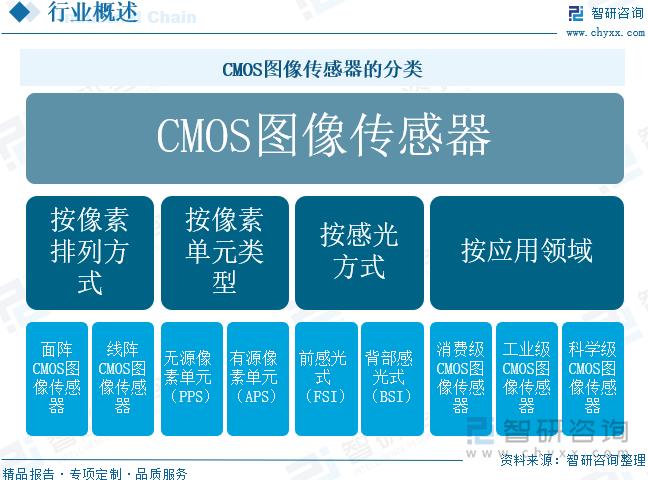
Industry Overview - The CMOS image sensor (CIS) is a crucial component that converts photons into electrons for digital processing, primarily used in digital cameras and surveillance systems [3][11] - The global CMOS image sensor market is projected to grow from $21.79 billion in 2023 to $28.6 billion by 2029, with a compound annual growth rate (CAGR) of 4.29% from 2017 to 2023 [13][19] - In China, the CMOS image sensor market is expected to reach approximately 52.68 billion yuan in 2024, driven by trends in multi-camera smartphones, smart electric vehicles, and increased demand for security monitoring [1][17] Market Dynamics - The global CMOS image sensor shipment volume increased from 5.254 billion units in 2017 to 6.76 billion units in 2023, with an estimated 7.206 billion units in 2024 [13][15] - The smartphone sector is the largest application area for CMOS image sensors, accounting for over 60% of the market share [11][15] - The Chinese smartphone market is projected to recover in 2024, with an estimated shipment volume of 286 million units, reflecting a year-on-year growth of 5.6% [11][19] Technological Advancements - The three major upgrade directions for CMOS image sensors are high pixel count, high frame rate, and improved imaging quality [5][25] - Key performance indicators for evaluating CMOS image sensor quality include optical size, pixel size, pixel count, frame rate, signal-to-noise ratio, and dynamic range [5][25] - The industry is moving towards high-resolution sensors to meet the demands of 4K/8K video and AI image analysis applications [25][27] Competitive Landscape - The global CMOS image sensor market is dominated by major players such as Sony, Samsung Electronics, and Hynix, with Sony being the market leader [19][21] - Domestic companies like Rockchip, SmartSens, and OmniVision are emerging as significant players in the Chinese market, benefiting from increased R&D investment and industry collaboration [19][21] Key Companies - Rockchip Electronics Co., Ltd. focuses on the design and development of smart application processors and is expected to achieve a revenue of 3.136 billion yuan in 2024, representing a growth of 46.95% [21] - SmartSens Technology Co., Ltd. specializes in high-performance CMOS image sensors and anticipates a revenue of 5.968 billion yuan in 2024, reflecting a growth of 108.89% [23]


钟睒睒十年捐400亿创办钱塘大学,2025年启动
Sou Hu Cai Jing· 2025-07-07 01:04
Core Viewpoint - The recent announcement by Zhong Shanshan, founder of Nongfu Spring, to invest 40 billion yuan in establishing Qiantang University over the next decade has stirred significant interest in both the education and business sectors, highlighting a trend of entrepreneurs engaging in higher education initiatives [2][3][7]. Group 1: Investment and Strategic Intent - Zhong Shanshan's commitment of 40 billion yuan is equivalent to the total net profit of Nongfu Spring over the past five years, indicating a substantial investment in education [3][17]. - The establishment of Qiantang University aims to contribute to knowledge expansion and scientific innovation, focusing on both basic research and technology application [4][14]. - The collaboration between Zhong Shanshan and the Hangzhou government aligns with the city's goal of becoming an "innovation-driven city," enhancing its competitive edge in the Yangtze River Delta technology innovation circle [6][14]. Group 2: Comparison with Other Entrepreneurial Universities - Other entrepreneurs, such as Cao Dewang and Yu Renrong, are also investing heavily in education, with Cao Dewang pledging 10 billion yuan for Fuyou University and Yu Renrong committing 30 billion yuan for Dongfang University [2][8]. - Fuyou University focuses on addressing the manufacturing sector's needs, while Dongfang University emphasizes foundational research and cutting-edge technology, showcasing different educational approaches among these new institutions [10][15][16]. - The varying educational models—Cao's "public-private partnership," Zhong's "enterprise foundation and government cooperation," and Yu's "entrepreneur-led" model—reflect diverse strategies in addressing educational needs [18]. Group 3: Educational Philosophy and Goals - Zhong Shanshan's personal experiences with education drive his commitment to establishing Qiantang University, emphasizing the transformative power of knowledge [3][4]. - The university's dual focus on scientific research and technology transfer aims to create a robust innovation engine for Zhong's business empire, particularly in health and biotechnology sectors [4][6]. - The ambition to attract top talent and foster a research-oriented environment is evident in the plans for Qiantang University, which aims to recruit over 500 leading talents and 15 top-tier researchers annually [6][14].



豪威集团: 关于控股股东部分股权质押的公告
Zheng Quan Zhi Xing· 2025-07-04 16:12
Summary of Key Points Core Viewpoint - The announcement details the share pledge situation of the controlling shareholder of Haowei Integrated Circuit (Group) Co., Ltd., indicating a significant portion of shares has been pledged, which may impact the company's financial stability and governance [1]. Group 1: Share Pledge Details - The controlling shareholder, Mr. Yu Renrong, holds 333,472,250 shares, accounting for 27.40% of the total share capital of the company. He has pledged 195,308,400 shares, which is 58.57% of his holdings [1]. - The total pledged shares by Mr. Yu Renrong and his concerted parties amount to 408,576,912 shares, representing 33.57% of the total shares and 61.73% of their total holdings [1]. - The pledged shares do not involve any guarantees related to major asset restructuring or performance compensation [1]. Group 2: Financial Implications - The controlling shareholder's pledged shares account for 20.27% of their holdings and 6.80% of the company's total share capital, with a corresponding financing amount of 320 million yuan [1]. - In the next year, the number of pledged shares due to expire is 61,918,400 shares, which is 15.15% of their holdings and 5.09% of the company's total share capital, with a financing balance of 280 million yuan [1]. - The controlling shareholder has sufficient financial capability to repay the pledged shares, with repayment sources including operational income, dividends, and self-raised funds [1].
豪威集团(603501) - 关于控股股东部分股权质押的公告
2025-07-04 09:00
| 证券代码:603501 | 证券简称:豪威集团 | 公告编号:2025-072 | | --- | --- | --- | | 转债代码:113616 | 转债简称:韦尔转债 | | 豪威集成电路(集团)股份有限公司 关于控股股东部分股权质押的公告 本公司董事会及全体董事保证本公告内容不存在任何虚假记载、误导性陈 述或者重大遗漏,并对其内容的真实性、准确性和完整性承担法律责任。 重要内容提示: 豪威集成电路(集团)股份有限公司(以下简称"公司")控股股东虞 仁荣先生持有公司股份 333,472,250 股,占公司目前总股本的 27.40%;本次质押 情况变动后,虞仁荣先生累计质押股份为 195,308,400 股,占其持股比例的 58.57%。 一、本次股份质押的情况 公司于 2025 年 7 月 4 日获悉控股股东虞仁荣所持有本公司的部分股份被质 押,具体事项如下: 1、本次股份质押的基本情况 | 股东名称 | 是否为控 | 本次质押 | 是否为限售股 (如是,注明 | 是否补 | 质押起始日 | 质押到期日 | 质权人 | 占其所持 | 占公司总 | 质押融资 | | --- | --- | --- ...
芯火三十年:纵横四海(2013-2021)
3 6 Ke· 2025-07-03 07:27
Core Viewpoint - The Chinese semiconductor industry has undergone significant development from 2000 to 2021, driven by the collaboration of national, corporate, and financial forces, culminating in a complex landscape shaped by globalization and subsequent challenges from geopolitical tensions [2][57]. Group 1: Historical Development - From 2000 to 2012, the Chinese semiconductor industry entered its "root and sprout" phase, establishing an initial industrial chain [1]. - The year 2014 marked a pivotal moment with the establishment of the National Integrated Circuit Industry Investment Fund, which provided essential financial support for the industry [4][6]. - Between 2014 and 2017, this financial influx accelerated the growth of Chinese semiconductor companies through mergers, acquisitions, and investments, integrating them into the global supply chain [1][5]. Group 2: Financial Forces - The emergence of various financial institutions, such as Zhilu Capital and Wuyuefeng Capital, provided market-oriented investment capabilities, enhancing the ability to acquire overseas semiconductor firms [8][10]. - Notable acquisitions included the purchase of Rui Neng Semiconductor for 800 million RMB, which significantly advanced China's position in the power semiconductor sector [9]. - The establishment of the Zhongguancun Rongxin Industrial Alliance in 2015 facilitated collaboration among various investment institutions, enhancing the success rate of overseas acquisitions [22]. Group 3: Corporate Forces - Major corporations like Unisoc and Changjiang Electronics have expanded their influence through strategic acquisitions, such as Unisoc's purchase of RDA Microelectronics for 910 million USD, enhancing its capabilities in mobile communication chips [13][31]. - The collaboration between large enterprises and national funds has enabled significant mergers, such as Changjiang Electronics' acquisition of STATS ChipPAC for 780 million USD, positioning it among the top semiconductor packaging and testing companies globally [11][13]. - The rapid growth of these companies has contributed to the establishment of a competitive landscape in the semiconductor industry, with firms like Unisoc becoming a leading player in the global market [13][31]. Group 4: Challenges and Adjustments - The period from 2018 to 2020 saw increasing challenges due to U.S. sanctions and trade tensions, which hindered the ability of Chinese companies to pursue overseas acquisitions [39][46]. - The establishment of the second phase of the National Integrated Circuit Industry Investment Fund in 2019 aimed to strengthen domestic capabilities and support key sectors like IC design and AI [47][48]. - By 2021, the focus shifted towards restructuring and preparing for a new phase of development, as the global landscape for semiconductor investments became increasingly restrictive [56][54]. Group 5: Future Outlook - The Chinese semiconductor industry is entering a phase of self-reliance and independence, with a focus on enhancing domestic capabilities and reducing reliance on foreign technology [57]. - The collaboration among national, corporate, and financial forces is expected to continue driving innovation and growth in the sector, despite external pressures [57].


AI高景气有望延续,人工智能ETF(515980)红盘蓄势,成分股新易盛涨近3%,深桑达A、石头科技涨逾2%
Sou Hu Cai Jing· 2025-07-03 02:51
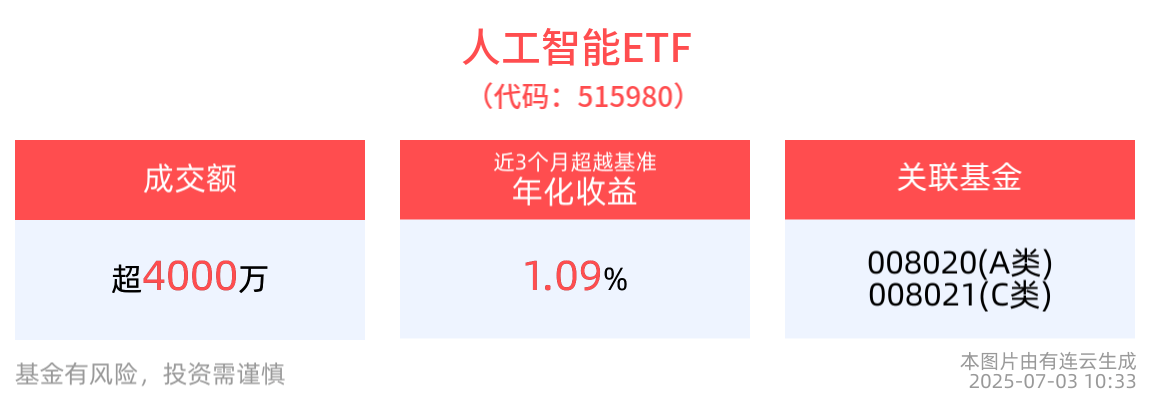
Core Viewpoint - The artificial intelligence (AI) sector is showing strong performance, with the China Securities Artificial Intelligence Industry Index (931071) and related ETFs reflecting positive trends in the market [1][4]. Group 1: Market Performance - As of July 3, 2025, the China Securities Artificial Intelligence Industry Index (931071) increased by 0.70%, with notable gains from stocks such as Xinyisheng (300502) up 2.95% and Shitou Technology (688169) up 2.52% [1]. - The AI ETF (515980) also saw an increase of 0.59%, indicating a positive sentiment in the AI investment space [1]. Group 2: Liquidity and Scale - The AI ETF recorded a turnover of 1.24% during the trading session, with a transaction volume of 43.44 million yuan, and an average daily transaction volume of 172 million yuan over the past week [3]. - The latest scale of the AI ETF reached 3.491 billion yuan, with leveraged funds continuing to invest, as evidenced by a net financing purchase of 16.65 million yuan on the previous trading day [3]. Group 3: Index Composition and Weighting - The China Securities Artificial Intelligence Industry Index is constructed from 50 representative listed companies based on their AI business proportion, growth level, and market capitalization, with the top ten weighted stocks accounting for 52.07% of the index [3]. - The top ten stocks in the index include companies like Zhongke Shuguang (603019) and Keda Xunfei (002230), with varying weightings that reflect their market significance [6]. Group 4: Investment Outlook - Fund manager Gao Zhe suggests that the current A-share market is in a volatile phase, but the AI sector remains a key area of growth, especially as the second quarter earnings reports approach [4]. - The AI industry is viewed as a high-certainty growth area, making it a focal point for investors seeking opportunities amidst market fluctuations [4].



【IPO前哨】豪威集团凭啥成为“过江龙”?
Jin Rong Jie· 2025-07-02 10:46
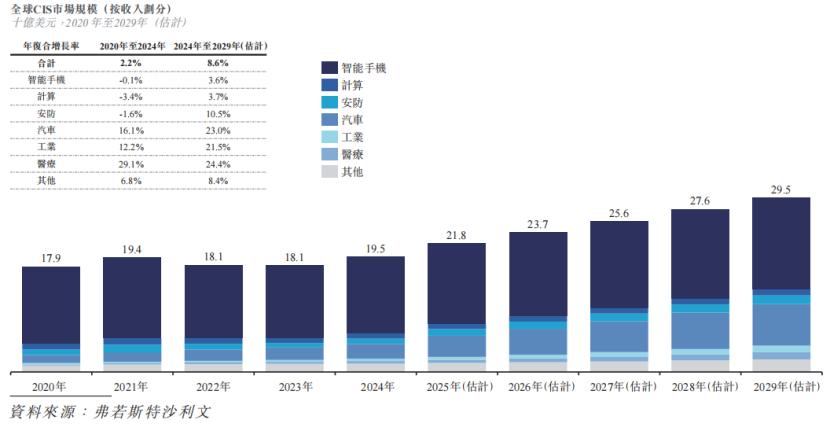
Core Viewpoint - OmniVision Group, formerly known as Weir Shares, is a fabless semiconductor design company that has submitted an application for a Hong Kong IPO, joining a list of A-share companies with a market capitalization exceeding 100 billion RMB [1] Company Background - Founded in 2007 by Yu Renrong, Weir Shares primarily engaged in semiconductor distribution and design, and was listed on the Shanghai Stock Exchange in May 2017 [2] - The acquisition of OmniVision Technologies in August 2019 allowed Weir Shares to enter the CMOS image sensor (CIS) market, significantly increasing its design business revenue [3] - Following the acquisition, Weir Shares rebranded as OmniVision Group in June 2025, with revenue reaching 25.707 billion RMB in 2024, of which 19.190 billion RMB (74.65%) came from image sensor solutions [4] Market Opportunities - The global CIS market is highly concentrated, with the top five players holding 84.1% of the market share; OmniVision Group ranks among the top three with a market share of 13.7% in 2024 [6] - The smartphone sector is the largest application area for CIS, accounting for over 65% of the market, while the automotive sector is the fastest-growing application area [6] - OmniVision Group is the largest player in the automotive CIS market, holding a 32.9% market share, benefiting from the rising penetration of smart vehicles in China [7] - The company is also making progress in medical, security, machine vision, and smart glasses sectors, positioning itself to capture growth in these rapidly developing areas [8]