
YIJIAHE(603666)

Search documents
亿嘉和(603666.SH):通过高新技术企业重新认定
Ge Long Hui A P P· 2026-02-12 08:54
Core Viewpoint - The company Yijiahe (603666.SH) has received the "High-tech Enterprise Certificate" from the Jiangsu Provincial Department of Science and Technology, Jiangsu Provincial Department of Finance, and the State Taxation Administration Jiangsu Provincial Taxation Bureau, indicating its recognition as a high-tech enterprise for a new three-year term [1] Group 1 - The certificate number is GR202532015077, and it was issued on December 19, 2025 [1] - This recognition is a renewal of the company's previous high-tech enterprise certificate, which had expired [1]

亿嘉和:通过高新技术企业重新认定
Ge Long Hui· 2026-02-12 08:52
Core Viewpoint - The company Yijiahe (603666.SH) has received a new High-tech Enterprise Certificate from the Jiangsu Provincial Department of Science and Technology, Jiangsu Provincial Department of Finance, and the State Taxation Administration of Jiangsu Province, indicating its continued recognition as a high-tech enterprise [1] Group 1 - The certificate number is GR202532015077, and it was issued on December 19, 2025, with a validity period of three years [1] - This recognition is a renewal of the company's previous high-tech enterprise certification, which had expired [1]
行业洞察:从工业场景到多领域渗透,轨道交通机器人加速智能化落地
Tou Bao Yan Jiu Yuan· 2026-02-06 12:24
Investment Rating - The report indicates a strong growth potential for the rail transit robot industry, with a market size expected to reach 8.9 billion CNY in 2024 and exceed 12 billion CNY in 2025, driven by multi-field demand [7]. Core Insights - The rail transit robot market is experiencing rapid growth due to the increasing demand for industrial automation and the replacement of high-risk scenarios. The market is projected to grow significantly, with a strong momentum driven by diverse applications [7]. - The industry faces challenges related to technology and cost constraints, particularly in high-precision algorithms and multi-sensor collaboration, which require advanced computing power. The competition is focused on creating an ecosystem centered around "computing power + services" [7]. - Policy support is expected to accelerate the standardization of the industry, with subsidies and standards anticipated to be introduced by 2027, leading to a significant increase in domestic production rates of core components [7]. Summary by Sections Industry Overview - Rail transit robots are defined as automated devices used in the rail transit sector, equipped with sensors, actuators, and control systems to perform related tasks autonomously [8]. - The classification of rail transit robots includes operational robots for track inspection, station service robots, and maintenance robots for train depots, each serving specific functions in various environments [8]. Core Technologies - The core technologies of rail transit robots encompass autonomous navigation, computer control, human-machine interaction, sensor perception, and target recognition, which collectively support intelligent, safe, and reliable operations [10][12]. - Autonomous navigation ensures safe and efficient operation through high-precision positioning and path planning, while computer control provides precise execution and task scheduling capabilities [12]. Application Areas - Rail transit robots are utilized across various application areas, including construction, manufacturing, maintenance, and passenger services, enhancing operational efficiency and safety [17]. - In construction, robots are employed for track laying and component manufacturing, while in maintenance, inspection robots play a crucial role in ensuring infrastructure safety through intelligent inspections and defect detection [17]. Future Trends - The future of rail transit robots is expected to evolve towards "single-machine intelligence—group intelligence—data closed-loop," facilitating comprehensive application expansion and real-time unified scheduling [25]. - Predictive maintenance and large model diagnostics will be supported by multi-modal data training for fault recognition, enhancing the overall operational efficiency and safety of rail transit systems [25][29].

亿嘉和:大部分零部件均已实现了国产化
Zheng Quan Ri Bao· 2026-02-05 12:13
Core Viewpoint - The company has achieved a high level of localization in its components, particularly in core devices, which are primarily sourced domestically [2] Group 1 - The company has realized localization for most of its components, focusing on key parts and technologies within the industry [2] - The company is addressing core pain points in the commercialization of robotics by strategically developing critical components [2] - Through independent research and innovation, the company is gradually building a competitive moat [2]

亿嘉和:公司的海外业务主要涉及商用清洁机器人产品
Zheng Quan Ri Bao· 2026-02-05 12:13
Core Viewpoint - The company, Yijiahe, is focusing on expanding its overseas business primarily through commercial cleaning robot products, utilizing a distributor model to reach end customers in international markets [2] Group 1: Business Model - The overseas sales strategy involves collaboration with third-party distributors to sell products to end customers [2] - The company adapts its distribution structure based on various factors such as trade policies, market competition, and service radius [2] Group 2: Support and Training - Yijiahe empowers local partners by providing product training, technical support, and market collaboration [2] - The company plans to continuously monitor regional market dynamics to optimize its channel structure [2] Group 3: Future Outlook - There is an emphasis on enhancing the sustainability of overseas business operations [2]
亿嘉和:公司将根据实际情况稳步推进相关措施,持续提升经营质量
Zheng Quan Ri Bao· 2026-02-05 12:13
Core Viewpoint - The company is focusing on cost reduction and efficiency improvement through systematic management optimization and operational enhancement [2] Group 1: Cost and Efficiency - The company is advancing management optimization and operational improvement centered around four core directives: cost, efficiency, quality, and profit [2] - Continuous optimization of management and resource allocation is being implemented to strengthen control over key business investments [2] Group 2: Quality Control - The company emphasizes the construction of a quality system and reinforces quality control throughout the entire process [2] Group 3: Performance Management - A performance assessment mechanism centered on business units is being gradually established to promote specialized development and resource collaboration [2] - The company plans to steadily advance relevant measures based on actual conditions to continuously enhance operational quality [2]
亿嘉和:公司持续推动具身智能技术在实际场景中的落地并创造应用价值
Zheng Quan Ri Bao· 2026-02-05 12:13
Group 1 - The core strategy of the company focuses on "embodied intelligence + industry applications," aiming to promote the practical implementation of embodied intelligence technology and create application value [2] - The electric grid is one of the company's core businesses, which has seen continuous improvement in intelligence over the years, yet there remains significant market potential for further development in electric grid intelligence [2] - The company is actively exploring sustainable business models for its non-electric grid industry ventures that were previously expanded [2] Group 2 - The overall production and operational situation of the company is stable, with ongoing dynamic optimization of resource allocation and cost management [2] - Specific performance metrics should be referenced in the company's official periodic reports and related announcements [2]
亿嘉和:截至2025年6月30日,公司本科及以上学历人员占比超过77%
Zheng Quan Ri Bao· 2026-02-05 12:13
Core Viewpoint - The company emphasizes technological innovation as its core strategy, focusing on the application and breakthroughs of cutting-edge technologies in the robotics field [2] R&D Investment - The company is committed to high levels of R&D investment, concentrating on intelligent perception, motion control, system integration, and scenario adaptation to enhance product performance and user experience [2] - The company has maintained a high level of R&D investment in recent years, but acknowledges the long cycles, high costs, and uncertainties associated with technological research and development [2] Talent Development - The company places significant importance on building a technical talent system by attracting experienced R&D professionals and optimizing team structure to enhance technical capabilities [2] - As of June 30, 2025, over 77% of the company's employees hold a bachelor's degree or higher, with the R&D team covering key fields such as computer science, artificial intelligence, robotics technology, electronic information, and precision manufacturing [2] Employee Incentives - The company has established a competitive compensation system and career development pathways, along with measures like employee stock ownership plans, long-term assessment incentives, and systematic training mechanisms to stimulate innovation and team cohesion [2] Strategic Focus - The company aims to balance technological advancement with R&D efficiency and operational quality, ensuring competitiveness in technology iteration and product innovation [2]
44家低空企业披露业绩预告:万丰奥威等预增,上工申贝等续亏
2 1 Shi Ji Jing Ji Bao Dao· 2026-02-02 07:20
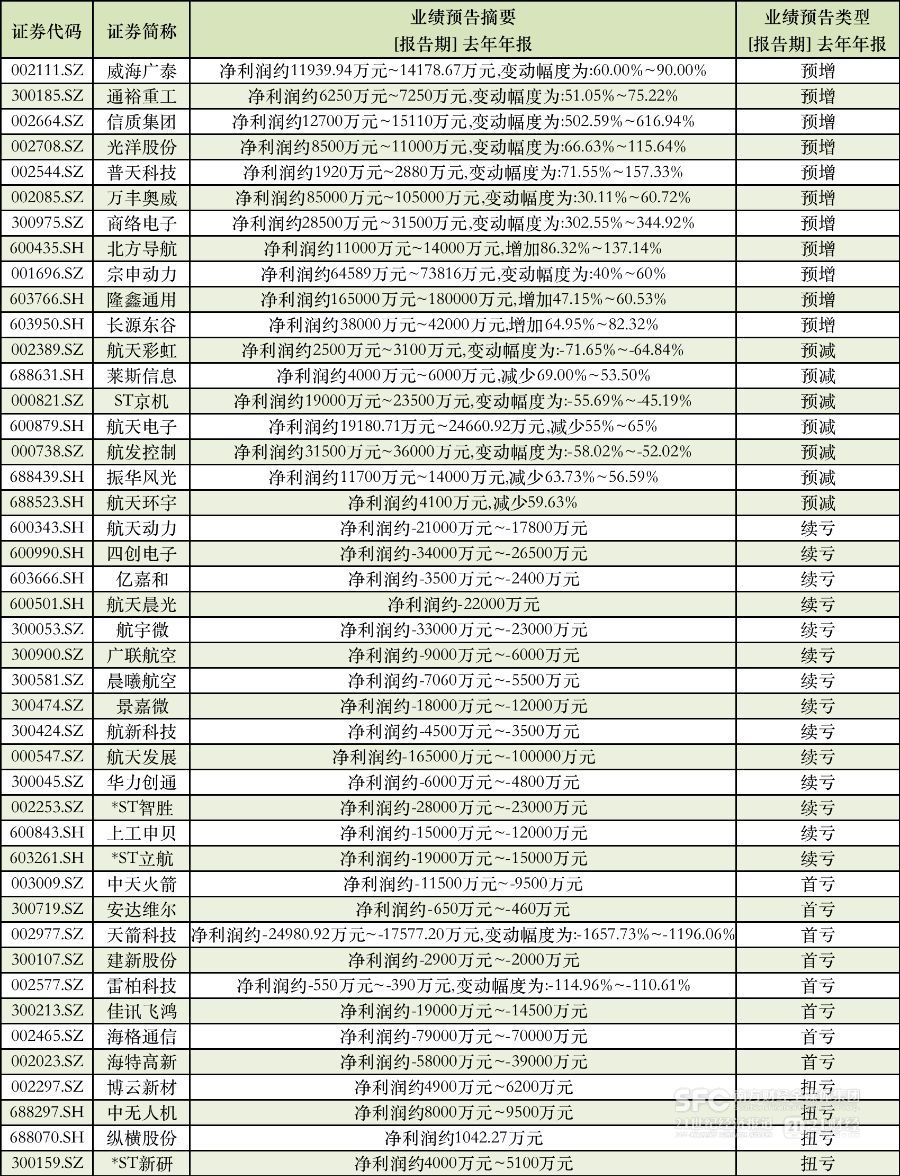
Core Viewpoint - The low-altitude economy sector is showing mixed results for 2025, with 22 companies expected to be profitable while another 22 are projected to incur losses, indicating a significant divergence in performance within the industry [3]. Performance Forecast Summary Profit Growth - 11 companies are expected to report profit increases, with notable projections including: - Xinzhi Group (002664.SZ) and Shangluo Electronics (300975.SZ) anticipating several-fold increases in net profit [4]. - Weihai Guangtai (002111.SZ), Tongyu Heavy Industry (300185.SZ), and Guangyang Co. (002708.SZ) expecting over 50% growth in net profit [4]. - Wan Feng Aowei (002085.SZ) and Zongshen Power (001696.SZ) also forecasted net profit growth [4]. Losses - 22 companies are projected to incur losses, with several notable cases: - Zhongtian Rocket (003009.SZ) and Andavil (300719.SZ) have shifted from profit to loss [7]. - Haige Communication (002465.SZ) is investing heavily in R&D, leading to increased costs and a projected loss [7]. - Companies like Aerospace Power (600343.SH) and Sihua Electronics (600990.SH) are also expected to continue reporting losses [8]. Industry Insights - The low-altitude economy's contribution to overall profits remains limited, with most revenue still coming from aircraft manufacturing and infrastructure construction [3]. - Companies like Wan Feng Aowei are leveraging their low-altitude business to drive profit growth, supported by strong orders in general aviation aircraft manufacturing and strategic acquisitions [5]. - The industry is witnessing a shift towards commercial applications of low-altitude technologies, with companies preparing for a significant commercialization phase in 2026 [9][10]. Strategic Developments - Companies are increasingly focusing on integrating low-altitude infrastructure and management platforms, as seen with Suzhou Keda's strategic investments in civil aviation infrastructure [11]. - The emphasis on R&D and market expansion in emerging fields like low-altitude economy is evident, with companies aiming to enhance their competitive edge through innovative solutions [7][11].


马斯克量产倒计时!脑机接口进入潜伏期,脑机接口商业化前夜,近期国内布局加速!优质企业详细解读
Xin Lang Cai Jing· 2026-01-27 12:24
Group 1 - Tianqi Co., Ltd. has entered the brain-computer interface (BCI) sector by investing in Suzhou Huahui Chip, focusing on high-density flexible neural electrode technology, achieving animal testing stages, and becoming a key player in domestic BCI hardware localization. The developed flexible neural electrode has 1024 channels, with signal acquisition precision and anti-interference capabilities at an internationally advanced level. The company has also completed biocompatibility surface modification technology to reduce inflammation after electrode implantation, with core patents authorized by the National Intellectual Property Administration [1][2][3] - Innovation Medical, through its subsidiary Boling Brain Machine, is one of the first companies in China to commercialize BCI rehabilitation products. The core product, Cyberlink AC5, was officially launched in October 2025, generating sales revenue of 114,000 yuan in 2025. Another product, Cyberlink AM5, has completed multi-center clinical trials and is progressing through the approval process. The company plans to establish five additional clinical cooperation centers to accelerate the application of BCI technology in treating neurological diseases [4][5][6] - iFlytek is a leading company in the non-invasive BCI field, leveraging its artificial intelligence technology to develop BCI collaborative technology. The company has established long-term partnerships with universities for research and development. Its non-invasive BCI system has been piloted in 120 schools nationwide, improving student attention by 30%. In the medical field, a collaboration with Beijing Tiantan Hospital has achieved a 92% accuracy rate in identifying abnormal brain signals for epilepsy [7][8][9] Group 2 - Jiahe Intelligent focuses on the research and mass production of BCI hardware, particularly EEG acquisition devices and core components, serving both consumer and medical-grade markets. The company has achieved large-scale production of EEG acquisition headphones with a signal recognition accuracy of 92%, primarily used in sleep monitoring and attention training. It plans to expand into overseas BCI hardware markets by 2026 [10][11][12] - Tom Cat is the first company in China to apply BCI technology in consumer scenarios, focusing on interactive games and rehabilitation training products. The company launched a mind-controlled game product in 2025, which quickly gained over 500,000 users. It also collaborates with rehabilitation institutions to develop BCI rehabilitation training systems, showing a 35% average improvement in patient motor function scores [13][14][15] - Hanwei Technology, through its subsidiary Weisheng Technology, is a leading company in the EEG sensor field, with an annual shipment of over 2 million units. The company has developed an epilepsy early warning system with an 88% accuracy rate in clinical tests. It also focuses on flexible pressure sensors for invasive BCI electrodes, addressing industry pain points [16][17][18] Group 3 - StarNet Ruijie leverages its network communication technology to develop low-power, high-stability EEG signal transmission systems and data encryption modules, becoming a core supplier for BCI data links. The developed transmission system supports real-time transmission of 1024-channel EEG signals with a latency of less than 10ms and a stability of 99.9% [19][20][21] - Yijiahe focuses on the integration of BCI and embodied intelligent robots, exploring applications in smart healthcare. The company has signed a strategic cooperation agreement to develop real-time emotional companionship and brain-controlled robots, enhancing the emotional care capabilities of robots [22][23][24] - Lihua Technology is focused on incubating and investing in the BCI sector, successfully incubating three high-tech companies in the field. The company collaborates with the Shenzhen Institute of Advanced Technology to provide comprehensive services for incubated companies, addressing development pain points [25][26][27] Group 4 - Sanbo Neurosurgery is a leading private hospital in the neurosurgery field, focusing on the clinical application and research of BCI. The company has successfully conducted an interventional BCI surgery, accumulating valuable experience for clinical applications. It is also recruiting participants for ongoing clinical trials [28][29][30] - Shiyun Circuit is a core enterprise in the PCB field, providing customized PCB products for BCI devices. The company focuses on high-density, flexible PCB designs, achieving low signal loss rates below 2% [31][32][33] - Meihua Medical is a leading supplier of core components for BCI, having entered the core supply chain for invasive BCI products. The company has developed components that have passed biocompatibility tests, ensuring long-term stability and safety for implanted devices [34][35][36]


