
TRANSSION(688036)

Search documents
2025年第一季度,受经济不确定性影响,拉美智能手机市场同比下降4%, 荣耀市场份额创历史新高
Canalys· 2025-06-04 11:52
Core Viewpoint - The Latin American smartphone market experienced a 4% year-on-year decline in Q1 2025, ending six consecutive quarters of growth, with total shipments reaching 33.7 million units [1][8]. Market Performance - Samsung led the market with 11.9 million units shipped, a 7% increase year-on-year, driven by strong demand for entry-level models A06 and A16 [1][8]. - Xiaomi ranked second with 5.9 million units, a 10% increase, supported by the popularity of the Redmi 14C 4G and Note 14 series [1][8]. - Motorola fell to third place with 5.2 million units, a 13% decline, due to its reliance on low-end products like G15 and G05 [1][8]. - Honor's strong performance with the X series led to a 2% increase in shipments to 2.6 million units, securing the fourth position [1][8]. - Transsion ranked fifth with 2.1 million units, experiencing a significant 38% decline, marking its first drop in the region [1][8]. Market Trends - The smartphone market in Latin America showed a clear polarization, with growth concentrated in entry-level and high-end segments, while the mid-range market, which accounts for 78% of total shipments, remains the primary battleground [2][7]. - Economic uncertainty, particularly concerns over tariff increases, has severely impacted the market, leading manufacturers to tighten aggressive sales strategies and retailers to reduce inventory [2][7]. - The Brazilian market was the only one among the top five to see growth, with a 3% increase in shipments to 9.5 million units, driven by increased investments from Chinese brands like Honor, Xiaomi, and realme [4][5]. Future Outlook - Canalys predicts a slight decline of 1% in the Latin American smartphone market for 2025, influenced by global economic uncertainties and potential inflation [7]. - Manufacturers are expected to focus on maintaining lean and flexible inventory management, optimizing product portfolios, and enhancing consumer experience to remain competitive in a redefined growth environment [7].




Canalys(现并入Omdia)数据快闪:2025年第一季度,全球智能手机重点市场厂商排名
Canalys· 2025-06-03 03:26
Core Insights - The global smartphone market experienced a modest growth of only 0.2% in Q1 2025, with shipments reaching 296.9 million units, marking a continuous decline in growth rate over three consecutive quarters [1] - Samsung maintained its leading position with 60.5 million units shipped, followed by Apple with 55 million units, and Xiaomi with 41.8 million units [1] Global Market Overview - The smartphone market is facing challenges due to the end of a phase of high replacement cycles and manufacturers seeking healthier inventory levels [1] - In Western Europe, Samsung led with a 36% market share, while Apple grew by 11% year-on-year [2] - In Africa, Transsion dominated with a 47% share, despite a 5% decline, while Xiaomi saw a significant growth of 32% [2] - Latin America saw Samsung at 35% market share with a 7% increase, while Xiaomi grew by 10% [2] - In the United States, Apple led with a 60% share, experiencing a 26% growth, while Samsung followed with 24% [6] Regional Highlights - In Mainland China, Xiaomi took the lead with a 19% market share and a remarkable 40% growth, followed closely by Huawei at 18% [5] - In India, vivo led with a 22% share, while Samsung and Xiaomi faced declines of 23% and 38% respectively [5] - Brazil's market was led by Samsung with a 43% share, while Lenovo and Xiaomi also held significant positions [6] - In Mexico, Samsung led with 25% market share, while Xiaomi and Lenovo faced declines [7]




上证科创板新一代信息技术指数下跌1.22%,前十大权重包含九号公司等
Jin Rong Jie· 2025-05-30 09:42
金融界5月30日消息,上证指数低开低走,上证科创板新一代信息技术指数 (科创信息,000682)下跌 1.22%,报1327.32点,成交额176.06亿元。 从上证科创板新一代信息技术指数持仓样本的行业来看,信息技术占比88.35%、可选消费占比5.04%、 工业占比4.45%、通信服务占比2.16%。 数据统计显示,上证科创板新一代信息技术指数近一个月下跌2.54%,近三个月下跌9.60%,年至今上 涨0.17%。 据了解,上证科创板新一代信息技术指数从科创板市场中选取50家市值较大的下一代信息网络、电子核 心、新兴软件和新型信息技术服务、互联网与云计算、大数据服务、人工智能等领域上市公司证券作为 指数样本,以反映科创板市场新一代信息技术产业上市公司证券的整体表现。该指数以2019年12月31日 为基日,以1000.0点为基点。 从指数持仓来看,上证科创板新一代信息技术指数十大权重分别为:中芯国际(9.96%)、海光信息 (9.54%)、寒武纪(8.98%)、澜起科技(6.8%)、中微公司(5.88%)、金山办公(5.06%)、传音 控股(2.58%)、石头科技(2.57%)、九号公司(2.47%)、芯原 ...




传音控股: 传音控股2024年年度权益分派实施公告
Zheng Quan Zhi Xing· 2025-05-28 09:22
Core Points - Shenzhen Transsion Holdings Co., Ltd. announced a cash dividend of 1.5 RMB per share, totaling approximately 1.71 billion RMB for the fiscal year 2024 [1] - The dividend distribution plan was approved at the annual shareholders' meeting held on May 21, 2025 [1] - The record date for shareholders is set, and the cash dividend will be distributed through the China Securities Depository and Clearing Corporation [1] Dividend Distribution Details - Each shareholder will receive a cash dividend of 1.5 RMB per share, with a total cash distribution of 1,710,525,862.50 RMB based on a total share capital of 1,140,350,575 shares [1] - The cash dividend will be distributed to shareholders registered with the China Securities Depository and Clearing Corporation after the market closes on the record date [1] - Specific arrangements for different types of shareholders, including individual shareholders and Qualified Foreign Institutional Investors (QFII), are outlined, detailing tax implications and net dividend amounts [1] Tax Implications - For individual shareholders holding shares for over one year, the cash dividend is exempt from personal income tax, resulting in a net distribution of 1.5 RMB per share [1] - For QFII shareholders, a 10% withholding tax will apply, leading to a net cash dividend of 1.35 RMB per share [1] - Other institutional investors will receive the full cash dividend of 1.5 RMB per share, with tax obligations to be handled independently [1]
传音控股(688036) - 传音控股2024年年度权益分派实施公告
2025-05-28 09:00
证券代码:688036 证券简称:传音控股 公告编号:2025-017 截至股权登记日下午上海证券交易所收市后,在中国证券登记结算有限责任 公司上海分公司(以下简称"中国结算上海分公司")登记在册的本公司全体股东。 3. 分配方案: 本次利润分配以方案实施前的公司总股本1,140,350,575股为基数,每股派发现 金红利1.5元(含税),共计派发现金红利1,710,525,862.50元。 是否涉及差异化分红送转:否 每股分配比例 每股现金红利1.5元(含税) 相关日期 1. 发放年度:2024年年度 2. 分派对象: 深圳传音控股股份有限公司2024年年度权益分派实施公告 本公司董事会及全体董事保证公告内容不存在任何虚假记载、误导性陈述或 者重大遗漏,并对其内容的真实性、准确性和完整性依法承担法律责任。 重要内容提示: | 股权登记日 | 除权(息)日 | 现金红利发放日 | | --- | --- | --- | | 2025/6/4 | 2025/6/5 | 2025/6/5 | 一、 通过分配方案的股东大会届次和日期 本次利润分配方案经公司2025 年 5 月 21 日的2024年年度股东大会审议通 ...
发现报告:传音控股机构调研纪要-20250527
发现报告· 2025-05-27 10:13
Summary of Transsion Holdings Conference Call Company Overview - Transsion Holdings is a provider of smart terminal products and mobile internet services, focusing on emerging markets. The company operates well-known mobile brands TECNO, itel, and Infinix, as well as digital accessories and home appliance brands [3][4][5] Key Financial Performance - For 2024, Transsion reported revenue of 68.715 billion CNY, a year-on-year increase of 10.31%, and a net profit of 5.549 billion CNY, a slight increase of 0.22% [10] - In Q1 2025, revenue was 13.004 billion CNY, a decrease of 25.45% year-on-year, with a net profit of 490 million CNY, down 69.87% [10][12] Market Position and Strategy - Transsion holds a 10.6% share of the global mobile phone market, ranking fourth among manufacturers, and has over 40% market share in the African smartphone market [4][14] - The company aims to expand its presence in emerging markets, including South Asia, Southeast Asia, the Middle East, and Latin America, while also diversifying into digital accessories and home appliances [13] Innovation and R&D - Transsion has established R&D centers in Shanghai, Shenzhen, and Chongqing, focusing on hardware, software, and mobile internet development. As of the end of 2020, the company employed 1,915 R&D personnel [4] - The company emphasizes technological innovation, particularly in imaging technology and localized services, to enhance user experience and maintain competitive advantages [4][11] Competitive Landscape - The company faces increasing competition from brands like Xiaomi and REALME in the African market. However, it has maintained a leading position through localized technology and strong brand recognition [14] - Transsion plans to enhance its mid-to-high-end product offerings and expand its AIoT ecosystem to meet diverse consumer needs [13][15] Challenges and Outlook - The decline in Q1 2025 revenue and profit is attributed to market competition and supply chain costs. The company is focused on stabilizing its operations and improving profitability [12][16] - Transsion's gross margin fell below 20% for the first time in Q1 2025, indicating increased promotional efforts to remain competitive [16] Social Responsibility - Transsion collaborates with the UN Refugee Agency to support educational initiatives for African refugee children, reflecting its commitment to social value creation in emerging markets [3]
非洲手机竞争:荣耀首进前五,小米专门对打传音?
Guan Cha Zhe Wang· 2025-05-27 10:08
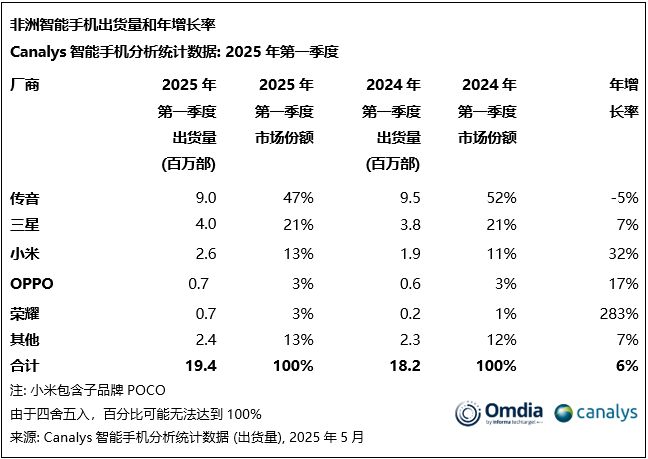
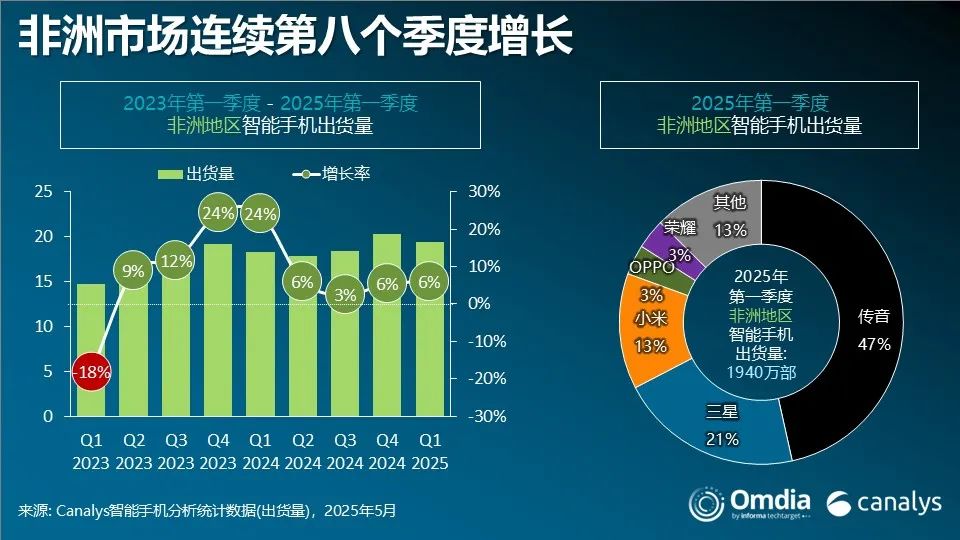
Core Insights - The African smartphone market experienced a 6% year-on-year growth in Q1 2025, reaching 19.4 million units shipped, marking the eighth consecutive quarter of growth [1][2][3] - Key factors driving this growth include active offline retail, renewed focus on broad market coverage by manufacturers, policy adjustments in key markets, easing currency fluctuations, and the launch of new cost-effective products targeting value-conscious consumers [1][3] Market Performance - Transsion led the market with 9 million units shipped, holding a 47% market share, despite a 5% decline in shipments year-on-year [2][3] - Samsung ranked second with 4 million units shipped, a 7% increase year-on-year, capturing 21% of the market share [3] - Xiaomi ranked third with 2.6 million units shipped, achieving a 32% year-on-year growth and a 13% market share [2][3] Competitive Landscape - The competition in the African smartphone market is intensifying, with consumers increasingly favoring high-cost performance devices [3][4] - Xiaomi has established a strategic group to directly compete with Transsion, focusing on low-cost models and local marketing initiatives [4][5] - Honor achieved a remarkable 283% year-on-year growth, entering the top five in the African market by focusing on high-end products and partnerships with local telecom operators [6][8] Consumer Trends - 4G devices accounted for 85% of shipments in Q1 2025, with mid-range price segments (100 to 199 USD) representing 42% of the market [8] - The African smartphone market is expected to see moderate growth of 3% in 2025, constrained by slow infrastructure development, rising sovereign debt, and macroeconomic instability [8]
传音控股业绩会:强化中高端产品突破
Zheng Quan Shi Bao Wang· 2025-05-27 09:45
Core Viewpoint - Transsion Holdings reported a revenue of 68.715 billion yuan for 2024, a year-on-year increase of 10.31%, while the net profit attributable to shareholders was 5.549 billion yuan, a slight increase of 0.22%. However, in Q1 2025, the revenue dropped to 13.004 billion yuan, a decrease of 25.45%, and the net profit fell to 490 million yuan, down 69.87% [1] Group 1: Company Performance - In 2024, Transsion Holdings achieved a revenue of 68.715 billion yuan, marking a 10.31% increase year-on-year [1] - The net profit attributable to shareholders for 2024 was 5.549 billion yuan, reflecting a 0.22% increase year-on-year [1] - For Q1 2025, the company reported a revenue of 13.004 billion yuan, which is a 25.45% decrease compared to the previous year [1] - The net profit for Q1 2025 was 490 million yuan, showing a significant decline of 69.87% year-on-year [1] Group 2: Market Position and Strategy - Transsion Holdings is recognized as a leading player in the emerging smartphone market, particularly in Africa, where it holds a market share of over 40% for five consecutive years [1] - The company has established a strong brand presence with its TECNO, itel, and Infinix smartphone brands, and has expanded into digital accessories and home appliances [1] - The chairman emphasized the long-term strategy of deepening the African market, leveraging its high market share and brand influence to enhance its competitive advantage [2] Group 3: Product Development and Innovation - The company plans to continue expanding its smartphone business while focusing on high-end product development, investing in areas such as imaging, AI, and charging technologies [2] - Transsion is developing a customized operating system based on Android, which includes applications tailored to the needs of emerging market users [3] - The company is addressing the unique challenges of emerging markets, such as high traffic costs and low bandwidth, by developing technologies that optimize connectivity and user experience [2][3]
Canalys:非洲智能手机市场延续增长势头 预计2025年增长3%
智通财经网· 2025-05-27 03:13
Core Insights - The African smartphone market is experiencing growth, with a 6% year-on-year increase in shipments in Q1 2025, reaching 19.4 million units [1][7] - Key markets such as Egypt, Algeria, and South Africa are driving this growth, while Nigeria faces challenges due to economic pressures [3][6] Market Performance - Egypt remains the largest smartphone market in North Africa, with a 34% increase in shipments, attributed to the IMEI whitelist policy and improved macroeconomic stability [3] - Algeria's smartphone market grew by 16%, supported by government policies and advancements in telecommunications technology [3] - South Africa saw a 14% increase, benefiting from tax reductions on low-cost smartphones and the transition from 2G/3G to 4G/5G networks [3] - In contrast, Nigeria's market shrank by 7% due to ongoing economic challenges, although its young population presents long-term growth potential [3] Company Performance - Transsion's shipments declined by 5% after seven consecutive quarters of growth, facing increased competition from rivals adopting similar distribution models [4] - Samsung captured 21% of the market share, with strong performance in South Africa and Egypt, where its A series models are popular [4] - Xiaomi achieved a 32% growth, driven by strong sales in Egypt and Nigeria [4] - OPPO and Honor also reported growth, with Honor experiencing a remarkable 283% increase due to its high-end products and partnerships [4] Market Challenges - Despite growth potential, the African smartphone market faces economic challenges that may hinder momentum, including rising living costs and bureaucratic inefficiencies [6] - 4G devices accounted for 85% of shipments in Q1 2025, indicating limited consumer purchasing power and a reliance on financing options [6] - The market is projected to grow modestly by 3% in 2025, influenced by slow infrastructure development and rising sovereign debt [6]
Canalys:预计2025年非洲智能手机市场增长3%
news flash· 2025-05-27 02:43
Canalys:预计2025年非洲智能手机市场增长3% 《科创板日报》27日讯,Canalys最新数据显示,非洲智能手机市场2025年第一季度出货量同比增长 6%,达到1940万部,区域出货量已连续第八个季度实现增长。不过,在连续七个季度实现增长后,传 音2025年第一季度出货量同比下滑5%。Canalys预测,非洲智能手机市场在2025年预计实现3%的温和增 长。 ...