
Jinko Solar(688223)

Search documents
【安泰科】单晶硅片价格 (2025年12月11日)
中国有色金属工业协会硅业分会· 2025-12-11 15:11
Core Insights - The article discusses the current pricing trends of silicon wafers in the solar energy industry, highlighting specific price points for various types of silicon wafers and their fluctuations over time [2][3]. Pricing Trends - The highest and lowest prices for N-type G10L silicon wafers are recorded at 1.18 and 1.15 respectively, with no percentage fluctuation [2]. - N-type G12R silicon wafers have a price range of 1.20 to 1.18, also showing no percentage fluctuation [2]. - The N-type G12 silicon wafers are priced between 1.50 and 1.48, with a slight fluctuation noted [2]. - P-type M10 silicon wafers did not have any transactions recorded for the week [3]. Market Participation - The pricing data is based on the weighted average from 12 companies, which collectively accounted for 92.77% of the domestic production of monocrystalline silicon wafers in the third quarter of 2025 [3]. - The companies involved in the pricing statistics include major players such as JA Solar Technology Co., Ltd., Trina Solar Limited, and JinkoSolar Holding Co., Ltd. [3].





三峡2.5GW光伏组件,3GW逆变器,2.5GW光伏支架中标候选人公示
Xin Lang Cai Jing· 2025-12-11 10:16
Group 1: Solar Module Procurement - Six solar module companies have been shortlisted for the 2026 procurement by the Three Gorges Group, including Longi Green Energy, Tongwei Co., Jinko Solar, Hefei JA Solar, Huansheng Photovoltaic, and Chint New Energy [1][15] - The bidding prices for the modules range from 0.75 to 0.763 yuan/W, with an average price of 0.756 yuan/W [1][15] Group 2: Inverter Procurement - Five companies have been shortlisted for the 2026 inverter procurement, including Sungrow Power Supply, China National Building Material Group, Zhuzhou Converter Technology National Engineering Research Center, Shanghai Electric, and Xiamen Kehua Hengsheng [3][17] - The project scale for the inverters is 3000 MW, focusing on 300-400 kW string inverters and their auxiliary equipment [4][18] Group 3: Fixed Mounting Structure Procurement - Five companies have been shortlisted for the 2026 fixed mounting structure procurement, including Nanchang Nanfeng Fire Equipment Manufacturing, Suzhou Jusheng Solar Technology, Jiangsu Guoqiang Xingsheng Energy Technology, Yunnan Huaguo Technology, and Ningxia Longxiang New Energy [4][19] - The project scale for the fixed mounting structures is 2500 MW, with various bidding prices reported [5][19]



晶科能源跌0.74%,成交额2.61亿元,近5日主力净流入-8372.09万
Xin Lang Cai Jing· 2025-12-11 08:23
Core Viewpoint - JinkoSolar is focusing on advanced battery technologies, including N-type TOPCon, perovskite, and IBC batteries, to maintain its leadership in the solar energy sector. Group 1: Company Performance - On December 11, JinkoSolar's stock fell by 0.74%, with a trading volume of 261 million yuan and a market capitalization of 53.828 billion yuan [1] - For the period from January to September 2025, JinkoSolar reported a revenue of 47.986 billion yuan, a year-on-year decrease of 33.14%, and a net profit attributable to shareholders of -3.92 billion yuan, a decline of 422.67% [7][8] Group 2: Technology and Production - The company has successfully mass-produced high-efficiency N-type TOPCon batteries and is actively developing new technologies, including IBC and perovskite batteries [2] - JinkoSolar's N-type TOPCon production capacity in Hefei and Haining has progressed smoothly, with the Hefei factory achieving a mass production efficiency of 24.7% [2] - The company has set a world record for the conversion efficiency of perovskite/TOPCon tandem batteries, demonstrating the feasibility and potential of this technology [2] Group 3: Market and Investment Analysis - The main business of JinkoSolar includes the research, production, and sales of solar photovoltaic modules, battery cells, and silicon wafers, providing high-quality solar products globally [3] - The stock's average trading cost is 5.92 yuan, with recent reductions in holdings, indicating a dispersed ownership structure [6] - The company has distributed a total of 3.355 billion yuan in dividends since its A-share listing, with 3.125 billion yuan in the last three years [9]
中国十大储能巨头海外订单排行榜(2025年)
鑫椤储能· 2025-12-11 02:12
Core Viewpoint - The continuous emergence of "GWh-level" energy storage orders overseas demonstrates that leading Chinese energy storage companies are becoming a key force in reshaping the global energy storage landscape [2][5]. Group 1: Market Overview - From 2025 onwards, the total scale of overseas orders signed by the top 10 energy storage giants reached 166.26 GWh, which is 2.04 times the new installed capacity of 81.5 GWh in the overseas energy storage market in 2024 [2]. - Australia leads with an order volume of 41.16 GWh, followed by the Middle East with 38 GWh, and Asia (excluding China) with 33.642 GWh [2]. Group 2: Company Performance - All top 10 energy storage giants have overseas order volumes exceeding 4 GWh, with six companies surpassing 10 GWh. The top three are CATL (52.9 GWh), Hicharge (34.01 GWh), and BYD (19.7 GWh) [3]. - Specific overseas order details are provided in the appendix of the article, highlighting the significant contributions of these companies to the global market [3]. Group 3: Risks and Challenges - Many overseas orders are merely intention orders, with execution cycles lasting 2-3 years or longer. The global energy storage industry is currently facing unprecedented challenges, with potential risks accumulating behind the surge in overseas orders [5][6]. - The bankruptcy of Powin, a former top 3 global energy storage system integrator, could significantly impact the global development of many companies. Powin has built and is constructing energy storage systems exceeding 17 GWh globally [5][6]. - The future of many overseas projects is likely to face delays or terminations due to ongoing global policy and market negotiations, which will profoundly affect the globalization and structure of the energy storage industry [6]. Group 4: Financial Health and Strategy - Maintaining financial health is crucial for companies in the current industry landscape. Historically, financially healthy companies are more likely to survive industry downturns, while financially weak companies may face severe challenges, including debt defaults or bankruptcy [6]. - Companies must prioritize survival before expanding their global market influence and capabilities, especially considering the volatility of global economic and market demands [6].




晶科能源12月10日获融资买入2512.10万元,融资余额10.07亿元
Xin Lang Cai Jing· 2025-12-11 01:25
机构持仓方面,截止2025年9月30日,晶科能源十大流通股东中,香港中央结算有限公司位居第二大流 通股东,持股3.06亿股,相比上期减少1.32亿股。易方达上证科创板50ETF(588080)位居第六大流通 股东,持股1.47亿股,相比上期减少1824.29万股。华夏上证科创板50成份ETF(588000)位居第八大流 通股东,持股1.41亿股,相比上期减少7888.63万股。 融券方面,晶科能源12月10日融券偿还1.92万股,融券卖出10.99万股,按当日收盘价计算,卖出金额 59.59万元;融券余量55.60万股,融券余额301.35万元,超过近一年50%分位水平,处于较高位。 资料显示,晶科能源股份有限公司位于上海市闵行区申长路1466弄1号晶科中心,成立日期2006年12月 13日,上市日期2022年1月26日,公司主营业务涉及太阳能光伏组件、电池片、硅片的研发、生产和销 售以及光伏技术的应用和产业化,并以此为基础向全球客户提供高效、高质量的太阳能光伏产品。主营 业务收入构成为:产品销售100.00%。 截至9月30日,晶科能源股东户数7.73万,较上期增加4.14%;人均流通股129456股,较上 ...
万亿元级储能狂奔,保险后盾“掉队”!投保率不足30%,储能保险“卡”在哪里?
Mei Ri Jing Ji Xin Wen· 2025-12-10 14:05
Core Viewpoint - The energy storage industry is experiencing explosive growth, projected to reach a market size of nearly 1.27 trillion yuan by 2035, but it faces significant safety risks, including over 70 safety incidents reported globally in 2023, primarily involving fires and explosions [1][3][5]. Group 1: Industry Growth and Risks - The energy storage sector is expected to expand rapidly, with the value-added services market projected to grow from approximately $10.9 billion in 2025 to nearly $180 billion by 2035 [3]. - Safety incidents in the energy storage industry have raised alarms, with over 70 incidents reported in 2023, including more than 30 in South Korea and around 20 in the United States, primarily due to thermal runaway leading to fires and explosions [3][4]. - The risks in the energy storage industry span the entire supply chain, from research and design to manufacturing, installation, operation, and decommissioning, with interconnected risks amplifying potential hazards [3][4]. Group 2: Insurance Coverage and Challenges - The penetration rate of specialized energy storage insurance products is currently below 30%, indicating a significant gap in risk management within the industry [5][6]. - Most energy storage projects are only covered by basic property insurance rather than specialized products designed for the unique risks of energy storage systems, leading to inadequate coverage [6]. - Cost pressures and a lack of awareness about insurance are major factors contributing to low insurance uptake among smaller projects and downstream segments of the industry [6][7]. Group 3: Pricing and Risk Assessment - The pricing of energy storage insurance is complicated by limited historical data and the rapid pace of technological change, leading to a reliance on comparative methods for premium setting [7][8]. - Six core factors influence the final insurance premium, including technology level, physical spacing, fire safety measures, operational data, project scale, and external environmental conditions [8][9]. - Information asymmetry is a critical issue in the pricing of energy storage insurance, necessitating collaboration among policymakers, the insurance industry, and the energy storage sector to improve data sharing and risk assessment [10]. Group 4: Technological Integration and Risk Management - Insurance companies are increasingly adopting technology to enhance risk management, including early diagnosis and early warning systems for battery status changes [11][12]. - A comprehensive risk reduction service model is being developed, integrating insurance coverage with risk management services to proactively identify and mitigate risks [12][13]. - Future directions include promoting dynamic underwriting models based on digital twins and artificial intelligence to transform static insurance contracts into dynamic risk management services [14].
光伏"反内卷"有重磅进展!机构重点关注的超跌股名单出炉
Xin Lang Cai Jing· 2025-12-10 08:31
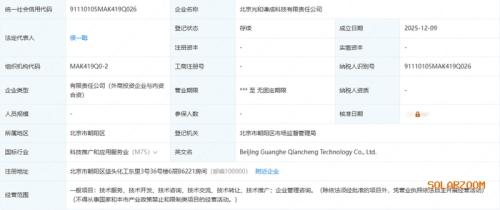
Core Viewpoint - The photovoltaic industry is entering a substantive phase of capacity optimization, with the establishment of a new company, Beijing Guanghe Qiancheng Technology Co., Ltd., aimed at exploring strategic cooperation opportunities within the industry [1][2]. Group 1: Company Establishment and Purpose - Beijing Guanghe Qiancheng Technology Co., Ltd. was officially registered on December 9, 2023, and is classified as a limited liability company with foreign investment [2]. - The main business of Guanghe Qiancheng includes providing technical services, development, consulting, and promoting technology within the photovoltaic sector [2]. - The establishment of a multi-crystalline silicon storage platform is seen as a significant step towards addressing the issue of overcapacity and intense competition in the photovoltaic industry [2]. Group 2: Industry Context and Developments - The multi-crystalline silicon storage platform is intended to be a joint effort by leading companies in the photovoltaic sector to acquire and eliminate outdated production capacity, thereby alleviating overcapacity and price competition [2]. - As of October 2023, 17 companies have signed agreements to form a consortium, with plans to complete the initiative by 2025 [2]. - Recent discussions among major players, including Tongwei and GCL, have focused on key details such as equity distribution and funding for the capacity integration initiative [2]. Group 3: Market Trends and Financial Performance - The current spot price for multi-crystalline silicon has risen to 52,000 yuan per ton, a 50% increase from the low of approximately 34,700 yuan per ton in July 2023 [3]. - The photovoltaic sector has shown signs of recovery, with a notable improvement in financial performance; the third quarter of 2023 saw a revenue of 140.3 billion yuan, despite a year-on-year decline of 6% [4]. - Among 21 listed companies in the photovoltaic supply chain, 14 reported a quarter-on-quarter increase in net profit, indicating a recovery trend, particularly in the silicon material segment [4]. Group 4: Investment Opportunities - Analysts are optimistic about potential investment opportunities arising from the establishment of the platform and the anticipated recovery in the photovoltaic sector [4]. - The focus on "anti-involution" measures, including price control and industry consolidation, is expected to gradually improve the competitive landscape and financial performance of existing photovoltaic companies [4]. - Companies like Trina Solar, which have a strong market position and are involved in high-efficiency product development, are likely to benefit from the ongoing industry reforms [5].

纳斯达克中国金龙指数收跌1.37%,热门中概股多数下跌
Mei Ri Jing Ji Xin Wen· 2025-12-09 21:17
Core Viewpoint - The Nasdaq China Golden Dragon Index experienced a decline of 1.37%, with most popular Chinese concept stocks also falling [1] Group 1: Stock Performance - Baidu saw a drop of 4.7% [1] - Other companies such as Beike, Xpeng, WeRide, and Li Auto all fell by over 3% [1] - Century Internet increased by 2% [1] - JinkoSolar rose by 2.5% [1] - Daqo New Energy experienced a rise of 3% [1]


万亿级储能狂奔 保险后盾“掉队”!投保率不足30% 储能保险“卡”在哪里?
Mei Ri Jing Ji Xin Wen· 2025-12-09 11:06
Core Viewpoint - The energy storage industry is experiencing explosive growth, projected to reach a market size of nearly $180 billion by 2035, but it faces significant safety risks, including over 70 safety incidents reported globally in 2023, primarily involving fires and explosions [3][4][10]. Group 1: Company Updates - JinkoSolar has disclosed progress regarding a fire incident in 2024, receiving a total of 220 million yuan in advance compensation, which is expected to positively impact its 2025 performance [1]. - The company has accounted for bad debt losses related to the insurance compensation from the fire incident [1]. Group 2: Industry Challenges - The insurance penetration rate for energy storage projects is below 30%, with most projects relying on traditional property insurance, leading to mismatches in coverage and insufficient risk protection [5][6]. - The industry faces challenges in pricing insurance due to a lack of historical data and the high costs associated with insurance, which many projects view as a "soft cost" [6][7]. Group 3: Risk Factors - The energy storage sector is exposed to various risks, including thermal runaway in batteries, electrical safety risks, and operational management risks, which can lead to significant safety incidents [4][6]. - The frequency of safety incidents, particularly in countries like South Korea and the United States, highlights the urgent need for improved risk management and insurance solutions [3][4]. Group 4: Insurance Pricing and Solutions - The pricing of energy storage insurance is influenced by multiple factors, including technology level, physical spacing, fire safety configurations, operational data, project scale, and external environmental conditions [8][9]. - The industry is moving towards a model of "having the right insurance" rather than just "having insurance," indicating a growing demand for specialized risk management solutions [7][10]. Group 5: Technological Innovations - Insurance companies are exploring technology-driven solutions to enhance risk management, such as early diagnosis and early warning systems for battery status changes [11][12]. - The integration of IoT technology and AI algorithms is being considered to create intelligent risk monitoring and early intervention systems [13][14].
晶科能源取得一种电池片的生产方法专利
Jin Rong Jie· 2025-12-09 09:12
声明:市场有风险,投资需谨慎。本文为AI基于第三方数据生成,仅供参考,不构成个人投资建议。 本文源自:市场资讯 作者:情报员 国家知识产权局信息显示,晶科能源股份有限公司取得一项名为"一种电池片的生产方法"的专利,授权 公告号CN119384065B,申请日期为2024年10月。 天眼查资料显示,晶科能源股份有限公司,成立于2006年,位于上饶市,是一家以从事电气机械和器材 制造业为主的企业。企业注册资本1000519.9351万人民币。通过天眼查大数据分析,晶科能源股份有限 公司共对外投资了53家企业,参与招投标项目1634次,财产线索方面有商标信息748条,专利信息2858 条,此外企业还拥有行政许可70个。 浙江晶科能源有限公司,成立于2006年,位于嘉兴市,是一家以从事电气机械和器材制造业为主的企 业。企业注册资本271434.298547万人民币。通过天眼查大数据分析,浙江晶科能源有限公司共对外投 资了9家企业,参与招投标项目96次,专利信息2630条,此外企业还拥有行政许可35个。 ...