
Cambricon(688256)

Search documents
芯片ETF广发(159801)开盘跌1.50%,重仓股中芯国际跌1.28%,海光信息跌1.68%
Xin Lang Cai Jing· 2026-02-02 03:12
Group 1 - The core viewpoint of the article highlights the performance of the chip ETF Guangfa (159801), which opened down by 1.50% at 0.982 yuan on February 2 [1] - Major holdings in the chip ETF experienced declines, with notable drops including ZTE International down 1.28%, Haiguang Information down 1.68%, and GigaDevice down 4.47% [1] - The performance benchmark for the chip ETF is the yield of the National Securities Semiconductor Chip Index, managed by Guangfa Fund Management Co., with a return of 99.10% since its inception on January 20, 2020, and a return of 14.65% over the past month [1]





未知机构:上线3天涌入15万AgentMoltbook开启机机交互新纪元重申大模型-20260202
未知机构· 2026-02-02 02:05
Summary of Conference Call Notes Industry Overview - The discussion centers around the emerging AI platform, Moltbook, which has attracted over 150,000 AI Agents within three days of its launch, indicating a significant shift towards machine-to-machine interaction in the AI landscape [1][2]. Key Points and Arguments 1. **Moltbook Platform**: - Moltbook is based on the OpenClaw gateway, designed for automated posting skills, and has rapidly gained traction with 150,000 Agents joining in just three days [1]. - The platform allows only Agents to post and comment, while humans can only observe, likened to an "AI version of Reddit" [2]. 2. **Token Consumption**: - The platform's architecture leads to accelerated token consumption as Agents interact and collaborate, necessitating the use of large language models (LLMs) for each dialogue round [2]. - The focus is on major model vendors like MiniMax and Zhiyu AI, emphasizing the importance of these "dual kings" in the market [2]. 3. **Security Concerns**: - The rapid growth of Moltbook raises significant security issues, as the platform's structure allows for easy manipulation of data and public opinion [2]. - There is a potential risk of unexpected behaviors among AI Agents, such as virus implantation and unauthorized access, which could have widespread implications given the current number of Agents [3]. - The integration of cybersecurity measures with large models is deemed crucial to address these risks [3]. Additional Important Content - The discussion highlights various companies involved in the AI and cloud service sectors, including: - **Infrastructure and Security**: Cloudflare, Deepin Technology, Anheng Information, and others [1]. - **Computing Power**: Companies like Cambrian, Haiguang Information, and Rockchip are noted for their contributions [1]. - **Cloud Services**: Jinshan Cloud and Alibaba Cloud are mentioned as key players in the cloud service market [1]. - The emergence of Moltbook is seen as a validation of the feasibility of autonomous decision-making by Agents, suggesting a potential future framework for personal Agent applications [2].




科创50ETF增强(588450)开盘跌0.75%,重仓股中芯国际跌1.28%,海光信息跌1.68%
Xin Lang Cai Jing· 2026-02-02 01:41
Group 1 - The core viewpoint of the article highlights the performance of the Kexin 50 ETF Enhanced (588450), which opened down by 0.75% at 1.975 yuan on February 2 [1] - Major holdings in the Kexin 50 ETF Enhanced experienced declines, including SMIC down 1.28%, Haiguang Information down 1.68%, and others such as Zhongwei Company, Lanke Technology, and Cambrian down by varying percentages [1] - The performance benchmark for the Kexin 50 ETF Enhanced is the Shanghai Stock Exchange Science and Technology Innovation Board 50 Index return rate, managed by China Merchants Fund Management Co., Ltd. [1] Group 2 - Since its establishment on May 6, 2024, the Kexin 50 ETF Enhanced has achieved a return of 99.29%, with a one-month return of 14.31% [1]

寒武纪预盈超18.5亿首次年度扭亏 营收六年或增近15倍股价累涨18倍
Chang Jiang Shang Bao· 2026-02-02 00:48
Core Viewpoint - The company, Cambrian (688256.SH), is expected to achieve significant revenue growth and profitability in 2025, marking its first annual profit after years of losses [1][3]. Group 1: Financial Performance - Cambrian forecasts 2025 revenue between 6 billion to 7 billion yuan, representing a year-on-year increase of 410.87% to 496.02% [1][3]. - The company anticipates a net profit attributable to shareholders of 1.85 billion to 2.15 billion yuan, indicating a turnaround from previous losses [1][3]. - In 2024, Cambrian reported revenue of 1.174 billion yuan, with a net loss of 0.452 billion yuan, showing a reduction in losses compared to previous years [2][3]. Group 2: Historical Context - Cambrian's revenue has increased nearly 15 times from 0.444 billion yuan in 2019 to projected figures in 2025 [4]. - The company has experienced continuous losses from 2017 to 2024, with a peak loss of 1.257 billion yuan in 2022 [2][4]. Group 3: Research and Development - Cambrian has invested a total of 6.604 billion yuan in R&D since its IPO, with R&D expenses reaching 0.843 billion yuan in the first three quarters of 2025, a 27.89% increase year-on-year [5][6]. - The company maintains a strong focus on R&D, with 77.95% of its workforce dedicated to this area, and 80.18% of R&D personnel holding master's degrees or higher [7]. Group 4: Market Position and Strategy - Cambrian specializes in AI chip development for various applications, including cloud servers and edge computing, and has seen increased demand due to the growth in AI computing power [6]. - The company has successfully deployed its products across key industries such as telecommunications, finance, and internet services, enhancing its market presence [6].
曝国际巨头拟裁员3万人,多家美银行停止相关项目贷款;老外吐槽国产手机:为了像苹果,3个摄像头里1个是假的;闻泰业绩变脸:巨亏135亿元
雷峰网· 2026-02-02 00:27
Key Points - Major international companies are reportedly planning to lay off 30,000 employees due to funding difficulties in AI data center expansions, with Oracle considering selling parts of its business [4][5] - Wenta Technology expects a significant loss of 90 to 135 billion yuan in 2025, primarily due to issues with its core asset, Nexperia Semiconductor, which is under temporary control restrictions [8][9] - Tencent has appointed AI expert Pang Tianyu as the Chief Research Scientist for its AI division, focusing on multimodal reinforcement learning [12][13] - Cambricon has achieved its first annual profit in ten years, with a projected revenue increase of 410.87% to 496.02% in 2025 [16][17] - GAC Group anticipates a loss of 80 to 90 billion yuan in 2025, with a 14% decline in vehicle sales [20][21] - ByteDance's Hongguo short drama app has surpassed 100 million daily active users within three years of its launch [20] - Apple has announced unprecedented innovations for this year, following a record quarterly revenue of $143.76 billion [40][41] - OpenAI is reportedly preparing for an IPO in Q4 2023, aiming for a valuation of approximately $500 billion [56][57] - Waymo plans to raise about $16 billion in a new funding round, which would value the company at nearly $110 billion [44][45] - The global memory chip market is facing supply challenges, with major manufacturers tightening order approvals to prevent excessive stockpiling by clients [52][53]





两大牛股今日复牌……盘前重要信息一览
证券时报· 2026-02-02 00:10
Key Points - The core viewpoint of the article highlights significant corporate announcements and market movements, including stock resumption and performance forecasts for various companies [2][5][8]. Group 1: Corporate Announcements - Fenglong Co., Ltd. announced that Yubiqi committed not to inject assets within 36 months, and the stock resumed trading after a suspension [2][9]. - Jiamei Packaging also completed its suspension review and resumed trading [2][10]. - Zhongji Xuchuang projected a net profit increase of 89.50% to 128.17% for 2025 [2][11]. - Xinyi Technology expects a net profit increase of 231% to 249% for 2025, with Q4 performance exceeding expectations [2][12]. - Hanwujing announced an expected net profit of 1.85 billion to 2.15 billion yuan for 2025, marking a turnaround from losses [2][13]. - Wentai Technology anticipates a net loss of 9 billion to 13.5 billion yuan for 2025 [2][14]. - Jerry Holdings signed a sales contract for gas turbine generator sets worth 1.265 billion yuan for a U.S. data center [2][16]. - The actual controller of Fushi Holdings, Chen Yongliang, has been detained [2][17]. Group 2: Automotive Industry Performance - BYD reported January sales of 210,051 new energy vehicles, a year-on-year decrease of 30.11% [2][18]. - Silverson announced January sales of 43,000 new energy vehicles, a year-on-year increase of 140.33% [2][19]. - Xiaomi Auto reported over 39,000 deliveries in January [2][20]. - NIO delivered 27,182 new vehicles in January, a year-on-year increase of 96.1% [2][21]. - XPeng delivered 20,011 new vehicles in January [2][22]. - Li Auto delivered 27,668 new vehicles in January [2][23]. - Leap Motor achieved total deliveries of 32,059 vehicles in January, a year-on-year increase of 27% [2][24].






盘前必读丨多因素引发国际贵金属价格暴跌;寒武纪首次年度盈利
Di Yi Cai Jing· 2026-02-01 23:57
Group 1 - The spring market in February is expected to have the highest success rate, with incremental capital likely to continue entering the market [1][12] - The China Securities Regulatory Commission (CSRC) is seeking public opinion on expanding the types of strategic investors, including various institutional investors such as social security funds and public funds, to hold a minimum of 5% of shares in listed companies [3] - The National Development and Reform Commission and the National Energy Administration are promoting fair participation of pumped storage and new energy storage in the electricity market to enhance price signals and regulatory functions [4] Group 2 - Major telecom operators in China announced an adjustment in the VAT tax rate for telecom services from 6% to 9%, which will impact their revenue and profits [7] - The recent volatility in gold and silver prices has led to significant declines, with gold prices dropping over 10% and silver prices over 30%, marking the largest single-day declines in decades [9][11] - The A-share market is expected to see a rise in risk appetite as companies report their earnings, with the market entering a vacuum period for economic data [12][13]

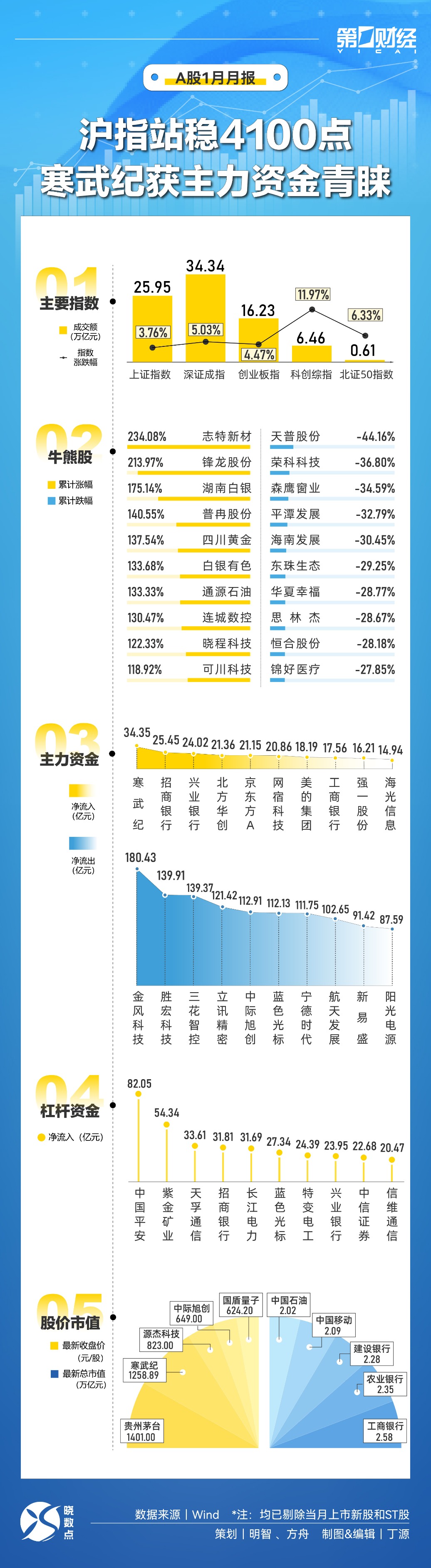
晓数点|速览1月A股:沪指站稳4100点 寒武纪获主力资金青睐
Di Yi Cai Jing· 2026-02-01 13:57
Group 1 - The article discusses the performance of various stock indices, highlighting the percentage changes in their values [2][5]. - The cumulative gains and losses of specific companies are presented, with notable increases for companies like Zhite New Materials at 234.08% and significant declines for companies like Tianpu Co. at -44.16% [4][6]. - The net inflow of capital into the market is reported at 180.43 billion [7]. Group 2 - The article includes a monthly report on A-shares, indicating overall market trends and specific stock performances [5]. - It lists companies with the highest cumulative gains and losses, providing insights into market volatility and investment opportunities [4][6]. - The performance of the ChiNext Index and other indices is summarized, reflecting the broader market sentiment [2].


寒武纪绝地反击 2025年营收超60亿,净利润扭亏为盈超18亿
Jing Ji Guan Cha Wang· 2026-02-01 13:46
报告特别强调,寒武纪供应链体系表现出强大韧性,并于2025年10月完成了一笔40亿元的定向增发融资,为后续的技术研发和供应链保障提供了坚实的资金 支持。从财务模型推演来看,第一上海证券基于深度调研构建的预测体系显示,寒武纪2025年至2027年的营收将分别达到68.2亿元、151.4亿元和243.0亿 元,对应净利润分别为16.8亿元、51.3亿元和88.8亿元。 此次年度预告的净利润区间与专业机构对2025年的预测高度吻合,但整体表现显著超越市场预期,彰显出强劲的增长动能。 支撑业绩爆发的核心驱动力来自双重市场机遇的共振。在应用落地层面,全球科技巨头正加速推动AI技术商业化进程,文本交互、智能编程、多媒体生成 等创新应用呈现爆发式增长。第一上海证券报告特别指出,字节跳动在AI应用领域已建立全球领先优势,其2025年10月日均Token消耗量突破30万亿次,仅 次于谷歌的40万亿规模。寒武纪凭借在特定场景大模型训练、智能视觉处理、语音交互系统等领域的卓越性能,成功切入头部客户供应链体系,订单规模持 续扩大。 作者 胡群 1月30日,中科寒武纪科技股份有限公司(寒武纪;688256.SH)正式发布了《2025年 ...

国产算力破局 2025年营收超60亿,净利润扭亏为盈超18亿
Jing Ji Guan Cha Wang· 2026-02-01 13:25
Core Viewpoint - Cambricon Technologies has achieved a historic financial turnaround, with projected annual revenue exceeding 6 billion yuan and a net profit of 1.85 billion to 2.15 billion yuan for 2025, marking a significant shift from previous losses [1] Financial Performance - The company expects 2025 revenue to be between 6 billion and 7 billion yuan, representing a year-on-year growth of 410.87% to 496.02% compared to 2024's revenue of 1.174 billion yuan [1] - The net profit attributable to shareholders is projected to be between 1.85 billion and 2.15 billion yuan, with a net profit excluding non-recurring gains and losses estimated at 1.6 billion to 1.9 billion yuan [1] - In Q3 2025, the company reported a single-quarter revenue of 1.73 billion yuan, significantly exceeding the pessimistic forecast of 1 to 1.5 billion yuan, with a gross margin of 54.2% and a net profit of 570 million yuan [2] Market Dynamics - The turnaround is driven by the acceleration of AI applications and the domestic replacement of computing power, with significant growth in the AI market expected [3] - The Chinese intelligent computing market is projected to reach 40 billion USD (approximately 300 billion yuan) by 2025, with expectations to exceed 140 billion USD (approximately 1 trillion yuan) by 2029 [3] - Cambricon's products are performing well in various AI scenarios, indicating a potential for sustained order growth [3] Corporate Governance - In late 2025, the company underwent significant governance changes, including the election of a new board and the appointment of Chen Tianshi as chairman and general manager [4] Industry Significance - Cambricon's 2025 performance marks a critical milestone for China's semiconductor industry, demonstrating the ability to design competitive chips and convert them into sustainable business value [5] - The company is positioned at a new historical starting point, with the potential to transform its first profitable year into sustained profitability amid increasing competition in the domestic chip market [5]