
HUA HONG SEMI(688347)

Search documents
芯片股逆市走强 华虹半导体(01347.HK)涨超7%
Mei Ri Jing Ji Xin Wen· 2025-11-18 03:03
Core Viewpoint - Semiconductor stocks are performing strongly against market trends, with notable gains in several companies [1] Company Summaries - Hua Hong Semiconductor (01347.HK) increased by 7.74%, reaching HKD 83.55 [1] - SMIC (00981.HK) rose by 3.7%, trading at HKD 75.65 [1] - Shanghai Fudan (01385.HK) saw a gain of 2.54%, priced at HKD 41.96 [1] - Jingmen Semiconductor (02878.HK) experienced a slight increase of 1.09%, with a price of HKD 0.465 [1]

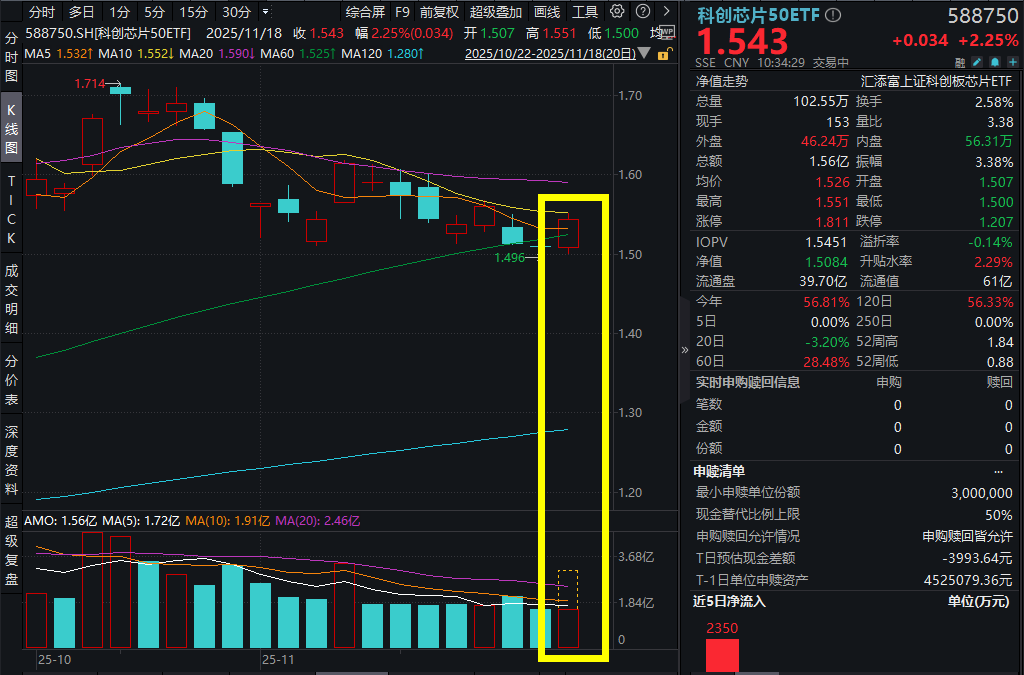
暴力反弹!东芯股份领涨超15%,华虹公司涨近5%,科创芯片50ETF(588750)放量大涨超2%,中芯国际:存储产能拉满,供不应求!
Xin Lang Cai Jing· 2025-11-18 02:56
Core Viewpoint - The A-share hard technology sector is leading a rebound, with the Kexin Chip 50 ETF (588750) showing significant trading volume and price increase, indicating strong market interest in semiconductor stocks [1][3]. Market Performance - As of 10:34, the Kexin Chip 50 ETF (588750) has surged over 2%, with trading volume exceeding the previous day's total within the first hour of trading [1]. - The constituent stocks of the Kexin Chip 50 ETF show a majority of gains, with Dongxin Co. (688110) up 15.06%, and several others like Yuanjie Technology and Huahong Semiconductor also experiencing notable increases [3][4]. Key Constituents - The top ten constituents of the Kexin Chip 50 ETF include companies like Huagong Information (1.01% increase), Zhongben International (0.99% increase), and others, with varying weightings in the index [4][5]. Industry Insights - Dongxin Co. reported that its GPU chip development is progressing as planned, with customer testing and market promotion activities ongoing [6]. - Semiconductor giant SMIC disclosed a 9.90% year-on-year revenue increase for Q3 2025, with a net profit growth of 43.10% [6]. - The semiconductor sector is experiencing heightened interest due to rising prices in storage chips, with NAND flash prices reportedly increasing by 50% [6]. Long-term Trends - The semiconductor sector's long-term growth is supported by trends in supply chain security and self-sufficiency, with a focus on domestic alternatives in equipment and materials [7]. - Emerging technologies like AI are expected to drive significant demand for chips, with the global storage market projected to reach $263.3 billion by 2025, growing at a CAGR of 11.5% from 2025 to 2029 [8]. Investment Opportunities - The Kexin Chip sector is highlighted as a promising area for index-based investment, with a focus on the core segments of the semiconductor industry [9]. - The Kexin Chip 50 ETF is noted for its higher "chip content" and growth potential compared to other indices, with a strong emphasis on high-tech upstream and midstream segments [9][10]. Performance Metrics - The Kexin Chip 50 ETF is projected to achieve a net profit growth rate of 100% for the full year 2025, significantly outperforming its peers [11]. - The index has shown a maximum increase of 187.69% since September 2024, indicating strong upward elasticity compared to other semiconductor indices [12][13].



港股半导体股盘初拉升,华虹半导体涨近3%
Mei Ri Jing Ji Xin Wen· 2025-11-18 02:09
每经AI快讯,11月18日,港股半导体股盘初拉升,华虹半导体涨近3%,中芯国际涨2%。 (文章来源:每日经济新闻) ...

半导体行业深度跟踪:存储景气上行价格涨幅扩大,设备等受益于下游扩产趋势
CMS· 2025-11-18 01:15
Investment Rating - The report maintains a "Buy" recommendation for the semiconductor sector, highlighting the upward trend in storage and related industries due to increased demand from AI and expansion in production lines [18][19]. Core Insights - The semiconductor industry is experiencing a significant upturn, driven by AI-related demand and the expansion of domestic production lines, particularly in advanced logic and storage sectors. The report emphasizes the importance of monitoring key components in the semiconductor index and related sectors [18][19]. - Notable companies like NVIDIA and AMD are optimistic about AI prospects, with NVIDIA projecting $500 billion in revenue from upcoming product lines over the next five quarters. AMD reported record revenue in Q3 2025, with expectations of over 60% CAGR in data center business [18][19]. - The report indicates a comprehensive increase in storage prices, particularly in DRAM and NAND, with significant price hikes observed in October 2025, driven by AI server demand [5][11]. Summary by Sections 1. Industry Overview - The semiconductor industry index decreased by 5.96% in October 2025, underperforming compared to the Philadelphia Semiconductor Index and Taiwan Semiconductor Index, which increased by 13.48% and 14.38%, respectively [33]. 2. Demand Side - The global smartphone shipment increased by 2.6% year-on-year in Q3 2025, while PC shipments rose by 9.4%. The wearable market saw significant growth, particularly in AI glasses, although growth is expected to slow in the latter half of the year [2][3]. 3. Supply Side - Capacity utilization rates are recovering, with TSMC reporting strong demand for AI data centers. SMIC's capacity utilization reached 95.8%, indicating a robust supply-side response to increasing demand [4][10]. 4. Price Trends - Since Q3 2025, DRAM and NAND prices have risen significantly, with October showing accelerated price increases. DDR4 and DDR5 products saw price hikes of 102.6% and 40.4%, respectively, due to supply-demand imbalances [5][11]. 5. Sales Performance - Global semiconductor sales reached $64.97 billion in September 2025, marking a year-on-year increase of 25.1% and a month-on-month increase of 7.0% [5][9]. 6. Investment Recommendations - The report suggests focusing on sectors benefiting from the ongoing upcycle in storage, equipment, and materials, as well as optimistic demand forecasts in the computing power sector. Specific companies to watch include domestic chip manufacturers and those benefiting from AI server demand [18][19].


恒生科技指数收跌近1%,携程联想领跌超3%



Cai Jing Wang· 2025-11-17 08:38
Core Viewpoint - The Hang Seng Index closed down approximately 0.71%, while the Hang Seng Tech Index fell by about 0.96%, indicating a negative trend in the Hong Kong stock market [1] Group 1: Company Performance - Lenovo Group and Trip.com Group both experienced declines of over 3% [1] - Baidu Group and Li Auto saw declines exceeding 2% [1] - Bilibili and Tongcheng Travel dropped by more than 1% [1] - Semiconductor Manufacturing International Corporation (SMIC) and Tencent Holdings had slight decreases [1] - Hua Hong Semiconductor and Meituan experienced slight increases [1]
本周小米、快手、百度等将披露业绩,机构:关注港股财报季,看好港股科技估值持续提升
Mei Ri Jing Ji Xin Wen· 2025-11-17 02:57
Group 1 - The Hong Kong stock market experienced a slight decline, with the Hang Seng Tech Index dropping over 0.5% on November 17, 2023 [1] - Major ETFs, particularly the Hang Seng Tech Index ETF (513180), followed the index's downward trend, with leading stocks like Trip.com, Lenovo, Baidu, and BYD Electronics underperforming, while Hua Hong Semiconductor, SMIC, and Alibaba showed gains [1] - A number of technology companies, including Baidu, Xiaomi, Kuaishou, Netease, and Xpeng Motors, are set to release their latest financial results this week, with key earnings announcements scheduled for November 17 and 18 [1] Group 2 - According to Minsheng Securities, the recent earnings reports from leading internet companies like Tencent and Bilibili exceeded market expectations, and there is a recommendation to focus on the upcoming financial results from Xiaomi, Trip.com, Kuaishou, and Netease [1] - The report highlights a positive outlook on the revaluation of AI in China, suggesting attention to platform-based internet companies with synergistic advantages in computing resources, model capabilities, and application scenarios, such as Tencent, Kuaishou, Alibaba, Xiaomi, Baidu, and Meituan [1] - As of November 14, the Hang Seng Tech Index ETF (513180) had a latest valuation (PETTM) of 22.47 times, which is lower than other major global tech indices, indicating that the index remains in a historically undervalued range [2]


芯片反攻!首只聚焦港股芯片产业链的港股信息技术ETF(159131)直线拉涨1%,机构:国产A...
Xin Lang Cai Jing· 2025-11-17 02:17
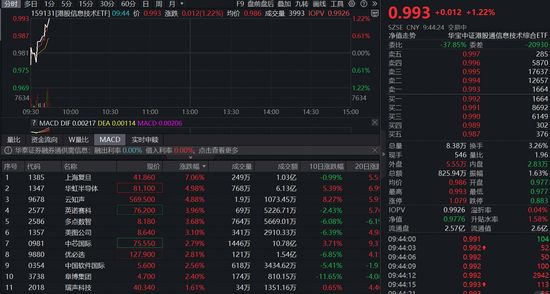
Core Viewpoint - The launch of the first Hong Kong stock ETF focusing on the semiconductor industry chain has led to significant price increases in related stocks, indicating a bullish sentiment in the market for domestic AI chips and semiconductor companies [1][3]. Group 1: Market Performance - The Hong Kong information technology ETF (159131) saw a price increase of 1.22% in early trading on November 17, with significant gains in constituent stocks such as Shanghai Fudan, which rose over 7%, and Huahong Semiconductor and Cloud Wisdom, which increased nearly 5% [1]. - The ETF is designed to track the performance of the semiconductor and technology sectors, with a composition of 70% hardware and 30% software, covering 42 Hong Kong-listed technology companies [3]. Group 2: Industry Trends - The domestic AI chip market is expected to experience a high growth rate, driven by the increasing commercialization of applications and a shift in orders towards domestic chips due to U.S. sanctions on NVIDIA products [2][3]. - As domestic advanced manufacturing processes mature, the competitiveness of low-end NVIDIA chips in China is declining, leading to a significant increase in market share for domestic chips [3]. Group 3: ETF Composition and Strategy - The ETF's index includes major players such as SMIC with a weight of 20.27%, Xiaomi Group-W at 9.11%, and Huahong Semiconductor at 5.64%, excluding large-cap internet companies like Alibaba and Tencent to focus on high-tech sectors [3]. - The index is designed to adjust its sample weights every six months, with a cap of 15% on individual stock weights, allowing for dynamic adjustments based on market conditions [4].

半导体设备&代工 - 需求景气、扩展加速
2025-11-16 15:36
Summary of Semiconductor Equipment & Foundry Conference Call Industry Overview - The global semiconductor industry experienced unexpected growth in Q3, driven by increased capital expenditure overseas, with expectations for continued high growth into 2026. AI demand is a key driver, but its sustainability will determine how long this semiconductor cycle remains elevated [1][2][3] Key Company Insights TSMC - TSMC's Q3 performance significantly outpaced the industry average, with revenue growth around 40% and gross margin nearing 60%. The strong demand for AI has led TSMC to increase its capital expenditure. The High-Performance Computing (HPC) segment now accounts for over 50% of its revenue, indicating that AI has become a dominant force in the high-end market. If AI growth continues, TSMC's revenue and profit margins have room for further increases [3][4] UMC and SMIC - The consumer electronics sector remains weak, with UMC and other overseas foundries underperforming. In contrast, SMIC benefits from domestic opportunities, achieving high capacity utilization and exceeding expected gross margins. Q4 revenue is projected to grow sequentially, with a year-on-year growth rate close to 10% [5][6] Hua Hong - Hua Hong focuses on industrial and automotive sectors, experiencing rapid growth due to accelerated domestic production. Its growth rate exceeds that of SMIC at around 20%, with high capacity utilization and significant margin improvements. As the largest power analog MCU foundry in China, Hua Hong's future outlook is positive [6][7] Semiconductor Equipment Industry - The semiconductor equipment sector is lagging behind the industry cycle, but capacity shortages are driving increased investment in equipment. Companies like TSMC have raised capital expenditures, and memory manufacturers are expected to expand further next year, enhancing the industry's outlook. Equipment growth is projected to exceed 20% starting in the second half of 2024 [8][9] Market Dynamics - The global foundry and semiconductor equipment markets performed well in Q3, driven by AI investment demand in overseas markets and strong demand for mature process foundries in the domestic market. The overall semiconductor growth in Q3 was again above expectations, with rising capital expenditures anticipated for 2026 [2][10] Storage Industry Insights - The storage industry is currently facing a supply-demand imbalance, primarily due to strong sales from Apple and rapid growth in the AI market, leading to a shortage of storage chips. This situation is expected to persist until at least the second half of 2026, despite potential acceleration in domestic production [13][14] Future Trends - The semiconductor equipment industry's growth is expected to continue, with historical cycles indicating a 50% increase in demand following each expansion phase. The current industry size is over $120 billion, with projections for growth to $150 billion in the next cycle [9][12] Conclusion - The semiconductor industry is experiencing a robust cycle driven by AI demand, with key players like TSMC and SMIC capitalizing on domestic opportunities. The equipment sector is poised for growth, and the storage market is currently constrained, indicating a complex but promising landscape for investors [1][2][3][4][5][6][7][8][9][10][11][12][13][14]
NAND市场供不应求趋势有望持续
2025-11-16 15:36
Summary of Conference Call Notes Industry Overview - The NAND market is expected to remain in a state of supply shortage until 2026, indicating that the storage market growth cycle is not over [1][2] - The DRAM market is characterized by high levels of monopoly, with downstream manufacturers like Xiaomi, OPPO, and vivo having low inventory levels, suggesting potential price increases in mobile terminals [4] Key Companies and Performance - **Kioxia**: Reported Q2 2025 revenue of 448.3 billion JPY, a 30% increase year-over-year; non-GAAP operating profit of 87.2 billion JPY, exceeding company guidance but falling short of market expectations [2][6] - **SanDisk**: Q1 2025 revenue of $2.3 billion, a 20% year-over-year increase; Q2 revenue expected between $2.55 billion and $2.65 billion, with gross margin rising from 29.9% to 41-43% [2][6] - **Samsung**: Suspended pricing in October and raised memory prices by 30-60% [6] - **Domestic Companies**: Notable mentions include De Ming Li, Jiang Bo Long, Bai Wei Storage, and Shannon Chip Creation, which are expected to benefit from the upcoming price increase cycle due to strong inventory and procurement capabilities [5] Market Dynamics - Data centers are a significant growth driver for the NAND market, with AI development significantly increasing demand for data centers [6][7] - Companies like Hon Hai Precision and AMD are performing well, with Hon Hai's cabinet numbers increasing by 300% year-over-year and AMD expecting revenue growth exceeding 35% due to collaboration with OpenAI [8] Investment Recommendations - Focus on the LAND, D-LAN, and Norflash markets due to ongoing supply shortages; recommended companies include module-related firms [11] - Anticipate a tenfold increase in general AI computing power demand over the next decade, with opportunities across design, manufacturing, and testing sectors; key players include SMIC and Huahong Semiconductor [11] - AIPCB industry chain stocks are recommended as demand is expected to recover, with companies like Shenghong Technology and Hu Dian Co. being highlighted [11] Additional Insights - Tencent is increasing its capital expenditure in AI for 2025, indicating a robust investment strategy despite economic uncertainties; AI training model iterations are contributing to growth in gaming and advertising [9] - Domestic computing power development is lagging behind international counterparts, particularly in large voice service providers [10]
华虹半导体(01347):3Q25业绩超指引,总产能利用率环比提升1.2pct
Guoxin Securities· 2025-11-16 12:16
Investment Rating - The investment rating for the company is "Outperform the Market" [5][19]. Core Views - The company reported 3Q25 results that exceeded guidance, with sales revenue of $635.2 million, a year-over-year increase of 20.7% and a quarter-over-quarter increase of 12.2%. The gross margin was 13.5%, up 1.3 percentage points year-over-year and 2.6 percentage points quarter-over-quarter. The guidance for 4Q25 anticipates sales revenue of approximately $650-660 million and a gross margin of 12%-14% [1][3]. - The company’s capacity utilization rate improved, with a monthly capacity equivalent to 468 thousand 8-inch wafers, representing a year-over-year increase of 19.7% and a quarter-over-quarter increase of 4.7%. The capacity utilization rate reached 109.5%, up 4.2 percentage points year-over-year and 1.2 percentage points quarter-over-quarter [1][2]. - Capital expenditures for 3Q25 were $261.9 million, with a focus on optimizing product structure to enhance average selling prices (ASP). The company is targeting the GaN field for power products and upgrading the Nor Flash process [3][4]. Summary by Sections Financial Performance - 3Q25 sales revenue was $635.2 million, with a gross margin of 13.5%. The company expects 4Q25 sales revenue to be around $650-660 million and gross margin to be 12%-14% [1][3]. - The company’s capital expenditures for 3Q25 totaled $261.9 million, with significant investments in manufacturing capacity [3][4]. Capacity and Utilization - The company’s monthly capacity equivalent to 8-inch wafers was 468 thousand, with a capacity utilization rate of 109.5% [1][2]. - The 12-inch capacity is steadily being released, contributing to revenue growth [1]. Market Demand - Demand for flash products is increasing, with significant growth in consumer electronics (QoQ +14.0%), communications (QoQ +11.5%), and computing (QoQ +25.6%) [2]. - The demand for analog and power management products remains strong, with a year-over-year increase of 34.1% and a quarter-over-quarter increase of 17.9% [2].