
HUA HONG SEMI(688347)

Search documents
华虹公司预计闪存业务在未来几个季度有强劲增长,科创半导体ETF(588170)整固蓄势
Mei Ri Jing Ji Xin Wen· 2025-11-20 03:59
截至2025年11月20日 11:04,上证科创板半导体材料设备主题指数下跌1.60%。成分股方面涨跌互现, 天岳先进领涨7.35%,有研硅上涨1.44%,和林微纳上涨1.36%;神工股份领跌4.89%,艾森股份下跌 3.98%,中微公司下跌3.89%。科创半导体ETF(588170)下跌1.69%,最新报价1.39元。 流动性方面,科创半导体ETF(588170)盘中换手7.5%,成交2.46亿元。拉长时间看,截至11月19日, 科创半导体ETF(588170)近1月日均成交4.55亿元,领先同类。 规模方面,科创半导体ETF(588170)近3月规模增长28.85亿元,实现显著增长。 招商证券指出,进入2025年三季度以来存储行业全面进入加速上行周期,不同于此前供给侧减产或退出 带来的价格短暂上行,本轮存储行业上行周期主要系AI时代下存储需求爆发推动,同时供给侧产能开 出有限,因此行业供需缺口持续扩大,价格加速上涨。在此背景下,海外存储原厂盈利能力持续提升, 国内部分存储模组公司快速扭亏为盈,2025年下半年利润预计将加速释放,利基存储芯片和存储产业链 配套公司亦将持续受益于存储涨价浪潮。 相关ETF:公 ...

港股开评:恒生科技指数涨0.7% 华虹半导体、百度涨超3%
Zheng Quan Shi Bao· 2025-11-20 01:55
Group 1 - The Hang Seng Index opened with a gain of 0.65% [1] - The Hang Seng Tech Index increased by 0.7% [1] - Hua Hong Semiconductor and Baidu both rose over 3% [1] - Kingsoft experienced a decline of over 2% [1]

港股科技股普涨:百度、华虹半导体高开超3%




Ge Long Hui A P P· 2025-11-20 01:45
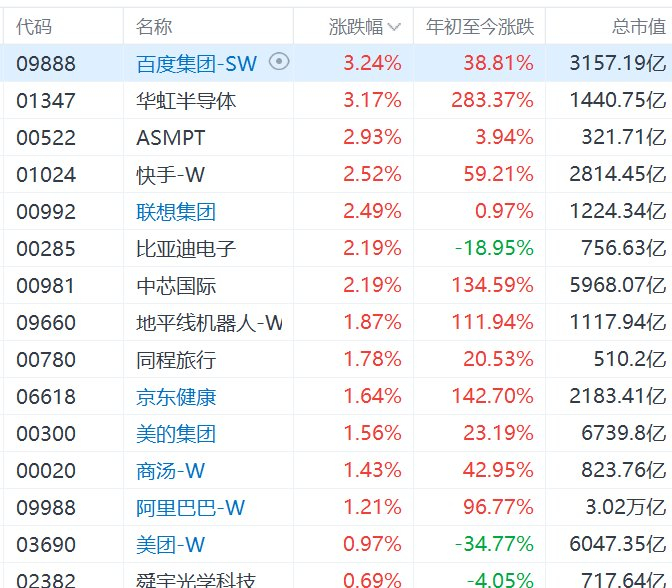
Core Viewpoint - The Hong Kong technology stocks experienced a broad rally, with the Hang Seng Technology Index opening up by 0.7% on November 20, 2023 [1] Group 1: Stock Performance - Baidu Group (SW) saw an increase of 3.24%, with a year-to-date gain of 38.81% and a total market capitalization of 315.72 billion [2] - Hua Hong Semiconductor rose by 3.17%, marking a significant year-to-date increase of 283.37%, with a market cap of 144.08 billion [2] - ASMPT increased by 2.93%, with a year-to-date gain of 3.94% and a market cap of 32.17 billion [2] - Kuaishou (W) rose by 2.52%, with a year-to-date increase of 59.21% and a market cap of 281.44 billion [2] - Lenovo Group increased by 2.49%, with a year-to-date gain of 0.97% and a market cap of 122.43 billion [2] - BYD Electronics rose by 2.19%, but has a year-to-date decline of 18.95%, with a market cap of 75.66 billion [2] - SMIC (中芯国际) increased by 2.19%, with a year-to-date gain of 134.59% and a market cap of 596.81 billion [2] - Horizon Robotics (W) saw an increase of 1.87%, with a year-to-date gain of 111.94% and a market cap of 111.79 billion [2] - Tongcheng Travel rose by 1.78%, with a year-to-date increase of 20.53% and a market cap of 51.02 billion [2] - JD Health increased by 1.64%, with a year-to-date gain of 142.70% and a market cap of 218.34 billion [2] - Midea Group rose by 1.56%, with a year-to-date increase of 23.19% and a market cap of 673.98 billion [2] - SenseTime (W) increased by 1.43%, with a year-to-date gain of 42.95% and a market cap of 82.38 billion [2] - Alibaba (W) rose by 1.21%, with a year-to-date increase of 96.77% and a market cap of 3 trillion [2] - Meituan (W) saw a smaller increase of 0.97%, with a year-to-date decline of 34.77% and a market cap of 604.73 billion [2]
两个月回撤超15%!恒科指数长期逻辑不改,市场关注AI落地效果
Zheng Quan Shi Bao· 2025-11-19 23:48
Core Viewpoint - Since 2025, the Hong Kong stock market, led by technology and innovative pharmaceuticals, has experienced a bull market, with the Hang Seng Index rising over 30% and the Hang Seng Tech Index exceeding 50%. However, since October, the Hang Seng Tech Index has seen a significant pullback of over 15% in less than two months, with a recent streak of four consecutive declines. Analysts believe that this short-term adjustment does not alter the long-term investment logic for leading tech stocks in Hong Kong, especially with the gradual implementation of AI technologies by companies like Tencent and Alibaba, which is expected to drive a second growth phase for internet enterprises. The long-term investment value of the Hang Seng Tech Index remains promising due to valuation advantages, funding support, and AI-driven industrial upgrades [1][3][4]. Group 1: Market Performance - Before October, Hong Kong tech stocks were performing well, with 9 out of 30 constituents of the Hang Seng Tech Index rising over 100%, and the top performer, Hua Hong Semiconductor, increasing nearly 270%. Other notable stocks like Tencent, Baidu, and Xiaomi also saw gains exceeding 50%, while only Meituan and Haier Smart Home experienced declines, with Meituan dropping over 30% [1][2]. - After October, the situation changed dramatically, with only 4 stocks rising, while 7 stocks fell over 20%, including Li Auto and Sunny Optical Technology, which both dropped over 27%. Tencent and Meituan also saw declines of around 5% [2]. Group 2: Fund Flows and Market Sentiment - There has been a noticeable outflow of southbound funds from certain Hang Seng Tech constituents, with Alibaba experiencing the highest net sell-off of 2.5 billion HKD, followed by Li Auto and Sunny Optical Technology with net sell-offs of 1.2 billion HKD and several hundred million HKD, respectively [2]. - The recent downturn in the Hang Seng Tech Index is attributed to three main factors: excessive prior gains leading to profit-taking, the U.S. imposing tariffs and tightening software export controls, and a mini-crash in U.S. AI stocks resulting in a significant drop in global tech risk appetite [2][3]. Group 3: Long-term Investment Logic - Despite short-term volatility, the long-term investment logic for the Hang Seng Tech Index remains intact, as it comprises internet giants and companies in semiconductors and electric vehicles that are considered scarce assets for both domestic and global investors [3][4]. - Analysts suggest that the current valuation of the Hang Seng Index and Hang Seng Tech Index is still significantly lower than their peaks in 2021, indicating potential for recovery and growth in the coming years [3]. Group 4: AI and Market Revaluation - The market is increasingly focused on the tangible effects of AI implementation, moving from a narrative-driven approach to one that emphasizes financial performance. Companies like Tencent and Alibaba are seeing revenue growth attributed to AI applications, with Tencent reporting a 15% year-on-year revenue increase and Alibaba planning substantial investments in AI and cloud infrastructure [5][6]. - The structural revaluation driven by AI and robotics is expected to benefit comprehensive platforms like Tencent, Alibaba, and Baidu, while smaller companies lacking their own ecosystems may face marginalization during the global de-bubble process [6].



华虹公司:明年或后年将推出40nm NOR FLASH产品
Ge Long Hui A P P· 2025-11-19 08:55
Core Viewpoint - The company reported strong growth in its NOR FLASH storage business, which is a segment of the overall flash memory market, outpacing the market growth in the third quarter [1] Company Performance - The company noted that its third-quarter growth rate in the NOR FLASH segment is significantly higher than the overall market, attributed to its own advancements [1] - The 55nm NOR FLASH has entered mass production in recent quarters, contributing to the company's performance [1] - The 55nm MCU is also entering mass production, further enhancing the company's growth prospects [1] Future Outlook - The company plans to launch 40nm products in the next year or two, which is expected to provide an additional growth impetus [1]
资金动向 | 北水净买入港股超74亿港元,持续加仓阿里、小米
Ge Long Hui A P P· 2025-11-18 11:39
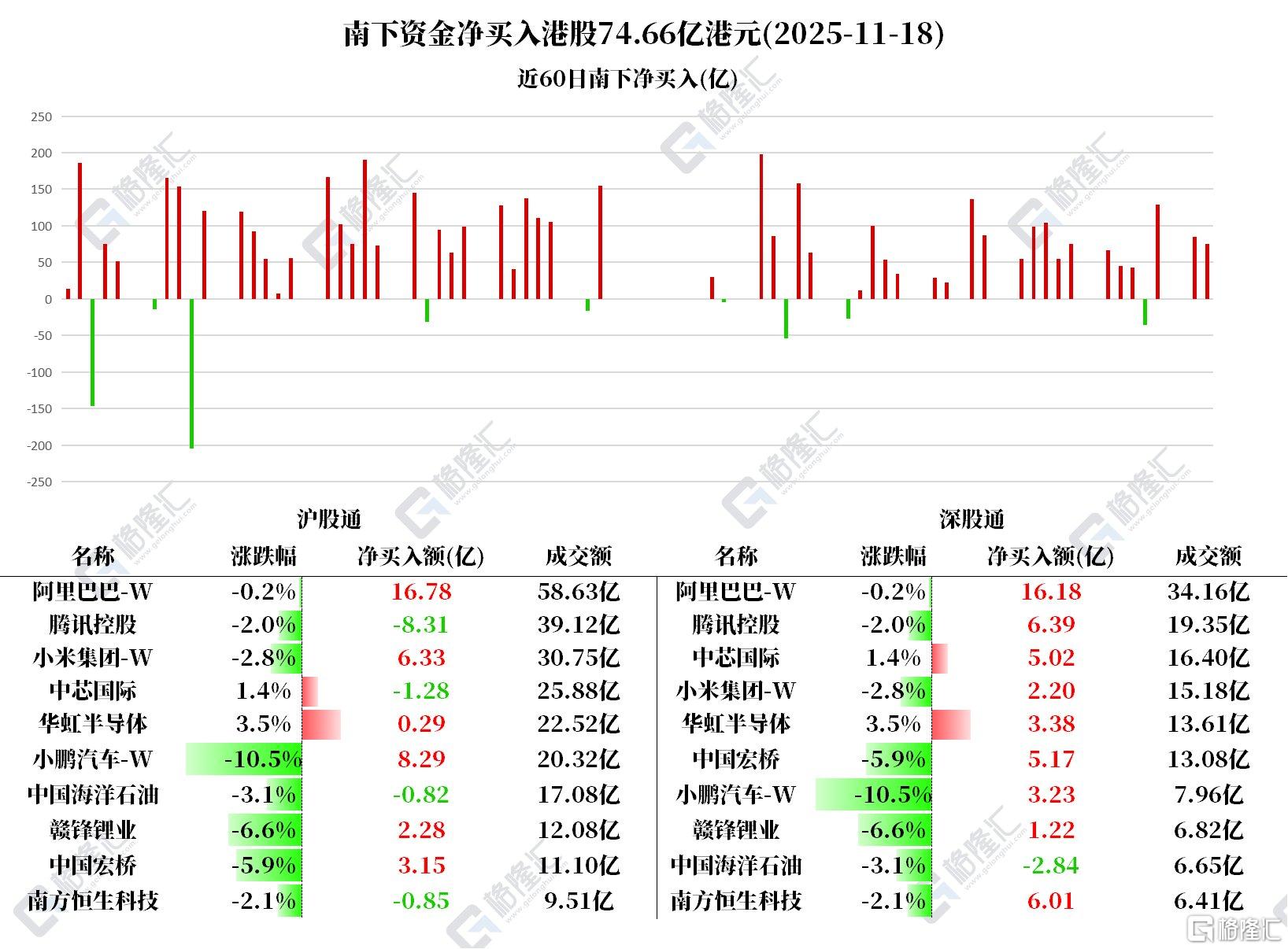
Group 1 - Net purchases of stocks include Alibaba-W at 32.97 billion, Xpeng Motors-W at 11.52 billion, Xiaomi Group-W at 8.53 billion, and others, while net sales include China National Offshore Oil at 3.65 billion and Tencent Holdings at 1.91 billion [1] - Southbound funds have continuously net bought Xiaomi for 15 days, totaling 106.6072 billion HKD, and have net bought Alibaba for 4 days, totaling 90 billion HKD [1] Group 2 - Alibaba-W saw a slight decline of 0.2% with a net purchase of 16.78 billion and a transaction amount of 58.63 billion [5] - Tencent Holdings experienced a decline of 2.0% with a net sale of 8.31 billion and a transaction amount of 39.12 billion [5] - Xiaomi Group-W had a decline of 2.8% with a net purchase of 6.33 billion and a transaction amount of 30.75 billion [5] - Xpeng Motors-W declined by 10.5% with a net purchase of 8.29 billion and a transaction amount of 20.32 billion [5] - China National Offshore Oil declined by 3.1% with a net sale of 0.82 billion and a transaction amount of 17.08 billion [5] Group 3 - Alibaba's AI application, Qianwen App, launched on the 17th, quickly rose to the fourth position in the Apple App Store free apps ranking, surpassing DeepSeek [6] - Xpeng Motors plans to launch 7 new vehicles with "super range extender" configurations in 2026, significantly expanding its total addressable market [6] - Xiaomi Group reported a total revenue of 113.1 billion for Q3 2025, a year-on-year increase of 22.3%, exceeding expectations [6] - Semiconductor company SMIC received a cautious outlook from JPMorgan, with a target price raised to 57 HKD [6] Group 4 - Daiwa maintained a "underperform" rating for Ganfeng Lithium, raising the target price from 23 HKD to 53 HKD, expecting the company to record net profits from 2025 to 2027 after a net loss in 2024 [7]


研报掘金丨国信证券:维持华虹半导体“优于大市”评级,业绩保持稳定增长
Ge Long Hui A P P· 2025-11-18 08:45
Core Viewpoint - Guosen Securities report indicates that Huahong Semiconductor's Q3 2025 performance exceeded guidance, with steady growth expected in Q4 2025 due to price recovery and product structure optimization [1] Group 1: Performance and Capacity - The company's production capacity is being further released, maintaining stable growth in performance [1] - The utilization rate has remained at full capacity for multiple quarters, with 12-inch capacity steadily contributing to revenue growth [1] Group 2: Market Demand and Product Development - Increased demand for flash memory products and strong demand for analog and power management products are noted [1] - The company aims to enhance its average selling price (ASP) through product structure optimization, targeting the GaN field for power products related to AI applications [1] Group 3: Strategic Outlook - The upgrade of Nor Flash processes and the continuous increase in BCD proportion are part of the company's long-term strategy [1] - The company maintains a competitive edge with leading processes and global top-tier clients in specialty process foundry [1] - Slight adjustments to expense and gross margin rates are made based on company guidance, maintaining an "outperform" rating [1]

60%疯狂提价!港A半导体闻风躁动,反攻信号初现?
Ge Long Hui· 2025-11-18 06:42
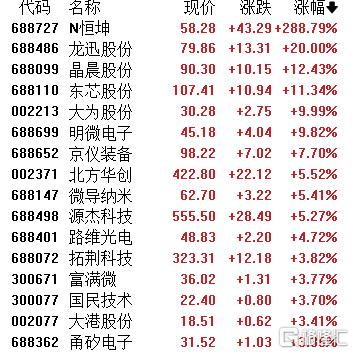
Group 1: Semiconductor Sector Performance - The semiconductor sector in Hong Kong and A-shares experienced a rebound, with notable stocks like Longxin Co. and Daway Co. hitting the daily limit up [1][2] - Key stocks such as SMIC, Cambrian, and Huagong Information also saw significant gains, indicating a strong market sentiment in the semiconductor industry [1][2] Group 2: Price Trends in Memory Chips - The price of DRAM has surged significantly, with a year-on-year increase of 171.8% expected by Q3 2025, driven by a "super cycle" in memory chips [4] - Samsung has raised prices for certain memory chips by up to 60% since September, with specific products like the 32GB DDR5 memory chip seeing a price increase from $149 to $239 [5][6] Group 3: Supply and Demand Dynamics - The demand for high-performance storage, particularly from AI servers, is a key driver behind the price increases, leading to a supply-demand imbalance [6][8] - Analysts predict that the shortage of traditional DRAM products like DDR4 may persist until 2027 due to the overwhelming demand from AI applications [7] Group 4: Industry Expansion and Future Outlook - SMIC reported a capacity utilization rate of 95.8%, indicating strong order demand and a supply shortage in the semiconductor market [8] - Major players like SK Hynix and Samsung are expanding their production capabilities to meet the growing demand, with significant investments planned for new facilities [8] - The long-term growth prospects for the storage industry are viewed positively, with expectations of continued price increases and supply-demand gaps in the coming years [8][9]


科技创新渐成经济增长新支点
Jin Rong Shi Bao· 2025-11-18 04:56
Core Insights - The Sci-Tech Innovation Board (STAR Market) has become a key indicator of the performance and development trends of "hard technology" enterprises in China, with significant growth in R&D investment and net profit [1][2]. Group 1: Performance Metrics - As of November 13, 592 companies on the STAR Market reported a total R&D investment of nearly 120 billion yuan and total revenue exceeding 1.1 trillion yuan for the first three quarters, with a net profit growth of 75% year-on-year in Q3 [1]. - For the first three quarters of 2025, STAR Market companies achieved a revenue of 1,105 billion yuan, a year-on-year increase of 7.9%, and a net profit of 49.27 billion yuan, up 8.9% year-on-year [2]. - Over 70% of STAR Market companies reported revenue growth, and nearly 60% reported net profit growth, with 158 companies seeing net profit increases exceeding 50% [2]. Group 2: R&D Investment - The total R&D investment for STAR Market companies reached 119.75 billion yuan, which is 2.4 times the net profit, with a median R&D intensity of 12.4%, leading all A-share sectors [4]. - The "1+6" reform initiated in June aims to support unprofitable tech companies, with 35 such companies showing promising development by prioritizing R&D [4]. Group 3: Sector Performance - The integrated circuit sector saw 121 related companies on the STAR Market achieve a revenue growth of 25% and a net profit growth of 67% in the first three quarters [6]. - The artificial intelligence sector has emerged as a new growth pillar, with companies like Cambrian and Haiguang Information reporting revenue increases of nearly 24 times and 55%, respectively [6]. - The biopharmaceutical sector experienced a revenue growth of 11% and a net profit growth of 48%, with nine new drugs approved for market and significant international business development [7].


【招商电子】半导体行业深度跟踪:存储景气上行价格涨幅扩大,设备等受益于下游扩产趋势
招商电子· 2025-11-18 03:15
Core Viewpoint - Nvidia and AMD maintain an optimistic outlook on AI, with Nvidia projecting $500 billion in revenue from Blackwell and Rubin series products over the next five quarters. AMD reported record revenue in Q3 2025 and anticipates a CAGR of over 60% for its data center business. The storage cycle is on an upward trend, driven by increasing demand in the AI era, leading to a sustained supply-demand gap and accelerated price increases in October. The domestic self-controllable process is accelerating, benefiting from the expansion of advanced logic and storage production lines in China by 2026. Investment opportunities are suggested in the storage sector, equipment/materials benefiting from downstream expansion, and optimistic computing power sectors [3][4][5]. Industry Sentiment Tracking - Demand Side: Some consumer electronics sectors are recovering, with innovations driven by AI and automotive applications. Global smartphone shipments increased by 2.6% YoY in Q3 2025, while PC shipments rose by 9.4% YoY. Wearable AI glasses saw significant growth, although growth is expected to slow in the second half of the year. Server shipments are projected to grow by 24.1% YoY [4][5]. - Inventory Side: Power MCU and analog DOI saw a decrease, with inventory adjustments nearing completion. Q3 2025 saw an increase in average inventory for both domestic and overseas smartphone chip manufacturers [5]. - Supply Side: Capacity utilization rates are recovering, with TSMC reporting strong demand for AI data centers. SMIC's capacity utilization reached 95.8%, and domestic advanced logic production line expansions are expected to accelerate by 2026 [5][6]. - Price Side: Since Q3 2025, DRAM and NAND prices have risen significantly, with October seeing accelerated price increases due to AI server demand [6]. - Sales Side: Global semiconductor sales in September 2025 reached $64.97 billion, marking a 25.1% YoY increase [6]. Industry Chain Tracking - Design/IDM: Demand for AI-related chips is increasing, with Nvidia and AMD showing strong performance. AMD's Q3 2025 revenue reached a record high, and its data center business is expected to grow significantly [8][9]. - Storage: The storage industry is experiencing a cyclical upturn driven by AI demand, with profitability improving for manufacturers [9]. - MCU: The market is seeing a mild recovery, although the effect of customers pulling inventory ahead of time has weakened compared to the first half of the year [10]. - Analog: Demand for AI-related products remains optimistic, but domestic consumer demand has weakened, affecting Q3 performance [10]. - RF: Mergers among major players are reshaping the market landscape, presenting opportunities for domestic manufacturers [11]. - CIS: Domestic manufacturers are making breakthroughs, particularly in automotive applications [11]. - Power Semiconductors: Infineon has raised its revenue guidance for AI data centers, while domestic companies showed mixed performance in Q3 2025 [12]. Investment Recommendations - Focus on sectors benefiting from the ongoing upturn in the storage cycle, equipment/materials benefiting from downstream expansion, and optimistic computing power sectors. Specific attention is recommended for domestic chip manufacturers and companies poised to benefit from the recovery in AI server demand [15].
