
VeriSilicon(688521)

Search documents
大基金概念板块11月17日跌0.07%,拓荆科技领跌,主力资金净流出20.3亿元
Sou Hu Cai Jing· 2025-11-17 09:21
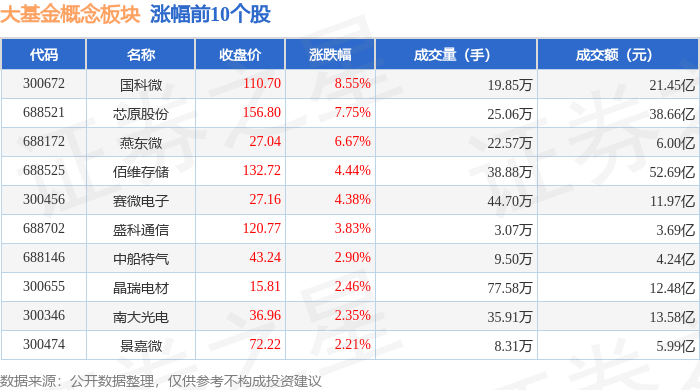
Market Overview - The large fund concept sector experienced a slight decline of 0.07% on November 17, with TuoJing Technology leading the drop [1] - The Shanghai Composite Index closed at 3972.03, down 0.46%, while the Shenzhen Component Index closed at 13202.0, down 0.11% [1] Stock Performance - Notable gainers in the large fund concept sector included: - GuoKeWei (300672) with a closing price of 110.70, up 8.55% [1] - XinYuan Co. (688521) at 156.80, up 7.75% [1] - GuaiDong Micro (688172) at 27.04, up 6.67% [1] - Conversely, TuoJing Technology (688072) saw a significant decline of 5.72%, closing at 311.13 [2] Capital Flow - The large fund concept sector saw a net outflow of 2.03 billion yuan from institutional investors, while retail investors contributed a net inflow of 1.16 billion yuan [2][3] - Key stocks with notable capital flows included: - XinYuan Co. (688521) with a net inflow of 4.93 billion yuan from institutional investors [3] - GuoKeWei (300672) with a net inflow of 1.91 billion yuan from institutional investors [3] - NanDa GuangDian (300346) with a net inflow of 94.64 million yuan from institutional investors [3]



半导体板块11月17日跌0.09%,拓荆科技领跌,主力资金净流出42.09亿元
Zheng Xing Xing Ye Ri Bao· 2025-11-17 08:46
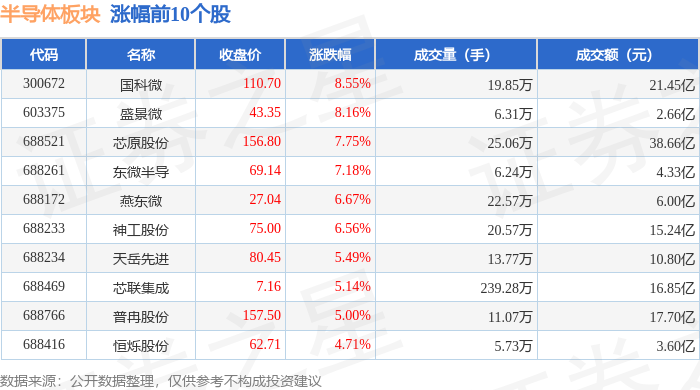
Market Overview - The semiconductor sector experienced a slight decline of 0.09% on November 17, with Tuojing Technology leading the drop [1] - The Shanghai Composite Index closed at 3972.03, down 0.46%, while the Shenzhen Component Index closed at 13202.0, down 0.11% [1] Top Performers - Tuke Micro (300672) saw a significant increase of 8.55%, closing at 110.70 with a trading volume of 198,500 shares and a transaction value of 2.145 billion [1] - Shengjing Micro (603375) rose by 8.16%, closing at 43.35 with a transaction value of 266 million [1] - Chip Origin (688521) increased by 7.75%, closing at 156.80 with a transaction value of 3.866 billion [1] Underperformers - Tuojing Technology (688072) led the decline with a drop of 5.72%, closing at 311.13 and a transaction value of 3.020 billion [2] - Jingyi Equipment (688652) fell by 5.06%, closing at 91.20 with a transaction value of 540 million [2] - Hengxuan Technology (688608) decreased by 4.57%, closing at 213.85 with a transaction value of 1.066 billion [2] Capital Flow - The semiconductor sector saw a net outflow of 4.209 billion from institutional investors, while retail investors contributed a net inflow of 2.684 billion [2] - The overall capital flow indicates a mixed sentiment, with institutional investors withdrawing funds while retail investors increased their positions [2] Individual Stock Capital Flow - Chip Origin (688521) had a net inflow of 4.93 billion from institutional investors, while retail investors saw a net outflow of 4.70 billion [3] - Tuke Micro (300672) experienced a net inflow of 191 million from institutional investors, with retail investors also withdrawing 1.19 billion [3] - Other notable stocks include Fumu Micro (688385) with a net inflow of 73.63 million from institutional investors [3]
ROKID发布AI眼镜,看好端侧需求起量及云厂引领下的AI生态完善
Tianfeng Securities· 2025-11-17 08:01
Investment Rating - The industry rating is maintained as "Outperform" [11] Core Insights - The report highlights the accelerating investment in AI infrastructure by major tech companies, indicating a robust demand for computing power and a positive outlook for the AI ecosystem [1][17] - The end-side AI market is expected to see significant growth, with key players like Apple, Nvidia, and Meta leading innovations and product launches [2][20][24] Summary by Sections AI Cloud Side - The ongoing US-China talks are easing tensions, leading to increased investments from major tech firms, which is expected to drive demand in the computing supply chain [1][17] - Meta has raised its capital expenditure forecast to $70-72 billion, driven by urgent needs in AI computing [1][18] - Microsoft's capital expenditure reached $34.9 billion in Q1 2026, with plans to double its data center capacity in the next two years [1][19] - Alphabet has adjusted its capital expenditure guidance for 2025 to $91-93 billion, focusing on expanding AI and cloud computing infrastructure [1][19] AI End Side - Apple reported record earnings, with iPhone revenue expected to grow by double digits in Q1 2026, and is increasing its AI R&D investments [2][20] - Nvidia's GTC Washington summit showcased the Vera Rubin superchip, with GPU shipment targets raised to 20 million by 2026 [2][24] - Meta's smart glasses have seen strong sales, with Reality Labs exceeding expectations, prompting increased production [2][26] - Industrial Fulian's net profit surged by 62% YoY in Q3, validating the profitability of its AI server business [2][29] - Luxshare Precision is leading innovations in AR technology and showcasing advanced optical interconnect solutions [2][32] - Google officially launched the seventh-generation TPU "Ironwood," expected to be available soon [2][41] - Rokid has introduced the new BOLON AI smart glasses, marking a significant collaboration in the smart wearable sector [2][8]





芯片ETF景顺(159560)开盘跌0.19%,重仓股中芯国际跌1.15%,寒武纪跌0.61%
Xin Lang Cai Jing· 2025-11-17 06:47
芯片ETF景顺(159560)业绩比较基准为中证芯片产业指数收益率,管理人为景顺长城基金管理有限公 司,基金经理为张晓南,成立(2023-11-09)以来回报为59.95%,近一个月回报为-3.94%。 风险提示:市场有风险,投资需谨慎。本文为AI大模型自动发布,任何在本文出现的信息(包括但不 限于个股、评论、预测、图表、指标、理论、任何形式的表述等)均只作为参考,不构成个人投资建 议。 来源:新浪基金∞工作室 11月17日,芯片ETF景顺(159560)开盘跌0.19%,报1.602元。芯片ETF景顺(159560)重仓股方面, 中芯国际开盘跌1.15%,寒武纪跌0.61%,海光信息涨0.75%,北方华创跌0.14%,澜起科技涨0.09%,兆 易创新涨0.99%,中微公司涨0.00%,豪威集团涨0.30%,芯原股份涨3.08%,长电科技跌0.13%。 ...




芯片50ETF(516920)开盘跌0.10%,重仓股中芯国际跌1.15%,寒武纪跌0.61%
Xin Lang Cai Jing· 2025-11-17 01:37
Core Viewpoint - The Chip 50 ETF (516920) opened at 1.000 CNY, experiencing a slight decline of 0.10% on November 17, indicating a challenging market environment for semiconductor stocks [1] Group 1: ETF Performance - The Chip 50 ETF's performance benchmark is the CSI Chip Industry Index return [1] - Since its inception on July 27, 2021, the ETF has recorded a return of -0.08% [1] - Over the past month, the ETF has seen a return of -4.01% [1] Group 2: Major Holdings Performance - Major holdings in the Chip 50 ETF include: - SMIC (中芯国际) down 1.15% [1] - Cambricon (寒武纪) down 0.61% [1] - Haiguang Information (海光信息) up 0.75% [1] - Northern Huachuang (北方华创) down 0.14% [1] - Lattice Semiconductor (澜起科技) up 0.09% [1] - GigaDevice (兆易创新) up 0.99% [1] - Zhongwei Company (中微公司) unchanged [1] - OmniVision (豪威集团) up 0.30% [1] - Chipone (芯原股份) up 3.08% [1] - JCET (长电科技) down 0.13% [1]
芯原股份戴伟民:AI眼镜仍处于技术验证与生态构建阶段
Ju Chao Zi Xun· 2025-11-14 16:09
Core Insights - The AI market at the edge is currently in an "acceleration phase," with a focus on the application of new terminal forms, particularly AI glasses, which are becoming a focal point in the industry [1] - AI glasses are expected to reshape user experiences in digital life and social scenarios, with broad application potential across consumer electronics, industrial, and medical fields [1] - The current stage of AI glasses is characterized by technology validation and ecosystem building, with significant challenges remaining before widespread adoption, particularly in terms of power consumption and efficiency [1] Company Developments - The company is actively optimizing and industrializing technology platforms related to AI glasses, collaborating with several leading global AI/AR/VR eyewear manufacturers [3] - A recent announcement revealed a partnership with Google to launch the Coral NPU IP, aimed at "always-on," ultra-low power edge applications for large language models [3] - The company is developing verification chips based on this IP for AI/AR glasses and smart home scenarios, facilitating the deployment of large language models at the edge [3] Industry Challenges - For edge AI devices, especially AI glasses, transitioning from concept-heavy releases to true large-scale commercialization requires advancements in computing power, power consumption, algorithms, and content ecosystems [3] - Collaboration with international ecosystem partners on NPU IP and chip platforms is expected to strengthen the company's technical and ecological positioning within the edge AI industry chain [3]
芯原与谷歌联合推出开源Coral NPU IP 构建边缘AI生态系统
Zheng Quan Shi Bao Wang· 2025-11-14 11:11
Group 1 - The core point of the news is that Chipone Technology (688521.SH) has announced a collaboration with Google to launch the Coral NPU IP, aimed at always-on, ultra-low power edge AI applications, enhancing the development of a robust edge AI ecosystem [1][2] - The Coral NPU is built on the RISC-V open instruction set architecture and supports mainstream machine learning frameworks, making it suitable for wearable devices and pervasive sensing systems [1][2] - Chipone is developing a verification chip based on the Coral NPU IP for applications such as AI/AR glasses and smart home devices, accelerating the deployment of large language models at the edge [2] Group 2 - In Q3 2025, Chipone achieved a record revenue of 1.281 billion yuan, marking a quarter-on-quarter increase of 119.26% and a year-on-year increase of 78.38% [2] - The company signed new orders worth 1.593 billion yuan in Q3 2025, a significant year-on-year increase of 145.80%, with approximately 65% of these orders related to AI computing [3] - For the first three quarters of 2025, new orders totaled 3.249 billion yuan, surpassing the total new orders for the entire year of 2024 [3]
芯原股份(688521):25Q3量产业务加速放量,营收同比高增78%
Shenwan Hongyuan Securities· 2025-11-14 08:50
Investment Rating - The report maintains a "Buy" rating for the company [2] Core Insights - The company reported a significant revenue increase of 78% year-on-year in Q3 2025, with total revenue reaching 1.281 billion yuan [6] - The company is positioned as the largest domestic and eighth largest global design IP vendor, benefiting from the ASIC customization trend [6] - The company has adjusted its revenue forecasts upward while lowering profit margins due to increased R&D investments [6] Financial Data and Profit Forecast - Total revenue for 2025 is projected at 3.353 billion yuan, with a year-on-year growth rate of 44.4% [5] - The company expects to incur a net loss of 661 million yuan in 2025, with a gradual improvement in profitability anticipated by 2027 [5][7] - R&D expenses are projected to be 1.677 billion yuan in 2025, accounting for 42.47% of revenue [6][7] Market Position and Orders - The company secured new orders worth 15.93 billion yuan in Q3 2025, a year-on-year increase of 145.8%, with AI-related orders constituting approximately 65% [6] - The company has a strong order backlog, with new orders in the first three quarters of 2025 exceeding the total for the entire year of 2024 [6] Strategic Acquisitions - The company plans to acquire a 97.0070% stake in Chipai Technology to enhance its RISC-V CPU IP offerings [6]
芯原股份董事长兼总裁戴伟民:当前AI眼镜仍处于技术验证与生态构建阶段
Zhong Zheng Wang· 2025-11-14 06:00
Core Insights - The AI edge market is in an acceleration phase with new applications emerging continuously, particularly in AI glasses, which are transitioning from a "hundred models" competition to a "hundred glasses" competition [1] - AI glasses are expected to revolutionize digital life and social interactions due to their natural human-computer interaction interfaces and enhanced local AI processing capabilities, showing significant potential in consumer electronics, industrial, and medical fields [1] - Current challenges for AI glasses include power consumption and efficiency, which are critical for achieving lightweight and long standby times, necessitating small model processing capabilities [1] Company Developments - The company is focusing on optimizing the technology platform and industrialization of AI glasses, collaborating with several leading global AI/AR/VR glasses clients [1] - On November 13, the company announced a partnership with Google to launch the Coral NPU IP, aimed at always-on, ultra-low power edge applications for large language models [1] - The company is developing verification chips based on Coral NPU IP for AI/AR glasses and smart home applications to accelerate the deployment of large language models at the edge [1]
集成电路ETF(159546)开盘跌1.81%,重仓股中芯国际跌0.08%,寒武纪跌2.52%
Xin Lang Cai Jing· 2025-11-14 05:04
Core Viewpoint - The integrated circuit ETF (159546) opened with a decline of 1.81%, indicating a bearish trend in the sector [1] Group 1: ETF Performance - The integrated circuit ETF (159546) opened at 1.795 yuan [1] - Since its establishment on October 11, 2023, the fund has achieved a return of 82.90% [1] - The fund's performance over the past month has decreased by 6.56% [1] Group 2: Major Holdings Performance - Major holdings in the ETF include: - SMIC (中芯国际) opened down 0.08% [1] - Cambricon (寒武纪) fell by 2.52% [1] - Haiguang Information (海光信息) decreased by 2.13% [1] - Lattice Technology (澜起科技) dropped by 2.97% [1] - GigaDevice (兆易创新) declined by 5.05% [1] - Haowei Group (豪威集团) fell by 1.18% [1] - Chipone (芯原股份) decreased by 2.10% [1] - JCET (长电科技) dropped by 1.15% [1] - Unisoc (紫光国微) fell by 1.81% [1] - Tongfu Microelectronics (通富微电) decreased by 2.47% [1]
