Hunan Aerospace Huanyu (688523)

Search documents
航天环宇:预计2025年净利润同比减少59.63%左右
Xin Lang Cai Jing· 2026-01-26 08:07
Core Viewpoint - The company, Hunan Aerospace Huanyu Communication Technology Co., Ltd., is expected to experience a significant decline in net profit for the year 2025, with projections indicating a decrease of approximately 59.63% compared to the previous year [1] Financial Projections - The estimated net profit attributable to the parent company's shareholders for 2025 is around 41 million yuan, which represents a decrease of approximately 60.57 million yuan from the previous year [1] - The projected net profit attributable to the parent company's shareholders, excluding non-recurring gains and losses, is expected to be about 19.6 million yuan, reflecting a decrease of around 55.97 million yuan year-on-year, equating to a decline of approximately 74.06% [1]

坚定加仓!卫星产业ETF(159218)盘中放量净流入近4亿!航天环宇、中科星图跌超10%
Sou Hu Cai Jing· 2026-01-26 07:16
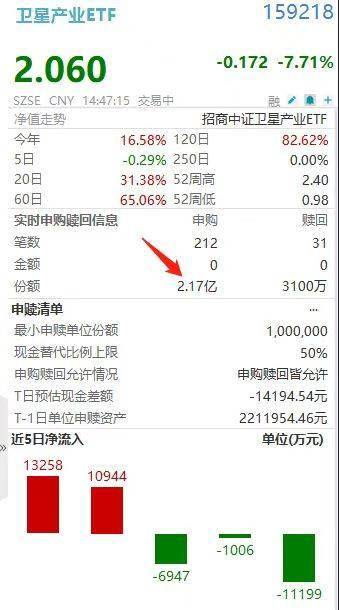
Core Viewpoint - The satellite sector experienced significant volatility, with the satellite industry ETF (159218) dropping by 7.53%, while over 390 million CNY flowed into the ETF, indicating a "buy the dip" mentality among investors [1]. Group 1: Market Performance - As of 14:50, the satellite industry ETF (159218) was down 7.71% to 2.060 CNY [2]. - The ETF's recent performance includes a 5-day decline of 0.29% and a 20-day increase of 31.38% [2]. - The ETF has seen a net inflow of 132.58 million CNY over the past five days, despite the current market downturn [2]. Group 2: Industry Drivers - The substantial capital influx during the downturn is driven by a strong belief in the "golden decade" strategic opportunities within the satellite industry [1]. - Three core pillars driving the industry include state-led satellite internet "new infrastructure," cost revolution from reusable rocket technology, and the application blue ocean from direct mobile connections to integrated air-space systems [1]. Group 3: Future Outlook - The industry is expected to transition from "stories and expectations" to "orders and performance" as domestic and international reusable rockets undergo intensive testing and national satellite constellation bidding progresses [3]. - For ordinary investors, utilizing the satellite industry ETF (159218) is seen as an efficient strategy to participate in the industry transformation while mitigating risks associated with individual stock volatility [3]. - The current market turbulence may mark the beginning of a healthier and more differentiated structural market trend [3].

A股商业航天概念跌幅扩大:中国卫星、博威合金等跌停
Ge Long Hui· 2026-01-26 03:20
Group 1 - The A-share commercial aerospace sector is experiencing a continuous adjustment, with significant declines in stock prices [1] - China Satellite has hit the daily limit down, indicating a severe drop in investor confidence [1] - Other companies such as Bowei Alloys and Runbei Aerospace Technology also faced daily limit down, while companies like Xinke Mobile, Shaoyang Hydraulic, Zhenyou Technology, Aerospace Huanyu, and Chaojie Co. saw declines exceeding 10% [1]


A股商业航天概念盘中持续调整,中国卫星封跌停,此前博威合金、润贝航科跌停,信科移...
Xin Lang Cai Jing· 2026-01-26 03:14
Group 1 - The A-share commercial aerospace sector is experiencing continuous adjustments, with significant declines in stock prices [1] - China Satellite has hit the daily limit down, indicating a severe drop in investor confidence [1] - Other companies such as Bowei Alloy and Runbei Aerospace Technology also faced daily limit downs, while companies like Xinke Mobile, Shaoyang Hydraulic, Zhenyou Technology, Aerospace Huanyu, and Chaojie Co. saw declines exceeding 10% [1]
1月23日科创板高换手率股票(附股)
Zheng Quan Shi Bao Wang· 2026-01-23 10:24
Market Performance - The Sci-Tech Innovation Board (STAR Market) index rose by 0.78%, closing at 1553.71 points, with a total trading volume of 6.727 billion shares and a turnover of 334.942 billion yuan, resulting in a weighted average turnover rate of 3.42% [1] - Among the tradable stocks on the STAR Market, 481 stocks closed higher, with 27 stocks experiencing a rise of over 10%, including Ruihua Technology, Laplace, and Zhenlei Technology, which hit the daily limit [1] - The turnover rate distribution shows that 2 stocks had a turnover rate exceeding 20%, 39 stocks between 10% and 20%, 114 stocks between 5% and 10%, 133 stocks between 3% and 5%, 247 stocks between 1% and 3%, and 65 stocks with a turnover rate below 1% [1] Individual Stock Highlights - Aerospace Huanyu had the highest turnover rate at 22.28%, closing up by 13.27% with a trading volume of 1.499 billion yuan [1] - Qingyun Technology closed down by 1.03% with a turnover rate of 20.25%, and a trading volume of 733 million yuan [1] - Other notable stocks with high turnover rates include Gaocai Co., Shengke Nano, and Haohan Depth, with turnover rates of 18.50%, 18.45%, and 18.10% respectively [1] Sector Analysis - The electronics sector had the most stocks with a turnover rate exceeding 5%, totaling 47 stocks, followed by the power equipment and computer sectors with 25 and 20 stocks respectively [2] - In terms of capital flow, 91 stocks with high turnover rates saw net inflows from main funds, with Zhenlei Technology, Jinko Solar, and Xinke Mobile receiving the highest net inflows of 585 million yuan, 445 million yuan, and 436 million yuan respectively [2] - Conversely, stocks with significant net outflows included Lankai Technology, Baiwei Storage, and Tengjing Technology, with net outflows of 932 million yuan, 876 million yuan, and 272 million yuan respectively [2] Leverage Fund Movements - A total of 76 stocks with high turnover rates received net purchases from leveraged funds, with notable increases in financing balances for Zhongkong Technology, Baiwei Storage, and Godewei, which increased by 521 million yuan, 507 million yuan, and 263 million yuan respectively [2] - Stocks with significant decreases in financing balances included Lankai Technology, Moer Thread, and Huafeng Technology, which decreased by 287 million yuan, 189 million yuan, and 188 million yuan respectively [2]




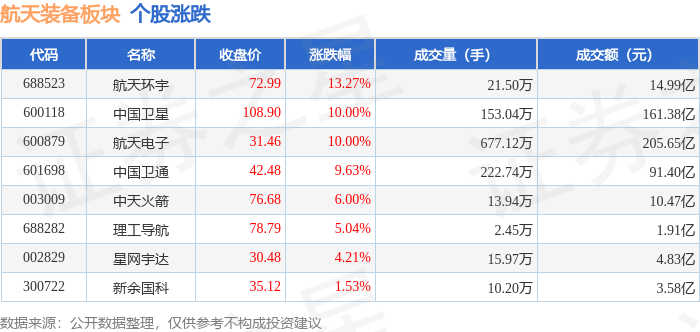
航天装备板块1月23日涨9.46%,航天环宇领涨,主力资金净流入38.33亿元
Zheng Xing Xing Ye Ri Bao· 2026-01-23 09:12
Core Viewpoint - The aerospace equipment sector experienced a significant increase of 9.46% on January 23, with Aerospace Hanyu leading the gains. The Shanghai Composite Index closed at 4136.16, up 0.33%, while the Shenzhen Component Index closed at 14439.66, up 0.79% [1]. Group 1: Stock Performance - Aerospace Hanyu (688523) closed at 72.99, with a rise of 13.27% and a trading volume of 215,000 shares [1]. - China Satellite (600118) closed at 108.90, increasing by 10.00% with a trading volume of 1,530,400 shares [1]. - Aerospace Electronics (600879) closed at 31.46, also up by 10.00%, with a trading volume of 6,771,200 shares [1]. - China Satcom (601698) closed at 42.48, rising by 9.63% with a trading volume of 2,227,400 shares [1]. - Zhongtian Rocket (003009) closed at 76.68, increasing by 6.00% with a trading volume of 139,400 shares [1]. - Other notable performances include: - Ligong Navigation (688282) at 78.79, up 5.04% [1] - StarNet Yuda (002829) at 30.48, up 4.21% [1] - Xinyu Guoke (300722) at 35.12, up 1.53% [1]. Group 2: Capital Flow - The aerospace equipment sector saw a net inflow of 3.833 billion yuan from institutional investors, while retail investors experienced a net outflow of 2.3 billion yuan [1]. - The capital flow for key stocks includes: - Aerospace Electronics (600879) with a net inflow of 1.886 billion yuan from institutional investors and a net outflow of 899.6 million yuan from retail investors [2]. - China Satellite (600118) had a net inflow of 1.483 billion yuan from institutional investors and a net outflow of 1.043 billion yuan from retail investors [2]. - China Satcom (601698) recorded a net inflow of 262 million yuan from institutional investors and a net outflow of 190 million yuan from retail investors [2]. - Zhongtian Rocket (003009) had a net inflow of 97.5 million yuan from institutional investors and a net outflow of 79.3 million yuan from retail investors [2].




科创板收盘播报:科创50指数涨0.78% 通信设备股表现强势
Xin Hua Cai Jing· 2026-01-23 07:26
Group 1 - The Sci-Tech Innovation 50 Index opened lower on January 23, followed by a narrow adjustment, and eventually closed with a slight increase of 0.78% at 1553.71 points, with a total trading volume of approximately 110.8 billion yuan [1] - The overall Sci-Tech Innovation Index rose by 1.85% to 1899.78 points, with a total trading volume of about 334.9 billion yuan [1] - On January 23, 600 stocks in the Sci-Tech Innovation Board saw an average increase of 2.28% and an average turnover rate of 3.87%, with a total trading volume of 334.9 billion yuan and an average fluctuation of 4.77% [1] Group 2 - In terms of individual stock performance, stocks such as Ruihua Technology, Laplace, Zhenlei Technology, and Jinko Solar reached their daily limit, showing significant gains [1] - Conversely, Jucheng Co. experienced a decline of 7.87%, marking the largest drop among the stocks [1] - In trading volume, Lanke Technology led with a total of 12.04 billion yuan, while ST Pava had the lowest trading volume at 1.258 million yuan [2] Group 3 - Regarding turnover rates, Aerospace Huanyu had the highest turnover rate at 22.28%, while Bairen Medical recorded the lowest at 0.18% [3]


成分股多股涨停,科创综指增强ETF涨1.04%
Xin Lang Cai Jing· 2026-01-23 06:33
Group 1 - The aerospace new materials, forklift electrification for overseas markets, and flexible protective layers for robots are viewed positively by institutions, indicating growth certainty or long-term potential [1] - As of January 23, the Shanghai Composite Index rose by 0.29%, the Shenzhen Component Index increased by 0.55%, and the ChiNext Index went up by 0.27% [1] - The ETF market saw the Kweichow Moutai (588670) increase by 1.04%, with several component stocks such as Laplace (688726.SH) and Zhenray Technology (688270.SH) hitting the daily limit [1] Group 2 - Huatai Securities indicates that large low-orbit constellations will drive the scaling of rockets, with cost reductions and engine performance improvements expected to boost two new materials for rockets [2] - The supply side of aerospace stainless steel is highly segmented and customized, with companies having first-mover advantages likely to gain structural growth opportunities; high-temperature alloy suppliers have a competitive landscape that is favorable [2] - CITIC Securities reports that with rising raw material prices and increased demand for AI and storage, a new round of packaging price increases is anticipated, with a focus on advanced packaging and storage packaging segments [2]



卫星互联网商业化提速!睿创微纳20%涨停,著名演员黄景瑜官宣将上太空,SpaceX2027年推第二代星链系统
Jin Rong Jie· 2026-01-23 03:15
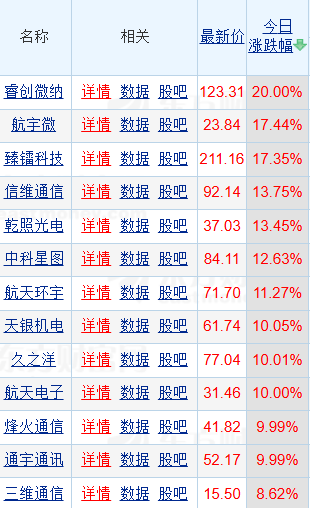
Market Performance - The satellite internet sector experienced a significant increase, with the sector rising by 4.72% as of the report's publication [1] - Leading stocks included Ruichuang Micro-Nano, which surged by 20.00%, and several others such as Tongyu Communication and Aerospace Electronics, which hit the daily limit [1][2] Industry Trends - The core market speculation is driven by the accelerated commercialization of satellite internet, with expectations for new developments from overseas giants and steady progress in domestic low-orbit satellite networks [2] - The third Beijing Commercial Space Industry High-Quality Development Promotion Conference and the 2026 Beijing International Commercial Space Exhibition will take place from January 23 to 25, featuring over 300 global companies [3] Technological Developments - SpaceX plans to launch its second-generation Starlink system in 2027, with the approval to deploy 7,500 new satellites capable of achieving internet speeds of up to 1 Gbps [4] - Blue Origin announced its TeraWave satellite communication network, consisting of 5,408 satellites, set to launch in Q4 2027, offering symmetrical data transmission speeds of up to 6 Tbps [4] Related Industries - The demand for low-orbit satellite networks is increasing, with domestic satellite production capabilities improving, leading to a potential expansion of the industry scale [6] - There is a pressing need for high-performance RF chips for satellite communication, particularly those supporting direct satellite connections for mobile devices, benefiting from technological advancements [6] - Ground terminal equipment is essential for the commercialization of satellite internet, with companies capable of developing and manufacturing these devices expected to see growth opportunities [6] - The satellite internet sector can address communication gaps in remote areas, with increasing demand for high-bandwidth services from enterprises and government users, indicating a broad long-term growth potential for companies in this space [6]


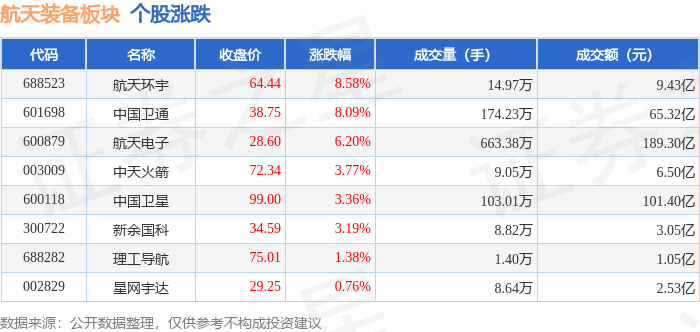
航天装备板块1月22日涨5.87%,航天环宇领涨,主力资金净流入4.31亿元
Zheng Xing Xing Ye Ri Bao· 2026-01-22 09:01
Core Viewpoint - The aerospace equipment sector experienced a significant increase of 5.87% on January 22, with Aerospace Hanyu leading the gains [1] Group 1: Market Performance - The Shanghai Composite Index closed at 4122.58, up 0.14%, while the Shenzhen Component Index closed at 14327.05, up 0.5% [1] - Key stocks in the aerospace equipment sector showed notable price increases, with Aerospace Hanyu rising by 8.58% to a closing price of 64.44 [1] Group 2: Stock Performance Details - Aerospace Hanyu (688523) had a trading volume of 149,700 shares and a transaction value of 943 million [1] - China Satellite (600118) closed at 99.00, up 3.36%, with a trading volume of 1,030,100 shares and a transaction value of 101.40 million [1] - Aerospace Electronics (600879) saw a 6.20% increase, closing at 28.60, with a trading volume of 6,633,800 shares and a transaction value of 189.30 million [1] Group 3: Fund Flow Analysis - The aerospace equipment sector saw a net inflow of 431 million from institutional investors, while retail investors experienced a net outflow of 645 million [1] - China Satellite (601698) had a net inflow of 321 million from institutional investors, but a net outflow of 417 million from retail investors [2] - Aerospace Hanyu (688523) recorded a net inflow of 99.16 million from institutional investors, with retail investors showing a net outflow of 82.14 million [2]