
Geovis(688568)

Search documents
IT服务板块12月31日涨1.2%,立方控股领涨,主力资金净流入4.54亿元
Zheng Xing Xing Ye Ri Bao· 2025-12-31 09:07
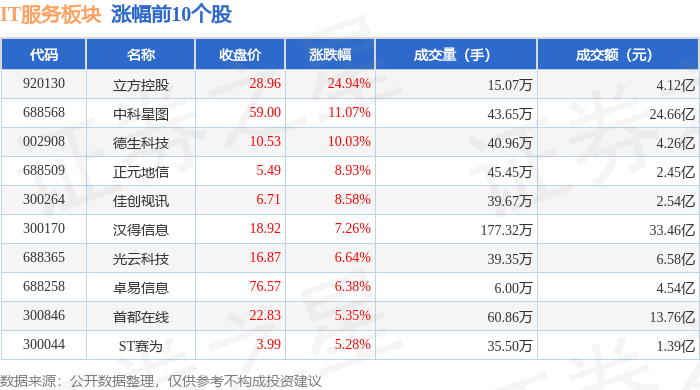
Core Insights - The IT services sector experienced a 1.2% increase on December 31, with Lifan Holdings leading the gains [1] - The Shanghai Composite Index closed at 3968.84, up 0.09%, while the Shenzhen Component Index closed at 13525.02, down 0.58% [1] IT Services Sector Performance - Lifan Holdings (code: 920130) closed at 28.96, with a significant increase of 24.94% and a trading volume of 150,700 shares, amounting to a transaction value of 412 million yuan [1] - Other notable performers included: - Zhongke Star Map (code: 688568) with a closing price of 59.00, up 11.07% and a trading volume of 436,500 shares, totaling 2.466 billion yuan [1] - Desheng Technology (code: 002908) closed at 10.53, up 10.03% with a trading volume of 409,600 shares, amounting to 426 million yuan [1] - Zhengyuan Dixin (code: 688509) closed at 5.49, up 8.93% with a trading volume of 454,500 shares, totaling 245 million yuan [1] Capital Flow Analysis - The IT services sector saw a net inflow of 454 million yuan from institutional investors, while retail investors contributed a net inflow of 133 million yuan [2] - Notable capital flows included: - Han De Information (code: 300170) with a net inflow of 381 million yuan from institutional investors [3] - Capital inflow for Lifan Holdings (code: 920130) was 143 million yuan from institutional investors [3] - Desheng Technology (code: 002908) experienced a net inflow of 144 million yuan from institutional investors [3]


中科星图成立低空装备系统公司
Zheng Quan Shi Bao Wang· 2025-12-31 07:33
Group 1 - The core point of the article is the establishment of a new company, 中科星图低空装备系统(安徽)有限公司, which is fully owned by 中科星图 [1] - The registered capital of the new company is 200 million yuan [1] - The business scope of the company includes satellite navigation services, manufacturing and sales of intelligent unmanned aerial vehicles, and manufacturing of radar and supporting equipment [1]
涨超7%!卫星产业ETF(159218)持续拉升,航天环宇、国博电子等近十只成分股涨超10%
Jin Rong Jie· 2025-12-31 06:53
Group 1 - The satellite industry ETF (159218) increased by 7.06% as of December 31, with several constituent stocks, including Aerospace Huanyu, Guobo Electronics, and Xinwei Communication, rising over 10% [1][2] - The trading volume for the satellite industry ETF exceeded 410 million [1] - The analysis indicates that the commercial aerospace sector has formed a positive cycle of "cost reduction - incremental growth - application - revenue" driven by policy, capital, technology, and market factors [2] Group 2 - The satellite industry ETF (159218) is the first ETF tracking the CSI Satellite Industry Index, covering the entire industry chain, including satellite manufacturing, launch vehicles, ground equipment, and operational services [2] - This ETF has become an important tool for investors to allocate resources in the commercial aerospace sector and to smooth out individual stock volatility [2]


AI算力方向强势收官2025!云计算ETF(159890)午后上攻强势冲击6连阳
Sou Hu Cai Jing· 2025-12-31 06:27
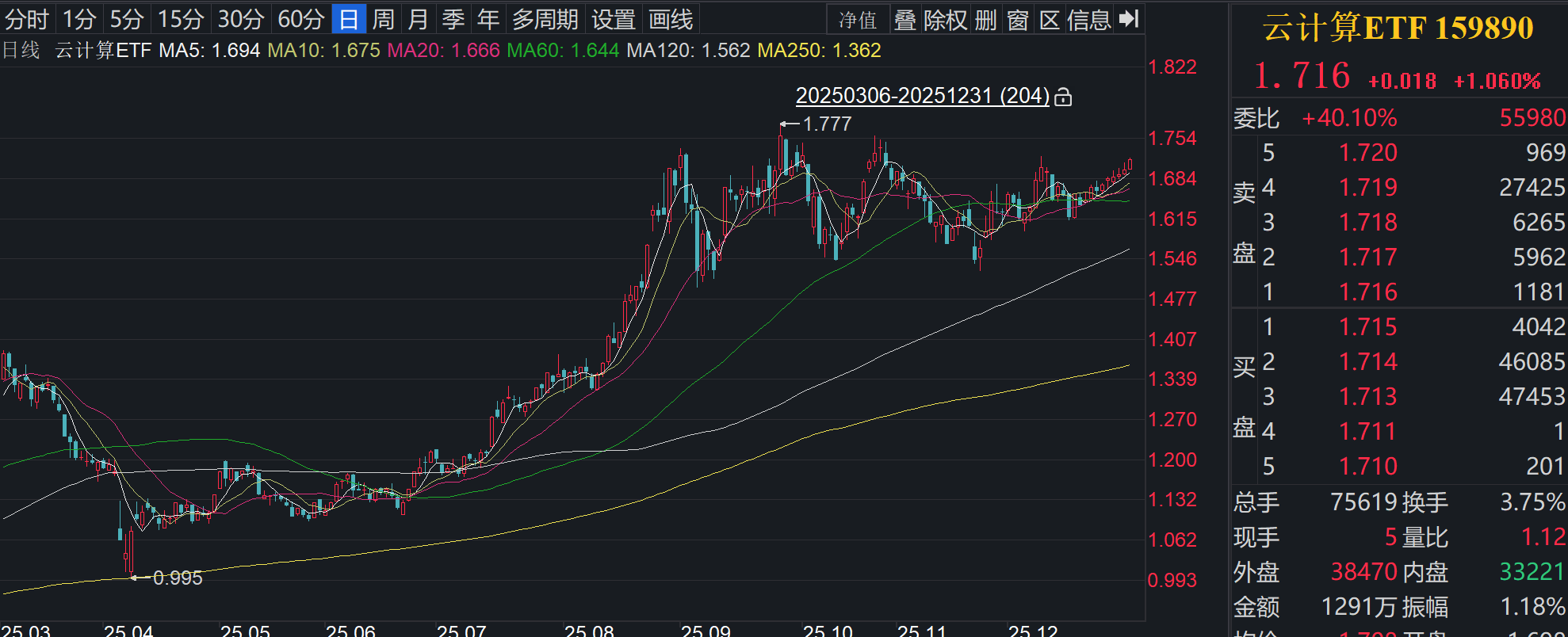
Core Viewpoint - The AI computing power sector is experiencing significant growth, driven by government initiatives and increasing demand for domestic AI chips, particularly the H200 chip, which is set to be delivered to Chinese customers soon [3][4][5]. Group 1: Market Performance - On the last trading day of 2025, AI computing stocks saw a strong afternoon rally, with the cloud computing ETF (159890) rising over 1% and achieving a six-day winning streak [1]. - Notable stock performances included a rise of 11.46% for Yidian Tianxia, over 8% for Hand Information, and more than 4% for companies like Zhongke Xingtai and Wanxing Technology [1]. Group 2: Policy and Industry Developments - A key government official announced the implementation of the "AI+" initiative, which aims to create extensive application scenarios for AI computing power chips, leading to rapid growth in demand and innovation within the sector [3]. - The conditional opening of the H200 chip to China is seen as a positive development, with major tech companies like Alibaba and ByteDance planning significant purchases to enhance their AI capabilities [4]. Group 3: Domestic Chip Strategy - Domestic companies are adopting varied strategies in response to the H200 chip's availability, with Alibaba and ByteDance pursuing large-scale purchases, while Baidu focuses on self-developed Kunlun AI chips to reduce reliance on external suppliers [4]. - Tencent is exploring indirect methods to acquire advanced computing power, aiming to secure over $1.2 billion in usage rights for the latest B200/B300 chips [4]. Group 4: Growth Projections - According to IDC and Inspur, China's intelligent computing power is projected to reach 1,037.3 EFLOPS by 2025, with a compound annual growth rate of 46.2% from 2023 to 2028 [6]. - The general computing power in China is expected to grow to 85.8 EFLOPS by 2025, with a compound annual growth rate of 18.8% during the same period [6]. Group 5: Investment Opportunities - The current landscape of the AI computing market presents numerous opportunities for investment, with a focus on domestic chip development and technological innovation [5][6]. - The cloud computing ETF (159890) tracks a diverse range of companies involved in AI infrastructure and applications, indicating a comprehensive approach to the AI computing era [6].


卫星ETF(159206)早盘再冲高!强势涨超2%,成分股乾照光电、信维通信领涨!
Sou Hu Cai Jing· 2025-12-31 02:24
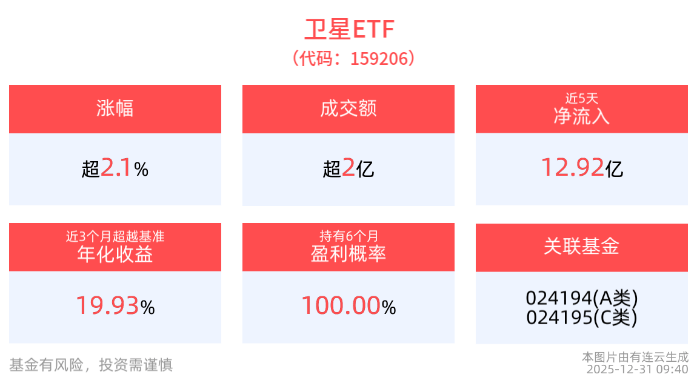
Core Viewpoint - The satellite ETF (159206) has seen a significant increase of 2.12%, driven by strong performances from constituent stocks such as Qianzhao Optoelectronics (300102), which rose over 10% [2][3]. Group 1: Market Performance - Qianzhao Optoelectronics (300102) reached a price of 26.30 with a gain of 10.46%, achieving a trading volume of 2.154 billion [3]. - Xunwei Communication (300136) increased by 7.57% to a price of 57.01, with a trading volume of 3.052 billion [3]. - China Satellite (600118) saw a rise of 6.43% to 91.87, with a trading volume of 4.292 billion [3]. - Tianyin Electromechanical (300342) increased by 5.31% to 33.34, with a trading volume of 0.824 billion [3]. - Aerospace Electronics (600879) rose by 3.46% to 20.05, with a trading volume of 2.845 billion [3]. Group 2: Industry Developments - The successful launch of the Practice-29 satellite by the Long March 7 rocket marks a significant achievement in China's space exploration efforts, with the satellite entering its designated orbit [2][4]. - The upcoming year is expected to see a surge in satellite launches, with plans for the "National Grid Constellation" and "Thousand Sails Constellation" exceeding 10,000 satellites, indicating a rapid increase in low-orbit satellite deployment [4]. - Recent government policies are favoring the commercial space sector, with initiatives aimed at promoting high-quality development in commercial aerospace by 2027 [4][5]. Group 3: Investment Landscape - The commercial aerospace sector is experiencing a strategic elevation in importance, with investment in the sector rising from 1.1 billion in 2015 to 34.13 billion in 2024, and the number of companies exceeding 500 [5]. - The industry’s output value has grown from 1 trillion in 2010 to 2.3 trillion in 2024, establishing commercial aerospace as a significant industry [5]. - The satellite ETF (159206) focuses on commercial aerospace and satellite communication, positioning it for potential growth under the "Aerospace Power" initiative [5].


中科星图股价跌1.76%,招商基金旗下1只基金重仓,持有54.61万股浮亏损失52.43万元
Xin Lang Cai Jing· 2025-12-30 01:45
Group 1 - The core point of the article highlights the performance of Zhongke Xingtou, which saw a decline of 1.76% in its stock price, reaching 53.45 yuan per share, with a total market capitalization of 43.192 billion yuan [1] - Zhongke Xingtou, established on January 20, 2006, and listed on July 8, 2020, operates in the fields of software sales, data services, technology development, integrated machine products, and system integration [1] - The company's revenue composition includes 53.46% from civil geographic information, 27.46% from special geographic information, 14.34% from commercial aerospace, 4.73% from low-altitude economy, and 0.01% from other sources [1] Group 2 - From the perspective of major fund holdings, one fund under China Merchants Fund has a significant position in Zhongke Xingtou, with the China Merchants CSI Satellite Industry ETF holding 546,100 shares, accounting for 6.16% of the fund's net value [2] - The estimated floating loss for the fund today is approximately 524,300 yuan [2] Group 3 - The China Merchants CSI Satellite Industry ETF was established on May 14, 2025, with a current scale of 386 million yuan and has achieved a return of 65.09% since inception [3] - The fund manager, Xu Rongman, has been in charge for 4 years and 282 days, overseeing a total asset scale of 32.689 billion yuan, with the best and worst fund returns during the tenure being 62.15% and -64.01%, respectively [3]
商业航天新信号,几个关键趋势来了丨每日研选
Shang Hai Zheng Quan Bao· 2025-12-30 01:00
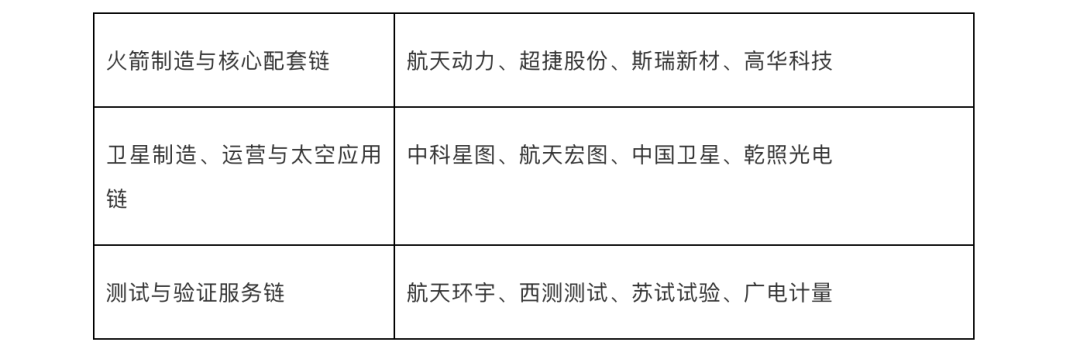
Core Viewpoint - The commercial aerospace sector is experiencing significant interest from major funds, driven by policy breakthroughs and advancements in rocket reusability, which are expected to enhance the industry's growth potential [2][3]. Policy Developments - The Shanghai Stock Exchange has issued guidelines for commercial rocket companies to apply for the Sci-Tech Innovation Board, marking a significant policy breakthrough that supports the industry [2]. - The new regulations require commercial rocket companies to demonstrate successful orbital launches using reusable technology, providing a clear path for listing and reflecting strong national support for the aerospace strategy [2]. Technological Advancements - Reusable rocket technology is identified as a key factor in reducing launch costs, with first-stage rocket bodies accounting for 60% of total costs [3]. - The successful test flights of reusable rockets like Long March 12 and Zhuque 3 are expected to lay a solid foundation for achieving low-cost, high-frequency launches by 2026, marking a pivotal moment for satellite deployment [2][3]. Investment Opportunities - The commercial aerospace industry is anticipated to enter a rapid development phase, with several investment opportunities identified: - **Rocket Manufacturing and Core Supply Chain**: Increased demand for advanced materials and components due to the development of reusable rockets. Beneficiaries include Aerospace Power, Chaojie Co., Srey New Materials, and Huagao Technology [4][5]. - **Satellite Manufacturing, Operations, and Space Applications**: The rise in rocket capacity will shift focus to mass satellite production and launch, benefiting companies like Zhongke Xingtou, Aerospace Hongtu, China Satellite, and Qianzhao Optoelectronics [4][5]. - **Testing and Verification Services**: The need for complex testing during the development and production phases will drive demand for specialized third-party service providers, with beneficiaries including Aerospace Hanyu, West Measurement, Su Testing, and Guangdian Measurement [4][5].


通用航空ETF基金(561660)涨超1.7%,商业航天利好不断
Xin Lang Cai Jing· 2025-12-29 05:44
Core Viewpoint - The commercial aerospace sector is experiencing significant growth driven by supportive government policies and the recent establishment of clearer IPO guidelines for commercial rocket companies, which is expected to accelerate their market entry and boost related industries. Group 1: Market Performance - The Zhongzheng General Aviation Theme Index (931855) rose by 1.62% as of December 29, 2025, with notable increases in constituent stocks such as Guangwei Composites (300699) up 14.57%, Haige Communication (002465) up 10.04%, and Leike Defense (002413) up 9.97% [1] - The General Aviation ETF (561660) increased by 1.70%, marking its fourth consecutive rise, with the latest price reported at 1.2 yuan [1] Group 2: Policy Developments - In November 2025, the National Space Administration issued the "Action Plan for Promoting High-Quality and Safe Development of Commercial Aerospace (2025-2027)", which supports commercial entities in developing new technologies and products, and establishes a national commercial aerospace development fund [1] - The Shanghai Stock Exchange released specific guidelines for commercial rocket companies to access the Sci-Tech Innovation Board, which is expected to expedite the IPO process for leading private commercial rocket firms [2] Group 3: Industry Insights - The commercial rocket sector is identified as the "launch base" of commercial aerospace, with its industrialization expected to drive demand across satellite manufacturing, ground equipment, and space applications [2] - The Zhongzheng General Aviation Theme Index includes 50 listed companies involved in aviation materials, components, aircraft manufacturing, infrastructure, operations, and applications, reflecting the overall performance of the general aviation sector [2] - As of November 28, 2025, the top ten weighted stocks in the Zhongzheng General Aviation Theme Index accounted for 40.68% of the index, including companies like Aerospace Electronics (600879) and China Satellite Communications (601698) [2]





商业航天“蓄势待发”:火箭射上去,价格打下来
第一财经· 2025-12-26 13:06
Core Viewpoint - The article emphasizes that the Chinese commercial aerospace industry is entering a rapid development phase, driven by government policies and capital investments, particularly in the areas of rocket launches and satellite applications [3][4][5]. Group 1: Policy and Investment - The National Venture Capital Guidance Fund has officially started operations, focusing on increasing investments in early-stage projects in aerospace and other innovative sectors [3]. - The Shanghai Stock Exchange has released guidelines for commercial rocket companies, allowing them to apply for listing under specific standards that emphasize "hard technology" attributes [3]. Group 2: Industry Development and Challenges - The commercial aerospace industry is facing a bottleneck in rocket launches, characterized by low supply, insufficient payload capacity, and high costs, which limits the economic feasibility of deploying large satellite constellations [7][10]. - The industry is experiencing a significant push for rocket capacity expansion, particularly for satellite internet and space computing deployments, with companies like Zhongke Xingtou actively engaging in the entire aerospace value chain [7][11]. Group 3: Technological Advancements and Market Dynamics - The focus on reducing costs through the maturation of reusable rocket technology and the mass production of satellites is critical for the industry's future [8][12]. - The successful launch of new rocket models and the ability to secure customer orders are essential for establishing a sustainable commercial value in the aerospace sector [12][16]. Group 4: Market Growth and Financial Metrics - By 2025, the Chinese commercial aerospace industry is projected to reach a scale of 2.5 to 2.8 trillion yuan, with an annual growth rate exceeding 20% and over 600 companies operating in the sector [15]. - The total financing in the industry is expected to reach 18.6 billion yuan in 2025, with satellite applications receiving the highest funding [15]. Group 5: Regulatory Environment and Future Directions - The establishment of the Commercial Aerospace Department aims to enhance regulatory efficiency and coordination across various aspects of the industry, including launch approvals and satellite operation licenses [18]. - The focus for the future will be on creating a commercial closed-loop system and optimizing regulatory frameworks to support large-scale, high-adhesion commercial applications [15][17].

商业航天“蓄势待发”:火箭射上去,价格打下来
Di Yi Cai Jing· 2025-12-26 12:16
Core Insights - The Chinese commercial space industry is experiencing a significant push due to favorable policies and capital influx, with the National Venture Capital Guidance Fund officially launched to support early-stage projects in aerospace [1] - The industry is currently facing a "three shortages" situation: a lack of rockets, launch sites, and satellites, which poses a bottleneck for development [5][9] Group 1: Industry Development - The launch of the National Venture Capital Guidance Fund aims to enhance investment in early-stage aerospace projects, particularly in active innovation regions [1] - The Shanghai Stock Exchange has released guidelines for commercial rocket companies, emphasizing the importance of "hard technology" and prioritizing companies involved in national projects [1] - The commercial space sector is expected to grow significantly, with projections indicating a market size of 2.5-2.8 trillion yuan by 2025, with a compound annual growth rate of over 20% [10] Group 2: Technological Advancements - The industry is at a critical juncture for technological breakthroughs and scale expansion, focusing on reducing costs through reusable rocket technology and mass satellite manufacturing [4] - The successful launch of the "Yixian-A" satellite by a student team demonstrates the potential for innovative satellite applications in the commercial space sector [2] - Companies are accelerating technological advancements, with expectations for new rocket models to achieve competitive launch costs close to those of SpaceX by 2025-2026 [7] Group 3: Market Dynamics - The current imbalance in the commercial space ecosystem highlights the rocket launch segment as a key constraint, with limited supply and high costs affecting satellite deployment [3] - The demand for satellite resources is increasing, but the supply of launch sites is insufficient, leading to delays in satellite launches [8][9] - The industry is witnessing a surge in IPO activities, with over 10 companies initiating listing processes, primarily in rocket manufacturing [5][6] Group 4: Regulatory Environment - The establishment of the Commercial Space Administration aims to enhance regulatory efficiency and support the development of the commercial space sector [13] - The recent action plan emphasizes the need for low-cost, reliable, and reusable rockets, as well as the development of commercial launch sites and integrated measurement and control systems [12][13] - The industry is encouraged to explore new application scenarios and products to support a trillion-level market [11]