PAB(000001)

Search documents
A股中小银行前三季度业绩分化
Zheng Quan Ri Bao· 2025-11-02 16:41
Core Insights - The performance of A-share listed banks in the third quarter of 2025 shows significant differentiation among small and medium-sized banks, with city commercial banks leading, rural commercial banks in the middle, and joint-stock banks under pressure [1] Group 1: City Commercial Banks - City commercial banks have demonstrated outstanding performance, with 14 out of 17 banks reporting year-on-year revenue growth and 16 reporting net profit growth [2] - Chongqing Bank reported the highest performance, achieving revenue of 11.74 billion yuan, a year-on-year increase of 10.4%, and a net profit of 4.879 billion yuan, up 10.19% [2] - Other banks like Qingdao Bank, Nanjing Bank, and Ningbo Bank also showed steady growth, with Qingdao Bank's revenue at 11.013 billion yuan (5.03% increase) and net profit at 3.992 billion yuan (15.54% increase) [2] Group 2: Rural Commercial Banks - Most rural commercial banks also reported increases in both revenue and net profit, but the growth rates were relatively moderate, with most banks showing single-digit growth [3] - A few rural banks achieved double-digit growth, contrasting with the performance of city commercial banks [3] Group 3: Joint-Stock Banks - Joint-stock banks faced a decline in both revenue and net profit, although the rate of decline has narrowed compared to the first half of the year, indicating signs of stabilization [3] - For instance, Ping An Bank reported revenue of 100.668 billion yuan, down 9.8%, and net profit of 38.339 billion yuan, down 3.5%, with declines narrowing by 0.2 and 0.4 percentage points respectively [3] Group 4: Asset Quality - The overall asset quality of small and medium-sized banks has improved, with non-performing loan ratios remaining low [4] - Specific banks like Wuxi Rural Commercial Bank and Nanjing Bank maintained non-performing loan ratios of 0.78% and 0.83% respectively, while Chongqing Bank's ratio decreased to 1.14% [4] - Factors contributing to the improvement in asset quality include enhanced risk management, focused regional market strategies, and effective macroeconomic policies [4]



银行2025年三季报业绩综述:业绩和息差好于预期
ZHESHANG SECURITIES· 2025-11-02 08:59
Investment Rating - The industry rating is maintained as "Positive" [3] Core Views - The performance of listed banks in Q1-Q3 2025 shows resilience, with state-owned banks achieving positive results across the board, and the improvement in net interest margins for joint-stock and city commercial banks exceeding expectations [4] - The revenue growth rate for listed banks is stable at 0.9% year-on-year, while profit growth has increased to 1.6% [4] - The non-interest income growth rate for listed banks has narrowed, with a year-on-year increase of 5.0% [4] Summary by Sections Performance Overview - Listed banks' revenue growth is stable at 0.9%, and net profit growth has improved to 1.6% in Q1-Q3 2025, slightly slowing from H1 [4] - The net interest margin for listed banks has shown marginal improvement, with a quarterly increase of 0.3 basis points to 1.37% [4] Revenue and Profit Drivers - The asset scale growth for listed banks is 9.3% year-on-year, with a decrease in loan growth to 7.7% and an increase in financial investment growth to 15.8% [4][11] - The non-interest income growth rate has decreased by 2.0 percentage points compared to the previous quarter [4] Risk and Asset Quality - The average non-performing loan (NPL) ratio for 42 sample banks remains stable at 1.23%, while the average attention rate has increased by 2 basis points to 1.69% [5] - Retail loan risks continue to rise, with notable increases in NPL ratios for retail loans at certain banks [5] Dividend Trends - More banks have disclosed mid-term dividend plans for 2025, with some banks increasing their mid-term dividend rates compared to 2024 [6] Investment Recommendations - The report suggests that bank stocks may rebound in Q4, with a focus on small and medium-sized banks in economically developed regions and stable high-dividend large banks [6]






多家银行合计被罚超2亿元,回应来了
Zhong Guo Ji Jin Bao· 2025-11-01 13:39
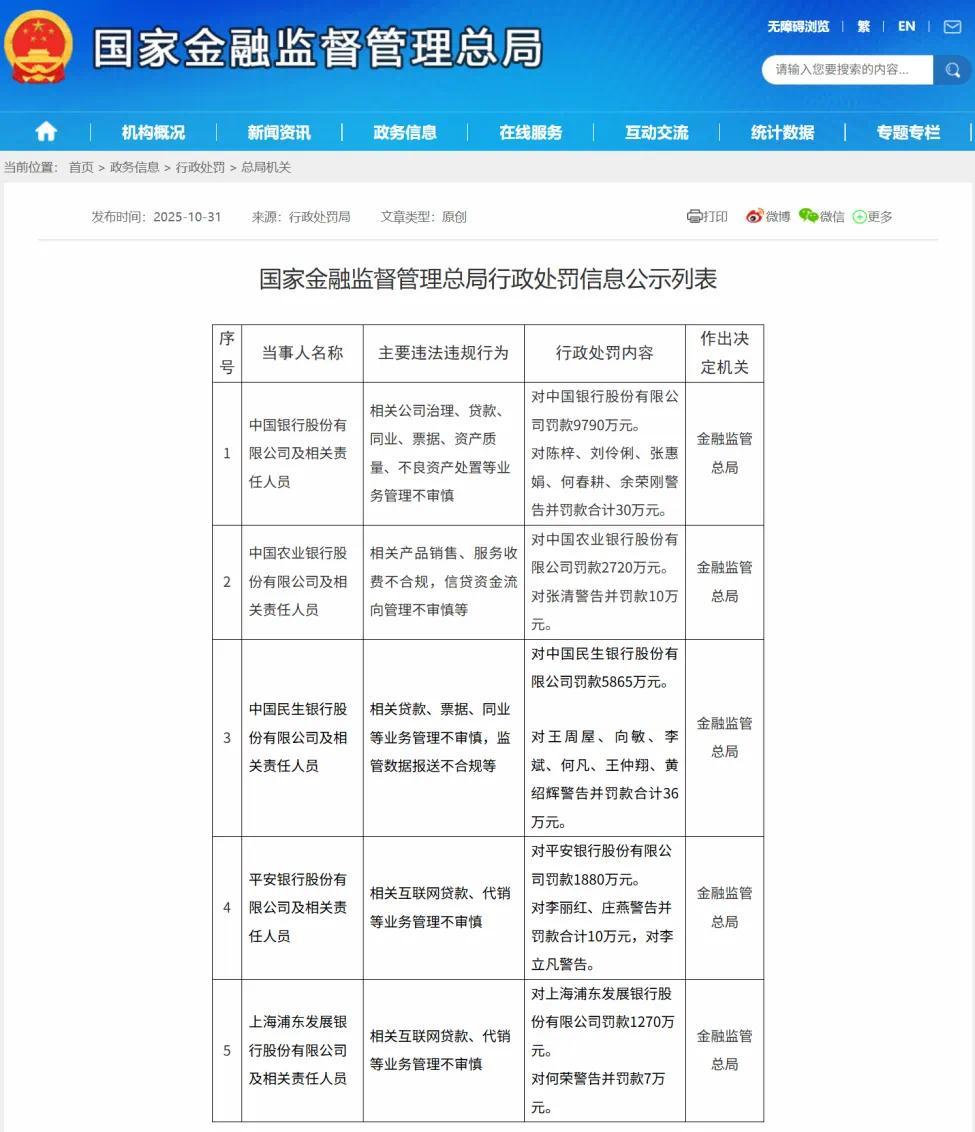
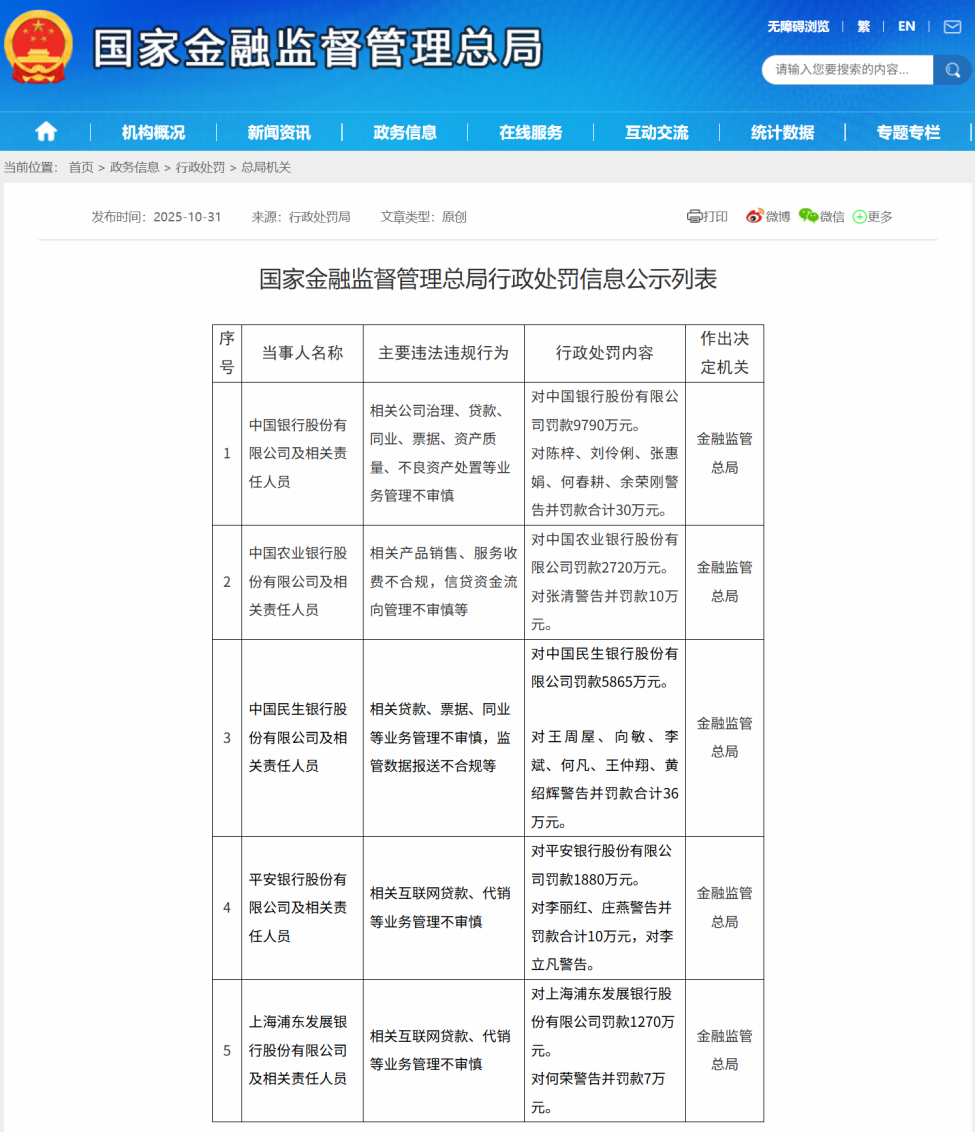
Core Points - The National Financial Regulatory Administration announced significant fines totaling over 215 million yuan for five major banks in China, including China Bank, Agricultural Bank, Minsheng Bank, Ping An Bank, and Shanghai Pudong Development Bank, due to various regulatory violations [1][4]. Group 1: China Bank - China Bank was fined 97.9 million yuan for issues related to corporate governance, loan management, interbank transactions, bill management, asset quality, and non-performing asset disposal [4]. - Five responsible personnel received warnings and fines totaling 300,000 yuan [4]. - The bank emphasized its commitment to rectifying the identified issues and improving risk management and internal controls [4]. Group 2: Agricultural Bank - Agricultural Bank faced a fine of 27.2 million yuan for non-compliance in product sales, service fees, and improper management of credit fund flows [5]. - One responsible individual was warned and fined 100,000 yuan [5]. - The bank stated that the penalty was a follow-up to previous inspections and highlighted its efforts in addressing the regulatory concerns [5]. Group 3: Minsheng Bank - Minsheng Bank was fined 58.65 million yuan for imprudent management of loans, bills, and interbank transactions, as well as non-compliance in data reporting [5]. - Six responsible personnel received warnings and fines totaling 360,000 yuan [5]. - The bank had previously been fined 5.9 million yuan in September for issues related to system management and operational controls [5]. Group 4: Ping An Bank and Shanghai Pudong Development Bank - Both Ping An Bank and Shanghai Pudong Development Bank were fined for imprudent management of internet loans and agency sales [5]. - Ping An Bank was fined 18.8 million yuan, with two personnel receiving warnings and fines totaling 100,000 yuan [5]. - Shanghai Pudong Development Bank was fined 12.7 million yuan, with one personnel receiving a warning and a fine of 70,000 yuan [5].

中行、农行、民生、平安、浦发五家银行合计被罚超2.15亿元
Jing Ji Guan Cha Bao· 2025-11-01 07:34
Core Viewpoint - The tightening of financial regulation is leading to increased scrutiny and penalties for major banks in China, highlighting compliance failures and internal control weaknesses across the industry [2][8][9]. Group 1: Regulatory Actions - Five major banks, including Bank of China, Agricultural Bank of China, Minsheng Bank, Ping An Bank, and Pudong Development Bank, were collectively fined over 215 million yuan for various violations [2][4]. - The penalties reflect a broader trend of intensified regulatory oversight aimed at improving risk management and compliance within the banking sector [3][8]. Group 2: Specific Bank Penalties - Bank of China received the highest fine of 97.9 million yuan, with penalties against responsible individuals totaling 300,000 yuan, primarily due to issues identified during a risk management inspection [4][5]. - Agricultural Bank of China was fined 27.2 million yuan, with a focus on non-compliance in product sales and loan management practices [5]. - Minsheng Bank faced a fine of 58.65 million yuan, with violations related to loan management and regulatory data reporting [6]. - Ping An Bank was penalized 18.8 million yuan for issues in internet lending and product distribution management [6]. - Pudong Development Bank was fined 12.7 million yuan, primarily for similar issues in internet lending and product distribution [6]. Group 3: Industry Implications - The penalties indicate a systemic issue within the banking sector, where even large institutions struggle with compliance and internal controls, particularly in the context of rapidly evolving financial products [7][9]. - The regulatory environment is shifting towards a model where compliance is becoming a core competitive advantage for financial institutions, necessitating proactive risk management strategies [9].


多家银行,合计被罚超2亿元!回应来了
Zhong Guo Ji Jin Bao· 2025-11-01 06:53
Core Viewpoint - Five banks in China received significant fines totaling over 215 million yuan due to various regulatory violations, highlighting ongoing issues in risk management and compliance within the banking sector [1][4]. Group 1: Fines and Violations - China Bank was fined 97.9 million yuan for imprudent management in areas such as corporate governance, loans, and asset quality, with five responsible personnel receiving warnings and fines totaling 300,000 yuan [2][3]. - Agricultural Bank was fined 27.2 million yuan for non-compliance in product sales and service fees, with one responsible person receiving a warning and a fine of 100,000 yuan [2][4]. - China Minsheng Bank faced a fine of 58.65 million yuan for imprudent management in loans and data reporting, with six responsible personnel receiving warnings and fines totaling 360,000 yuan [2][4]. - Ping An Bank and Shanghai Pudong Development Bank were both fined for imprudent management in internet loans and agency sales, with Ping An Bank fined 18.8 million yuan and Shanghai Pudong Development Bank fined 12.7 million yuan [2][5]. Group 2: Responses and Remedial Actions - China Bank emphasized its commitment to rectifying issues identified during a 2023 risk management inspection and has reportedly completed most of the necessary corrections [4]. - Agricultural Bank stated that the fine was a follow-up to previous inspections and that it has addressed most issues promptly, adhering to a principle of comprehensive remediation [4]. - Minsheng Bank acknowledged previous fines and has taken steps to address regulatory concerns, indicating a proactive approach to compliance [5].
多家银行,合计被罚超2亿元!回应来了
中国基金报· 2025-11-01 06:48
Summary of Key Points Core Viewpoint - Five banks in China received significant fines totaling over 215 million yuan, highlighting ongoing regulatory scrutiny in the banking sector [2]. Group 1: Regulatory Actions and Penalties - China Bank was fined 97.9 million yuan for imprudent management in areas such as corporate governance, loans, and asset quality, with five responsible individuals receiving warnings and fines totaling 300,000 yuan [3][4]. - Agricultural Bank faced a penalty of 27.2 million yuan due to non-compliance in product sales and service fees, with one individual fined 100,000 yuan [5]. - China Minsheng Bank was fined 58.65 million yuan for imprudent management in loans and data reporting, with six individuals receiving warnings and fines totaling 360,000 yuan [5]. - Ping An Bank and Shanghai Pudong Development Bank were both fined for imprudent management in internet loans and related services, with Ping An Bank fined 18.8 million yuan and Shanghai Pudong Development Bank fined 12.7 million yuan [6]. Group 2: Responses from Banks - China Bank emphasized its commitment to rectifying issues identified during regulatory inspections and improving risk management and internal controls [4]. - Agricultural Bank stated that it has addressed most issues raised by regulators and is focused on systematic rectification [5]. - China Minsheng Bank acknowledged previous penalties and has taken steps to address regulatory concerns [5].
股份制银行三季报分化加剧 光大银行盈利下滑幅度超同业
Jing Ji Guan Cha Wang· 2025-11-01 05:28
Core Insights - The performance of China’s listed commercial banks shows a clear divide, with some banks like Shanghai Pudong Development Bank (SPDB) demonstrating strong profit growth, while China Everbright Bank (CEB) faces significant declines in both revenue and net profit [3][4]. Financial Performance - SPDB reported a net profit of 38.819 billion yuan for the first three quarters, a year-on-year increase of 10.21%, while CEB's revenue and net profit fell by 7.94% and 3.63%, respectively [3][4]. - In Q3 alone, CEB's revenue and net profit saw declines of 13.01% and 10.99%, contrasting sharply with the stable or growing performance of peers like SPDB [3][4]. Comparative Analysis - CEB's revenue decline of 7.94% is significantly worse than peers such as China Merchants Bank (-0.51%) and SPDB (+1.88%) [4][5]. - CEB's net profit decline of 3.63% ranks it among the lowest in the sector, while SPDB leads with a 10.21% increase [4][5]. Revenue and Profit Drivers - CEB's net interest income decreased by 5.11%, reflecting a narrowing net interest margin due to falling loan rates and rigid funding costs [6]. - Non-interest income showed volatility, with a significant drop in investment income, which shifted from a net gain of 3.758 billion yuan to a net loss of 4.982 billion yuan [6]. Asset Quality Concerns - CEB's non-performing loan ratio slightly increased to 1.26%, and its provision coverage ratio decreased by 11.67 percentage points to 168.92%, indicating potential risks and profit erosion [6]. Strategic Challenges - CEB is investing heavily in technology finance, green finance, and digital transformation, which has led to increased short-term costs and pressure on profit margins [7]. - The bank's shift towards lower-priced policy-oriented credit assets has further exacerbated the narrowing net interest margin [7]. Industry Context - The banking sector is facing a critical challenge as traditional interest margin benefits diminish, raising questions about future profitability [8]. - CEB's struggles reflect a broader industry trend where banks must adapt quickly to find sustainable business models amid changing economic conditions [8].



合计被罚超2亿元!5家银行领千万级罚单
Zhong Guo Zheng Quan Bao - Zhong Zheng Wang· 2025-10-31 15:14
Core Points - Five banks in China, including Bank of China, Minsheng Bank, Agricultural Bank of China, Ping An Bank, and Shanghai Pudong Development Bank, were fined a total of 215.25 million yuan for various violations [1][4] - The violations involved multiple business areas such as non-performing asset disposal, product sales, loan management, and regulatory data reporting [1][4] Summary by Bank - **Bank of China**: Fined 97.9 million yuan for issues related to corporate governance, loans, interbank transactions, bills, asset quality, and non-performing asset disposal. Five responsible personnel received warnings and fines totaling 300,000 yuan [2][4] - **Agricultural Bank of China**: Fined 27.2 million yuan for non-compliance in product sales, service charges, and imprudent management of credit fund flows. One responsible personnel, Zhang Qing, received a warning and a fine of 100,000 yuan [4] - **Minsheng Bank**: Fined 58.65 million yuan for imprudent management of loans, bills, interbank transactions, and non-compliance in regulatory data reporting. Six responsible personnel received warnings and fines totaling 360,000 yuan [3][4] - **Ping An Bank**: Fined 18.8 million yuan for imprudent management of internet loans and agency sales. Two responsible personnel received warnings and fines totaling 100,000 yuan, and one received a warning [4] - **Shanghai Pudong Development Bank**: Fined 12.7 million yuan for imprudent management of internet loans and agency sales. One responsible personnel, He Rong, received a warning and a fine of 70,000 yuan [4] Regulatory Context - The China Banking and Insurance Regulatory Commission emphasized its focus on key issues affecting financial stability, key individuals causing major financial risks, and key behaviors disrupting market order during the "14th Five-Year Plan" period [4]
涉贷款、票据等业务违规 5家银行领2.15亿元罚单
Mei Ri Jing Ji Xin Wen· 2025-10-31 15:02
Summary of Key Points Core Viewpoint - Five major Chinese banks, including Bank of China, Agricultural Bank of China, Minsheng Bank, Ping An Bank, and Shanghai Pudong Development Bank, received fines totaling over 215 million yuan due to imprudent business management practices across various sectors such as loans, interbank transactions, bills, and sales [1][2]. Group 1: Penalties and Amounts - Bank of China was fined 97.9 million yuan for issues related to corporate governance, loans, interbank transactions, bills, asset quality, and non-performing asset disposal [1]. - Agricultural Bank of China faced a penalty of 27.2 million yuan for non-compliance in product sales, service charges, and imprudent management of credit fund flows [1]. - Minsheng Bank was fined 58.65 million yuan for multiple violations including imprudent management of loans, bills, interbank transactions, and non-compliance in regulatory data reporting [1]. - Ping An Bank received a fine of 18.8 million yuan for imprudent management in internet loans and agency sales [2]. - Shanghai Pudong Development Bank was fined 12.7 million yuan for similar issues in internet loan management [2]. Group 2: Responsible Personnel - In total, five responsible personnel from Bank of China were warned and fined a combined 300,000 yuan [1]. - One responsible personnel from Agricultural Bank of China was warned and fined 100,000 yuan [1]. - Six personnel from Minsheng Bank received warnings and were fined a total of 360,000 yuan [1]. - Three personnel from Ping An Bank were warned, with two receiving fines totaling 100,000 yuan [2]. - One personnel from Shanghai Pudong Development Bank was warned and fined 70,000 yuan [2].
银行业绩下行周期接近尾声 资产质量改善趋势确立
Jing Ji Guan Cha Wang· 2025-10-31 11:50
Core Viewpoint - The apparent stability of bank non-performing loan (NPL) ratios conceals deeper structural changes, indicating that the era of "soft landing" achieved through provisioning adjustments and risk rotation is nearing its end [2][8] Group 1: Banking Performance - China Construction Bank reported a 1.44% year-on-year increase in operating income to 560.281 billion yuan for the first three quarters of 2025, with net profit rising by 0.52% to 258.446 billion yuan [3] - The bank's asset quality remains robust, with a non-performing loan ratio of 1.32%, down 0.02 percentage points from the end of the previous year, and a provisioning coverage ratio of 235.05%, up 1.45 percentage points [3] - Other major banks, such as China Bank and Postal Savings Bank, also show varying levels of asset quality, with China Bank's NPL ratio at 1.24% and Postal Savings Bank's NPL ratio at 0.94% [4] Group 2: Risk Assessment - Some joint-stock banks are experiencing thinner provisioning buffers, with Everbright Bank's NPL ratio at 1.26% and a provisioning coverage ratio of 168.92%, nearing regulatory warning lines [5] - In contrast, certain regional banks demonstrate stronger risk resilience, such as Chengdu Bank with an NPL ratio of only 0.68% and a provisioning coverage ratio of 433.08% [6] - The focus of risk has shifted from corporate to retail, with banks like China Merchants Bank reporting an increase in attention loans, indicating rising concerns in personal lending sectors [7] Group 3: Future Outlook - The banking industry is expected to face a genuine stress test as excess provisioning space narrows and retail risks continue to emerge, marking a transition from scale expansion to quality prioritization [2][8] - The ability to balance risk clearance and sustainable profits will determine the future restructuring of the industry [8]