
ZTE(000063)

Search documents
中兴通讯:拟出资2亿元认购粤港澳大湾区创业投资引导基金合伙企业份额
Jin Rong Jie· 2026-02-06 09:28
中兴通讯(000063.SZ)公告称,公司拟作为有限合伙人出资2亿元人民币认购粤港澳 大湾区创业投资引导 基金合伙企业(有限合伙)份额,基金重点关注新一代信息科技、生物技术、 高端装备制造、 新材料 与 新能源、电子硬件、前沿材料等国家政策支持的领域。 ...
中兴通讯(000063.SZ)拟2亿元参投粤港澳基金 布局优质产业投资标的
智通财经网· 2026-02-06 09:26
Core Viewpoint - ZTE Corporation plans to invest 200 million yuan as a limited partner in the Guangdong-Hong Kong-Macao Greater Bay Area Venture Capital Guidance Fund, aiming to support its core business strategy and gain investment returns through quality industry investments [1] Investment Details - The company will subscribe to shares of the Guangdong-Hong Kong-Macao Greater Bay Area Venture Capital Guidance Fund, signing the partnership agreement [1] - The fund will focus on sectors supported by national policies, including next-generation information technology, biotechnology, high-end equipment manufacturing, new materials and new energy, electronic hardware, and frontier materials [1] Strategic Implications - The investment is intended to support the strategic execution of the company's core business [1] - By participating in the fund, the company aims to position itself for potential investment returns from high-quality industry targets [1]
中兴通讯(00763) - 海外监管公告 关於认购粤港澳基金份额的公告
2026-02-06 09:25
香港交易及結算所有限公司及香港聯合交易所有限公司對本公告的內容概不負責,對其 準確性或完整性亦不發表任何聲明,並明確表示,概不對因本公告全部或任何部份內容 而產生或因倚賴該等內容而引致的任何損失承擔任何責任。 ZTE CORPORATION 中興通訊股份有限公司 (於中華人民共和國註冊成立的股份有限公司) (股份代號:00763) 海外監管公告 本公告乃根據香港聯合交易所有限公司證券上市規則第13.10B條而作出。 茲載列中興通訊股份有限公司(「本公司」)在深圳證券交易所網站發布的以下公告全文, 僅供參閱。 承董 事會 命 方榕 董事長 深圳,中國 二零二六年二月六日 於本公告日期,本公司董事會包括執行董事:徐子陽;非執行董事:方榕、閆俊武、諸 為民、張洪;獨立非執行董事:莊堅勝、王清剛、徐奇鵬;以及職工董事:李妙娜。 证券代码(A/H):000063/00763 证券简称(A/H):中兴通讯 公告编号:202608 中兴通讯股份有限公司 关于认购粤港澳基金份额的公告 1、中兴通讯股份有限公司(简称"中兴通讯"或"本公司")拟作为有限合伙人出 资 2 亿元人民币(本公告货币单位均为人民币)认购粤港澳大湾区创业 ...
中兴通讯(00763) - 海外监管公告 第十届董事会第二十次会议决议公告
2026-02-06 09:22
本公告乃根據香港聯合交易所有限公司證券上市規則第13.10B條而作出。 茲載列中興通訊股份有限公司(「本公司」)在深圳證券交易所網站發布的以下公告全文, 僅供參閱。 香港交易及結算所有限公司及香港聯合交易所有限公司對本公告的內容概不負責,對其 準確性或完整性亦不發表任何聲明,並明確表示,概不對因本公告全部或任何部份內容 而產生或因倚賴該等內容而引致的任何損失承擔任何責任。 ZTE CORPORATION 中興通訊股份有限公司 (於中華人民共和國註冊成立的股份有限公司) (股份代號:00763) 海外監管公告 中兴通讯股份有限公司 第十届董事会第二十次会议决议公告 承董 事會 命 方榕 董事長 深圳,中國 二零二六年二月六日 於本公告日期,本公司董事會包括執行董事:徐子陽;非執行董事:方榕、閆俊武、諸 為民、張洪;獨立非執行董事:莊堅勝、王清剛、徐奇鵬;以及職工董事:李妙娜。 证券代码(A/H):000063/00763 证券简称(A/H):中兴通讯 公告编号:202607 本公司及董事会全体成员保证董事会决议公告的内容真实、准确和完整,没有虚假记 载、误导性陈述或重大遗漏。 中兴通讯股份有限公司(简称"公司" ...
中兴通讯:拟出资2亿元认购粤港澳基金
Xin Lang Cai Jing· 2026-02-06 09:18
Core Viewpoint - The company plans to invest 200 million RMB as a limited partner in the Guangdong-Hong Kong-Macao Greater Bay Area Venture Capital Guidance Fund Partnership [1] Group 1 - The company will subscribe to shares of the partnership in the Guangdong-Hong Kong-Macao Greater Bay Area Venture Capital Guidance Fund [1] - The company has signed the partnership agreement for the fund [1]
中兴通讯(000063) - 第十届董事会第二十次会议决议公告
2026-02-06 09:15
中兴通讯股份有限公司 第十届董事会第二十次会议决议公告 本公司及董事会全体成员保证董事会决议公告的内容真实、准确和完整,没有虚假记 载、误导性陈述或重大遗漏。 中兴通讯股份有限公司(简称"公司")已于 2026 年 2 月 3 日以电子邮件的 方式向公司全体董事发出了《关于召开中兴通讯股份有限公司第十届董事会第二 十次会议的通知》。2026 年 2 月 6 日,公司第十届董事会第二十次会议(简称"本 次会议")以通讯表决方式召开。本次会议应表决董事 9 名,实际表决董事 9 名。 本次会议的召开符合有关法律、行政法规、部门规章和《中兴通讯股份有限公司 章程》的有关规定,会议合法、有效。 本次会议审议通过了《关于认购粤港澳大湾区创业投资引导基金合伙企业 (有限合伙)份额的议案》,决议内容如下: 1、同意中兴通讯股份有限公司与深润国创(深圳)投资有限公司、国家创 业投资引导基金有限公司、广东省战略性新兴产业投资引导基金有限责任公司、 深圳市国创引科创投资合伙企业(有限合伙)、华润投资创业(天津)有限公司、 深圳市红土创业投资有限公司、江门市投资有限公司、东莞市科创资本产业发展 投资有限公司、珠海市新质生产力投资基 ...
通信行业:moltbot爆火背后对AIOT意义重大,SpaceX计划组建百万太空
Shanxi Securities· 2026-02-06 07:25
Investment Rating - The report maintains an investment rating of "Leading the Market-A" for the communication industry, indicating an expected outperformance of over 10% compared to the benchmark index [1][36]. Core Insights - The emergence of Moltbot as a significant application in Silicon Valley represents a major leap in AI capabilities, enabling seamless workflow automation from thought to execution. This application has rapidly gained popularity, surpassing 100,000 stars on GitHub, making it one of the fastest-growing open-source projects globally [4][12]. - The report highlights the potential for unlimited cloud computing power driven by applications like Moltbot, which could lead to increased capital expenditures in cloud service providers (CSPs) due to rising demand for computational resources [4][12]. - The demand for cloud hosts and various types of home servers is expected to grow rapidly, benefiting public cloud vendors as they offer more secure and stable solutions compared to local PCs [5][13]. - AIOT (Artificial Intelligence of Things) applications on the edge are anticipated to have significant potential, as Moltbot combines cloud capabilities with local execution, creating a closed-loop system for industrial intelligence [5][13]. - SpaceX's plan to establish a satellite computing cluster consisting of up to 1 million satellites represents a substantial development in space computing capabilities, which could integrate with existing satellite networks and enhance data processing capabilities [6][14]. Summary by Sections Industry Trends - Moltbot's capabilities include automating tasks such as email management, scheduling, and even automated trading, showcasing its versatility and potential for widespread adoption [4][12]. - The report suggests that the rapid spread of Moltbot and similar applications will lead to increased demand for cloud computing resources, potentially causing a "computing power crunch" [4][12]. Market Overview - The communication index rose by 5.83% during the week of January 26 to January 30, 2026, while the broader market indices showed mixed results, with the Shanghai Composite Index declining by 0.44% [7][15]. - The top-performing sectors included optical cables and marine cables, with significant weekly gains [7][15]. Recommended Companies - The report recommends focusing on companies in various segments, including: - Cloud Computing: Zhongji Xuchuang, Xinyi Sheng, Tianfu Communication, Industrial Fulian, Woer, Zhishang Technology, Guangku Technology [6][15]. - CPU/CXL: Haiguang Information, Lanke Technology, ZTE, Wantong Development [6][15]. - Edge Computing: Ruixin Micro, Zhaoyi Innovation, Yinghantong, Guanghetong, Yiyuan Communication, Meige Intelligent [6][15]. - Inter-satellite Laser Communication: Fenghuo Communication, Guangxun Technology, Guangku Technology, Aerospace Electronics, Zhongrun Optics, Tengjing Technology [6][15].





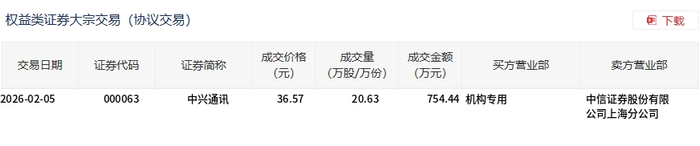
中兴通讯今日大宗交易平价成交20.63万股,成交额754.44万元
Xin Lang Cai Jing· 2026-02-05 09:04
| 交易日期 | 证券代码 | 证券简称 | 成交价格 (元) | 成交量 | 成交金额 | 买方营业部 | 卖方营业部 | | --- | --- | --- | --- | --- | --- | --- | --- | | | | | | (万股/万份) | (万元) | | | | 2026-02-05 | 000063 | 中兴通讯 | 36.57 | 20.63 | 754.44 机构专用 | | 中信证券股份有限 | | | | | | | | | 公司上海分公司 | 2月5日,中兴通讯大宗交易成交20.63万股,成交额754.44万元,占当日总成交额的0.32%,成交价36.57 元,较市场收盘价36.57元持平。 ...

中兴通讯跌2.02%,成交额16.36亿元,主力资金净流出1.71亿元
Xin Lang Cai Jing· 2026-02-05 05:22
Core Viewpoint - ZTE Corporation's stock has experienced a decline, with a 3.88% drop year-to-date and a 7.95% drop over the last five trading days, indicating a challenging market environment for the company [1]. Group 1: Stock Performance - As of February 5, ZTE's stock price was 36.37 CNY per share, with a trading volume of 16.36 billion CNY and a market capitalization of 1739.77 billion CNY [1]. - The stock has seen a decline of 9.05% over the last 20 days and 11.08% over the last 60 days [1]. Group 2: Financial Performance - For the period from January to September 2025, ZTE reported a revenue of 1005.20 billion CNY, reflecting a year-on-year growth of 11.63%, while the net profit attributable to shareholders decreased by 32.69% to 53.22 billion CNY [2]. - The company has distributed a total of 171.37 billion CNY in dividends since its A-share listing, with 81.14 billion CNY distributed over the last three years [3]. Group 3: Shareholder Information - As of January 30, ZTE had 606,900 shareholders, a decrease of 0.51% from the previous period, with an average of 6,639 circulating shares per shareholder, which increased by 0.51% [2]. - Major shareholders include Hong Kong Central Clearing Limited, which holds 76.88 million shares, and several ETFs that have seen a reduction in their holdings [3].
A股公司密集设立产业基金 布局新质生产力核心赛道
Zheng Quan Ri Bao Zhi Sheng· 2026-02-04 16:11
Core Insights - A-share listed companies are accelerating their industrial capital layout by establishing or participating in industrial investment funds, focusing on emerging sectors such as artificial intelligence, high-end equipment, smart energy, and new-generation information technology [1][5] Group 1: Investment Announcements - Jiangsu Fengshan Group announced an investment of 15 million yuan to acquire a 29.99% stake in a venture capital partnership, with a total fund size of 50.01 million yuan, primarily targeting information technology [1] - ZTE Corporation plans to invest 117 million yuan for a 39% stake in a fund with a total size of 300 million yuan, focusing on new-generation information technology, new energy, artificial intelligence, and advanced manufacturing [2] - Suwen Electric Power Technology's subsidiary intends to invest 5 million yuan in a fund with a total size of 68.5 million yuan, focusing on smart detection services, high-end equipment, robotics, and smart energy [3] - Fujian Torch Electronics announced a commitment of 200 million yuan for a 40% stake in a fund targeting new materials, new energy, military industry, electronic components, and high-end equipment manufacturing [4] Group 2: Industry Trends and Expert Opinions - The trend of A-share companies establishing industrial funds is characterized by a focus on sectors like artificial intelligence, robotics, high-end equipment, and smart energy, aligning with national innovation-driven development strategies [5] - The investment model is noted for its stability and flexibility, with most companies participating as limited partners and using their own funds, minimizing financial pressure on daily operations [5] - The ongoing strategic emerging industry policies, including tax incentives and special loans, are driving the acceleration of industrial capital layout among listed companies [5] - The establishment of these funds is still in the preparatory stage, with many not yet registered or having formal agreements, indicating uncertainty in future investment rhythms [6]