
ZTE(000063)

Search documents
三年百亿,京东中兴联手,友商无眠
3 6 Ke· 2026-02-04 12:51
Core Insights - The strategic agreement between JD.com and ZTE aims for a sales target of 10 billion yuan over three years, indicating a significant partnership beyond mere sales collaboration [2][5] - The collaboration reflects a shift towards "certainty" in business operations, with ZTE seeking to hedge financial risks and JD.com offering a comprehensive solution to ensure predictable revenue streams [2][12] Group 1: ZTE's Financial Strategy - ZTE is experiencing a duality in performance, with revenue growth of over 11% year-on-year but a significant drop in net profit by nearly one-third, indicating underlying financial instability [4] - The company's core business of network construction for telecom operators has seen its revenue share fall below 50%, marking a structural shift in its revenue model [4] - ZTE's new business ventures, while growing at 180%, have lower profit margins, leading to a situation where increased sales do not equate to higher profits [4][5] - The partnership with JD.com is viewed as a long-term income swap agreement, providing ZTE with a stable cash flow amidst declining traditional revenue sources [5][10] Group 2: JD.com's Strategic Positioning - JD.com has evolved from a simple online marketplace to a provider of comprehensive retail solutions, offering brands a package that includes guaranteed traffic, sales channels, logistics, and financial services [12][18] - The collaboration with ZTE serves as a model for JD.com to attract other brands facing similar market uncertainties, thereby expanding its ecosystem and reinforcing its competitive edge [19][20] - JD.com's strategy aims to transform its role from a mere platform to a "retail infrastructure supplier," enhancing its value proposition through a robust network effect [22][23] Group 3: Market Dynamics and Future Implications - The partnership may lead to a new market structure where brands align closely with a few dominant platforms, creating "symbiotic monopolies" that could reshape competition dynamics [27][29] - As brands increasingly rely on platforms like JD.com for stability, the market may shift from open competition to ecosystem-based alliances, limiting choices for consumers [30][32] - The focus on data-driven product development may enhance efficiency but could also stifle innovation, leading to a market that prioritizes short-term gains over long-term breakthroughs [40][41] - Regulatory frameworks may need to adapt to address the challenges posed by these new ecosystem dynamics, ensuring fair competition and consumer choice [47][48]




国内外AI年报分析展望




2026-02-04 02:27
Summary of the Conference Call on AI Annual Report Analysis Industry Overview - The conference focused on the analysis and outlook of AI annual reports, particularly in the TMT (Technology, Media, and Telecommunications) sector, with a specific emphasis on domestic and international AI companies [1][2][4]. Key Points and Arguments General Market Sentiment - The period from October 31 to March is characterized as a performance vacuum, where the focus is on thematic investments rather than immediate earnings results [2][3]. - The spring market is expected to see a resurgence, with significant activity anticipated around March [3][4]. North American Companies - North American companies, particularly those involved in AI and cloud computing, have reported earnings that exceeded expectations, indicating strong capital expenditure in AI [4][6]. - Companies like Microsoft and Meta have shown robust spending on AI infrastructure, reflecting a positive outlook for the sector [4][6]. - Despite some domestic companies underperforming, their stock prices have rebounded, suggesting that market sentiment is more focused on thematic trends rather than immediate earnings [5][6]. Domestic AI Companies - Domestic AI companies are experiencing a supply-demand imbalance, with strong demand for AI-related products and services, despite some companies reporting earnings below expectations [6][7]. - The industry is characterized by a shortage of materials and components, which is driving prices up and creating a favorable environment for growth [6][7][10]. Future Growth Projections - There is a consensus that the growth trajectory for AI companies will continue to be strong, with expectations for significant growth in 2026 and beyond [8][9]. - Many companies are currently undervalued, trading at price-to-earnings (P/E) ratios between 15x to 20x, which presents a potential investment opportunity [8][9]. Specific Company Insights - Companies like Wan, Tianfu Communication, and others are highlighted for their potential despite recent earnings misses, as the overall industry outlook remains positive [4][6][7]. - The demand for GPUs and AI chips is expected to remain high, with domestic companies like Cambrian facing challenges but still showing potential for recovery [9][10]. Application and Innovation - The conference emphasized the importance of AI applications, particularly in gaming and media, with companies like Tencent and ByteDance leading the charge [14][15]. - The emergence of AI-driven applications is seen as a significant growth area, with expectations for increased investment and innovation in this space [14][15]. Regulatory and Market Concerns - There are concerns regarding potential regulatory impacts on the gaming industry, but these are largely viewed as unfounded and not likely to affect the overall market significantly [15][16]. - The market is currently experiencing volatility, but analysts suggest that this presents buying opportunities for fundamentally strong companies [21][22]. Additional Important Insights - The conference highlighted the importance of monitoring capital expenditure trends among major tech companies, as this will influence the demand for AI infrastructure and services [36][37]. - The potential for new technologies, such as diamond-based cooling materials for semiconductors, was discussed as a future growth area [24][25]. - Analysts recommend focusing on companies with strong fundamentals and growth potential, particularly in the AI and semiconductor sectors, as the market continues to evolve [22][23][39].
中兴通讯:截至2026年1月30日股东总数606919户
Zheng Quan Ri Bao Wang· 2026-02-03 13:47
证券日报网讯 2月3日,中兴通讯(000063)在互动平台回答投资者提问时表示,截至2026年1月30日, 公司股东总数为606919户,其中A股股东606633户,H股股东286户(包括285户登记股东和代表非登记 股东持股的香港中央结算代理人有限公司)。 ...
经纬恒润与中兴微电子签署战略合作
Xin Lang Cai Jing· 2026-02-03 12:52
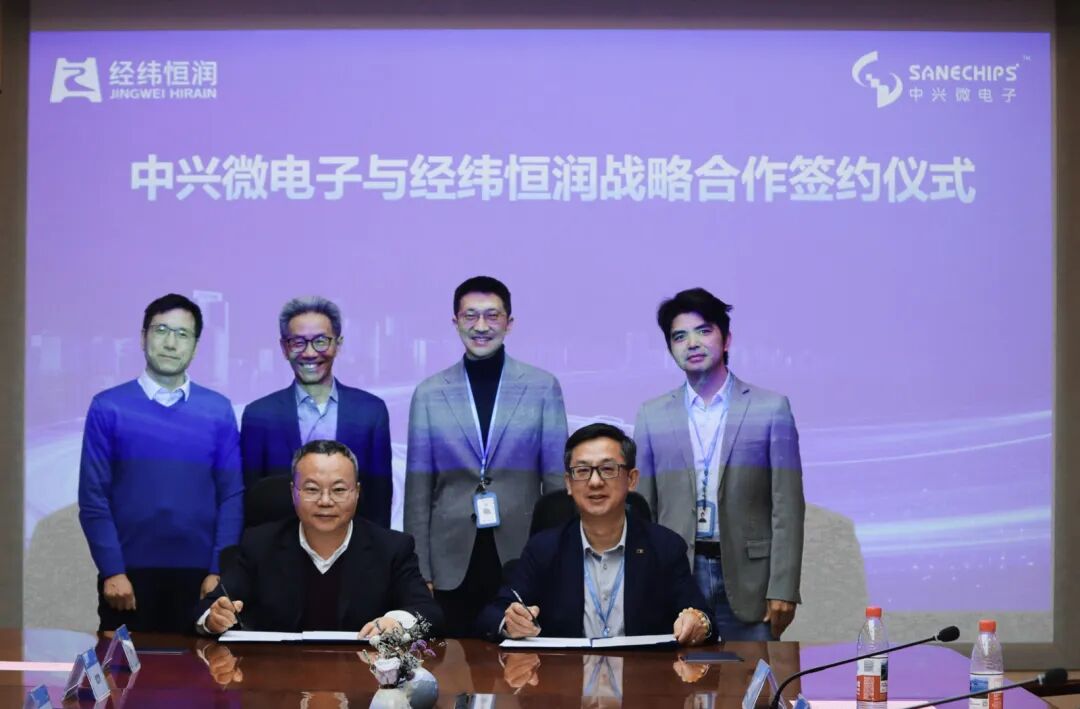
Core Viewpoint - The strategic cooperation agreement between Jingwei Hirain and ZTE Microelectronics aims to develop integrated software and hardware solutions for smart vehicles, focusing on intelligent connectivity, autonomous driving, and smart cockpit technologies [2][5]. Group 1: Strategic Cooperation Details - The agreement was signed on February 2, with both companies collaborating on core solutions for smart vehicles [2][5]. - The partnership will leverage Jingwei Hirain's experience in automotive electronic systems and ZTE Microelectronics' expertise in automotive-grade "connectivity + computing" SoC chips [2][5]. - Key areas of collaboration include the development of domestic solutions for smart cockpit, autonomous driving, central computing platforms, and T-Box applications, as well as exploring AI large models for cockpit interaction and driving decision-making [2][5]. Group 2: Technological Integration and Future Plans - The companies plan to promote full-stack technological collaboration from underlying chips, operating systems, middleware to upper-layer applications, aiming to build an open technological ecosystem [2][5]. - Future efforts will focus on integrating resources in algorithm software, automotive-grade chips, domain controllers, and system integration to provide mass-producible smart vehicle solutions for domestic and international automakers [3][6]. - This cooperation supports the technological independence and ecosystem development of China's intelligent connected vehicle industry [3][6].

无人机空管平台:支撑行业发展的核心基础设施
Tou Bao Yan Jiu Yuan· 2026-02-03 12:08
Investment Rating - The report does not explicitly state an investment rating for the UAV air traffic management platform industry. Core Insights - The UAV air traffic management platform is identified as a core infrastructure supporting the low-altitude economy, enabling dynamic management of airspace resources and real-time scheduling of aircraft through digital technologies [7]. - The industry faces challenges such as insufficient inter-departmental collaboration, outdated regulations, high user costs, and complex operations, which impact user experience [7]. - Future developments will focus on system integration to enhance collaborative management and improve positioning accuracy and response efficiency, ultimately reducing costs for broader accessibility [7]. Summary by Sections Definition - The UAV air traffic management platform is defined as an integrated management system designed specifically for UAVs, combining communication, navigation, monitoring, and automation technologies to ensure safe and efficient flight operations [9]. Significance of Emergence - The new UAV air traffic management platform effectively addresses the challenges of managing a large number of dispersed low-altitude flights, leveraging automation and multi-departmental collaboration to unlock the potential of UAV services [12]. Development History - The development of China's UAV air traffic management system has evolved through clear phases, from early framework exploration to the establishment of policies, now advancing towards comprehensive and intelligent development [19]. Policy Analysis - China is constructing a comprehensive governance system for UAV air traffic management based on three pillars: regulatory hierarchy, management entities, and policy updates, aiming for a balance between safety regulation and industry development [21]. Core Participating Companies - The UAV air traffic management market is characterized by cross-industry competition, led by established companies with core technologies, focusing on providing comprehensive integrated services rather than single products [26][27]. Development Challenges and Constraints - The industry faces multiple challenges, including technical bottlenecks in communication coverage and algorithm accuracy, inefficient inter-departmental collaboration, and high costs that hinder user acceptance [29]. Market Size - The UAV air traffic management platform market is projected to grow significantly, with estimates indicating a rise from 3.25 billion RMB in 2020 to 4.39 billion RMB in 2024, reflecting a compound annual growth rate of 7.51% [45].


中兴胜讼!美国法院驳回三星诉讼!
国芯网· 2026-02-03 12:05
Core Viewpoint - The article discusses the recent legal developments between ZTE Corporation and Samsung Electronics regarding patent licensing agreements, highlighting ZTE's advantages following a U.S. court ruling that dismissed Samsung's lawsuit [1]. Group 1: Legal Developments - On February 3, a U.S. district court ruled in favor of ZTE, dismissing Samsung's lawsuit related to fair, reasonable, and non-discriminatory (FRAND) licensing agreements, which strengthens ZTE's position in ongoing negotiations [1]. - Prior to this ruling, ZTE had already achieved preliminary victories in lawsuits against Samsung in the UK, China, and Brazil [3]. Group 2: Patent Licensing Agreement - The dispute between ZTE and Samsung originated from a global patent cross-licensing agreement signed in 2021, which covers both parties' 4G asset portfolios and early standard essential patents (SEPs) [3]. - This agreement is set to expire at the end of 2023, but includes a clause preventing litigation until December 31, 2024 [3]. - ZTE holds over 6,500 families of 5G standard essential patents and believes that the value of its patent portfolio should be reflected in the new licensing fees, while Samsung argues that ZTE's proposed rates are excessively high and not in line with FRAND principles [3]. Group 3: Ongoing Litigation - Following the expiration of the agreement, Samsung initiated litigation against ZTE in the UK on December 19, 2024, and subsequently filed similar lawsuits in Germany, the European Unified Patent Court, and the U.S. [3]. - In response, ZTE filed a lawsuit against Samsung in Chongqing, China, on December 23, 2024, and subsequently in Hangzhou, Germany, and Brazil, seeking unconditional injunctions for patent infringement [4].
中兴通讯尚未实施股份回购
智通财经网· 2026-02-03 11:32
智通财经APP讯,中兴通讯(00763)公布,公司于 2025 年 12 月 12 日召开的第十届董事会第十七次会议 审议通过了《关于以集中竞价交易方式回购公司 A 股股份方案的议案》,同意公司使用自有资金以集 中竞价交易方式回购公司 A 股股份,用于实施公司员工持股计划或者股权激励。回购资金总额不低于 人民币 10 亿元且不超过人民币 12 亿元(均包含本数),回购价格不超过人民币 63.09 元/股。截至 2026 年 1 月 31 日,公司尚未实施本次股份回购。 ...
中兴通讯(00763.HK):截至2026年1月31日尚未实施A股股份回购
Ge Long Hui· 2026-02-03 11:01
根据《上市公司股份回购规则》《深圳证券交易所上市公司自律监管指引第9号——回购股份》等相关 规定,公司在回购股份期间,应当在每个月的前三个交易日内公告截至上月末的回购进展情况。 现将有关情况公告如下:截至2026年1月31日,公司尚未实施本次股份回购。 格隆汇2月3日丨中兴通讯(00763.HK)公告,中兴通讯股份有限公司(以下简称"公司")于2025年12月12日 召开的第十届董事会第十七次会议审议通过了《关于以集中竞价交易方式回购公司A股股份方案的议 案》,同意公司使用自有资金以集中竞价交易方式回购公司A股股份,用于实施公司员工持股计划或者 股权激励。回购资金总额不低于人民币10亿元且不超过人民币12亿元(均包含本数),回购价格不超过人 民币63.09元/股。 ...
中兴通讯(00763)尚未实施股份回购
智通财经网· 2026-02-03 10:59
智通财经APP讯,中兴通讯(00763)公布,公司于 2025 年 12 月 12 日召开的第十届董事会第十七次会议 审议通过了《关于以集中竞价交易方式回购公司 A 股股份方案的议案》,同意公司使用自有资金以集 中竞价交易方式回购公司 A 股股份,用于实施公司员工持股计划或者股权激励。回购资金总额不低于 人民币 10 亿元且不超过人民币 12 亿元(均包含本数),回购价格不超过人民币 63.09 元/股。截至 2026 年 1 月 31 日,公司尚未实施本次股份回购。 ...
中兴通讯(00763) - 海外监管公告 关於回购A股股份的进展公告
2026-02-03 10:49
香港交易及結算所有限公司及香港聯合交易所有限公司對本公告的內容概不負責,對其準確 性或完整性亦不發表任何聲明,並明確表示,概不對因本公告全部或任何部份內容而產生或 因倚賴該等內容而引致的任何損失承擔任何責任。 ZTE CORPORATION 中興通訊股份有限公司 (於中華人民共和國註冊成立的股份有限公司) (股份代號:00763) 证券代码(A/H):000063/00763 证券简称(A/H):中兴通讯 公告编号:202605 海外監管公告 本公告乃根據香港聯合交易所有限公司證券上市規則第13.10B條而作出。 茲載列中興通訊股份有限公司(「本公司」)在深圳證券交易所網站發布的以下公 告全文,僅供參閱。 承董事會命 方榕 董事長 深圳,中國 二零二六年二月三日 於本公告日期,本公司董事會包括執行董事:徐子陽;非執行董事:方榕、閆俊武、 諸為民、張洪;獨立非執行董事:莊堅勝、王清剛、徐奇鵬;以及職工董事:李妙娜。 2026 年 2 月 4 日 中兴通讯股份有限公司 关于回购 A 股股份的进展公告 本公司及董事会全体成员保证信息披露的内容真实、准确和完整,没有虚假记载、误导性陈述或重 大遗漏。 中兴通讯股份有限 ...