
SWHY(000166)

Search documents
申万宏源荣获“机构间REITs市场年度优秀投资机构”等多项荣誉
申万宏源证券上海北京西路营业部· 2026-01-09 05:22
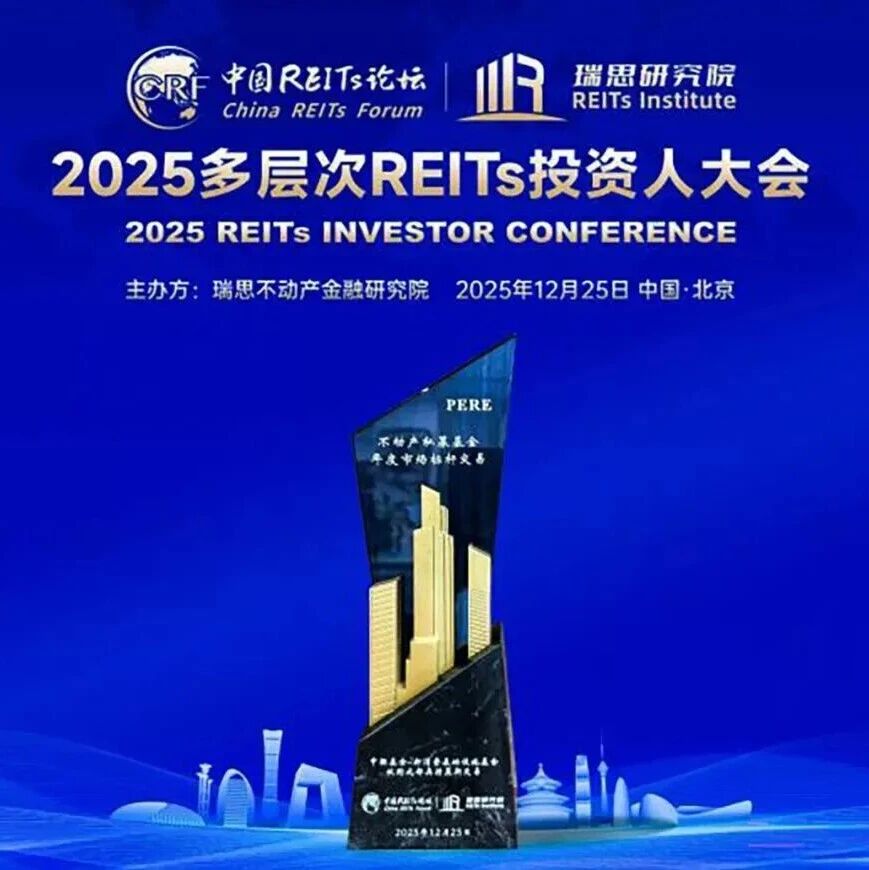
Core Viewpoint - The article highlights the achievements of Shenwan Hongyuan Securities and its subsidiary Hongyuan Huizhi at the "2025 Multi-level REITs Investor Conference Annual Meeting," emphasizing their recognition as leading institutions in the REITs market and their contributions to the development of the multi-level REITs market in China [2][4]. Group 1 - Shenwan Hongyuan Securities was awarded "Annual Excellent Investment Institution in Inter-Institutional REITs Market," while Hongyuan Huizhi received the title of "Annual Excellent Investment Institution in Real Estate Private Fund Market" [2]. - The "Zhonglian Fund - New Consumption Infrastructure Fund Acquisition of Chengdu Outlets Project," in which Hongyuan Huizhi participated, was recognized as the "Annual Market Benchmark Transaction in Real Estate Private Fund Market" [2]. - The evaluation was organized by the China REITs Forum and the Ruisi Real Estate Financial Research Institute, aimed at recognizing significant contributions in public REITs, inter-institutional REITs, and real estate private funds [4]. Group 2 - Shenwan Hongyuan has been deeply involved in the construction of China's multi-level REITs market, covering public REITs, inter-institutional REITs, and real estate private funds, leveraging its "investment + investment banking" synergy [4]. - Hongyuan Huizhi focuses on investing in core asset categories such as affordable rental housing, industrial plants, shopping centers (including outlets), and data centers, employing diverse strategies to enhance the defensive capability and value elasticity of its investment portfolio [5]. - Shenwan Hongyuan Securities' FICC division acts as a market maker for all public REITs and several inter-institutional REITs products, providing professional support to enhance market liquidity and reasonable pricing [5].


“领导30万、员工1万”,质疑年终奖分配不公,申万期货一员工被停职
经济观察报· 2026-01-09 04:08
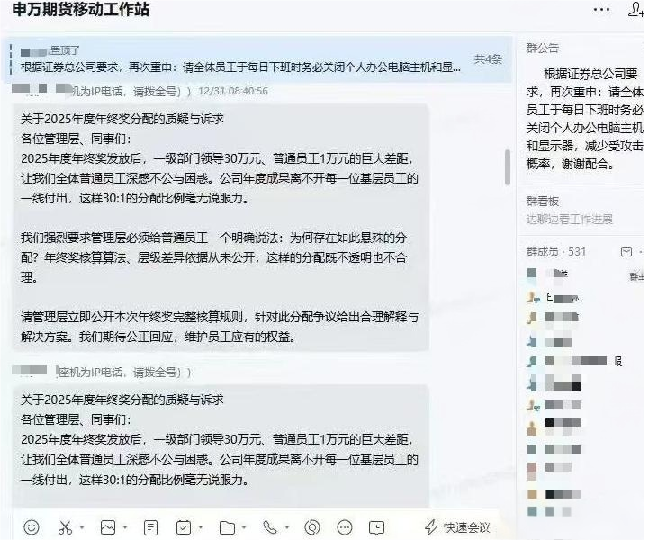
申 万 期 货 员 工 在 公 司 群 里 对 年 终 奖 分 配 提 出 质 疑 , 他 认 为"30:1的分配比例毫无说服力"。1月8日,该员工对记者 表示,其在群里发送质疑是为了解"30万元与1万元差异"的数 据真实性,但截至目前仍未收到回应。 作者:牛钰 封图:图虫创意 近日,一张显示与申银万国期货有限公司(下称"申万期货")年终奖相关的截图在网络上流传。 截图顶端一行字为"申万期货移动工作站",下方主要内容为,一名员工在有531人的企信工作群 内发言,针对2025年度年终奖分配质疑:"2025年度年终奖发放后,一级部门领导30万元、普通 员工1万元的巨大差距,让我们全体普通员工深感不公与困惑。" 据了解,申万期货为申万宏源集团股份有限公司(下称"申万宏源",000166.SZ)的控股子公 司。 资料显示,申万期货成立于2007年12月11日,注册资本金7.76亿元,经营范围包括:商品期货 经纪、金融期货经纪、期货投资咨询、资产管理。申万期货官网公布的组织架构图显示,共设有财 富管理部、机构客户部、网络金融部、金融产品中心等14个一级部门。 图片来源:网络 经济观察报记者联系到了上述发文员工,该员工表 ...

申万宏源投行业务质量评价连降两级 多次收到“罚单”
Xi Niu Cai Jing· 2026-01-09 03:44
Group 1 - The core point of the news is the decline of Shenwan Hongyuan Securities' underwriting and sponsorship business quality rating from A to C, which has attracted market attention [2] - In September 2024, Shenwan Hongyuan's deputy general manager Wang Zhaoping was taken away by relevant authorities, and he resigned from his position due to personal reasons [1] - Shenwan Hongyuan has faced multiple penalties in 2025 for violations in its underwriting business, including disciplinary actions from the Shanghai Stock Exchange and the Shenzhen Stock Exchange [3] Group 2 - The China Securities Association announced the evaluation results for 93 securities companies' investment banking business quality for 2025, categorizing 12 as A, 66 as B, and 15 as C [2] - Shenwan Hongyuan was specifically criticized for its role as a sponsor for Guohong Tools' IPO on the Sci-Tech Innovation Board, leading to a public reprimand and disciplinary measures against its representatives [3] - The Shenzhen Stock Exchange required Shenwan Hongyuan to implement corrective measures and submit a written report signed by responsible personnel due to issues with a withdrawn project [3]

“领导30万、员工1万”,质疑年终奖分配不公,申万期货一员工被停职
Jing Ji Guan Cha Wang· 2026-01-09 03:31
经济观察报记者联系到了上述发文员工,该员工表示,其在申万期货工作已有5年,每年12月31日发放 当年的年终奖,季度奖金与年终奖在其全部收入中占比过半。2021年至2023年,他的年终奖平均约为4 万元。但2024年公司突然停发年终奖,仅在2025年2月补发了9000元"过节费";2025年12月31日发放的 年终奖,他仅拿到1万元,叠加这一年的季度奖金也大幅缩水,约等于2025年薪酬减少约45%。 近日,一张显示与申银万国期货有限公司(下称"申万期货")年终奖相关的截图在网络上流传。截图顶 端一行字为"申万期货移动工作站",下方主要内容为,一名员工在有531人的企信工作群内发言,针对 2025年度年终奖分配质疑:"2025年度年终奖发放后,一级部门领导30万元、普通员工1万元的巨大差 距,让我们全体普通员工深感不公与困惑。" 据了解,申万期货为申万宏源(000166)集团股份有限公司(下称"申万宏源",000166.SZ)的控股子 公司。 资料显示,申万期货成立于2007年12月11日,注册资本金7.76亿元,经营范围包括:商品期货经纪、金 融期货经纪、期货投资咨询、资产管理。申万期货官网公布的组织架构图显示 ...
A股融资回暖、港股上市热!2025年投行排位竞争白热化
Sou Hu Cai Jing· 2026-01-09 03:12
Group 1 - In 2025, the capital market's comprehensive reform led to a significant recovery in A-share financing, with total financing amounting to 1.08 trillion yuan, a 2.7-fold increase from the previous year [2][3] - The Hong Kong IPO market is expected to raise approximately 286.3 billion HKD in 2025, more than doubling from 2024, reclaiming the top position globally [6] - The restructuring of Guotai Junan Securities and Haitong Securities has intensified competition among investment banks, impacting the long-standing dominance of the "Big Four" [7][9] Group 2 - In A-share financing, equity issuance accounted for 82% of the total, with a significant contribution from four state-owned banks that completed 520 billion yuan in capital increases [5] - The IPO financing in A-shares reached 131.77 billion yuan, a 95.6% increase year-on-year, although still less than a quarter of the peak in 2022 [5] - The semiconductor industry led the A-share IPO financing with 23.09 billion yuan, followed by automotive and electrical equipment sectors [5] Group 3 - The competitive landscape for underwriting has shifted, with Guotai Haitong Securities rising to second place in A-share underwriting, while CITIC Securities maintained the top position [8][9] - The top ten A-share underwriters included several firms with significant changes in rankings, highlighting a dynamic market environment [9] - The quality evaluation of investment banking services has become more stringent, with a shift from scale to quality in competition among firms [13][14] Group 4 - The internationalization of the securities industry has been a key trend, with several firms experiencing substantial growth in Hong Kong IPO underwriting [11] - The regulatory environment has tightened, leading to a comprehensive penalty system for investment banking activities, affecting numerous firms and individuals [14]



惠通科技募投项目宣布延期 一年前上市申万宏源保荐
Zhong Guo Jing Ji Wang· 2026-01-09 02:50
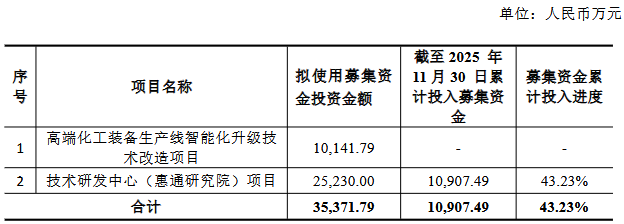
Core Viewpoint - The company has announced a delay in the investment projects funded by raised capital, extending the expected completion dates for two key projects to December 31, 2026 [1][2]. Group 1: Project Delay Announcement - The board of directors approved the extension of the "Intelligent Upgrade of High-end Chemical Equipment Production Line" and "Technical Research Center (Huitong Research Institute)" projects [1][2]. - The delay is attributed to fluctuations in the macroeconomic environment and changes in downstream market demand, leading to an optimization of the investment pace for the projects [2][3]. Group 2: Financial Details of Investment Projects - The total amount of raised funds for the projects is 353.72 million yuan, with 252.30 million yuan allocated for the Technical Research Center project [2][3]. - As of November 30, 2025, the cumulative investment in the Technical Research Center project reached 109.07 million yuan, representing 43.23% of the planned investment [2][3]. Group 3: Impact of the Delay - The delay does not involve changes to the project implementation entities, methods, content, purposes, or investment scales, and is not expected to materially affect the implementation of the projects [2][3]. - The decision to extend the project timeline is considered prudent and aligns with the company's long-term development strategy, aiming to enhance the projects' benefits [2][3].
快手-W盘中涨近5% 申万宏源维持“买入”评级
Xin Lang Cai Jing· 2026-01-09 02:45
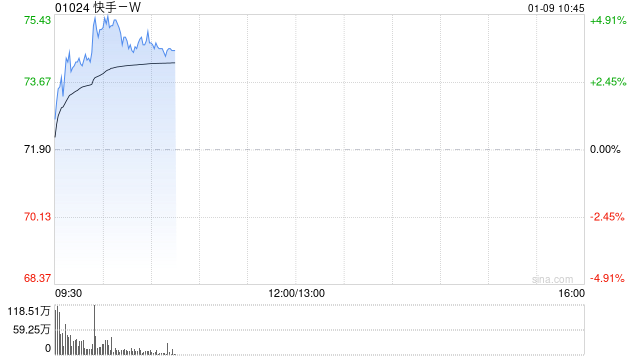
Core Viewpoint - Kuaishou-W (01024) has seen a stock price increase of 3.69%, currently trading at 74.55 HKD, with a trading volume of 1.357 billion HKD, driven by significant updates in its Kuailing AI technology [1][5]. Group 1: Company Updates - Shenwan Hongyuan maintains a "Buy" rating for Kuaishou-W, citing the growth potential from recent major updates in Kuailing AI [1][5]. - In December, Kuaishou launched the world's first full-modal video model, Kuailing O1, and the first audio-visual synchronous model, Kuailing 2.6 [1][5]. - Kuailing O1 enhances workflow efficiency through full-modal editing, while Kuailing 2.6 integrates closely with various sectors such as gaming, advertising, short dramas, and live streaming [1][5]. Group 2: Market Performance - According to Similar Web data, Kuailing AI's global website traffic has significantly increased, surpassing competitors like Minimax, Runway, and Midjourney by the end of December 2025 [1][5]. - Kuailing 2.6 and Kuailing O1 offer clear pricing advantages over Google Veo3.1 and Sora2, with Kuailing 2.6's high-quality audio-visual synchronous version priced between 0.44 to 0.88 RMB per second, showcasing strong cost performance [6]. - Kuailing AI's revenue exceeded 300 million RMB in Q3 2025, with expectations for annual revenue to reach 140 million USD, potentially driving stock price increases [6].

“领导年终奖30万元,普通员工1万”,期货公司员工称因降薪讨说法遭袭:动手的是总经理,已报警!公司:编造虚假信息
Mei Ri Jing Ji Xin Wen· 2026-01-08 15:19
每经记者|王海慜 每经编辑|金冥羽 叶峰 最近,有自称为申银万国期货(以下简称申万期货)的员工在社交平台上开设"公司降薪维权专场"进行直播引发了大量关注。据网传的部分直播视频片段 显示,该人士在进行交涉时,遭到了对方袭击导致摔倒。 今天,每经记者和视频中被打一方——申万期货员工刘凯(化名)取得了联系,他表示,2024年、2025年连续两年申银万国期货都大幅削减员工年终奖, 他这次和公司总经理陆某江交涉也是想给自己和其他同事讨个说法,没料到对方会出手打人。 据他介绍,对于被公司总经理袭击受伤一事,他已经报警,警方已经立案。另外,从1月5日起他已被公司停职,还收到了公司的警告信。就此事件,记者 已向申万期货及母公司申万宏源证券提出采访请求,截至发稿尚未获得回应。 申万期货员工直播维权遭停职警告 最近,有申银万国期货员工在社交平台上开设"公司降薪维权专场"进行直播。后续相关视频画面显示,在他和公司某人士交涉时,遭到对方袭击,导致他 摔倒。公开信息显示,申万期货是上市公司申万宏源旗下申万宏源证券的控股子公司,持股比例近98%。 最近刘凯的降薪维权直播视频在网上流传 刘凯日前在公司内部群上发的信息 图 片来自:网络 今 ...

申万宏源:2025年前三季度公司经纪业务手续费净收入44.85亿元
Zheng Quan Ri Bao· 2026-01-08 15:03
(文章来源:证券日报) 证券日报网1月8日讯 ,申万宏源在接受调研者提问时表示,公司全面落实"以客户为中心"理念,围 绕"渠道力、服务力、产品力、数字力、精细化管理能力"建设加大布局投入,完善矩阵式客户服务,持 续丰富综合金融服务手段,提升客户体验和服务效率,积极优化投资顾问服务,做优产品货架,稳步提 升代理和双融"基本盘",并加快向买方投顾业务模式转型,打造公司财富管理品牌。2025年前三季度, 公司经纪业务手续费净收入44.85亿元,同比增长65.55%。 ...
申万宏源:公司自主研发一站式数智化财富管理平台“申财有道”
Zheng Quan Ri Bao· 2026-01-08 14:29
Group 1 - The core viewpoint of the article highlights the company's accelerated digital transformation and integration of technology with business innovation [2] - The company has developed a one-stop intelligent wealth management platform called "Shencai Youdao," which integrates comprehensive financial service resources [2] - The "Yiwan Qiyuan" platform for institutional clients includes modules for intelligent research, trading support, and a full range of product offerings, addressing complex market demands [2] Group 2 - The company aims to further enhance its financial technology capabilities by leveraging AI to improve customer service experiences and internal operational efficiency [2] - There is a focus on building a standardized and intelligent system to inject digital momentum into the company's core competitiveness [2]