
GREE(000651)

Search documents
珠海民企组建“产业共同体”,龙头企业领衔9个细分产业专委会
2 1 Shi Ji Jing Ji Bao Dao· 2025-08-25 12:01
Core Insights - Zhuhai's private enterprises are transitioning from "individual efforts" to "collective action" in response to global supply chain restructuring and industrial upgrades [1][3] - The establishment of the Zhuhai Municipal Federation of Industry and Commerce's Modern Industrial System Special Committee aims to create a collaborative development platform covering a "4+3" industrial system [1][2] Group 1: Establishment of Special Committees - Nine specialized committees have been formed, focusing on new generation information technology, new energy, new materials, electronic chemicals, intelligent manufacturing, biomedicine, medical devices, cross-border trade, low-altitude economy, and marine economy [1][2] - Leading companies like Gree Electric Appliances, Livzon Pharmaceutical Group, and SANY Marine Heavy Industry will play significant roles in their respective committees, driving innovation and collaboration within their industries [2] Group 2: Addressing Economic Challenges - The private economy in Zhuhai contributes 91% of the city's business entities and 85% of urban employment, yet faces pressures from global supply chain changes, technological upgrades, and talent shortages [3] - Companies like Guangdong Jianshi Lock have invested heavily in automation, reducing workforce from nearly 4,000 to about 700 while significantly increasing production [3] Group 3: Digital Transformation and Market Adaptation - SANY Marine has initiated a digital transformation strategy focusing on smart manufacturing and operations, which has improved production efficiency and quality [4] - Companies are adapting to international market challenges by establishing overseas production facilities to mitigate tariffs, as seen with Jianshi Lock's operations in Thailand and Peru [4]




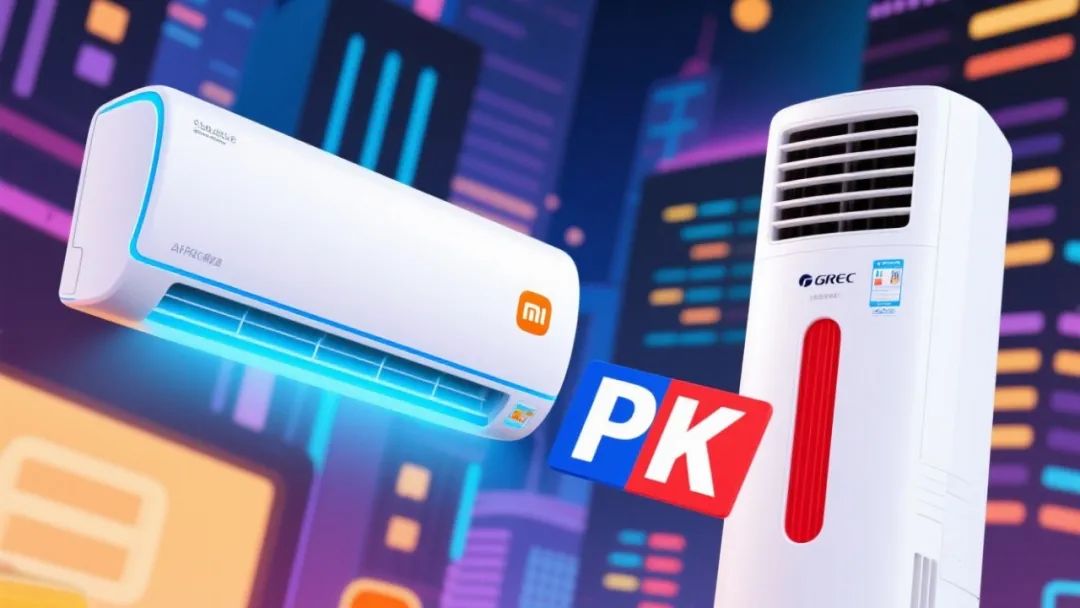
口水战“升级”!格力高管“打假”小米
Di Yi Cai Jing· 2025-08-25 10:01
Core Viewpoint - The competition between Xiaomi and Gree in the air conditioning market has intensified, with both companies disputing sales rankings and market shares [2][8]. Group 1: Sales Data and Market Share - According to data from AVC, as of July 2025, Xiaomi's online market share for air conditioners reached 16.71%, a year-on-year increase of 2.83%, while Gree's market share was 15.22%, reflecting a decline of 1.1% [6]. - As of August 17, 2025, Gree maintained a higher online market share at 17.71% compared to Xiaomi's 15.77% [8]. - In terms of sales revenue, Gree's online sales revenue share was 23.35%, significantly higher than Xiaomi's 14.82% [8]. Group 2: Industry Insights and Strategies - Industry experts suggest that sales data should be evaluated over a longer period and across all channels, not just online sales [9]. - Gree's offline market share for sales revenue was 29.42%, while Xiaomi's was only 0.26%, indicating a substantial gap [9]. - Gree is responding to competition by launching new AI-powered air conditioning products and adjusting supply prices to retailers, with some mid-range products seeing a price reduction of about 10% [10]. Group 3: Future Plans and Market Positioning - Xiaomi plans to expand its air conditioning production capacity, with a new factory in Wuhan expected to produce 3 million units annually by 2026, aiming for a revenue target of 10 billion yuan by 2030 [9]. - In the second quarter, Xiaomi's air conditioner shipments exceeded 5.4 million units, with a year-on-year growth rate of over 60% [10].

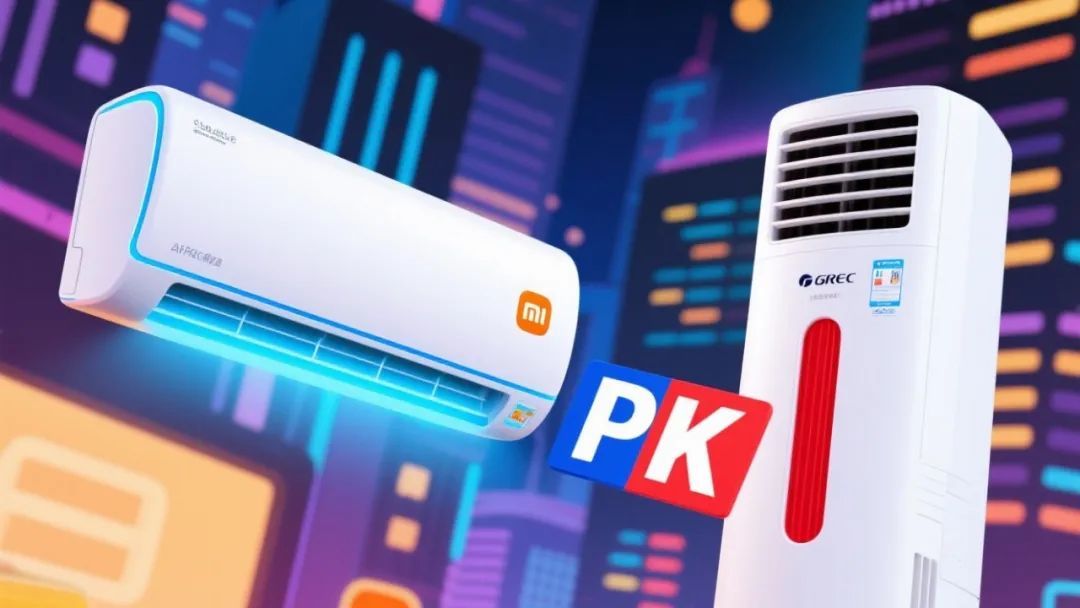
口水战“升级”,格力高管“打假”小米
Di Yi Cai Jing· 2025-08-25 09:09
Core Viewpoint - The competition between Xiaomi and Gree regarding air conditioner sales rankings has intensified, with both companies exchanging public statements and data claims [2][8]. Market Performance - According to data from AVC, as of July 2025, Xiaomi's online market share for air conditioners reached 16.71%, a year-on-year increase of 2.83%, while Gree's market share was 15.22%, reflecting a decline of 1.1% [6]. - In contrast, as of August 17, 2025, Gree's online market share was reported at 17.71%, while Xiaomi's was 15.77%, indicating that Gree still leads in the online market [8]. - When considering sales revenue, Gree's share was 23.35%, significantly higher than Xiaomi's 14.82% [8]. Industry Insights - Industry experts suggest that sales comparisons should not be limited to short-term data but should consider annual performance and all distribution channels [10]. - In the offline market, Gree's sales revenue share was 29.42%, while Xiaomi's was only 0.26%, highlighting a substantial gap [10]. Strategic Responses - In response to competition, Gree has introduced new air conditioning products featuring AI dynamic energy-saving chips and has adjusted supply prices down by approximately 10% for some mid-range models [11]. - Xiaomi is expanding its air conditioning business, with plans to produce 3 million units annually by 2026 and aims for a revenue target of 10 billion yuan by 2030 [10].
口水战“升级”!格力高管“打假”小米
第一财经· 2025-08-25 08:58
Core Viewpoint - The ongoing competition between Xiaomi and Gree in the air conditioning market has intensified, with both companies disputing sales rankings and market shares [3][5][6]. Group 1: Sales Data and Market Share - According to data from AVC, as of July 2025, Xiaomi's online market share for air conditioners reached 16.71%, a year-on-year increase of 2.83%, while Gree's market share was 15.22%, reflecting a year-on-year decline of 1.1% [5]. - However, as of August 17, 2025, Gree's online market share was reported at 17.71%, compared to Xiaomi's 15.77%, indicating that Gree still leads in the online market [8]. - In terms of sales revenue, Gree held a significant advantage with a share of 23.35%, while Xiaomi's share was only 14.82% [8]. Group 2: Industry Insights and Strategies - Industry experts suggest that sales data should be evaluated over a longer period and across all channels, not just focusing on short-term online sales [8]. - Gree's strategy includes launching new air conditioning products equipped with AI energy-saving chips and offering competitive pricing through its sub-brand, Jinghong [10]. - Xiaomi is expanding its air conditioning business, with plans to produce 3 million units annually by 2026 and a revenue target of 10 billion yuan by 2030 [9]. Group 3: Competitive Responses - Gree's market director emphasized the importance of long-term quality over short-term sales rankings, advocating for industry standards like a "ten-year free repair" policy [9]. - Xiaomi's recent product launches, including budget-friendly air conditioners, have prompted competitors to adjust their pricing strategies, with Gree reducing supply prices for mid-range products by approximately 10% [10].

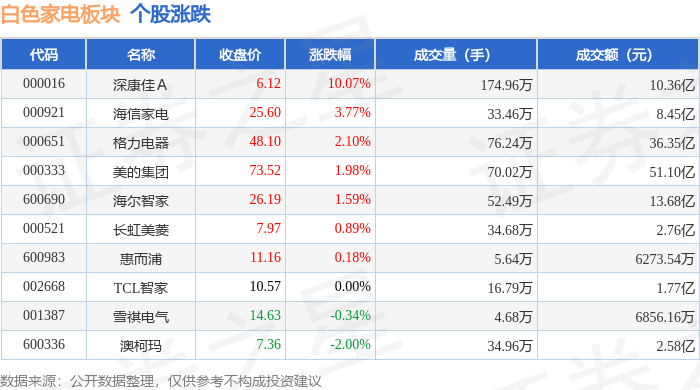
白色家电板块8月25日涨1.99%,深康佳A领涨,主力资金净流入3.39亿元
Zheng Xing Xing Ye Ri Bao· 2025-08-25 08:47
Market Performance - The white goods sector increased by 1.99% on August 25, with Shenzhen Konka A leading the gains [1] - The Shanghai Composite Index closed at 3883.56, up 1.51%, while the Shenzhen Component Index closed at 12441.07, up 2.26% [1] Individual Stock Performance - Shenzhen Konka A (000016) closed at 6.12, with a rise of 10.07% and a trading volume of 1.7496 million shares [1] - Hisense Home Appliances (000921) closed at 25.60, up 3.77%, with a trading volume of 334,600 shares [1] - Gree Electric Appliances (000651) closed at 48.10, up 2.10%, with a trading volume of 762,400 shares [1] - Midea Group (000333) closed at 73.52, up 1.98%, with a trading volume of 1.7002 million shares [1] - Haier Smart Home (600690) closed at 26.19, up 1.59%, with a trading volume of 524,900 shares [1] - Other notable performances include Changhong Meiling (000521) at 7.97 (+0.89%), Whirlpool (600983) at 11.16 (+0.18%), and TCL Smart Home (002668) at 10.57 (0.00%) [1] Fund Flow Analysis - The white goods sector saw a net inflow of 339 million yuan from institutional investors, while retail investors experienced a net outflow of 88.85 million yuan [1] - Major stocks like Shenzhen Konka A had a net inflow of 2.32 billion yuan from institutional investors, while retail investors had a net outflow of 1.27 billion yuan [2] - Gree Electric Appliances had a net inflow of 85.69 million yuan from institutional investors, but a net outflow of 90.78 million yuan from retail investors [2] - Hisense Home Appliances experienced a net inflow of 43.96 million yuan from institutional investors, with a net outflow of 46.46 million yuan from retail investors [2]




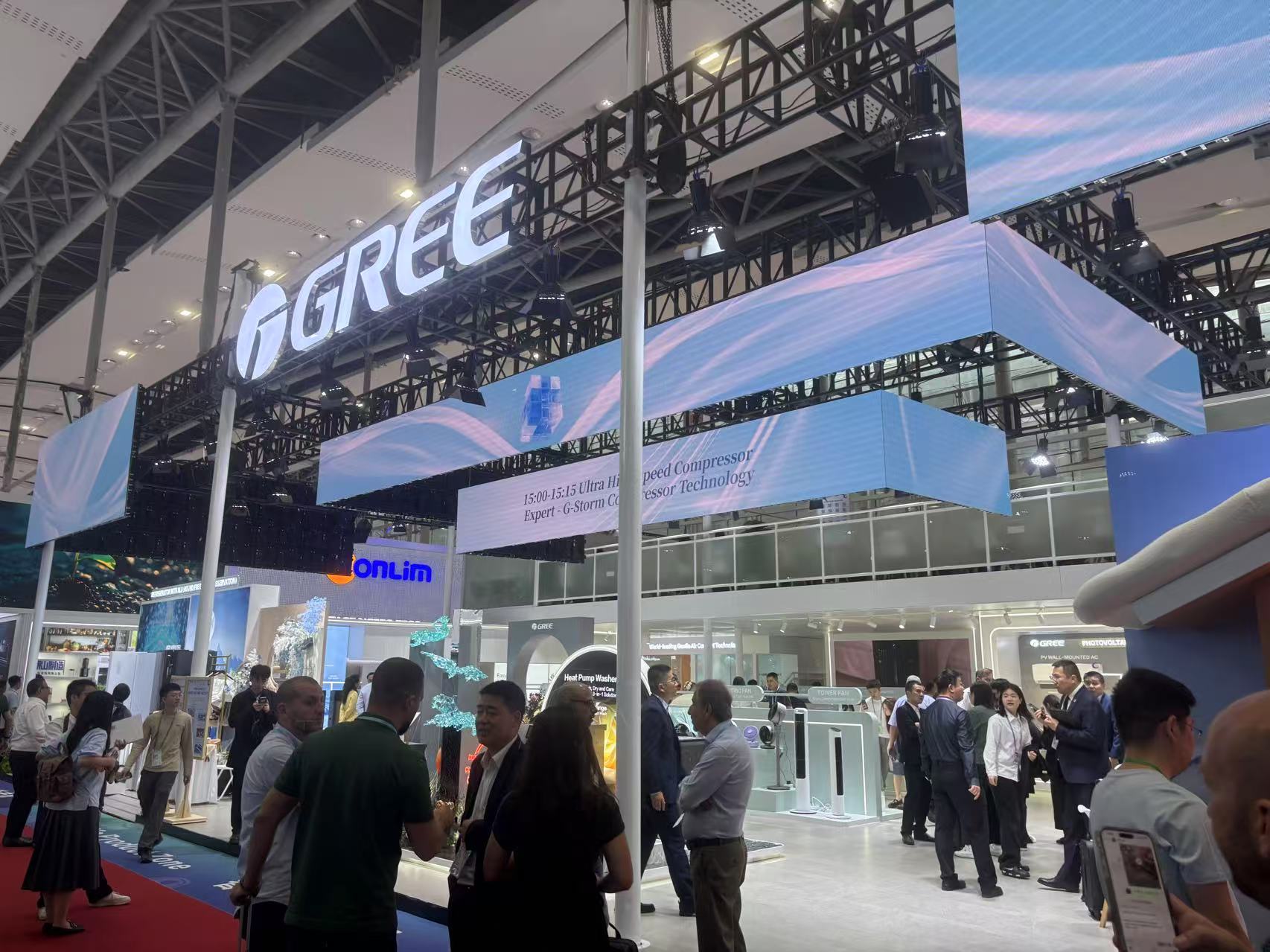
争议线上空调数据,格力高管“打假”小米,双方口水战“升级”
Di Yi Cai Jing· 2025-08-25 08:26
Core Viewpoint - The competition in the air conditioning industry is not only about short-term sales but also about long-term quality and technological advancements [1] Group 1: Market Competition - Gree Electric's market director publicly invited Xiaomi to join a ten-year free repair program, highlighting ongoing disputes over sales data [3] - According to data from AVC, Xiaomi's online air conditioner sales surpassed Gree's in July, with market shares of 16.71% for Xiaomi (up 2.83% year-on-year) and 15.22% for Gree (down 1.1% year-on-year) [3] - Gree's online market share was reported at 17.65% in July, placing it second behind Midea, while Xiaomi was third with 15.73% [4] Group 2: Data Discrepancies - Industry insiders suggest discrepancies in data may arise from changes in statistical methods by AVC, raising questions about the reliability of these figures [5] - As of August 17, Gree's online market share was 17.71% and Xiaomi's was 15.77%, with Gree also leading in sales revenue at 23.35% compared to Xiaomi's 14.82% [5][6] Group 3: Long-term Strategy - Industry experts emphasize that competition should not focus solely on short-term sales but should consider long-term quality and market positioning [6] - Gree is responding to competition by launching AI-powered air conditioning products and reducing prices for mid-range models to enhance market competitiveness [7] - Xiaomi plans to increase its air conditioning production capacity significantly, aiming for an annual output of 3 million units by 2026 and a revenue target of 10 billion yuan by 2030 [6]
格力高管质疑小米高管引用数据真实性
Xin Lang Ke Ji· 2025-08-25 02:33
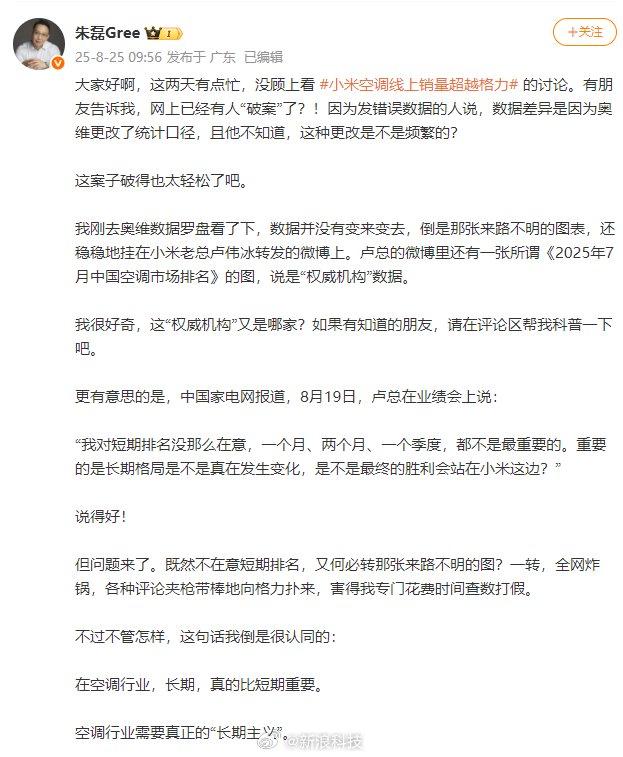
更有意思的是,中国家电网报道,8月19日,卢总在业绩会上说: "我对短期排名没那么在意,一个月、两个月、一个季度,都不是最重要的。重要的是长期格局是不是 真在发生变化,是不是最终的胜利会站在小米这边?" 说得好! 但问题来了。既然不在意短期排名,又何必转那张来路不明的图?一转,全网炸锅,各种评论夹枪带棒 地向格力扑来,害得我专门花费时间查数打假。 【#格力高管再谈空调销量排名争议##格力高管回应卢伟冰言论#】珠海格力电器股份有限公司市场总监 @朱磊Gree 再次发文谈空调销量排名争议,称: 我刚去奥维数据罗盘看了下,数据并没有变来变去,倒是那张来路不明的图表,还稳稳地挂在小米老总 卢伟冰转发的微博上。卢总的微博里还有一张所谓《2025年7月中国空调市场排名》的图,说是"权威机 构"数据。 我很好奇,这"权威机构"又是哪家?如果有知道的朋友,请在评论区帮我科普一下吧。 我刚去奥维数据罗盘看了下,数据并没有变来变去,倒是那张来路不明的图表,还 稳稳地挂在小米老总卢伟冰转发的微博上。卢总的微博里还有一张所谓《2025年7 月中国空调市场排名》的图,说是"权威机构"数据。 我很好奇,这"权威机构"又是哪家?如果有知道 ...
格力电器朱磊:奥维数据并没有变来变去,那张来路不明的图表还挂在卢伟冰的微博上
Xin Lang Ke Ji· 2025-08-25 02:30
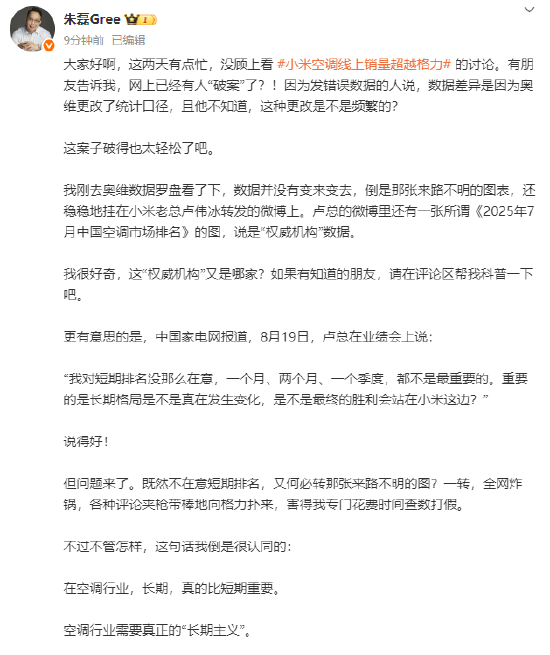
珠海格力电器股份有限公司市场总监朱磊子在微博发文回应"小米空调线上销量超越格力"。 朱磊表示,有朋友告诉我,网上已经有人"破案"了?!因为发错误数据的人说,数据差异是因为奥维更 改了统计口径,且他不知道,这种更改是不是频繁的?这案子破得也太轻松了吧。 他提到,刚去奥维数据罗盘看了下,数据并没有变来变去,倒是那张来路不明的图表,还稳稳地挂在小 米老总卢伟冰转发的微博上。卢总的微博里还有一张所谓《2025年7月中国空调市场排名》的图,说 是"权威机构"数据。"我很好奇,这'权威机构'又是哪家?如果有知道的朋友,请在评论区帮我科普一下 吧。" 朱磊还提到,卢伟冰在业绩会上说对短期排名没那么在意。他反问,既然不在意短期排名,又何必转那 张来路不明的图? 近日,"小米空调线上销量超越格力"登上微博热搜。 在8月15日、16日,小米高管卢伟冰、王化先后转发了奥维云网数据#小米空调线上销量超越格力#的消 息。 王化表示"没想到新时代这么快就来了"。卢伟冰则表示,"能力的坚实提升,才能赢得高质量的增长。 再次感谢大家对小米大家电的支持"。 8月18日晚,朱磊在微博回应小米空调线上销量超越格力#称,据奥维云网数据,7月格力空调 ...
服务号4个月改名3次,70岁董明珠在焦虑什么?
Sou Hu Cai Jing· 2025-08-24 23:18
Core Viewpoint - Gree's frequent renaming of its service account has sparked industry attention, raising questions about the company's branding strategy and its deep association with its CEO, Dong Mingzhu [2][4][5]. Group 1: Renaming Events - Gree's service account was renamed from "Dong Mingzhu Health Home" to "Gree Good Product Guide" on August 13, 2024, and then reverted back to "Dong Mingzhu Health Home" just one day later [2]. - The service account has undergone multiple name changes since 2024, originally starting as "Gree Electric" and later evolving to "Gree Dong Mingzhu Store" to strengthen the personal brand of Dong Mingzhu [2][4]. Group 2: Market Position and Strategy - Gree's air conditioning business remains dominant, accounting for approximately 70-75% of its revenue, while other home appliance categories contribute minimally [4][10]. - The company aims to shift market perception from being solely an air conditioning brand to a broader home appliance brand, leveraging Dong Mingzhu's personal brand for marketing [4][5]. Group 3: Financial Performance and Competition - Gree's revenue has declined by 10 billion yuan from 2018 to 2024, while competitors like Midea and Haier have seen significant growth [11]. - In 2024, Gree's revenue was 190 billion yuan, a decrease of 7.31%, while Midea's revenue was 409.1 billion yuan, reflecting a growth of 9.47% [12]. - Gree's R&D expenditure in 2024 was 6.9 billion yuan, significantly lower than Midea's 16.2 billion yuan and Haier's 10.7 billion yuan, indicating a potential risk in maintaining technological competitiveness [11][12]. Group 4: Leadership and Succession - Dong Mingzhu has indicated that she has identified several potential successors, but the actual transition remains uncertain [6][9]. - Despite stepping down as president, Dong Mingzhu retains significant control over Gree through major shareholders and continues to influence strategic decisions [9][10]. Group 5: Market Challenges - Gree faces increasing competition from brands like Xiaomi, which has captured a market share of 13.7% in air conditioning, growing by 53.9% year-on-year [10]. - The company's overseas revenue in 2024 was 28.2 billion yuan, significantly lagging behind Midea's 169 billion yuan, highlighting Gree's challenges in expanding its international presence [13].

下周大事提醒:“全市场最重要的财报”来了、美联储最青睐通胀指标将出炉



Ge Long Hui A P P· 2025-08-24 14:32
Group 1 - Key Point 1: Focus on the release of important economic data including the US July PCE, Q2 GDP, and July durable goods orders, as well as China's August official PMI and July profits of large-scale industrial enterprises [1] - Key Point 2: Companies scheduled to announce earnings include Nvidia, Alibaba, Meituan, Pinduoduo, Luxshare Precision, Newray, and Zhongji Xuchuang [1] - Key Point 3: Additional tariffs imposed by the US on India, bringing the total tariff rate to 50% [1][5] Group 2 - Key Point 1: Earnings announcements on August 25 include Pinduoduo, Haidilao, Luxshare Precision, Poly Development, Hengli Hydraulic, and Newray [2] - Key Point 2: On August 26, key economic indicators such as the US July durable goods orders will be released, along with earnings from companies like China Petroleum and Aier Eye Hospital [3] - Key Point 3: On August 27, the release of China's July profits of large-scale industrial enterprises is anticipated, alongside earnings from companies like Nvidia and Meituan [4] Group 3 - Key Point 1: On August 28, the US will release revised Q2 GDP and PCE data, with earnings announcements from companies like Yili and Mindray [5] - Key Point 2: On August 29, the US July PCE price index will be released, with Alibaba also announcing its earnings [6] - Key Point 3: China's August official manufacturing PMI will be released on August 31 [7]